A fiber supplement should be chosen by its ingredient, disclosed dietary-fiber amount, intended use, and directions—not by the number of capsules or the size of the bottle. Different fibers behave differently, and a blend does not automatically reproduce the results of an isolated ingredient studied at a known dose.
Full House illustrates the label question. Its pictured panel lists a 1,525 mg proprietary blend per two capsules. That is the total blend weight, not a stated amount of dietary fiber or of psyllium alone.
Start with your goal
Are you trying to close a food-fiber gap, make bowel movements more comfortable, or understand fullness between meals? Those goals call for different questions. Persistent constipation, pain, or a sudden bowel change should not be reduced to a shopping decision.
The NIDDK nutrition guide encourages adequate fiber from foods, gradual increases, and appropriate fluids. A supplement can be considered within that plan, especially when a clinician identifies a practical reason for one.
Fiber type matters
| Ingredient or category | Useful distinction |
|---|---|
| Psyllium | A gel-forming fiber used in bulk-forming laxative products |
| Glucomannan | A soluble fiber obtained from konjac |
| Inulin | A fermentable fiber often discussed as a prebiotic |
| Mixed plant foods | Supply different fibers along with other nutrients |
Solubility is only one feature. Viscosity, water-holding properties, and fermentation can affect how a fiber behaves. The evidence review of fiber supplements explains why products are not interchangeable solely because they all contain fiber.

Compare actual amounts
Read the serving size and dietary-fiber line. If only a proprietary-blend total is provided, keep that limitation visible. Do not divide a study dose by the number of capsules and assume you have found an equivalent serving.
Full House combines konjac root extract, psyllium husk powder, glucomannan, and apple cider vinegar powder. Individual amounts are not disclosed in the pictured panel. The capsules-versus-powder article shows how to compare products without confusing blend milligrams and fiber grams.
Water and medicine timing are part of use
The pictured Full House directions specify two capsules daily with an 8 oz glass of water. Do not dry-swallow a fiber supplement or assume a small sip is equivalent to the directed glass. MedlinePlus psyllium instructions explain the importance of adequate liquid and relevant precautions.
Ask a pharmacist about the timing of your specific oral medicines. Fiber products can affect how some medicines are taken or absorbed, and the correct interval is not the same for every drug. See fiber and medication timing for a useful appointment checklist.
Start thoughtfully and reassess
Avoid changing several supplements and your entire diet on the same day. A gradual food-fiber increase can be easier to evaluate. For a fixed combination product, follow its label rather than opening or dividing capsules to invent a personalized dose.
Note comfort, stool pattern, and whether the routine addresses the original goal. If symptoms persist or worsen, contact your clinician. Severe pain, vomiting, trouble swallowing, blood in stool, or inability to pass stool and gas needs prompt assessment rather than more fiber.
Fullness is not a guaranteed weight-loss effect
Some fibers can influence fullness under certain conditions, but that does not establish a predictable weight-loss result from every blend. The NIH weight-loss supplement review describes inconsistent evidence for ingredients such as glucomannan. Meal composition, amount, and the broader care plan still matter.
Use the Full House label guide to review the disclosed formula. A good supplement decision is one where the ingredient, amount, directions, and purpose are clear enough to evaluate.

Turn a general fiber goal into a specific question
“I need more fiber” can describe a food-intake gap, a constipation concern, or a desire to feel fuller between meals. These goals overlap, but they are not interchangeable. Identifying the actual question helps you choose the information and professional advice that matter.
If the issue is a low-fiber food pattern, begin with the meals and portions you regularly eat. If the issue is a new or persistent bowel symptom, the symptom deserves assessment rather than an automatic supplement purchase. If the issue is appetite, ask whether the product has evidence for that outcome and whether the overall meal plan is adequate.
A clear goal also provides a way to reassess. You can review whether food variety improved, whether the routine is tolerable, or whether a clinician-defined symptom plan is helping. Without that goal, it is easy to keep adding products without knowing what would count as a useful result.
Understand three properties that go beyond “fiber grams”
Solubility describes how a fiber behaves in water. Viscosity describes how thick or gel-like it becomes under relevant conditions. Fermentability concerns how gut microbes use it. These properties can differ, even among fibers grouped under the same broad label.
That is why two products with the same total fiber grams may not produce identical experiences or outcomes. The fiber evidence review discusses these distinctions. The amount remains important, but it is only one part of matching a product to a purpose.
For readers comparing psyllium, glucomannan, and inulin, the practical lesson is to avoid treating the names as synonyms. Ask which ingredient was studied for the outcome you care about, in what preparation, and at what amount. A general “gut health” claim cannot answer those questions by itself.
Work through a label comparison without inventing equivalence
Imagine one product explicitly lists 3 g dietary fiber per serving. Another lists a 1,525 mg blend containing several ingredients. The first number is a nutrient amount; the second is a formulation weight. Converting milligrams to grams does not change the type of information being disclosed.
For Full House, 1,525 mg equals 1.525 g of total blend per two capsules. The reviewed panel does not establish 1.525 g of dietary fiber or disclose the individual amounts of psyllium and glucomannan. Those limits should remain visible when comparing it with a product that lists dietary-fiber grams.
Do not calculate a larger capsule count to match a study dose from information that is missing. Increasing a combination product changes every ingredient. If the labeled serving does not answer your need, review the product choice with a clinician or dietitian rather than improvising a new dose.
Create the practical plan before the first serving
The plan needs more than a bottle. It includes the directed water, a suitable time, the ability to swallow the format comfortably, and any medicine-spacing instructions. If one of these pieces is missing, solve that issue before treating the routine as ready.
For Full House, the reviewed directions specify two capsules daily with an 8 oz glass of water. A capsule format does not remove the fluid requirement. If you have swallowing difficulty or a clinician-directed fluid restriction, get individualized advice before use.
Bring oral medicines into the timing review. A pharmacist can assess the exact products and instructions, including medicines that require food or an empty stomach. Do not move a prescribed medicine solely to make room for an optional supplement without checking the plan.
Make a change that you can interpret
If you start a new supplement while also adding several high-fiber foods, changing meal sizes, and altering medicines, it becomes difficult to identify the cause of any change in symptoms. Keep the initial routine understandable and record the main changes.
A gradual increase in food fiber is a common practical approach, but a fixed capsule blend should still be used according to its own directions. Do not open, divide, or combine capsules into a homemade titration schedule without appropriate guidance. The starting-fiber article explains this distinction.
Track the outcome that matches the original goal. A short note about comfort and bowel pattern may be useful for a symptom discussion. A food record may be more useful for a dietary gap. Neither needs to become a permanent, burdensome tracking project.
Recognize the limits of a supplement comparison
Severe or worsening pain, vomiting, trouble swallowing, blood in stool, or inability to pass stool and gas should not be treated as a reason to take more fiber. These symptoms can require prompt assessment. A general product comparison cannot rule out conditions in which added fiber may be inappropriate.
Likewise, persistent constipation should not be managed indefinitely by escalating products without review. A clinician may need to consider medicines, medical history, and other causes. The MedlinePlus psyllium information provides relevant precautions, but it does not replace individualized assessment.
The useful role of this guide is to make product information and questions clearer. It cannot establish the right treatment for every bowel symptom or guarantee a result from a proprietary blend.
Frequently asked questions
Is a product with several fibers always better?
No. More ingredient names do not establish better effectiveness or tolerance. The amounts, properties, evidence, and purpose matter. A blend with undisclosed individual amounts can be harder to compare with research than a clearly quantified ingredient.
Can I count a blend’s entire weight as dietary fiber?
No. Use the dietary-fiber disclosure when available. Full House’s 1,525 mg figure describes its total blend, which includes several ingredients. It is not a stated dietary-fiber amount.
Do capsules need water if they are easy to swallow?
Yes, follow the specific fluid directions. Ease of swallowing does not remove the way swelling fibers interact with water. Full House’s reviewed directions call for an 8 oz glass with the two-capsule serving.
Can a supplement replace fiber-containing foods entirely?
Do not assume it can replace the broader contribution of foods. Foods supply different fibers along with other nutrients and a meal structure. A supplement can be considered for a defined purpose while food variety remains part of the plan.
Explore Full House™
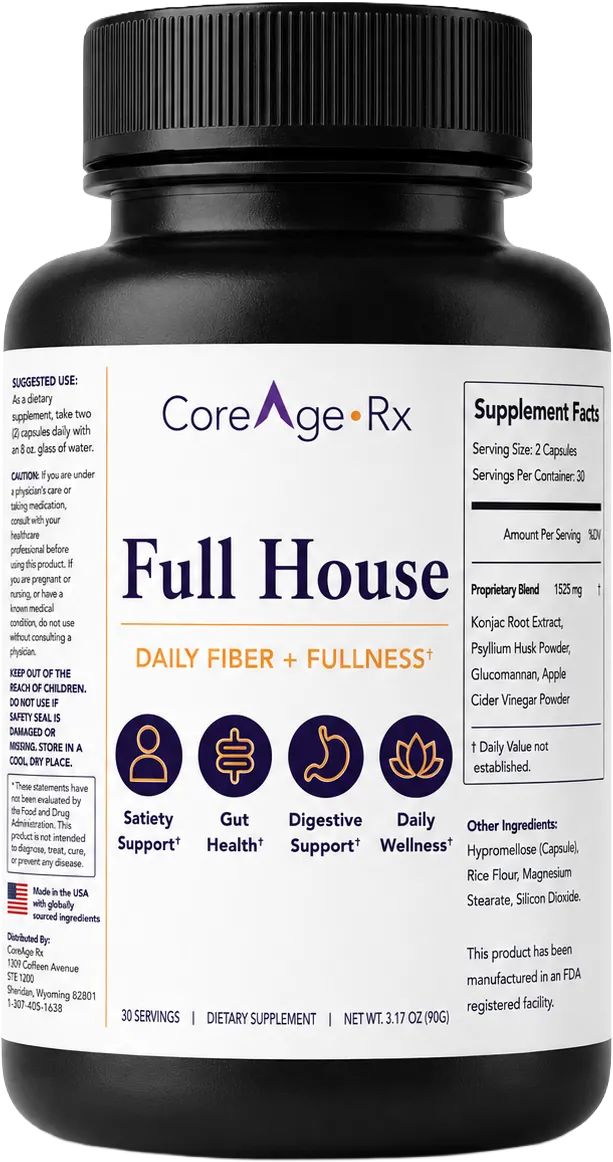
Full House combines konjac root extract, psyllium husk powder, glucomannan, and apple cider vinegar powder in a 1,525 mg proprietary blend per two capsules. See the current Full House™ page and check the bottle you receive before use.
Read the complete fiber and fullness series
- Psyllium vs. Glucomannan: What Is the Difference?
- Fiber Capsules vs. Powder: Compare Grams, Not Serving Counts
- Soluble vs. Insoluble Fiber: Why Both Matter
- How Much Fiber Do You Need Per Day?
- How to Start a Fiber Supplement Gradually
- When Should You Take a Fiber Supplement?
- Why Water Matters When You Take a Fiber Supplement
- Fiber Supplements and Medication Timing: Ask These Questions
- Fiber Supplements and Bloating: What to Change First
- Fiber and Fullness: What the Evidence Can and Cannot Promise
- Glucomannan and Konjac: Understanding This Fiber Ingredient
- Apple Cider Vinegar Powder in Supplements: What to Check
- Food Fiber vs. Supplements: How to Build a Practical Daily Plan
- Full House Ingredients and Label: Questions to Ask Before Use
- Constipation while taking a GLP-1 medication
Educational information, not individualized medical advice. Product information and linked research checked September 15, 2026. Ingredient research does not establish identical effects for a finished supplement.