
Fiber capsules and powders can both be convenient, but the format does not tell you how much dietary fiber you receive. Compare the disclosed grams per serving first. Capsule count, scoop weight, and proprietary-blend weight are not interchangeable measurements.
Read the serving carefully
A powder may use one scoop, while a capsule product may require several capsules. Neither format has a standard fiber amount. Use the Supplement Facts panel and the product’s directions rather than assuming that “one serving” means the same thing across brands.
The FDA supplement-labeling guidance explains that a proprietary blend may disclose a total weight without separate amounts for each component. That makes precise comparisons harder when the blend includes ingredients other than a single fiber.
A concrete label example
Full House’s pictured panel lists two capsules and a 1,525 mg proprietary blend. Converting the unit gives 1.525 g of total blend, not 1.525 g of confirmed dietary fiber. The blend includes konjac root extract, psyllium, glucomannan, and apple cider vinegar powder.
For comparison, imagine a different product that explicitly lists 3 g dietary fiber per serving. That hypothetical 3 g is a nutrient amount; Full House’s blend total is a formulation amount. You cannot treat the numbers as equivalent or calculate a matching number of Full House capsules from them.

Compare everyday use
| Consideration | Capsules | Powder |
|---|---|---|
| Preparation | No mixing step | Usually needs mixing |
| Swallowing | Capsule size and count matter | Texture and drink volume matter |
| Amount | Check fiber grams, if disclosed | Check fiber grams, if disclosed |
| Water | Still follow fluid directions | Use the specified liquid amount |
| Other ingredients | Capsule materials and excipients | Flavors, sweeteners, or other additions |
Convenience is a legitimate preference. It does not override safe swallowing or a product’s fluid instructions. MedlinePlus psyllium guidance applies relevant cautions across several formulations.
Do not compensate with extra servings
If the labeled serving does not provide the amount you are looking for, do not simply multiply it. A combination product increases every ingredient when you increase the serving. Review the product choice with a clinician or dietitian instead.
If your goal is dietary adequacy, start with how much fiber per day and the foods you already eat. A supplement can be evaluated after the gap is clearer.
Where Full House fits
The pictured directions call for two capsules daily with an 8 oz glass of water. It may appeal to someone who prefers capsules, but the label does not provide individual fiber amounts for a study-dose comparison. Read the Full House ingredient guide and medication-timing article before building it into a daily schedule.

Compare a serving as a set of instructions
A serving is more than a count of capsules or a scoop. It includes the amount supplied, how the product should be prepared, how much liquid is required, and how often it is intended to be taken. Compare the complete instruction set rather than selecting the format with the smallest-looking portion.
This prevents a common error: assuming that two capsules must be weaker or stronger than one scoop simply because the formats look different. Neither capsules nor scoops have a universal dietary-fiber amount. The label must provide the relevant number.
If one product discloses fiber grams and another discloses only a multi-ingredient blend total, the comparison is incomplete. You can still compare convenience, but you should not claim dose equivalence from those different measurements.
A worked comparison with hypothetical labels
Suppose Powder A lists 3 g dietary fiber per serving. Capsule B lists 2 g dietary fiber per its labeled serving of several capsules. Those amounts can be compared as disclosed dietary-fiber amounts, while the ingredient type and directions still deserve separate review.
Now add Full House to the comparison. Its reviewed panel lists 1,525 mg of a proprietary blend per two capsules, not a dietary-fiber amount. Converting the blend to 1.525 g does not make it directly comparable to the nutrient disclosures in the hypothetical products.
The correct entry for Full House’s dietary-fiber grams in this worksheet is “not stated in the reviewed panel.” That is more accurate than recording the blend weight as fiber or treating the undisclosed amount as zero. Clear uncertainty is part of a fair comparison.
Consider swallowing and texture as separate practical issues
Someone may prefer capsules because they dislike thick drinks. Another person may prefer a powder because swallowing capsules is difficult. Neither preference automatically establishes that the alternative is suitable when there is a genuine swallowing problem.
If swallowing is difficult, ask a clinician or pharmacist about the product before use. Do not open a capsule or mix its contents into food unless the formulation’s instructions or a qualified professional support that method. The fact that a capsule contains powder does not make every capsule interchangeable with a product designed for mixing.
For a powder, read the required liquid and preparation steps. For capsules, read the required water and serving count. Convenience should be assessed only after those instructions can be followed safely and accurately.
Compare the complete ingredient lists
Powders may contain flavors, sweeteners, or other additions. Capsules may contain capsule materials and processing ingredients. Full House’s reviewed other ingredients include hypromellose for the capsule, rice flour, magnesium stearate, and silicon dioxide.
These details do not create an automatic winner. They matter when they relate to preferences, allergies, restrictions, or previous symptoms. Review the actual product rather than assuming all capsules are simple or all powders are highly flavored.
A combination blend can also contain ingredients beyond a single fiber. Full House includes apple cider vinegar powder alongside the listed fiber-related ingredients. Increasing the serving changes that component too, which is another reason not to multiply capsules solely to chase a hypothetical fiber target.
Cost per serving is useful only when the serving is understood
Before comparing prices, write the complete label-directed serving next to each product name. This prevents a bottle advertised with a large capsule count from appearing to provide the same number of daily servings. Capsule count, daily serving count, and disclosed fiber grams are three separate measures of what the purchase supplies.
Use current prices and the label’s number of servings when comparing purchase cost. Include shipping or subscription terms if relevant to the actual decision. Prices change, so a fixed price in an old review should not be treated as current.
Cost per labeled serving is not always cost per gram of dietary fiber. You can calculate the latter only when the relevant fiber amount is disclosed. A proprietary blend total does not supply the missing denominator.
Also consider practical waste. A powder that is never used because the texture is unpleasant or capsules that remain untouched because the routine is difficult may offer poor personal value. The best comparison includes accurate amounts and a realistic use pattern.
Make a routine comparison before buying
| Daily-use question | Why it matters |
|---|---|
| Can I measure or count the serving accurately? | Prevents accidental changes in intake |
| Can I follow the required water directions? | Fluid is part of using swelling fibers |
| Does the format suit my swallowing ability? | Preference does not override a clinical limitation |
| Does the schedule fit my medicines? | Some products require individualized timing review |
| Is the ingredient amount clear enough for my goal? | Prevents a misleading dose comparison |
| What will I do if symptoms appear? | Creates a clear reassessment plan |
This worksheet may reveal that a different product or a food-based change better addresses the original need. Choosing a format should be the outcome of the comparison, not its starting assumption.
Frequently asked questions
Are capsules always easier on the stomach?
The format alone does not establish tolerance. Ingredient type, amount, other ingredients, the rest of the diet, and individual circumstances matter. Do not assume a capsule eliminates the possibility of bloating or other symptoms.
Can I open Full House capsules into a drink?
Do not change the reviewed method of use without manufacturer or qualified professional guidance. The pictured directions describe taking two capsules with water, not opening them into a homemade powder preparation.
Is one scoop equal to two capsules?
There is no standard conversion. Compare the actual disclosed amounts and directions. If the labels provide different types of information, acknowledge that a precise equivalence cannot be calculated.
Should I take more capsules if the blend seems small?
Do not exceed the directions to pursue a dose inferred from another product or study. Review the purpose and product choice with a clinician or dietitian. A larger serving changes the entire formula and may not resolve the information gap.
Explore Full House™
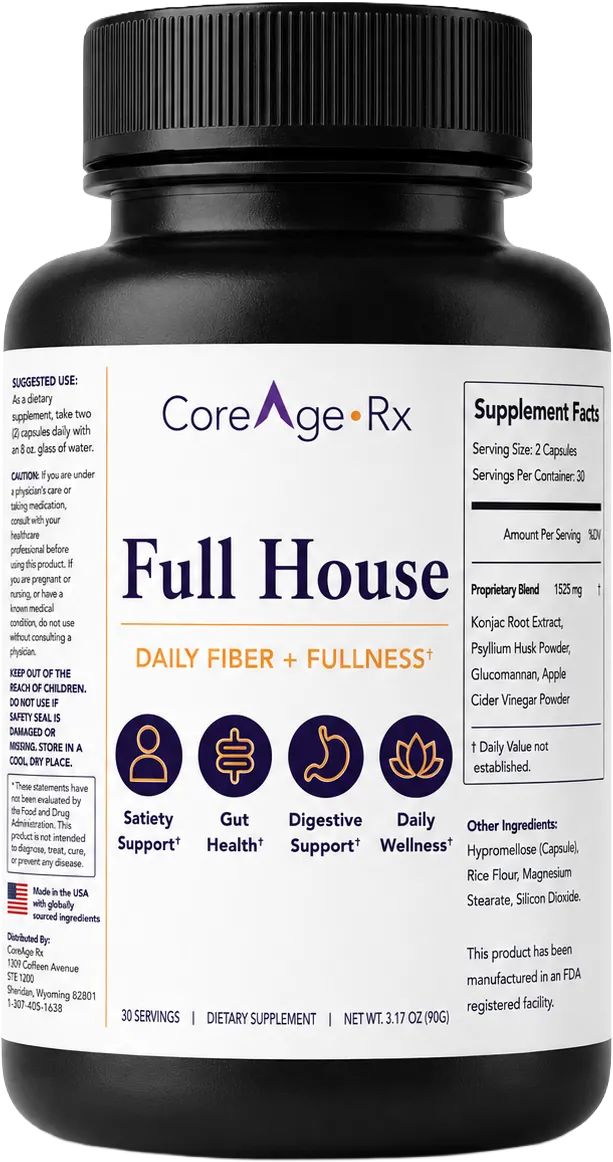
Full House combines konjac root extract, psyllium husk powder, glucomannan, and apple cider vinegar powder in a 1,525 mg proprietary blend per two capsules. See the current Full House™ page and check the bottle you receive before use.
Related reading
- Fiber Supplements: Types, Labels, and How to Choose
- Psyllium vs. Glucomannan: What Is the Difference?
- How Much Fiber Do You Need Per Day?
- Constipation while taking a GLP-1 medication
Educational information, not individualized medical advice. Product information and linked research checked September 15, 2026. Ingredient research does not establish identical effects for a finished supplement.