
A Fairlife shake can be a convenient source of milk protein. Whether it is a good choice for you depends on the exact bottle, what it replaces or adds to your day, and any allergy, nutrition, or digestive considerations. A higher protein number does not automatically make one shake the best option for every person.
Fairlife Nutrition Plan, Core Power, and Core Power Elite are different products. Their serving sizes, calories, and protein amounts differ. Reading the right label is the first step; judging a complete meal or weight-loss plan comes next.
This guide compares three named chocolate examples and answers the questions that matter beyond the front of the bottle.
Which Fairlife protein shake are you looking at?
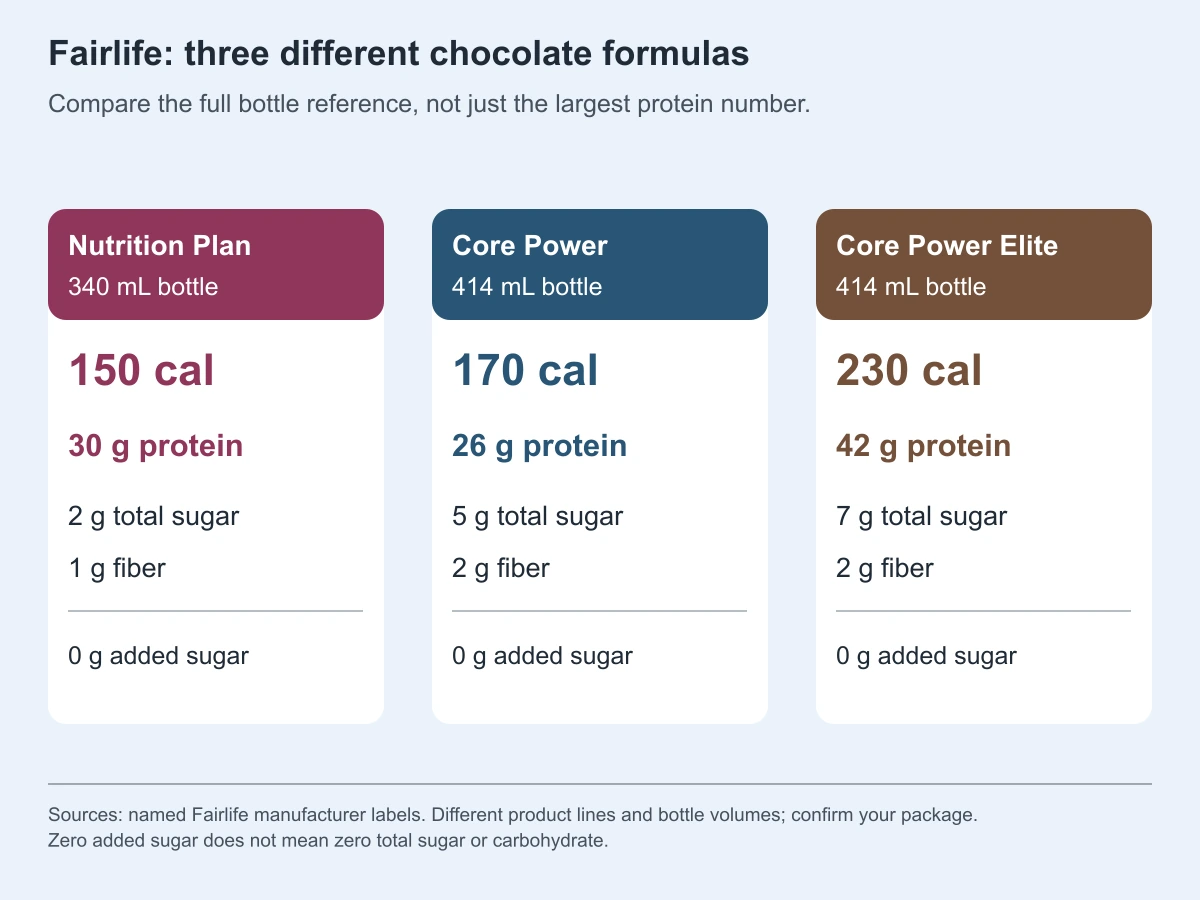
“Fairlife protein shake” can refer to more than one product line. Here are three examples from the manufacturer’s public labels, reviewed for this article:
| Chocolate product | Bottle reference | Calories | Protein | Total sugar | Fiber |
|---|---|---|---|---|---|
| Nutrition Plan | 340 mL | 150 | 30 g | 2 g | 1 g |
| Core Power | 14 fl oz / 414 mL | 170 | 26 g | 5 g | 2 g |
| Core Power Elite | 414 mL | 230 | 42 g | 7 g | 2 g |
Sources: Nutrition Plan chocolate, Core Power chocolate, and Core Power Elite chocolate. These are three specific formulas, rather than a statement about every flavor, bottle, country, or future formulation. Confirm the bottle you buy.
All three examples list zero grams of added sugar. That does not mean zero total sugar or zero carbohydrate. The total carbohydrate figures are 4 g, 8 g, and 9 g respectively for the three bottles in the table. If carbohydrate counting is part of your care, use the full panel and the amount you actually drink.
Notice that Nutrition Plan has more protein than the regular Core Power example while using a smaller bottle. The names and bottle size cannot substitute for the numbers. Likewise, Elite’s 42 g comes with a different calorie amount; it is not simply the same shake with a larger protein claim.
Are Fairlife shakes good for weight loss?
They may fit a weight-management eating pattern, but the label does not demonstrate that the shake causes weight loss. The useful comparison is what you would otherwise eat or drink and whether the overall pattern meets your needs.
Consider two situations. Someone who often skips lunch might use a shake alongside other food to make a workable meal. Someone who already eats enough may add a shake on top of the same meals. The shake’s label is identical in both situations; its role in the day is different.
A second comparison is satisfaction. If a drink leaves you wanting a full meal soon afterward, a different food combination may be more practical. If it helps during a busy period, convenience can be valuable. Neither response means your willpower is good or bad.
Our balanced-meal guide focuses on assembling meals you can repeat. Our hunger and food-noise article can help you describe appetite changes without reducing every food choice to a calorie number.
Can a protein shake replace a meal?
Do not assume that a protein drink is nutritionally complete. Fairlife describes Core Power as a recovery product rather than a complete meal replacement, and Nutrition Plan as a snack or pick-me-up. Those descriptions are product positioning, not a guarantee about what your individual diet needs. Fairlife manufacturer FAQ
Protein is one part of a meal. The table shows that these bottles contain only 1–2 g of fiber. A meal can also include foods that supply other nutrients, texture, and variety. The appropriate combination depends on appetite, medical needs, and what else you eat.
For a busy breakfast, a shake might accompany food rather than become the entire plan. For example, consider fruit and a grain food you tolerate, or a smaller mixed meal if fullness makes a large meal difficult. These are starting ideas, not exact calorie or protein prescriptions.
If most meals have become drinks because chewing, swallowing, nausea, or appetite is a persistent problem, tell a clinician. That situation deserves more attention than choosing between 26 g and 42 g of protein. Our breakfast article offers other practical combinations.
For food combinations beyond the named bottles, read our What to eat with a protein shake. It explains how to add variety, fiber and enough food around a drink, and why a protein number alone does not make a complete meal.
How much protein do you need?
A general article cannot determine your personal daily requirement or tell you how many shakes to drink. Body size, age, activity, medical conditions, food intake, and treatment goals can change the discussion.
Instead of starting with the biggest bottle number, review your usual meals. What protein foods do you already eat? When is intake difficult? Is the shake filling a specific gap, or have you been adding it because a number sounds impressive?
A dietitian can help translate a personal protein plan into food choices. Someone who has kidney disease should follow condition-specific advice rather than adopting a social-media high-protein target. NIDDK explains that protein and other nutrient needs require individual consideration in chronic kidney disease. NIDDK kidney nutrition guidance
Our protein and muscle article for semaglutide and tirzepatide protein guide discuss why function, food intake, and activity matter alongside the scale. They do not make one branded shake a required part of treatment.
Is lactose-free the same as dairy-free?
No. Fairlife says these products are made with milk and contain milk-derived protein. A lactose-free claim addresses lactose, the milk sugar. It does not remove the milk proteins that can be relevant to an allergy.
That is why lactose intolerance and milk allergy need different decisions. Some people with lactose intolerance can use lactose-free dairy products, but individual tolerance varies. Someone with a milk allergy should not treat “lactose-free” as proof that a milk-based shake is safe. NIDDK lactose-intolerance guidance and FDA food-allergen information
Check the ingredient and allergen statements on the actual bottle. Do the same when buying a different flavor or a product that only looks similar. Severe allergic symptoms need urgent help; they should not be treated as a normal adjustment to drinking protein.
Can Fairlife shakes cause bloating or stomach upset?
Personal tolerance can differ. A lactose-free product does not rule out every possible reason for digestive discomfort. The full ingredient list, the amount, how quickly you drink it, and what else you eat are worth discussing if a pattern develops.
Keep the description specific: bloating, nausea, reflux, abdominal pain, loose stools, or another symptom. Note whether it happens with the same bottle each time. “Protein shakes upset my stomach” is useful as a starting point, but the details help distinguish different situations.
Avoid assuming that stomach upset proves a milk allergy, that a larger protein amount is always responsible, or that discomfort must be endured for fitness benefits. Persistent or severe symptoms deserve care. If symptoms began around a medication change, mention that as well.
For people using a GLP-1 medicine, our semaglutide nausea article and tirzepatide nausea and reflux article explain when disrupted food or fluid intake needs follow-up. A shake cannot resolve every cause of medication-associated discomfort.
Can you drink Fairlife shakes while taking a GLP-1 medicine?
A ready-to-drink protein product may be convenient when appetite is lower, but it should be considered within the entire intake pattern. If you can manage a drink more easily than a large meal, discuss how to keep the day varied and adequate rather than relying only on drinks.
Do not use a shake to push through persistent vomiting or inability to drink. Current Ozempic and Zepbound labels warn about kidney injury associated with fluid loss. Difficulty maintaining intake can need clinical assessment, rather than a new brand of protein.
Track whether you are eating less because you feel comfortably satisfied or because symptoms make eating difficult. Those are different conversations. Our semaglutide first-month guide gives examples of useful observations to bring to follow-up.
If you are comparing CoreAge Rx semaglutide care and tirzepatide care, ask how nutrition concerns and new symptoms are handled. Prescription decisions depend on clinical eligibility and the actual product, not on whether you like a particular shake.
Is a protein shake the same as creatine or fiber?
No. These products serve different purposes. Milk protein, creatine, and a fiber supplement should not be counted as interchangeable ways to reach the same intake goal.
A name that includes “strength” does not necessarily mean protein, and a digestive-health product is not automatically a probiotic. Read the actual ingredient and supplement panel before adding another product to your routine.
For example, CoreAge Rx Strong Suit is a creatine monohydrate product, rather than a protein drink. Comparing it with a milk-protein shake requires understanding the different roles; one should not be counted as the other in a nutrition plan.
Our creatine versus protein article explains the distinction. Our choosing a creatine supplement guide also shows how to look past front-label wording. Neither product substitutes for a review of the foods and nutrients you are missing.
Storage, convenience, and cost questions
Follow the storage directions on the exact bottle, including what to do after opening. Fairlife’s FAQ describes unopened Core Power and Nutrition Plan products as shelf-stable, but opened storage is a different situation. A shake carried all day after opening should not inherit the unopened product’s storage claim.
For budgeting, compare price per bottle and how often you expect to use it. A case with a lower per-bottle cost may be worthwhile if you tolerate and regularly use it. It can be an expensive purchase if it does not suit your meals or taste.
You can also compare familiar food options on the same terms: preparation time, price, serving, protein, and enjoyment. There is no requirement to buy a branded drink to make progress. A convenience product earns its place by solving a real problem in your routine.
Frequently asked questions
Is Core Power Elite better than Nutrition Plan?
It has more protein in the example bottle, but “better” depends on what you need. Compare the full panel, bottle size, cost, taste, and whether it replaces or adds to other intake.
Does zero added sugar mean it will not affect blood sugar?
No. Added sugar is one label line. Use total carbohydrate and your own diabetes plan rather than making that inference. NIDDK diabetes eating guidance
Can I drink two shakes a day?
There is no universal number appropriate for everyone. Review the role of both bottles within your meals, your protein plan, and any medical restrictions. Frequent reliance on shakes because eating has become difficult warrants a discussion with the care team.
Must I drink it immediately after exercise?
A product’s recovery positioning does not establish a mandatory clock for every reader. Choose a routine that fits the broader food and training plan rather than treating the bottle as an urgent requirement.
If you mean milk rather than a ready-to-drink shake, read our comparison of Fairlife plain milk labels and meal questions. It uses current plain skim, 2% and whole 240 mL labels; the values should not be transferred to Core Power or other shakes.
How to choose a bottle that fits
Identify the product and serving, check milk allergy and tolerance, and decide what role the shake will play. Compare nutrition, cost, and convenience with other options. Then consider the rest of the day, especially meals that may be missing variety or substance.
A Fairlife shake can be useful. Its value comes from how it fits your actual needs, rather than from choosing the largest protein number or assuming a drink creates weight loss by itself.
Educational information for adults; individual treatment decisions require a qualified clinician. Sources reviewed October 1, 2026. Original AI-generated article images depict fictional people and objects, not patient outcomes. Other editorial images are illustrative. Graphics summarize the cited sources.