Semaglutide and tirzepatide are being discussed for more than weight loss. In liver research, both have produced favorable biopsy findings in people with metabolic dysfunction-associated steatohepatitis, or MASH. Semaglutide’s evidence has also supported a specific FDA-approved indication for Wegovy injection.
The details matter. Fat in the liver, active liver inflammation, fibrosis, cirrhosis, and liver failure are different stages or outcomes. A medicine can improve one without proving an effect on every other one. This guide compares the original ESSENCE and SYNERGY-NASH reports and a separate semaglutide trial in compensated cirrhosis.
First, separate liver fat from liver scarring
MASH is a form of metabolic liver disease in which fat accumulation is accompanied by liver-cell injury and inflammation. Fibrosis means scar tissue. Fibrosis stages describe the extent of scarring; F2 and F3 represent moderate and advanced fibrosis, while F4 is cirrhosis.
Older papers often use “NASH,” or nonalcoholic steatohepatitis. The terminology has changed, so a reader may encounter both names in the same evidence trail. The trial’s actual enrollment criteria still determine what was studied.
A report of fatty liver on an imaging study does not, by itself, tell someone that they have the same biopsy-confirmed condition and fibrosis stage as participants in these trials. Likewise, liver-enzyme blood tests are not interchangeable with a fibrosis stage. The relevant starting point is a clinician’s assessment of the liver condition and its severity.
The FDA’s MASH treatment explanation describes the disease, the approval pathway, and why confirmatory outcomes remain important.
ESSENCE: the phase 3 semaglutide trial
ESSENCE randomized 1,197 participants with biopsy-defined MASH and F2 or F3 fibrosis to weekly subcutaneous semaglutide 2.4 mg or placebo, in a 2:1 allocation. The planned study duration was 240 weeks. The 2025 paper reported a predefined interim analysis at week 72 in the first 800 participants: 534 assigned semaglutide and 266 assigned placebo. Novo Nordisk funded the trial. Original ESSENCE report.
The distinction between 1,197 enrolled participants and the first 800 in this interim analysis is important. The published 72-week percentages should not be described as the final result from every participant at 240 weeks.
There were two primary biopsy endpoints. One was resolution of steatohepatitis without worsening fibrosis. The other was improvement in fibrosis without worsening steatohepatitis. Each requires improvement in one aspect of the disease while avoiding deterioration in another.
What were the results?
MASH resolution without worsening fibrosis occurred in 62.9% of semaglutide participants and 34.3% of placebo participants. The trial’s estimated difference was 28.7 percentage points, with a 95% confidence interval of 21.1–36.2.
Fibrosis improvement without worsening MASH occurred in 36.8% versus 22.4%. The estimated difference was 14.4 percentage points, with a confidence interval of 7.5–21.3. The rounded 62.9 and 34.3 values subtract to 28.6; the reported modeled difference of 28.7 reflects the analysis and rounding, not a different endpoint.
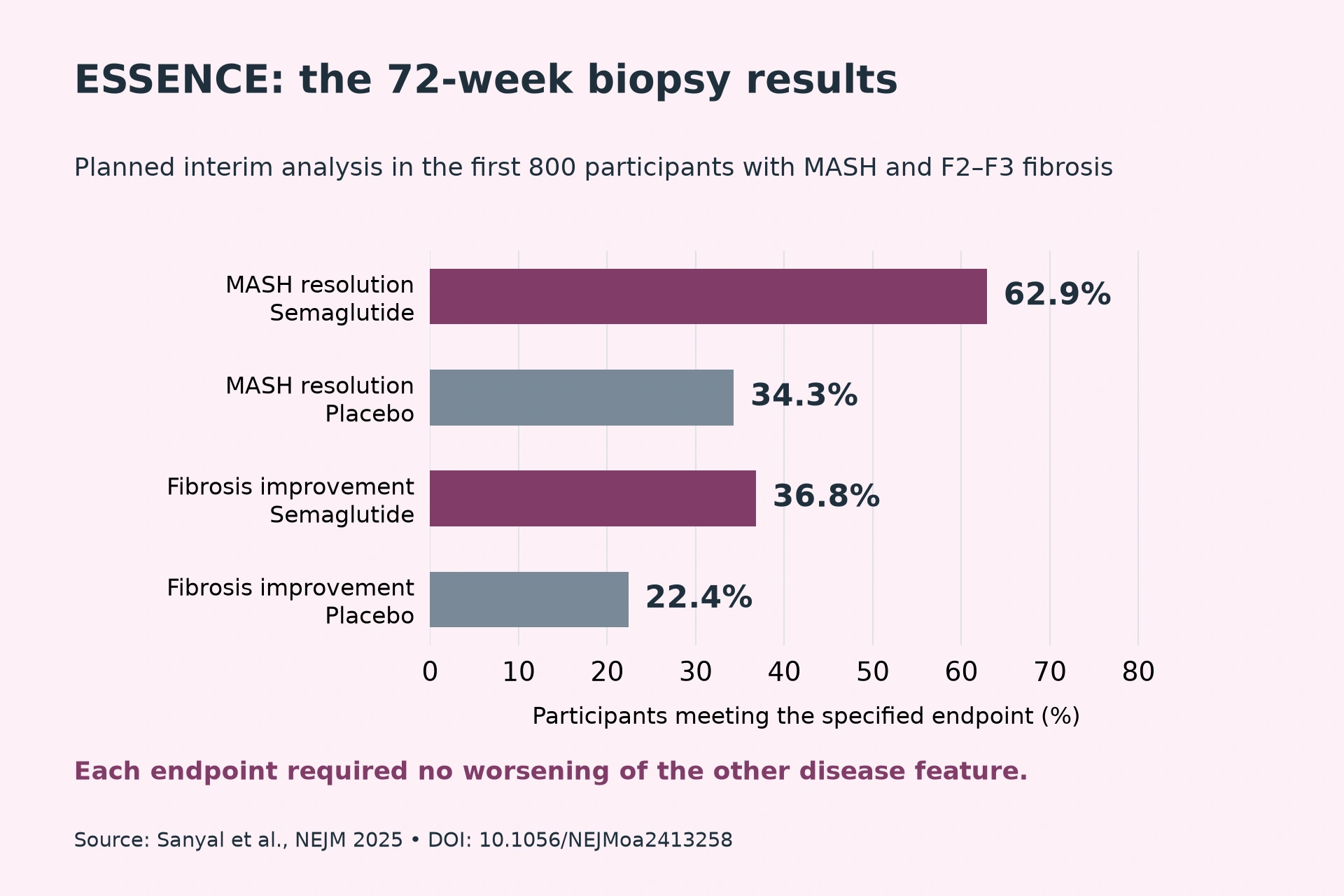
The combined achievement of MASH resolution and fibrosis reduction was also more common with semaglutide, at 32.7% versus 16.1%. Average weight change was −10.5% versus −2.0%. Gastrointestinal adverse events were more common in the semaglutide group.
These are meaningful findings in a condition where fibrosis is clinically important. They still describe biopsy-defined changes over a specified period. “The liver is cured” or “cirrhosis has been reversed” is not an accurate translation of these results.
What does the Wegovy approval mean?
The FDA approved Wegovy injection for adults with MASH and moderate-to-advanced fibrosis through the accelerated approval pathway. The supporting indication concerns noncirrhotic disease with F2–F3 fibrosis. It does not turn a positive F2–F3 study into an established treatment result in cirrhosis. FDA announcement and linked labeling.
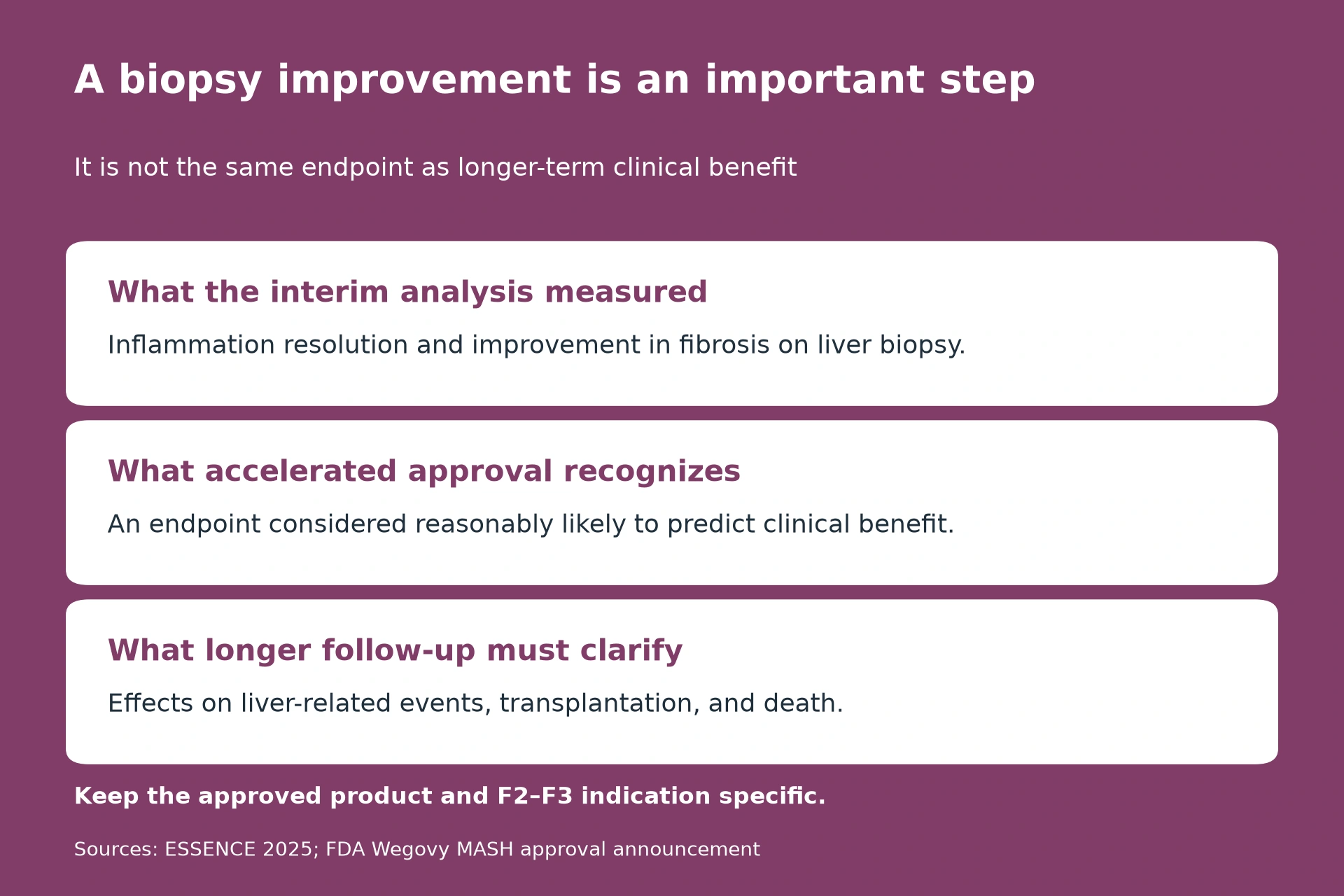
Accelerated approval uses an endpoint considered reasonably likely to predict clinical benefit while further evidence is collected. Here, biopsy changes supported approval. The FDA explains that the ongoing trial is intended to determine whether these improvements translate into fewer outcomes such as death, transplantation, and other liver-related events over the longer study period.
That is neither a reason to dismiss the approval nor a reason to treat all future clinical benefits as already proven. It tells readers exactly where the evidence stands.
SYNERGY-NASH: the smaller tirzepatide trial
SYNERGY-NASH was a phase 2, double-blind trial in 190 participants with biopsy-confirmed MASH and F2 or F3 fibrosis. Participants received tirzepatide 5, 10, or 15 mg weekly, or placebo, for 52 weeks. Eli Lilly funded the study. The main endpoint was MASH resolution without worsening fibrosis. Original SYNERGY-NASH report.
The reported response proportions were:
| Treatment group | MASH resolution without worsening fibrosis | Fibrosis improvement without worsening MASH |
|---|---|---|
| Placebo | 10% | 30% |
| Tirzepatide 5 mg | 44% | 55% |
| Tirzepatide 10 mg | 56% | 51% |
| Tirzepatide 15 mg | 62% | 51% |
These trial doses describe the randomized groups. They are not a self-treatment schedule or evidence that increasing an individual’s dose necessarily increases liver benefit.
Only 157 participants had evaluable week-52 biopsy results. The analysis handled missing results using a prespecified assumption based on the placebo pattern. Missing data and their treatment are part of interpreting the percentages, rather than a footnote that can be ignored.
The investigators concluded that larger and longer trials were needed. A promising phase 2 result establishes a strong reason for further study; it does not make tirzepatide’s liver evidence identical to semaglutide’s phase 3 program or product-specific approval.
Why the two trials cannot rank the medicines
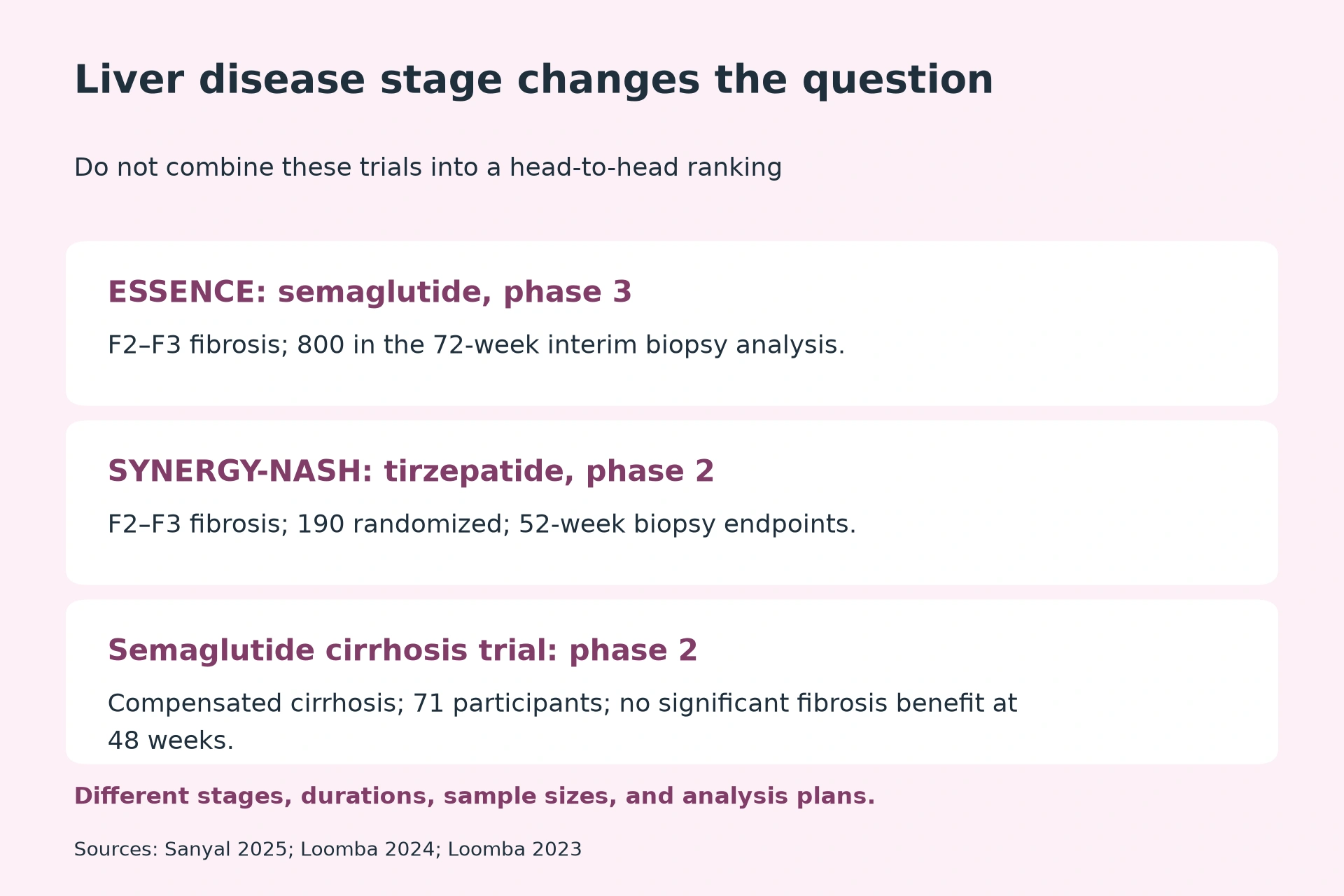
At a glance, a reader might compare the roughly 63% semaglutide response in ESSENCE with the 62% response in one tirzepatide group. That comparison ignores the different placebo response rates, sample sizes, study durations, and analysis plans.
Randomization makes comparisons within each trial more reliable. It does not randomize participants between two studies conducted under different conditions. The 34.3% ESSENCE placebo response and 10% SYNERGY-NASH placebo response alone should caution against a simple ranking based on active-treatment percentages.
Our semaglutide and tirzepatide comparison guide addresses the broader treatment discussion. For a liver-specific decision, ask about the current approved indication, disease stage, and direct evidence relevant to that stage.
The cirrhosis study that should not be left out
A 2023 phase 2 trial tested semaglutide 2.4 mg weekly in 71 adults with NASH-related compensated cirrhosis. Forty-seven received semaglutide and 24 placebo for 48 weeks. Unlike ESSENCE and SYNERGY-NASH, this study involved cirrhosis. Original cirrhosis trial.
The primary endpoint was at least one-stage fibrosis improvement without worsening NASH. It occurred in 5 of 47 semaglutide participants, or 11%, and 7 of 24 placebo participants, or 29%. The difference was not statistically significant. NASH resolution also did not differ significantly.
The study was small and the authors discussed limitations, including limited power, the 48-week duration, and pathology-assessment issues. A negative result in a small trial does not prove no future treatment strategy could help. It does mean that a review should not selectively use favorable noncirrhotic findings to claim proven reversal of cirrhosis.
Liver and kidney function remained stable during that trial, and no decompensating events or deaths were reported. Those observations in 71 participants over 48 weeks cannot establish broad safety in decompensated cirrhosis or every advanced-liver-disease setting.
What remains uncertain about the mechanism?
Weight reduction, changes in glucose metabolism, and other biological effects may all contribute to improved liver findings. The FDA notes that weight loss and potentially other incompletely understood mechanisms may improve inflammation and scarring.
These studies do not give a precise percentage of benefit attributable to each pathway. Nor do they show that the same improvement would occur with a different preparation, a much smaller dose, or a short course of treatment. Mechanistic hypotheses should be presented as hypotheses, not converted into guaranteed clinical outcomes.
A useful analogy is a photograph of a road being repaired: it provides evidence of structural improvement, but it does not by itself establish how many future accidents will be prevented. Biopsy improvement and long-term clinical outcomes are connected questions, not identical measurements.
How to make this useful in a clinical discussion
Start with the diagnosis and fibrosis assessment. Ask whether the concern is simple steatosis, MASH, F2–F3 fibrosis, or cirrhosis, and what evidence supports that classification. Then review other conditions, medications, alcohol exposure, nutrition, and the need for specialist care.
A person taking a GLP-1 medicine for another reason should not assume that improving liver enzymes proves their fibrosis has resolved. Follow-up should use the measures appropriate to the diagnosed condition. New jaundice, confusion, abdominal swelling, or gastrointestinal bleeding needs urgent clinical evaluation rather than an adjustment based on an online article.
If treatment is being explored through CoreAge Rx, review the semaglutide or tirzepatide information with the prescribing clinician. Ask about the exact product and its approved indication. The trials discussed here do not establish equivalent liver outcomes for every preparation sharing an ingredient name.
Our semaglutide questions guide and tirzepatide questions guide can help structure that visit. Related evidence on kidney outcomes, heart-failure outcomes, and lean mass during weight loss addresses separate aspects of health that may also matter.
Watch: the publisher explains SYNERGY-NASH
This NEJM video summarizes the phase 2 tirzepatide trial. It is useful context for that study, not a substitute for the newer semaglutide approval details or an endorsement of a particular treatment choice.
Common questions about the liver research
Does this apply to everyone with fatty liver?
No. The key trials enrolled people with biopsy-confirmed inflammatory disease and specified fibrosis stages. A fatty-liver finding alone does not establish that someone matches those participants or meets a product’s indication.
Did ESSENCE show fewer liver transplants or deaths?
The 72-week report focused on biopsy endpoints. The longer trial is intended to answer whether those improvements lead to better clinical outcomes. That question should remain open until the relevant results are available.
Is tirzepatide’s phase 2 result the same as a MASH approval?
No. An original study and a regulatory indication are different things. SYNERGY-NASH provides promising efficacy evidence, while the specific approval discussed here is for Wegovy injection. Check current product labeling with the clinician rather than inferring approval from a headline.
Can the percentages tell me which medication is better?
Not from these two separate placebo-controlled studies. Differences in population, duration, placebo response, missing-data handling, and trial phase prevent a reliable head-to-head ranking.
What is the key takeaway?
The MASH evidence has advanced substantially, especially for semaglutide in noncirrhotic F2–F3 disease. A careful review should include both the favorable biopsy findings and the negative cirrhosis trial, while keeping long-term clinical outcomes and product-specific indications distinct.
Original papers and supporting sources
The references distinguish full research papers, published abstracts, and official guidance. This educational narrative review is not a systematic review or an individual treatment recommendation. Sources were checked in October 2026.
- FDA. Wegovy approval for MASH and the accelerated approval pathway. FDA approval announcement.
- Sanyal AJ et al. Phase 3 Trial of Semaglutide in Metabolic Dysfunction-Associated Steatohepatitis. (2025). Published abstract reviewed. DOI: 10.1056/nejmoa2413258.
- Loomba R et al. Tirzepatide for Metabolic Dysfunction-Associated Steatohepatitis with Liver Fibrosis. (2024). Published abstract reviewed. DOI: 10.1056/nejmoa2401943.
- Loomba R et al. Semaglutide 2·4 mg once weekly in patients with non-alcoholic steatohepatitis-related cirrhosis: a randomised, placebo-controlled phase 2 trial. (2023). Full text reviewed. DOI: 10.1016/s2468-1253(23)00068-7. Open full text.