Knee osteoarthritis can make walking, climbing stairs, and staying active difficult. When obesity is also present, weight-management treatment may be part of a broader plan. The STEP 9 trial tested whether semaglutide improved both body weight and knee pain in this setting.
It found a larger average improvement in pain with semaglutide than placebo. That is a meaningful finding, but it is not the same as proof that the medicine rebuilt cartilage, prevented knee replacement, or treats every cause of knee pain.
What kind of knee pain was studied?
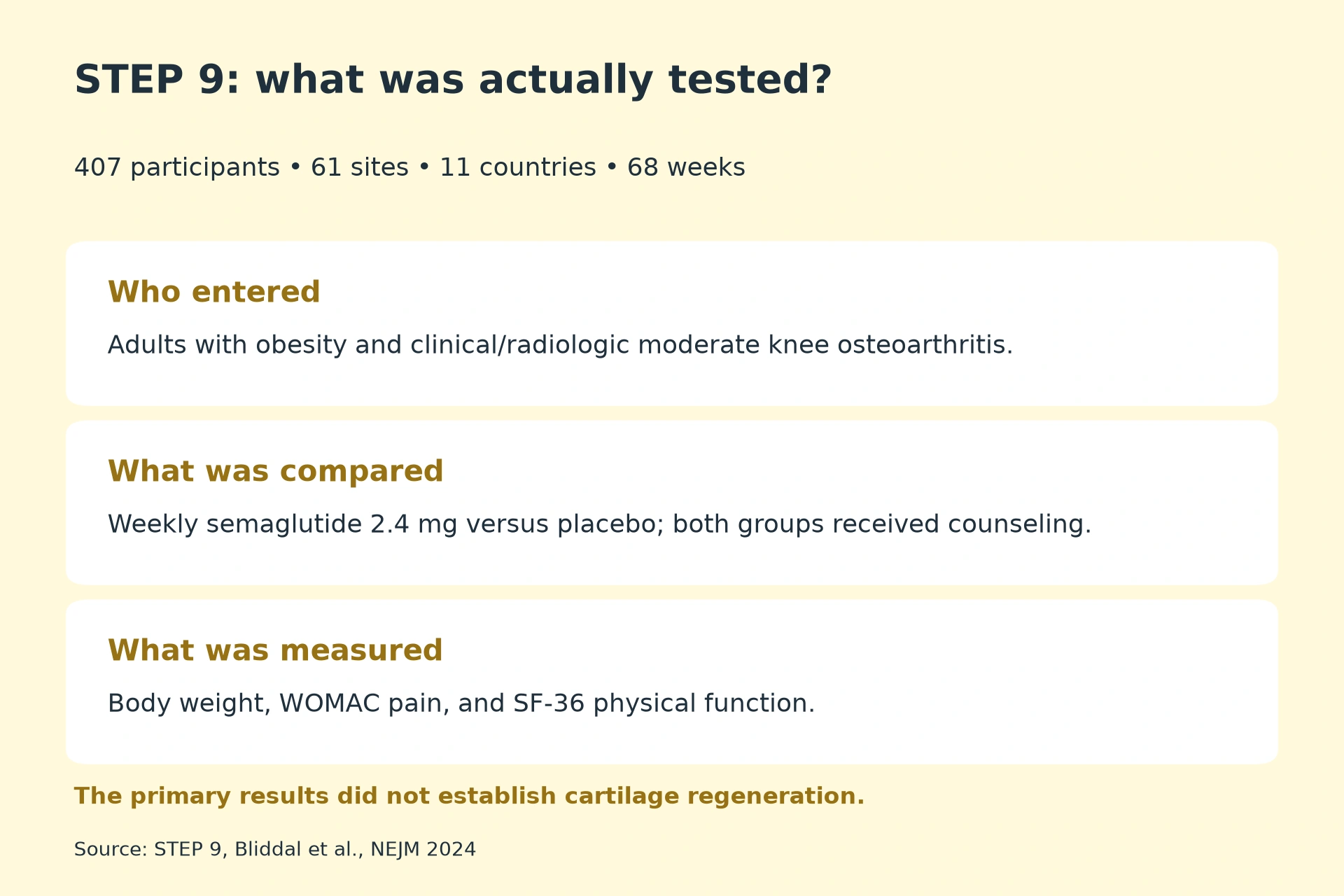
STEP 9 enrolled adults with a BMI of at least 30 and both clinical and radiologic evidence of moderate knee osteoarthritis. Participants also had at least moderate pain. This was not a study of undiagnosed knee pain, a recent sports injury, inflammatory arthritis, or every stage of osteoarthritis. Original STEP 9 paper.
The mean age was 56 years, the mean BMI was 40.3, and 81.6% of participants were women. The average baseline WOMAC pain score was 70.9 out of 100, so participants had substantial symptoms at entry.
Those details matter when someone asks whether the result applies to them. A person with mild intermittent discomfort, a lower BMI, or advanced structural disease awaiting surgery may have a different clinical question. The first step remains identifying the cause of the pain and the treatment goals.
Our menopause and joint-pain guide addresses another common source of questions about joint symptoms. Menopause-related symptoms and radiologically assessed knee osteoarthritis should not be treated as interchangeable diagnoses.
How was STEP 9 designed?
Researchers randomized 407 participants at 61 sites in 11 countries in a 2:1 ratio to weekly subcutaneous semaglutide 2.4 mg or placebo. The study was double-blind and lasted 68 weeks. Both groups received counseling on a reduced-calorie diet and physical activity. Novo Nordisk funded the trial.
The two primary endpoints were percentage change in body weight and change in WOMAC pain score. A key confirmatory secondary endpoint was the physical-function score from the SF-36 health survey. These outcomes describe different aspects of treatment: weight, knee symptoms, and broader ability to function.
A placebo group receiving counseling is important here. Pain and function can change over time for several reasons, including expectations, changes in activity, and other care. The comparison helps estimate the additional average effect of treatment assignment rather than attributing every improvement to the medicine.
What did the pain result mean?
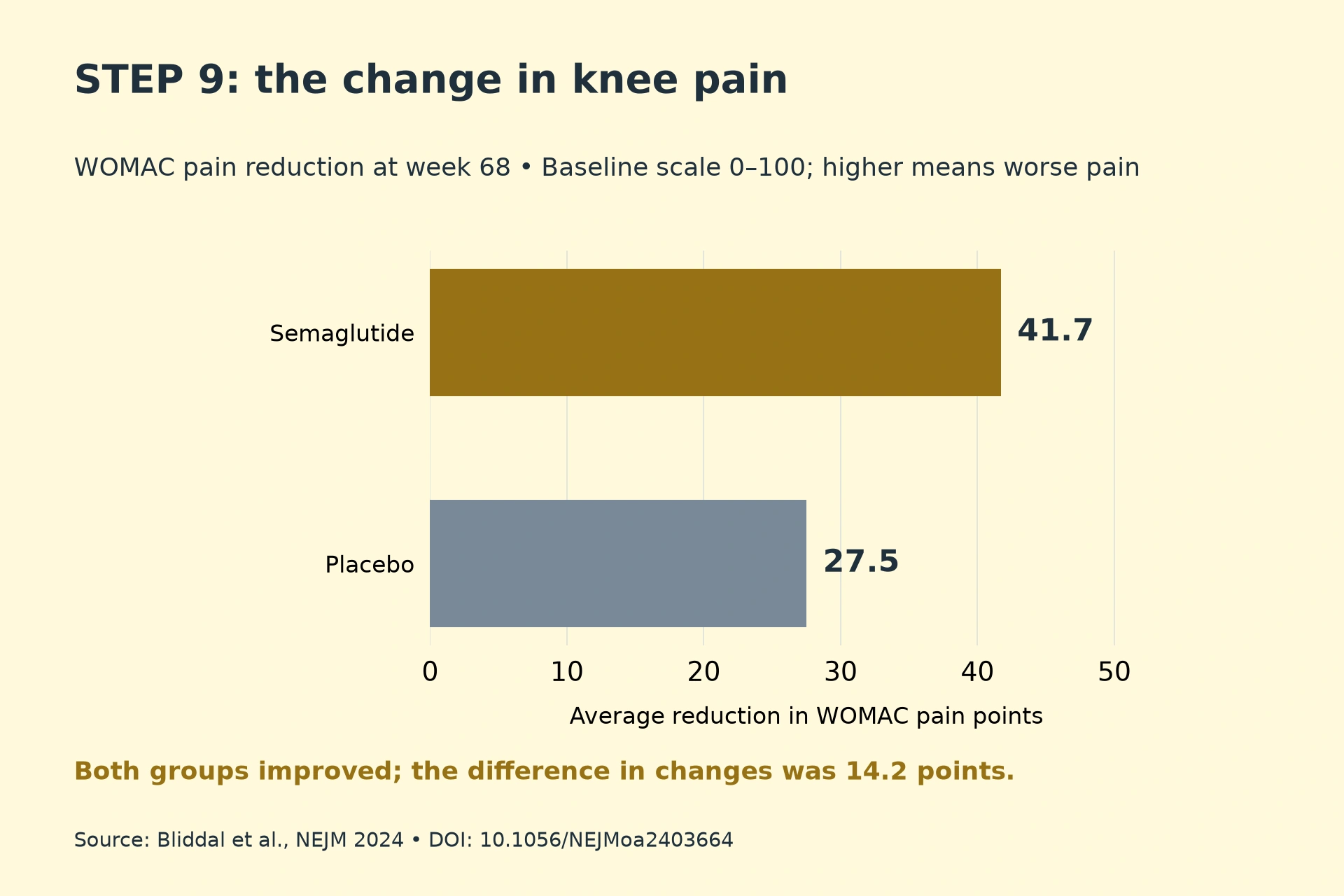
WOMAC is a questionnaire used to assess osteoarthritis symptoms. In STEP 9, the pain score was expressed on a 0–100 scale, with higher values indicating worse pain. By week 68, the average score had fallen 41.7 points in the semaglutide group and 27.5 points in the placebo group. STEP 9 results.
The difference between those changes is 14.2 points favoring semaglutide. That is a difference in score change, not a 14.2% chance of being cured and not a count of pain-free days. Both groups improved, and individuals could do better or worse than their group average.
It is also important not to calculate an exact final score for each group by subtracting its change from the overall baseline mean of 70.9. That baseline number describes the combined population, while the treatment analysis used the trial’s statistical model. A precise-looking calculation can be misleading if it mixes different summaries.
The useful conclusion is straightforward: in adults resembling the trial participants, semaglutide produced a greater average reduction in knee-osteoarthritis pain than placebo plus the same counseling.
What changed in weight and function?
Average body-weight change was −13.7% with semaglutide versus −3.2% with placebo. The SF-36 physical-function score improved by 12.0 points versus 6.5 points, respectively. Higher SF-36 physical-function scores indicate better function, the opposite direction from WOMAC pain scores.
This direction difference is easy to miss. A falling pain score is favorable, while a rising function score is favorable. Clear charts need to name the scale and the direction rather than simply use an upward arrow for “better.”
The combination of weight, pain, and function findings supports a clinically relevant benefit. It does not mean all daily activities became easy or that every limitation was caused by weight. People can still need individualized rehabilitation, pain management, or orthopedic evaluation.
Our semaglutide questions guide explains broader treatment considerations. The lean-mass research review is also relevant because protecting useful function during weight loss involves more than watching the scale.
Did weight loss cause all of the pain improvement?
Reducing body weight can reduce mechanical demands on a painful knee, and obesity is also linked to inflammatory and metabolic processes. STEP 9 showed that semaglutide assignment improved both weight and pain outcomes. It did not independently randomize the amount of weight loss while holding every other biological effect constant.
That means the trial cannot assign an exact share of the pain benefit to mechanical unloading versus other possible mechanisms. It is reasonable to discuss potential pathways, but “the drug directly repaired the joint” goes beyond what the STEP 9 endpoints established.
A second original trial helps put the weight-management component in context without pretending to answer the same medication question.
The IDEA trial: why exercise and nutrition still belong
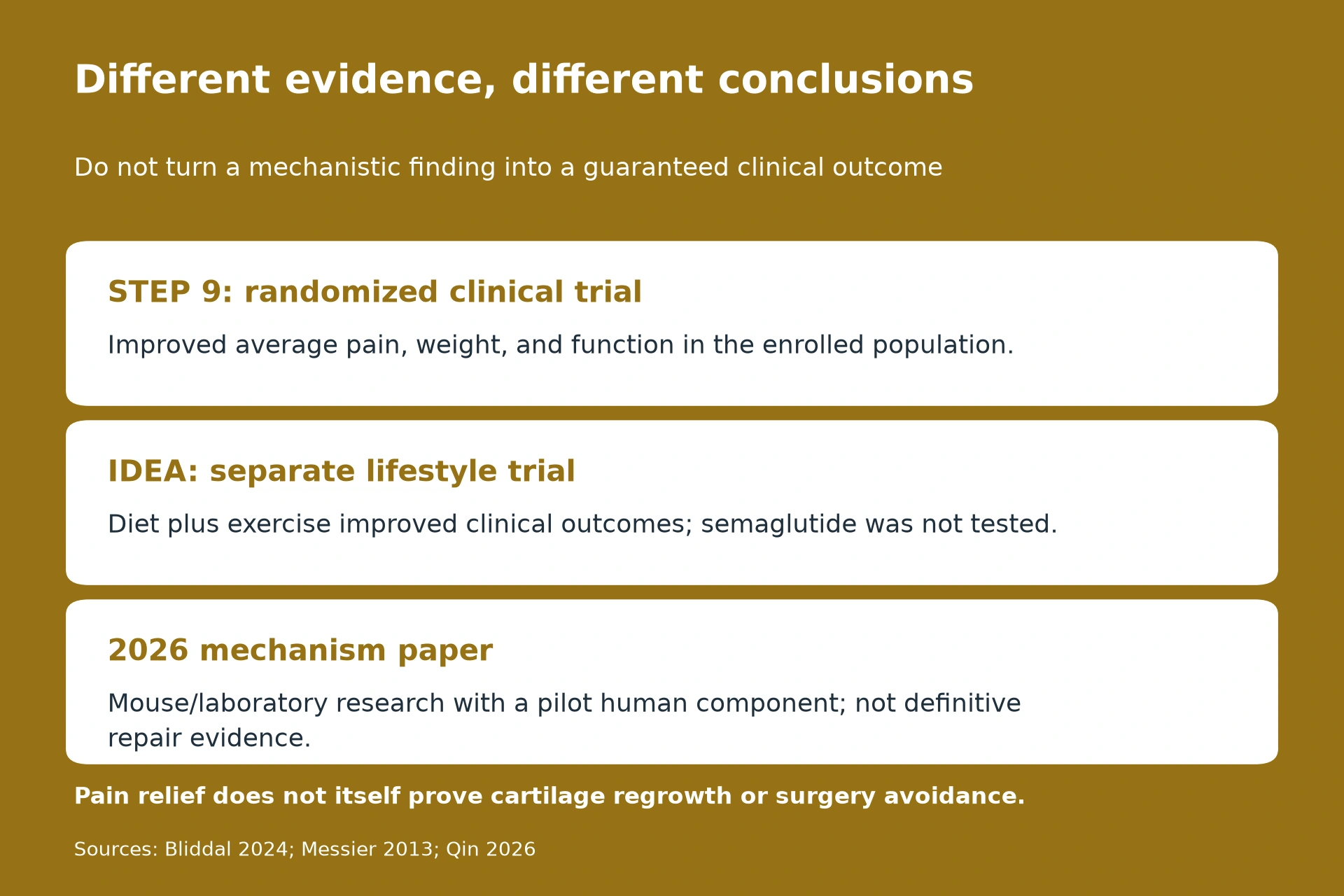
The 2013 IDEA trial randomized 454 adults aged 55 or older with overweight or obesity and knee osteoarthritis to intensive diet-induced weight loss plus exercise, diet alone, or exercise alone for 18 months. It was a separate lifestyle study at one center, not a semaglutide trial. Original IDEA report.
Mean weight loss was 11.4% with diet plus exercise, 9.5% with diet alone, and 2.0% with exercise alone. The combined group had better pain and function outcomes than either single strategy. Diet-based groups also showed favorable changes in measures related to joint loading or inflammation.
This supports the idea that exercise and nutrition are substantive parts of osteoarthritis care. It does not prove that adding any particular exercise plan to semaglutide produces the same amount of benefit, because IDEA did not test that combination.
IDEA also used a different pain scale, ranging from 0 to 20. Its pain numbers cannot be placed directly beside STEP 9’s 0–100 values without careful handling. The studies differed in participants, duration, interventions, and measurement. They complement each other; they do not create a valid cross-trial ranking.
What about the 2026 cartilage-mechanism paper?
A 2026 original paper reported semaglutide-related effects on cartilage and metabolism in an obesity-associated osteoarthritis mouse model, alongside a randomized pilot clinical study. Its abstract proposed a weight-loss-independent metabolic mechanism. Original 2026 mechanistic report.
This is an interesting research direction, and it should be labeled accurately. Animal-model findings, laboratory pathway experiments, a small pilot clinical component, and a large symptom-focused trial are different levels and types of evidence. They should not be merged into a headline that semaglutide is proven to regrow human knee cartilage or eliminate the need for replacement surgery.
This review uses the published abstract for that emerging paper and does not treat it as a definitive clinical cartilage-repair trial. The stronger direct clinical conclusion from STEP 9 remains improved pain, weight, and function in its enrolled population.
What are the main limitations of STEP 9?
First, the eligibility rules narrow the population to adults with obesity and a particular osteoarthritis presentation. Second, follow-up lasted 68 weeks, so it cannot establish effects over decades. Third, the main outcomes were weight, symptoms, and function; imaging-confirmed cartilage regeneration and joint replacement were not the primary questions answered.
The substantial placebo-group pain improvement also matters. It reminds readers that individual change is not identical to the medicine’s additional effect. Finally, tolerability can affect whether someone remains on treatment.
Adverse events leading to permanent discontinuation occurred in 6.7% of semaglutide participants and 3.0% of placebo participants. Gastrointestinal disorders were the most common reason. Serious adverse-event incidence was similar between groups. These results belong alongside the benefits, rather than being omitted from a pain-focused headline.
What this means when discussing treatment
A useful conversation begins with what the person most wants to do: walk farther, climb stairs, sleep with less pain, return to a valued activity, or reduce other weight-related health risks. Those goals help determine how progress will be assessed and which treatments need to work together.
Ask about a suitable exercise or physical-therapy plan, nutrition during weight loss, and what would prompt orthopedic review. A suddenly hot, markedly swollen knee, fever with joint pain, or inability to bear weight after an injury needs assessment for causes beyond chronic osteoarthritis.
If you are exploring CoreAge Rx’s semaglutide information page, discuss the exact product, its indication, and whether your overall health profile fits treatment. STEP 9 should not be presented as proof that every semaglutide preparation has the same knee-pain effect or as a self-directed prescription for arthritis.
Our guides to semaglutide nausea and vomiting, protein and muscle during semaglutide treatment, and weight maintenance after stopping cover related planning questions. For the randomized withdrawal evidence, see the GLP-1 weight-regain studies.
Watch the publisher explain STEP 9
NEJM’s short video introduces the study and its outcomes. It is a summary of the pain-and-weight trial, not a demonstration of cartilage repair.
Common questions about semaglutide and knee pain
Was semaglutide compared with knee replacement or physical therapy?
No. STEP 9 compared semaglutide with placebo, with both groups receiving diet and activity counseling. It cannot establish superiority to surgery or a particular rehabilitation program.
Does a 41.7-point pain reduction mean people became pain-free?
No. It is the average change in a questionnaire score within the semaglutide group. It does not say that every participant had no pain, and the placebo group also improved substantially.
Did the trial show cartilage regrowth?
No. Its reported primary findings concern weight and pain, with physical function as a key secondary outcome. A separate mechanistic paper should not be used to relabel STEP 9 as a cartilage-regeneration trial.
Can the result apply to knee pain without obesity?
That population was not the one enrolled. A clinician needs to consider the diagnosis, body size, disease severity, other health conditions, and treatment options rather than extend the trial automatically.
What is the most useful takeaway?
For adults resembling the STEP 9 population, semaglutide improved average knee pain and physical function while producing weight loss. It is evidence for an additional treatment consideration within a broader plan, with rehabilitation and realistic functional goals still central.
Original papers and supporting sources
The references distinguish full research papers, published abstracts, and official guidance. This educational narrative review is not a systematic review or an individual treatment recommendation. Sources were checked in October 2026.
- Bliddal H et al. Once-Weekly Semaglutide in Persons with Obesity and Knee Osteoarthritis. (2024). Published abstract reviewed. DOI: 10.1056/nejmoa2403664.
- Messier SP et al. Effects of intensive diet and exercise on knee joint loads, inflammation, and clinical outcomes among overweight and obese adults with knee osteoarthritis: the IDEA randomized clinical trial. (2013). Full text reviewed. DOI: 10.1001/jama.2013.277669. Open full text.
- Qin H et al. Semaglutide ameliorates osteoarthritis progression through a weight loss-independent metabolic restoration mechanism. (2026). Published abstract reviewed. DOI: 10.1016/j.cmet.2026.01.008.