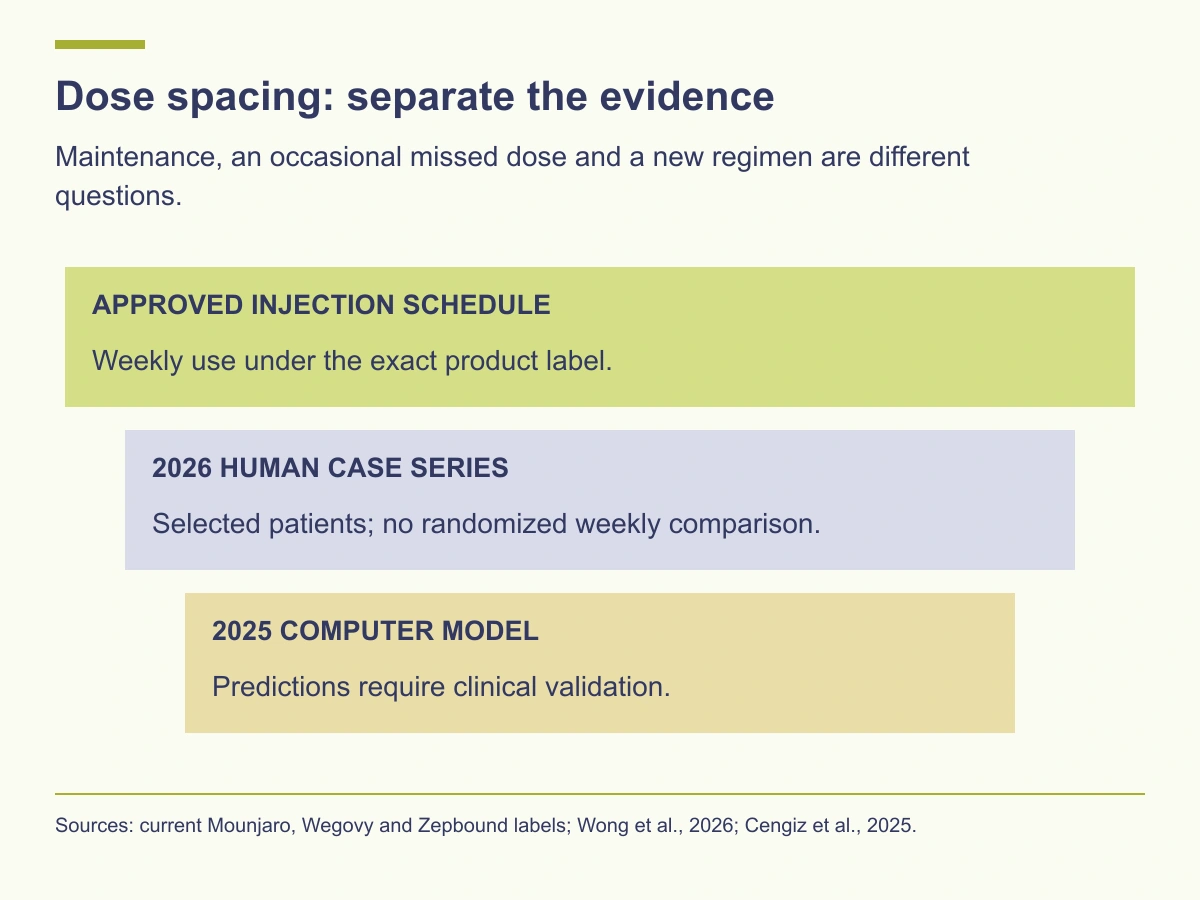
Mounjaro and Wegovy injections are labeled for once-weekly use. A planned every-other-week schedule is not the standard approved regimen, even when the goal changes from losing weight to maintaining it. Emerging research is exploring less-frequent treatment, but it does not establish a universal schedule you can safely adopt yourself.
The reason you are considering a change matters. A missed dose, a coverage problem, persistent side effects, and a planned maintenance discussion are different situations. Start by identifying which one applies, then ask the prescriber for a written plan tied to the exact product and your treatment goals.
What the approved schedules actually say
Mounjaro is a weekly tirzepatide injection. Wegovy injection is also weekly. Zepbound, the tirzepatide brand approved for weight management, likewise uses a weekly schedule, including its labeled maintenance doses. “Maintenance” describes an ongoing treatment phase; it does not automatically mean less-frequent injections. Mounjaro label, Wegovy label, Zepbound label
Wegovy also has a daily oral tablet formulation. Injection instructions should not be transferred to tablets, and oral and injectable milligram amounts are not interchangeable. If a service uses the general word “semaglutide,” ask for the exact product, route, and directions before discussing frequency.
A medication can remain in the body after a scheduled dose date without providing evidence that any longer interval is equally effective. Drug persistence, appetite changes, glucose control, and long-term clinical outcomes are related but different measures. Feeling less hungry is not a complete test of whether a diabetes or cardiovascular treatment goal remains adequately addressed.
Our oral semaglutide versus injections guide explains why formulation needs to be specified first. The rest of this article addresses recurring changes to injection frequency, not a tablet schedule.
A missed dose is not a planned alternative regimen
The labels provide instructions for an occasional missed dose so people can return to the prescribed schedule. That is different from deliberately omitting every second scheduled injection indefinitely.
For Mounjaro, the label says a missed dose can be taken within four days, or 96 hours. After that window, the dose is skipped and the regular weekly schedule resumes. It also specifies at least three days between doses when changing the weekly administration day. These are labeled exception rules, not evidence supporting a recurring two-week interval. Mounjaro administration instructions
For Wegovy injection, the current label uses the time remaining before the next scheduled dose: more than two days versus less than two days. If you are at the exact boundary or unsure how to apply it, ask the pharmacist. The current prescribing information directs reinitiation of escalation at a lower dose after two or more consecutive missed injections to reduce gastrointestinal risk. The prescriber should determine the restart dose and plan. Wegovy missed-dose instructions
An uncertain partial injection creates a different problem again. Do not use the missed-dose rule to justify automatically repeating a dose you may already have received. The Mounjaro pen-malfunction guide explains what to document and who to contact.
Why every-other-week dosing attracts interest
Common reasons include cost, supply interruptions, side effects, a desire for fewer injections, or a concern about continuing treatment after reaching a goal. These are reasonable issues to bring to a clinical review. They deserve a plan that addresses the actual problem rather than an improvised calendar change.
For example, if nausea is interfering with meals, the clinician needs the symptom pattern, current dose, recent changes, and hydration status. If insurance stops covering a medicine, the team needs the denial reason and expected remaining supply. If weight is stable, the discussion should include how long it has been stable and what other outcomes the medicine is treating.
Write down the main reason in one sentence. “I cannot afford the next refill” leads to different next steps from “I am maintaining my weight and want to discuss the least burdensome effective treatment.” Both are more useful than simply asking whether a two-week schedule is allowed.
What the newer human study found—and what it cannot prove
A 2026 retrospective case series examined 30 adults who remained on reduced-frequency semaglutide or tirzepatide after reaching a weight plateau on weekly treatment. Follow-up averaged about 36 weeks. The investigators reported maintenance of weight and several metabolic improvements in this selected group. Reduced-frequency GLP-1 case series
The selection details matter: four other participants who tried reduced-frequency dosing returned to weekly treatment because of weight regain before the first follow-up and were not included in the 30-person outcome analysis. There was no randomized weekly-treatment comparison group, and schedules varied. The study therefore cannot establish that every-other-week treatment works as well as weekly treatment for everyone.
It also does not establish a standard starting regimen, a universal restart protocol, or preservation of every approved cardiovascular, kidney, or other clinical benefit. It is useful preliminary human evidence for a clinician discussion, with limitations that remain important even when the headline sounds reassuring.

Computer models are another type of evidence
A 2025 study used mathematical models to simulate alternative semaglutide and tirzepatide dosing schedules. The authors explored potential weight effects and costs, but the analysis was not a trial assigning patients to those schedules. They specifically called for clinical validation of efficacy, tolerability, and safety. Alternative-dosing modeling study
A modeled prediction can help researchers decide what to study next. It cannot independently confirm how an individual will respond, how side effects will change, or whether a different schedule preserves outcomes beyond weight. Avoid turning a model’s percentage estimate into a personal promise.
The newer case series adds human observations, but it does not erase the need for controlled comparisons. It is more accurate to describe an evolving research question than to say either “there is no human evidence” or “every-other-week dosing has been proven equivalent.”
Match the concern to the next conversation
| Why you are considering a change | Information to bring | What the plan needs to address |
|---|---|---|
| One forgotten injection | Product and last confirmed dose time | The exact missed-dose instructions |
| Several missed injections | Length of gap, previous dose, symptoms | Restarting and possible re-escalation |
| Side effects | Timing, severity, intake, recent dose changes | Tolerability and whether treatment needs adjustment |
| Cost or coverage loss | Denial, pharmacy quote, supply remaining | Affordable continuity or a supervised alternative |
| Stable weight and maintenance goals | Weight trend, glucose goals, other indications | Benefits, burden, monitoring, and a follow-up decision |
| A device may not have delivered | Device details and observations | An uncertain dose, not an assumed completely missed one |
The table is a discussion tool, not a dosing algorithm. A change that is reasonable in one situation can be unsuitable in another, particularly when diabetes medicines or significant medical conditions are involved.
Diabetes goals need separate attention
Someone taking Mounjaro for type 2 diabetes may be tracking more than appetite and weight. A1c, day-to-day glucose readings, low-glucose risk from other medicines, and cardiovascular history can all matter. A stable scale does not establish stable glucose control.
Tell the prescriber about insulin and sulfonylureas, and do not change them independently to compensate for a different injection interval. Ask which readings need a call and how monitoring should change if the regimen changes. Our tirzepatide and metformin comparison explains why the complete combination deserves review.
If thirst, frequent urination, unusual weakness, vomiting, or markedly abnormal glucose develops, use your established diabetes action plan and obtain medical advice. Severe confusion, collapse, difficulty breathing, or an inability to safely swallow requires urgent help. Do not wait until the next planned maintenance visit to address significant symptoms.
If cost is driving the question
Before stretching doses, clarify whether the problem is a deductible, prior authorization, an excluded indication, a pharmacy-network issue, an expired savings offer, or a service fee. Those problems have different solutions. Ask for the denial or claim explanation instead of relying only on a message that the drug is “not covered.”
Compare legitimate options for the exact prescribed product and use. A manufacturer offer may depend on insurance type, presentation, quantity, and annual caps. A different branded product or compounded preparation should not be treated as a pharmacy-level substitute without a new clinical decision.
The Mounjaro cost guide and CVS pricing questions can help organize the conversation. Tell the care team how much supply remains so they can address continuity before an unplanned gap becomes longer.
For assessment-based service information, review CoreAge Rx tirzepatide care. Confirm the exact preparation, instructions, pharmacy, and full ongoing price. An advertised service or low-dose program does not itself validate an every-other-week regimen.

What a useful maintenance plan should contain
A maintenance discussion should start with the outcomes you want to preserve and the burden you want to reduce. Weight trend may be one measure, alongside glucose control, other indicated benefits, nutrition, strength, tolerability, and daily functioning.
Ask the clinician to document the actual prescription, follow-up timing, what to monitor, which changes should prompt contact, and what happens if weight or symptoms change. If a schedule outside labeling is proposed, ask how the evidence and uncertainty apply to you. Do not assume a plan developed for someone else can be copied.
The semaglutide stopping and maintenance guide discusses longer-term follow-up. Continuing treatment, changing a dose, changing frequency, and stopping are different choices; none should be reduced to whether there is still medicine in the body after a week.
Frequently asked questions
Can I take Mounjaro every other week to save money?
That is not its labeled schedule. Bring the affordability problem to the prescriber and pharmacist before changing it. A small observational study does not establish a universally effective or safe cost-saving regimen.
Can I take Wegovy every other week once I reach my goal?
The injection’s labeled maintenance schedule remains weekly. A maintenance review should consider the exact indication, response, symptoms, and follow-up plan rather than automatically changing the interval.
Does one missed dose ruin treatment?
An occasional missed dose has product-specific instructions. Use the current label and pharmacist guidance. Do not double up or turn the exception into a recurring schedule on your own.
Can I restart the old dose after a long break?
Ask the prescriber first. The duration of the gap and the exact product matter; Wegovy’s current label addresses lower-dose re-escalation after multiple consecutive missed injections. Previous tolerance does not supply a personal restart prescription.
Does reduced-frequency research apply to daily tablets?
The studies discussed here concern injectable semaglutide or tirzepatide regimens. They do not establish an every-other-week schedule for oral Wegovy or other daily medicines.
Educational information for adults; individual treatment decisions require a qualified clinician. Sources reviewed October 6, 2026. Original AI-generated article images depict fictional people and objects, not patient outcomes. Other editorial images are illustrative. Graphics summarize the cited sources.