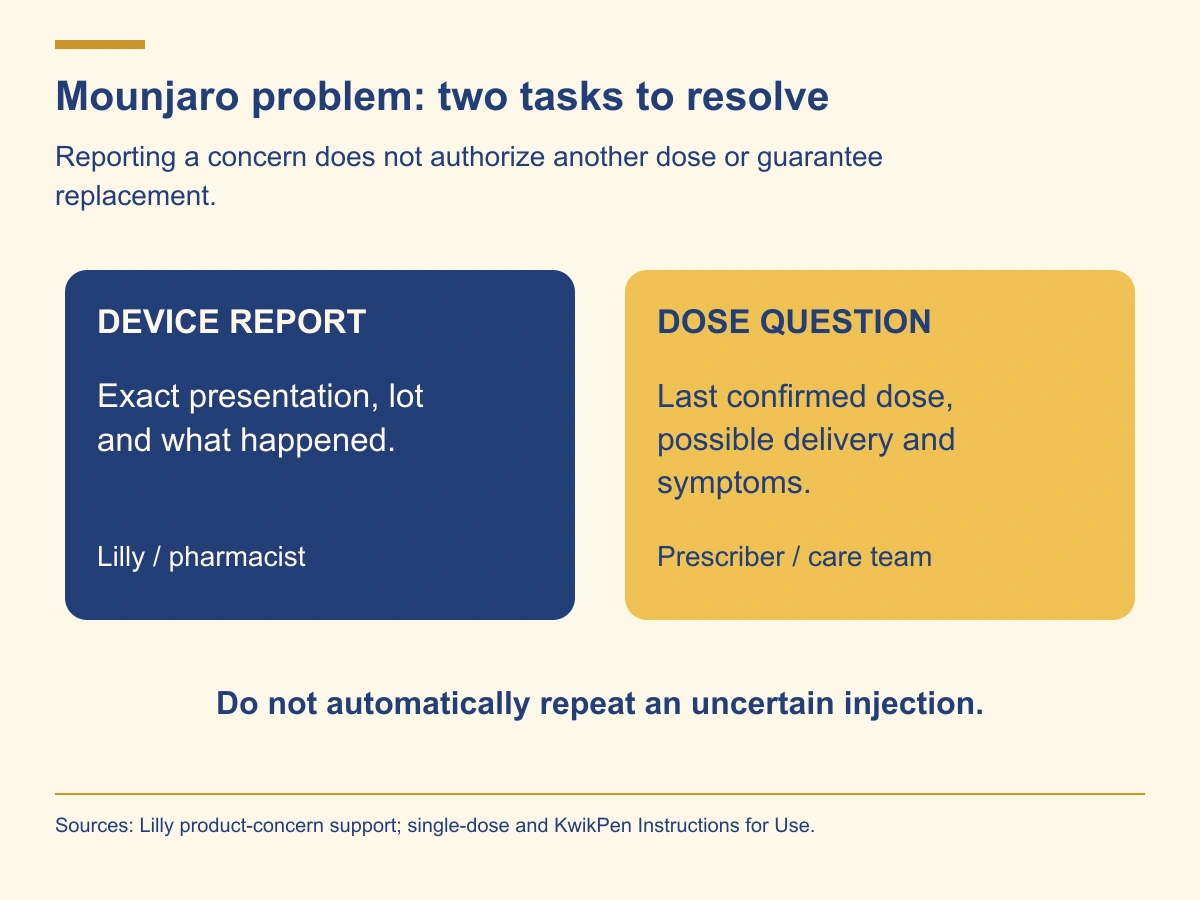
If a Mounjaro pen seems to malfunction, identify the exact device, note what happened, and contact Lilly or your pharmacist for product-specific guidance. If you are unsure how much medicine entered your body, do not automatically repeat the injection. Reporting a device concern and deciding what to do about an uncertain dose are related but separate tasks.
Lilly provides U.S. product-quality and replacement-support channels, but reporting a problem does not guarantee a free replacement or immediate supply. This guide explains what to record, which instructions apply, and how to coordinate with the prescriber while the device concern is reviewed.
First, distinguish a device problem from an urgent health problem
If you have trouble breathing, swelling of the face or throat, collapse, or another severe reaction, seek emergency medical care. Do not wait for a manufacturer report to be processed. Severe persistent abdominal pain, repeated vomiting, or inability to keep fluids down also deserves prompt clinical assessment. Mounjaro safety information
If the concern is limited to the pen’s operation, stop improvising with the device and read the instructions supplied with that presentation. Keep it safely away from children and avoid exposed needles. Do not dismantle it, force a mechanism, or try to draw medicine out with a syringe.
It helps to describe observations rather than conclusions. “The gray plunger was not visible” is more informative than “the dose failed.” “There was liquid on my skin” is more useful than an estimate of how many milligrams were lost. Those details allow support staff to apply the correct instructions.
Which Mounjaro pen do you have?
The current U.S. product information includes different presentations. The single-dose pen and the multidose KwikPen do not have the same operation or completion checks. A video for one can create confusion when used with the other. Mounjaro prescribing information
| Presentation | Distinguishing point | Where to check a concern |
|---|---|---|
| Single-dose pen | A prefilled device used for one weekly injection | The single-dose pen Instructions for Use |
| Mounjaro KwikPen | A single-patient pen containing four fixed weekly doses | The KwikPen Instructions for Use and troubleshooting section |
| Vial presentation | Requires its own prescribed supplies and training | The vial instructions and dispensing pharmacist |
| Product obtained outside the U.S. | Packaging and instructions may differ | The local label and country-specific manufacturer support |
Read the label on the device and carton. Record the country, product name, strength, and presentation before contacting support. If a refill looks different, ask the pharmacist whether the presentation changed and obtain training for the new device.
The Mounjaro injection guide covers routine administration and site questions. This article focuses on what to do when the expected process does not appear to have happened.
Single-dose pen: what the official instructions say
The U.S. single-dose pen instructions describe two main clicks and a visible gray plunger as part of the completion check. They direct users who cannot see the gray plunger to contact Lilly for further instructions and to store the pen safely while avoiding an accidental needle stick. A sound alone should not replace the full device-specific check. Single-dose pen Instructions for Use
Some observations that seem alarming are described in the instructions as normal, including air bubbles and a drop at the needle tip when the base cap is removed. A small drop of liquid or blood on the skin after injection is also addressed. These observations do not provide a way to measure a lost dose by eye.
Other situations have explicit instructions. For example, the manufacturer says not to use a pen dropped on a hard surface because it has glass parts. A frozen pen, damaged device, cloudy medicine, particles, or an inappropriate appearance should not be treated as a minor inconvenience to work around.
Do not apply a generic repair tip from a forum. The correct response depends on what happened and when. If medicine might already have been delivered, tell Lilly and your clinician before deciding about another injection. The distinction between an unused damaged pen and an uncertain completed injection matters.
KwikPen: different checks, different troubleshooting
Mounjaro KwikPen contains four fixed doses and has specific priming, dose-window, and injection-completion instructions. It requires a compatible new pen needle for each injection. The instructions include a sequence for an unsuccessful priming check and directions for difficulty pushing the dose knob. Follow that exact document rather than importing the single-dose pen’s click sequence. KwikPen Instructions for Use
The KwikPen instructions distinguish completing an interrupted injection from starting over. They explicitly caution against restarting or repeating an injection if you still think you did not receive the full dose. If you cannot confidently interpret the dose window or the situation no longer matches the instructions, contact support and the care team.
Remaining medicine after the four doses is not an authorized extra dose. The manufacturer says to discard the pen after those doses, not inject the leftover medicine, and not transfer it to a syringe. A pen that will not dial another full dose may be preventing an incomplete dose rather than malfunctioning.
Do not count clicks to create a different dose, combine leftovers, or share a pen even after changing the needle. The fact that liquid remains visible does not establish a safe quantity or a new dosing schedule.

How to report a Mounjaro product concern in the U.S.
Lilly’s official reporting page offers online support for product quality, usability, appearance, and replacement support. It directs people with side effects, side effects accompanying a product concern, certain third-party reports, or a preference for anonymity to Lilly Support Services at 1-800-545-5979. The page lists agent hours as 9 a.m. to 5 p.m. Eastern, Monday through Friday. Check the current page if those details change. Lilly product-concern reporting
Start through the official page rather than an unverified phone number in a comment or advertisement. Use the country-specific Lilly site for a product obtained outside the United States. Reporting requirements and support arrangements can differ.
Prepare the information Lilly requests: contact details, age, product and dosing information, batch or lot number, the date of the concern, and a description of what happened. If you are reporting a side effect, describe that separately from the device observation.
The page asks whether the device is still in your possession and requests retention for 21 days for quality concerns. Follow safe storage and sharps instructions while obtaining product-specific guidance. Do not retrieve a used device from a sharps container, expose a needle for a photograph, or ship a device without instructions. Safe handling takes priority over collecting an image.
A useful record to have before the call
Write down the following while the details are fresh:
- The name, strength, presentation, lot number, and expiration date from the packaging.
- The date and approximate time of the attempted injection.
- Whether the problem happened before use, during priming, during injection, or afterward.
- What the window, plunger, or dose indicator showed, as applicable to that device.
- Whether medicine may have entered the skin, leaked externally, or remained in the device.
- Any drop, freezing, heat exposure, visible damage, or unexpected appearance.
- Symptoms, glucose readings if relevant, and the last dose you know was completed.
You do not need to diagnose the mechanism yourself. A clear sequence helps the manufacturer investigate and helps the clinician assess the medication question. Keep the report confirmation or case number with your notes.
Lilly says a successful submission produces a confirmation and that follow-up may occur if more information is needed. It also asks people not to call simply to accelerate an existing report. New symptoms or a new concern should be reported as directed, and medical questions should go to the care team. Lilly reporting process
Will Lilly replace a malfunctioning pen?
Lilly advertises replacement support, but its public reporting page does not promise that every concern will receive a free replacement. The outcome can depend on the facts and the applicable process. Ask what happens next, whether information is missing, and whether any approved replacement requires pharmacy coordination.
The pharmacy may need to address the prescription, quantity, refill timing, or an insurance claim. A manufacturer case number does not automatically override those requirements. Ask who will contact whom so you do not assume a replacement is already waiting at the counter.
If your next scheduled dose is approaching, tell your prescriber rather than waiting silently for a product investigation. A supply problem may require a clinical plan before the administrative issue is resolved. The CVS Mounjaro cost and refill guide and general Mounjaro cost guide can help organize pharmacy questions without promising a particular price or stock level.
What about the dose you may have missed?
An uncertain partial dose is not automatically the same as a completely missed dose. Do not estimate an amount from a wet patch or inject another full dose to compensate. Give the clinician the timing, device details, and observations so they can decide what to do.
Mounjaro has specific labeled missed-dose instructions, but those instructions do not solve every uncertain-delivery situation. Repeated gaps, recent dose changes, side effects, and other glucose-lowering medicines may affect the plan. Our guide to every-other-week GLP-1 questions explains why an occasional missed-dose rule is not an ongoing alternative schedule.
If you take insulin or a sulfonylurea, follow your existing glucose-monitoring and low-glucose plan while seeking advice. Do not independently compensate by changing those medicines. If you may have taken too much, obtain prompt professional advice, especially if significant symptoms develop.

FDA reporting and ongoing care
Patients and clinicians can also report medication errors, adverse effects, and product-quality concerns through FDA MedWatch. Reporting helps document safety issues; it does not replace urgent care or provide an individual replacement authorization. FDA MedWatch
For assessment-based treatment questions, CoreAge Rx tirzepatide care explains its service. Confirm the actual preparation and dispensing pharmacy: manufacturer support for branded Mounjaro should not be assumed to cover a different or compounded product.
Frequently asked questions
I heard a click. Does that prove I received the dose?
Use the complete instructions for your exact pen, including its visual completion check. Different devices use different mechanisms. Tell support what you heard and saw rather than relying on the sound alone.
Is a drop of blood proof that medicine leaked out?
No. A small skin drop does not measure delivered medicine. Follow the device’s site-care instructions and seek advice for persistent bleeding, significant swelling, or uncertainty about delivery.
Can I repair a stuck pen myself?
Use only the troubleshooting directions for that presentation. Do not dismantle, force, heat, or extract medicine from the pen. Contact the manufacturer or pharmacist when the instructions do not resolve the issue.
Can I use leftover KwikPen medicine while waiting for a replacement?
No additional dose is authorized by visible leftover liquid. The manufacturer specifically says not to inject leftovers after the four fixed doses or transfer medicine into a syringe.
What is the most important information for my prescriber?
The exact product, last confirmed dose, attempted dose time, what may have been delivered, symptoms, and relevant glucose readings. Those details support a safer decision than simply saying the pen was defective.
Educational information for adults; individual treatment decisions require a qualified clinician. Sources reviewed October 6, 2026. Original AI-generated article images depict fictional people and objects, not patient outcomes. Other editorial images are illustrative. Graphics summarize the cited sources.