
Minoxidil usually requires months of consistent use before its benefit can be judged, but there is no single timeline for every product or person. Men’s and women’s topical labels have different directions and review points, and prescription oral minoxidil involves a separate clinical decision.
The useful question is not simply “How many weeks until more hair?” It is whether the diagnosis, product, application routine, and follow-up plan match. This guide explains early shedding, first signs of regrowth, longer-term assessment, and situations that should be reviewed sooner.
Start with the cause of the hair loss
Minoxidil is used for pattern hair loss, but not every episode of thinning has that cause. Sudden shedding, patchy loss, an inflamed or painful scalp, or uncertainty about the diagnosis warrants assessment rather than automatically starting a long trial of a product.
Topical labels include restrictions based on age, pattern of hair loss, scalp condition, and other circumstances. The men’s foam label reviewed here is intended for specified hair loss on the top of the scalp, not a blanket treatment for every receding hairline or sudden patch. Men’s minoxidil foam label
A dermatologist can help distinguish pattern loss from shedding after illness, nutritional problems, scalp disease, or another cause. If hair loss occurs during weight-management treatment, our GLP-1 hair-loss guide discusses that separate assessment.
What do current topical labels say about timing?
The following examples come from specific 5% foam labels. Follow your own carton and instructions, because a different formulation or prescription may have different directions.
| Product reviewed | Earliest results described | Longer period described |
|---|---|---|
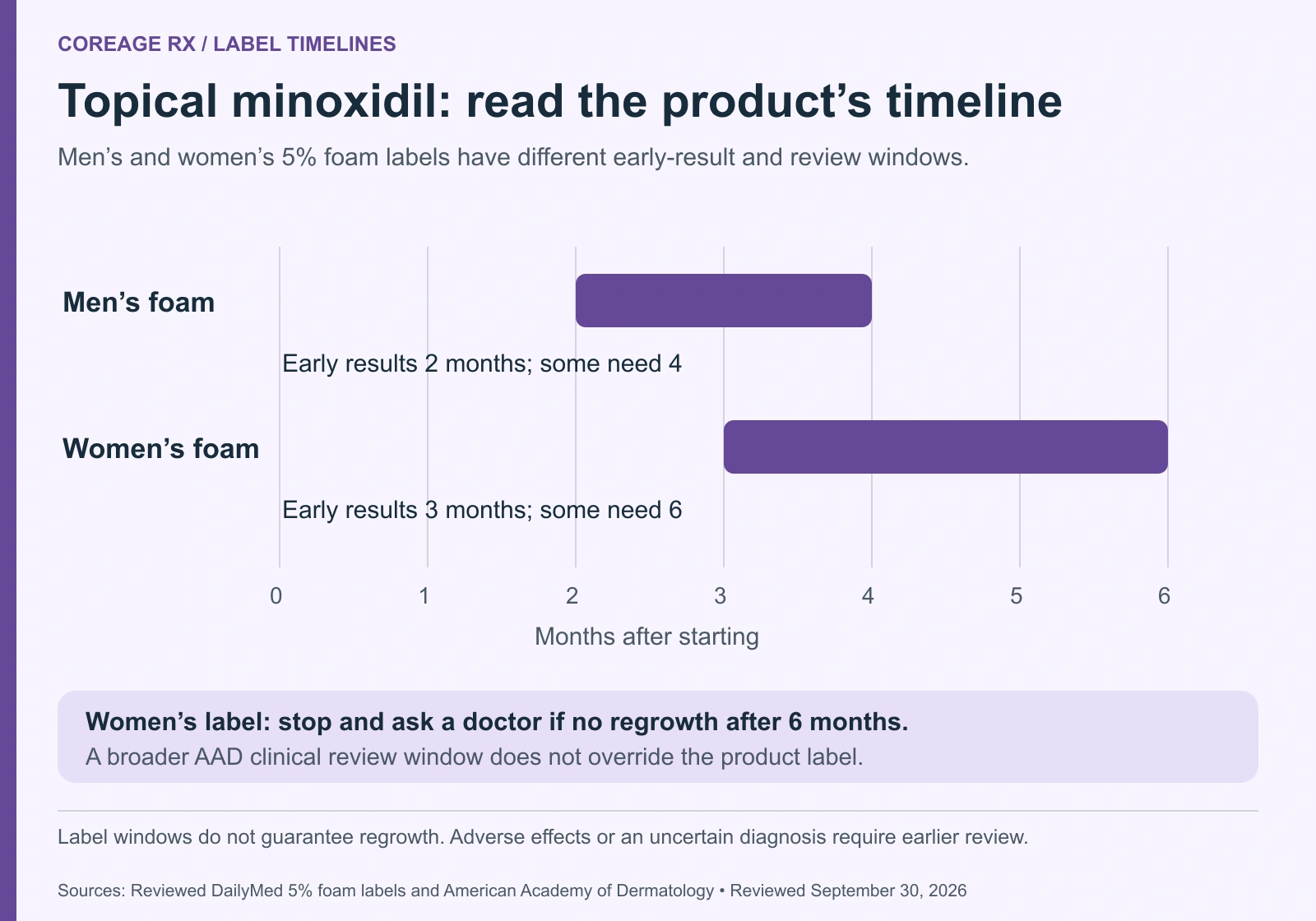
| Men’s 5% foam, used as labeled | Results may appear at two months | Some men may need at least four months to see results |
| Women’s 5% foam, used as labeled | Results may appear at three months | Some women may need at least six months to see results |
Neither label promises that everyone will respond. The women’s label instructs users to stop and ask a doctor if no regrowth is seen in six months. The men’s and women’s products also have different labeled application schedules. Men’s label, women’s label
Do not borrow the more convenient schedule or the longest waiting period from a different product. Confirm what you are using and when its instructions say to seek review.
Why do dermatologists sometimes discuss six to twelve months?
The American Academy of Dermatology describes a longer period, often six to twelve months, for judging how well minoxidil works for pattern hair loss. That is a broader clinical assessment window, not a guarantee of complete regrowth by a deadline. AAD male-pattern guidance, AAD female-pattern guidance
An early visible change and a fair assessment of the overall response are different questions. A few new hairs do not show the eventual result, while an unchanged photograph after a short period does not necessarily establish failure.
The longer clinical window should not override a product label’s instruction to stop and ask a doctor, nor should it delay help for adverse effects. Use the label’s review point to discuss whether continuing, changing treatment, or reconsidering the diagnosis is appropriate.
Can shedding increase when you first start?
Temporary increased shedding can occur. AAD’s female-pattern hair-loss guidance describes a possible increase during the first two to eight weeks of minoxidil use. That information helps set expectations, but it is not a diagnosis for every new shedding episode. AAD discussion of early shedding
Record when it began, how it compares with your previous pattern, and whether there is pain, redness, scaling, or patchy loss. Do not assume that more shedding means a stronger response or that severe ongoing shedding must be endured for treatment to work.
If the change is substantial, prolonged, or accompanied by scalp symptoms, contact the clinician or pharmacist. They may need to review the product, application, diagnosis, other medicines, and recent illness or stressors.
What should you track during the first months?
Choose a simple baseline before starting. Photographs are most useful when the lighting, angle, hairstyle, part location, and hair condition are similar each time. A bright overhead light in one photograph and a soft side light in another can create a misleading impression.
Record the product name, formulation, starting date, and usual application routine. Note missed periods, scalp irritation, major illnesses, and changes in other hair treatments. That context helps the clinician interpret photographs without assuming every difference is a medication effect.
Avoid checking for a meaningful result every day. A planned review at the interval recommended for your product or prescription is more informative than reacting to individual hairs in a shower or on a pillow.

Does using more make results arrive sooner?
The reviewed topical labels state that using more product or applying it more often will not improve results. Extra use can also increase the chance of unwanted effects or transfer to areas where hair growth is not desired. Men’s directions, women’s directions
Follow the amount and frequency for the actual product. Ask about application if the medicine runs onto the face, causes irritation, or is difficult to use consistently. A routine that repeatedly conflicts with your day may need a practical discussion rather than compensating with larger applications.
Do not combine multiple minoxidil products or add another prescription hair treatment without reviewing the complete plan. More active ingredients do not automatically produce a faster or better outcome.
For day-to-day use, see our guide to how to apply minoxidil and handle combing or drying. It explains why foam, solution and other preparations need their own amount, frequency and scalp-care instructions.
What if the scalp becomes irritated?
Redness, itching, scaling, or discomfort can make a routine difficult to maintain and may require stopping the product and seeking advice under its label. AAD advises users with an irritated scalp to stop minoxidil and see a dermatologist. AAD scalp-symptom guidance
The cause could involve the active medicine, the formulation, another scalp product, or a separate skin condition. Switching products repeatedly without identifying the problem can make the pattern harder to interpret.
Our minoxidil side-effects guide explains why route, ingredients, and medical history matter. A treatment timeline is useful only when the treatment remains appropriate and tolerable.
Which symptoms should not wait for a routine hair review?
The women’s foam label instructs users to stop and ask a doctor for chest pain, a rapid heartbeat, faintness or dizziness, sudden unexplained weight gain, swelling of the hands or feet, or scalp irritation and redness. Seek urgent help for severe symptoms. Women’s minoxidil safety instructions
The label also says to ask a doctor before use when there is heart disease. Minoxidil is not automatically harmless because a topical version is available without a prescription.
Pregnancy and breastfeeding require a separate discussion. AAD advises avoiding minoxidil during pregnancy, while planning pregnancy, and during breastfeeding. Do not continue a hair-growth experiment through a change in those circumstances without clinical advice. AAD pregnancy and breastfeeding guidance
Is the oral minoxidil timeline the same?
No. Oral minoxidil for hair loss is an off-label prescription use, and topical package instructions do not establish its dose, suitability, or follow-up schedule.
A 2024 randomized trial compared oral and topical minoxidil in men with androgenetic alopecia over 24 weeks. Ninety participants enrolled and 68 completed the study. Oral treatment did not demonstrate superiority over topical treatment for the trial’s overall primary hair-density comparison, although some photographic findings differed. Original comparative trial
Twenty-four weeks was a research assessment point, not a promise that every oral prescription will produce a result by then. The study also does not establish outcomes for every cause of hair loss, every patient group, or every dose.
Our oral minoxidil evidence review covers the route’s separate evidence and safety questions. Do not switch to tablets simply because topical progress feels slow.
What happens if you stop after improvement?
The topical labels state that continued use is needed to maintain regrowth; stopping can lead to renewed hair loss. That makes the long-term routine and cost part of the decision from the beginning. Men’s label, women’s label
Ask what ongoing use would involve and how to reassess the treatment if your priorities, health, or tolerance change. Improvement does not necessarily mean the underlying tendency to pattern hair loss has disappeared.
If several treatments are being used together, review the role of each before stopping or changing them. Our finasteride side-effects guide discusses a different medicine with different considerations; it should not be treated as an interchangeable substitute.

What if the result remains disappointing?
Bring consistent photographs, the product or prescription, and an honest account of the routine. The review can address several possibilities: an incorrect diagnosis, inconsistent application, insufficient time for the agreed assessment, irritation limiting use, or a genuinely limited response.
Do not assume failure means you should use a stronger preparation or keep adding products. Ask which alternative would address the actual diagnosis and what evidence supports it. Some people may need a different approach; no product restores all hair loss in everyone.
A practical way to use the timeline
Think in review stages: establish the diagnosis and baseline, confirm the correct routine, monitor tolerance, and assess visible change at the product’s stated review point. A clinician can then decide whether a longer observation period or another plan makes sense.
If treatment-related appetite changes or weight loss coincide with shedding, discuss nutrition and the broader medical history as well. The GLP-1 hair-loss article can help prepare that conversation. The best timeline keeps the diagnosis, expected benefit, and safety review together.
Keep scalp symptoms separate from hair growth
- Ketoconazole shampoo and hair-loss questions — Separate labeled scalp or skin uses from limited hair-regrowth research and discuss each treatment goal with a clinician.
Educational information for adults; individual treatment decisions require a qualified clinician. Sources reviewed September 30, 2026. Original AI-generated article images depict fictional people and objects, not patient outcomes. Other editorial images are illustrative. Graphics summarize the cited sources.