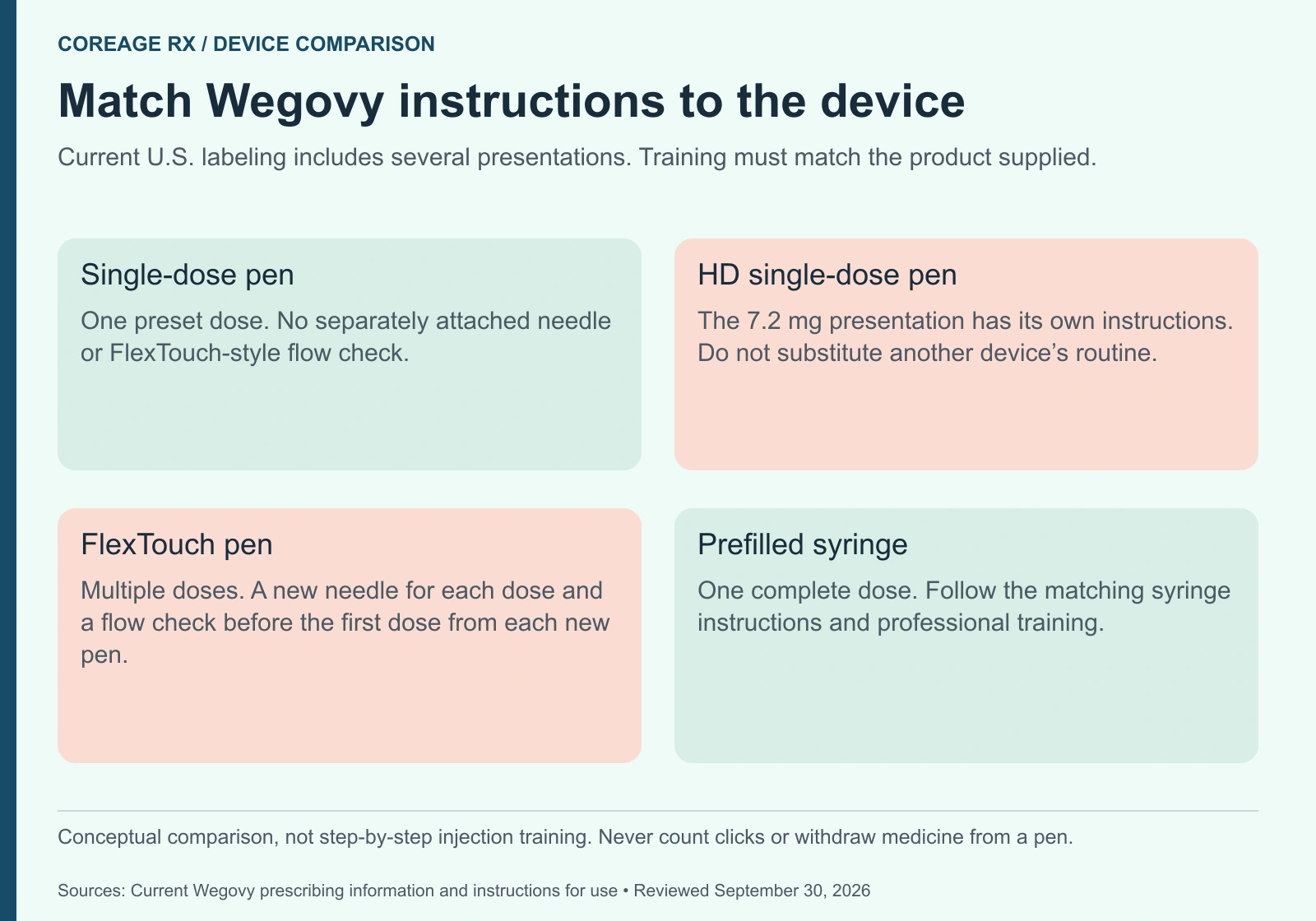
The correct way to inject Wegovy depends on the presentation in your package. Current U.S. labeling includes single-dose pens, a single-dose prefilled syringe, and a four-dose FlexTouch pen. Their needle preparation, dose confirmation, and disposal steps are different.
Before following a video or written tutorial, match it to the exact device and strength you received. This guide explains the major distinctions and common questions using current U.S. labeling checked September 27, 2026. Keep the manufacturer’s Instructions for Use and obtain training for your actual presentation. Wegovy prescribing information and instructions
Which Wegovy injection do you have?
Read the full name on the carton and device. Do not identify a product only by its color, a picture online, or the fact that it contains semaglutide.
| Presentation in current U.S. labeling | What to recognize |
|---|---|
| Single-dose pen | One preset dose; covered needle; device is discarded after use |
| Wegovy HD single-dose pen | A 7.2 mg single-dose presentation with its own labeling and clinical role |
| Single-dose prefilled syringe | One complete dose in a syringe with an integrated needle |
| Wegovy FlexTouch | A single-patient pen containing four 2.4 mg doses; requires compatible disposable needles |
The list describes labeled presentations, not a guarantee that every pharmacy stocks each one. The current FlexTouch contains 9.6 mg in the full pen; that is not the amount for one injection. Wegovy forms and strengths
Wegovy tablets are a separate oral treatment. A compounded semaglutide vial is also a different preparation and should not use borrowed Wegovy device instructions. Our semaglutide dosage guide explains why the product must come before the schedule or measurement.
Where can Wegovy be injected?
Wegovy injection is administered under the skin of the abdomen, thigh, or upper arm, using the regions shown in the matching instructions. The abdominal instructions specify staying at least two inches from the belly button. Rotate the exact spot rather than repeatedly using the same small area. Wegovy administration instructions
A region can be used again without using the identical spot. Choose a position that lets you see and operate the device correctly. For an upper-arm injection, discuss assistance and the instructions for your presentation; the prefilled-syringe instructions specify help from another person for the back of the arm.
Do not inject into a vein or muscle. Avoid an area that is unsuitable under the device’s skin-selection instructions, and ask for advice about persistent redness, swelling, tenderness, or other skin changes.
There is no reason to choose a supposedly “stronger” site to intensify treatment. Technique, comfort, and proper rotation are the relevant questions.
Is the thigh better than the stomach for a Wegovy injection?
The reviewed Wegovy injection label reports similar semaglutide exposure after injection in the abdomen, thigh or upper arm. That pharmacokinetic finding does not establish a site that produces better weight loss or reliably prevents nausea for an individual. Use an approved region under the instructions for your actual presentation, rotate the exact spot, and choose a position that allows correct device use. Ask the treating team about comfort, technique or persistent skin changes instead of switching to a supposedly stronger site. Wegovy prescribing information.
What should you check before every injection?
Wash and dry your hands, identify the prescribed medicine and strength, check the expiration date, and inspect the device and solution. Wegovy injection should be clear and colorless. Do not use a device that fails its instructions’ condition checks or a solution that looks cloudy or contains particles. Wegovy instructions
Have the necessary supplies ready, including skin-cleaning materials and a suitable sharps container. Read the storage instructions before removing the device from its packaging. Do not use a heat source such as a microwave or hot water to warm it.
If the pharmacy has changed the presentation, stop and obtain the matching instructions before proceeding. A familiar ingredient name does not mean the administration sequence is familiar.
Our semaglutide storage and travel guide discusses temperature and transport questions. A product exposed to freezing or uncertain heat needs a pharmacy review, not an experiment to see whether it still works.
How does the single-dose pen sequence work?
The single-dose pen already contains a preset dose and a covered needle. You do not attach a separate needle or turn a dose selector as you would with a FlexTouch pen. Follow the single-dose Instructions for Use for preparing the site and removing the cap. Single-dose pen instructions
The injection begins when the needle cover is pressed firmly against the skin. Maintain pressure while watching the yellow bar. The first click signals the start; the second click occurs while the injection is still in progress. The second click alone does not mean you should lift the pen.
The instructions say to keep applying pressure until the yellow bar stops moving, then lift the pen slowly. Removing the pen early can interrupt delivery. The needle cover locks after removal, so the injection cannot be stopped and restarted later.
Dispose of the used pen promptly in an appropriate sharps container. The manufacturer provides similar completion guidance in the separate Wegovy HD pen instructions; still confirm the exact package and prescribed strength.
Does a Wegovy pen need priming?
There is no single answer for every Wegovy pen. The single-dose pen’s sequence is different from the reusable, single-patient FlexTouch device.
For FlexTouch, the instructions include a flow check with each new pen before its first injection. They also require a new compatible needle for each injection. That does not mean the flow check should automatically be repeated before every later dose from the same pen. Follow the stated troubleshooting exceptions and instructions for the actual device. FlexTouch instructions
Do not use an Ozempic tutorial or a tutorial from another country as proof that your Wegovy device has the same steps. The concentration, dose selector, or available presentations may differ. Ask the pharmacist to show you the correct instructions while you hold the actual box.

What is different about FlexTouch dose completion?
FlexTouch uses a dose counter and dose button. The instructions direct the user to select the prescribed full dose shown by the counter, inject as trained, and keep the dose button pressed until the counter returns to zero. Then continue pressing with the needle in the skin while counting slowly to six before removing it. FlexTouch administration instructions
Do not estimate doses by counting clicks. Do not withdraw medicine from the pen into a syringe. Extra liquid associated with device preparation is not permission to improvise another dose.
Remove and safely discard the needle as instructed after each administration, and store the pen without a needle attached. Never share a FlexTouch pen with another person, even after changing the needle.
If you have vision problems or cannot reliably read and operate the device, arrange appropriate help. The label specifically addresses limitations on self-administration with FlexTouch.
What is different about the prefilled syringe?
The single-dose prefilled syringe contains one complete dose. It is not a vial-and-syringe setup in which you draw up a separately calculated volume. Its instructions include checking the solution and syringe condition, choosing and cleaning the site, and using the specific under-the-skin injection technique taught by the clinician. Prefilled-syringe instructions
The instructions specify pinching a skin fold, inserting at a 45-degree angle, and gently pressing the plunger fully until it stops. Use that sequence only for the matching prefilled syringe and after training; it is not an instruction to hold a pen at the same angle.
The manufacturer says visible air bubbles in this prefilled syringe are normal and should not be removed. Do not push out medicine to imitate another device’s priming process. The needle cap should not be replaced after use; put the syringe into the appropriate sharps container.
What if medicine leaks or you are unsure the dose went in?
A drop, a click, or an uncertain device position cannot tell an online reader how much medicine you received. Keep the device and packaging available and contact the pharmacist, manufacturer, or prescribing team for product-specific advice.
Do not automatically give a second injection. Repeating an uncertain dose can result in too much medication. For the single-dose pen, the instructions advise contacting the healthcare provider or manufacturer if the yellow bar does not move properly or stops during the injection. Wegovy troubleshooting
Describe the exact sequence: which presentation, what you saw, whether the completion indicator appeared, and whether medicine was on the skin. A clear account is more useful than trying to estimate a replacement amount yourself.
Can I take Wegovy injection at night?
The reviewed U.S. Wegovy injection label allows once-weekly administration at any time of day, with or without meals, under the prescribed schedule. Evening use is therefore a scheduling option, not a proven way to improve weight loss or prevent digestive symptoms. Wegovy tablets have separate morning, empty-stomach directions; do not transfer injection timing to tablets. If symptoms are persistent or you want to change the injection day after an interruption, ask for product-specific instructions rather than adding or repeating a dose. Wegovy prescribing information.
When should you take the weekly injection?
Wegovy injection is taken once weekly, with or without meals, under the prescribed schedule. Changing the day, missing doses, or restarting after an interruption requires the current product instructions and sometimes a clinician’s plan. Wegovy schedule
Our Wegovy dosage guide and semaglutide missed-dose guide explain these separate questions. Correct technique does not determine whether a dose should increase, whether treatment should resume at the prior amount, or whether an injection is appropriate during a significant illness.
Contact the prescriber about persistent nausea, vomiting, abdominal pain, or difficulty maintaining fluids, particularly before a planned increase.

How should used devices be discarded?
Place used pens, needles, and syringes into an appropriate sharps container promptly. Follow the device instructions and local disposal requirements. FDA describes the features of suitable containers and advises keeping used sharps out of loose household trash and recycling. FDA sharps guidance
Keep supplies away from children and other people. Do not share devices, reuse needles, or leave used sharps on a counter while planning to dispose of them later.
Should you pinch the skin for a Wegovy injection?
Identify the presentation before following a technique. The U.S. single-dose pen instructions describe pressing the pen firmly against the skin and maintaining pressure until the yellow bar stops moving; a second click alone does not mean the injection has finished. The separately labeled prefilled syringe instructions describe pinching and holding a skin fold and inserting at 45 degrees. Do not transfer the syringe technique or angle to a pen, or assume every Wegovy presentation uses the same steps. Obtain training using the Instructions for Use supplied with your actual device. Wegovy PI.
What should a training visit accomplish?
You should be able to identify the product, demonstrate its preparation and completion steps, explain storage and disposal, and know whom to contact if something goes wrong. Ask for new training when the presentation changes.
If considering CoreAge Rx semaglutide care, first confirm the exact preparation and pharmacy. A compounded product is not a Wegovy device. The right instructions are the ones verified for the medicine and supplies you actually receive.
Educational information for adults; individual treatment decisions require a qualified clinician. Sources reviewed September 30, 2026. Original AI-generated article images depict fictional people and objects, not patient outcomes. Other editorial images are illustrative. Graphics summarize the cited sources.