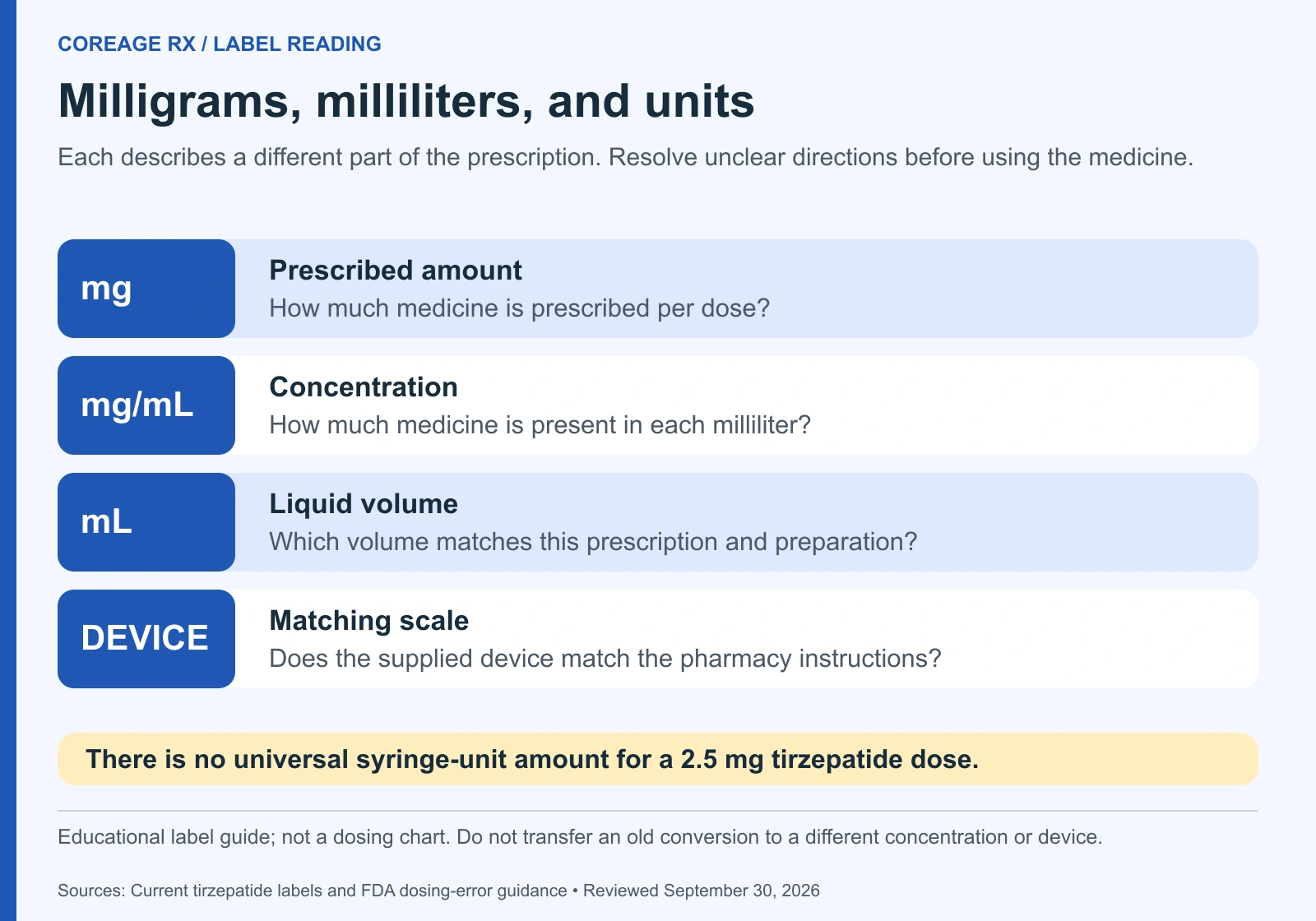
There is no fixed number of syringe units equal to 2.5 mg of tirzepatide. Milligrams describe an amount of medicine. Milliliters describe liquid volume. Syringe markings describe a measurement on a particular device. Connecting them requires the actual product concentration, prescribed dose, and correct syringe or pen instructions.
If you are holding a vial and the directions are unclear, pause and contact the dispensing pharmacist or prescriber before injecting. This guide explains the label terms and the questions that resolve confusion; it does not provide a universal conversion chart for an unidentified preparation.
What do mg, mL, and units mean?
Start by keeping the measurements separate:
| Label term | What it describes | What it does not establish alone |
|---|---|---|
| Milligrams, or mg | Amount of tirzepatide | The liquid volume to draw |
| Milliliters, or mL | Volume of liquid | How much tirzepatide that volume contains |
| Concentration, often mg/mL | Amount of medicine in each milliliter | The prescribed dose for a person |
| Syringe units or markings | A scale on a specified measuring device | A universal milligram amount |
| Total vial or pen contents | Amount or volume in the entire container | The amount for one injection |
FDA has described medication errors involving confusion between milligrams, milliliters, and syringe units in compounded semaglutide use. That alert concerns semaglutide specifically, but its measurement lesson is relevant when reviewing any separately measured injectable preparation: the label and device must agree. FDA dosing-error alert
Tirzepatide and semaglutide are different medicines. A measurement found in an article, video, or message about one should not be reused for the other.
Why can the same milligram dose have a different volume?
Concentration determines how much liquid contains a given amount of medicine. A more concentrated preparation holds more milligrams in each milliliter. Therefore, using the same liquid volume from two different concentrations can deliver different amounts of medication.
Current branded tirzepatide labeling provides a concrete example. Single-dose Mounjaro and Zepbound presentations use 0.5 mL doses, while their multidose presentations use 0.6 mL doses. The label identifies each strength and presentation separately. A 2.5 mg prescription does not, by itself, tell you which of those products or volumes is in your hand. Mounjaro label, Zepbound label
Those labeled examples are not instructions for a compounded vial. A compounded preparation may have another concentration, container, or measuring device. Confirm its own directions rather than borrowing a branded product’s volume.
Is 2.5 mg the same as 2.5 mL or 2.5 units?
No. The repeated number does not make the measurements equivalent. “2.5 mg,” “2.5 mL,” and “2.5 units” describe different things and cannot be substituted for each other.
The same problem applies to questions such as “How many mL is 7.5 mg?” or “How many units is 15 mg?” Without the exact concentration, a dose in milligrams does not determine a volume. Without the appropriate device information, a volume does not establish which marking to use.
If a label uses “cc,” that is a volume measurement equivalent to mL, not a substitute for milligrams. Bring that wording to the pharmacist if different documents use different abbreviations. The aim is one consistent instruction you can explain back accurately.
How many units is 5 mg of tirzepatide?
The milligram amount alone cannot answer that question. Syringe units describe a volume scale, while milligrams describe the medicine amount; the identified preparation and its concentration are needed to connect them. Have the dispensing pharmacist confirm the exact vial, prescribed amount and syringe marking together. Do not use a conversion for another concentration or withdraw medicine from a pen based on this question.
What does U-100 mean on a syringe?
A U-100 insulin syringe has a scale designed for U-100 insulin. When such a syringe is specifically supplied for measuring another prescribed liquid, its markings are being used as a volume reference. They do not turn tirzepatide into insulin or define tirzepatide’s activity in insulin units.
FDA’s semaglutide alert describes errors in which patients confused a small intended marking with a much larger one. In one example, 5 marked units represented 0.05 mL on the specified syringe, but patients drew 50 units instead. These are reported error examples, not instructions for your dose. FDA measurement-error examples
Syringes can differ in total capacity and the spacing or value of their markings. Ask the dispensing team to identify the correct syringe and the exact line for the prescribed volume. A photograph of another person’s syringe is not enough.
Does the amount on the front of the box equal one dose?
Not always. A single-dose presentation and a container holding several doses can display similar-looking numbers while describing different quantities.
For example, current tirzepatide labels distinguish single-dose pens and vials from multidose vials and four-dose KwikPens. The amount in the whole multidose container is not the same as the amount intended for each weekly injection. The KwikPen also contains extra volume for device priming; that does not authorize an additional dose. Mounjaro presentations, Zepbound presentations
Read the package’s full name, strength, concentration, total volume, and directions together. If the pharmacy changes the presentation at a refill, ask for new training even if the active ingredient and prescribed milligrams remain the same.
Our Mounjaro dosage guide and Zepbound dosage guide explain the prescribed schedules separately from the measurement question.

How many syringe units is 7.5 mg of tirzepatide?
There is no universal unit amount for 7.5 mg. Milligrams describe drug amount, milliliters describe liquid volume, and syringe markings depend on the actual supply and instrument. Current manufacturer single-dose and multidose presentations have different dose volumes, and a compounded vial needs its own concentration and written instructions. Have the pharmacist verify the exact product, concentration, prescribed amount, volume and syringe before injecting. Do not use a chart from another vial or transfer medicine from a pen to improvise a measurement. Mounjaro U.S. prescribing information. Zepbound U.S. prescribing information.
What information should the pharmacy confirm?
Use a short checklist during the call or consultation:
- The medicine’s full name and whether the preparation contains additional ingredients.
- The concentration exactly as printed, including both the number and unit.
- The prescribed amount for one administration, stated in milligrams.
- The corresponding liquid volume, when you are expected to measure from a vial.
- The correct syringe size and exact marking, demonstrated with the supplied equipment.
- The administration schedule, storage directions, and applicable discard dates.
Ask the pharmacist to reconcile any mismatch between the prescription, vial label, portal message, and printed handout. Do not choose whichever number looks most familiar. FDA encourages clinicians and compounders to provide suitable syringes and instruction because different concentrations and oversized syringes can contribute to errors. FDA dosing-error guidance
A useful final step is teach-back: explain the plan in your own words while the professional checks it. That can reveal a misunderstanding before medicine is administered.
What if the concentration changes at a refill?
An old syringe marking may no longer represent the same milligram dose. Treat a new concentration, vial size, or device as a reason to confirm directions before using the refill.
Keep the new packaging and compare it with the current prescription. Do not transfer old labels to a new vial or rely on a saved screenshot from an earlier order. If a portal message and the new bottle disagree, ask which instruction applies and obtain a corrected, consistent set of directions.
Our tirzepatide pharmacy guide discusses identity, labeling, shipping, and access to pharmacy support. A service should be able to explain the exact preparation it arranged, not leave you to reconstruct it from social media.
Should you use a conversion calculator?
A calculator can perform arithmetic, but it cannot verify that the entered concentration is correct, distinguish total vial contents from concentration, identify a mismatched syringe, or decide the prescribed dose. A mathematically correct answer based on the wrong label value is still the wrong instruction.
For that reason, do not use an online result as the final authority when your actual directions are unclear. Have the dispensing professional confirm the measurement using the actual label and supplies. This is particularly important when decimals, multiple ingredients, or several numbers appear on the package.
Do not calculate a larger dose because hunger persists or because someone else’s prescription uses a different marking. The tirzepatide plateau guide explains why treatment response needs a broader review.
Can you draw medicine out of a pen into a syringe?
Do not improvise a vial-style measurement from a pen. A pen has its own administration and priming instructions. The tirzepatide KwikPen instructions warn against transferring its medicine into a syringe and against treating leftover medicine as another dose. Current Mounjaro instructions, current Zepbound instructions
Use the device exactly as taught for your presentation. If it appears damaged, fails to operate, or leaves you uncertain whether the full dose was given, contact the pharmacist, manufacturer, or prescriber. Do not automatically repeat an injection to compensate for an uncertain one.
For body-region and rotation questions, see the Mounjaro injection-site guide or Zepbound injection-site guide.

What if you may have injected the wrong amount?
Contact the prescribing team or a poison-control service promptly for advice rather than waiting for symptoms to appear. In the United States, Poison Help is available at 1-800-222-1222. Call emergency services for severe symptoms such as collapse, breathing difficulty, severe persistent pain, or serious dehydration.
Have the product name, label, concentration, syringe or device, intended amount, estimated amount administered, and time of injection ready. Keep the packaging. Do not take an additional dose or try to correct the mistake with another medicine on your own.
FDA has received reports of adverse events with unapproved GLP-1 preparations, including concerns about incorrect doses and escalation schedules. Its detailed semaglutide error alert reports some cases requiring hospitalization. Those reports are a reason to seek specific advice, not a way to predict how any one person will respond. FDA GLP-1 concerns, FDA error alert
What should you expect from a treatment service?
Clear directions should identify the product, prescribed amount, appropriate supplies, and a way to obtain help. If considering CoreAge Rx tirzepatide care, ask the same questions about the exact preparation, dispensing pharmacy, and training.
Compounded products are not FDA-approved generic versions of Mounjaro or Zepbound. Our compounded GLP-1 guide explains that distinction. The correct measurement comes from your verified prescription and product instructions, not from the ingredient name alone.
Educational information for adults; individual treatment decisions require a qualified clinician. Sources reviewed September 30, 2026. Original AI-generated article images depict fictional people and objects, not patient outcomes. Other editorial images are illustrative. Graphics summarize the cited sources.