
Choosing a tirzepatide compounding pharmacy requires more than comparing prices or star ratings. Start by asking whether a compounded medicine is appropriate for your medical needs, then verify the prescription, pharmacy identity, product details, and access to professional advice. No online ranking can perform those checks for your individual prescription.
Compounded tirzepatide is not FDA-approved Zepbound or Mounjaro, and it is not an FDA-approved generic. FDA states that compounded drugs should be used for patients whose medical needs cannot be met by an approved drug. FDA compounding questions and answers
First ask why compounding is being proposed
A qualified clinician should explain the clinical reason for the proposed treatment. A compounded drug may address a specific patient need when an approved medicine is not medically appropriate, but a website’s broad promise of customization is not that explanation.
Ask which approved options were considered, what need the proposed preparation addresses, and how its uncertainties will be discussed. The answer should be specific enough that you understand what is being prescribed and why.
Our compounded GLP-1 medication guide explains the distinction between a compounded preparation and an approved product. If your goal is to compare the approved tirzepatide brands, start with Zepbound versus Mounjaro.
Identify the actual dispensing pharmacy
The telehealth website, clinical practice, payment processor, and dispensing pharmacy may be different organizations. Knowing the name of the platform does not establish who made or dispensed your medicine.
Before treatment, request the pharmacy’s legal name, physical address, telephone number, and the information needed to verify its license. When medication arrives, compare those details with the label. If a name or address does not match, contact the pharmacy using independently verified information.
FDA has reported fraudulent compounded semaglutide and tirzepatide labels that name nonexistent pharmacies or real pharmacies that did not make the product. A familiar name printed on a vial is therefore not sufficient authentication. FDA GLP-1 safety concerns
Do not post an unredacted prescription label publicly to ask strangers whether it looks genuine. It can contain personal information. The dispensing pharmacist and prescribing team are better starting points for a product-specific question.
Verify licensing through official resources
Use state board of pharmacy resources to check the exact pharmacy and address. FDA’s BeSafeRx site links to state licensing resources. Confirm the relevant authority to dispense to patients in your state, rather than assuming a license in one jurisdiction answers every question. FDA pharmacy-license resource
FDA advises consumers to look for an online pharmacy that requires a valid prescription, provides a U.S. physical address and telephone number, has a licensed pharmacist available, and is licensed through the appropriate state board. These are baseline checks, not a guarantee that every supplied product is appropriate or free from risk. FDA online-pharmacy guidance
A business registration, attractive website, social-media following, or third-party badge does not replace a pharmacy-license check. If the service will not identify the dispensing pharmacy or provide a way to speak with a pharmacist, resolve that issue before proceeding.
What do 503A and 503B mean?
These terms refer to different federal compounding frameworks. They do not mean that a compounded medicine has FDA approval.
| Term | Oversight distinction described by FDA | What patients should avoid assuming |
|---|---|---|
| State-licensed pharmacy operating under 503A conditions | State boards generally have primary day-to-day oversight; FDA can also inspect | State licensing proves every product is equivalent to an approved brand |
| Registered outsourcing facility under 503B | Primarily overseen by FDA, with risk-based inspections and current good manufacturing practice requirements | Registration is product approval or a guarantee of a clean inspection history |
| FDA-approved medicine | FDA evaluates the drug through its approval process | A different compounded formulation inherits that approval |
The applicable requirements depend on the setting and whether statutory conditions are met. FDA explains that products compounded in accordance with 503A conditions are exempt from current good manufacturing practice requirements, while outsourcing facilities are subject to them. Other quality and sanitary requirements still matter. FDA compounding questions and answers
If a supplier claims 503B registration, consult the current FDA outsourcing-facility list and the associated inspection information. Read what an entry means: an inspection observation is not itself a final agency determination, and the table does not include every state board action. FDA registered outsourcing facilities

Ask about quality without treating a certificate as a guarantee
Reasonable questions include who compounds the preparation, what testing applies, how the pharmacy tracks lots, and how recalls or quality complaints are handled. Ask the pharmacist to explain any testing document in relation to the exact product and lot being dispensed.
A certificate concerning an ingredient is not automatically a test of the finished sterile preparation. Likewise, a report presented by a marketing platform may not answer questions about storage, shipping, or the vial in your hand. FDA describes contamination and incorrect amounts of active ingredient among the risks of poor compounding practices. FDA compounding questions and answers
Patients are not expected to perform a laboratory audit. The practical aim is to obtain clear, verifiable information and professional accountability, and to recognize when a sales claim goes beyond what the documentation establishes.
Confirm ingredients, concentration, and measurement
Ask for the complete active-ingredient list, concentration, prescribed amount, route, and supplies. If another ingredient is included, ask why it is needed and what evidence supports the combination for you.
Three units often become confused:
- Milligrams: an amount of drug.
- Milliliters: a volume of liquid.
- Syringe units: markings on a particular syringe, which require the correct concentration and device context.
The same syringe marking can represent a different amount of drug when the concentration changes. A familiar-looking refill is not a reason to reuse an old conversion from memory.
FDA has received reports involving compounded GLP-1 dosing errors and doses beyond approved labeling. Ask the prescriber or pharmacist to show how the prescription, vial concentration, and supplied syringe correspond. Do not substitute an online “units chart” for that explanation. FDA GLP-1 safety concerns
Our tirzepatide questions guide and compounded tirzepatide side-effects article provide further context. They cannot calculate a safe instruction from incomplete label information.
Check shipping, storage, and the first-use date
Ask how the medicine should arrive, what storage conditions apply, and what to do if delivery is delayed. Keep the packaging and contact the pharmacy about an unexpected temperature, damaged container, missing instructions, or a mismatch between the order and the label.
FDA currently recommends not using an injectable GLP-1 product that arrives warm or with insufficient refrigeration. This shipping concern should not be confused with the approved in-use room-temperature allowance for a specific branded device. FDA GLP-1 safety concerns
For compounded GLP-1 multidose vials, FDA also currently recommends discarding the vial within 28 days of first use, even if medication remains or the compounder’s instructions allow longer. Record the first-use date, use a new sterile needle and syringe for each dose, and ask the pharmacy to resolve any conflicting directions. FDA GLP-1 safety concerns
An unopened beyond-use date and a first-use limit answer different questions. A large vial or prepaid supply should not pressure you to use a preparation past the applicable limit.
What clinical support should be available?
Confirm how to contact both the prescriber and pharmacist. The prescriber handles clinical suitability, treatment changes, and symptom evaluation; the pharmacist can clarify the dispensed preparation and its instructions. In practice, some concerns require both.
Ask what happens after a concentration change, a missed dose, persistent vomiting or diarrhea, or a possible measurement error. Know how urgent concerns are directed outside routine messaging. Severe symptoms require medical care rather than waiting for a customer-service reply.
If reviewing CoreAge Rx’s tirzepatide service, use these same questions. A provider’s own product page should be the beginning of a discussion about the actual prescription, pharmacy, and follow-up plan.

Compare the full cost and refill terms
Request an itemized explanation of medication, consultations, supplies, shipping, testing, and any recurring membership charge. Ask whether the quote changes with the prescribed preparation or dose and whether an advertised monthly price requires prepayment.
Also clarify cancellation deadlines and what happens once a prescription has been sent for fulfillment. A lower monthly equivalent can involve a larger upfront commitment. Our TrimRx alternatives comparison shows how different pricing structures can make headline comparisons misleading.
Avoid choosing a larger supply solely for its price if the storage and first-use limits do not fit the prescribed schedule. The financial quote should be consistent with how the medication is actually intended to be used.
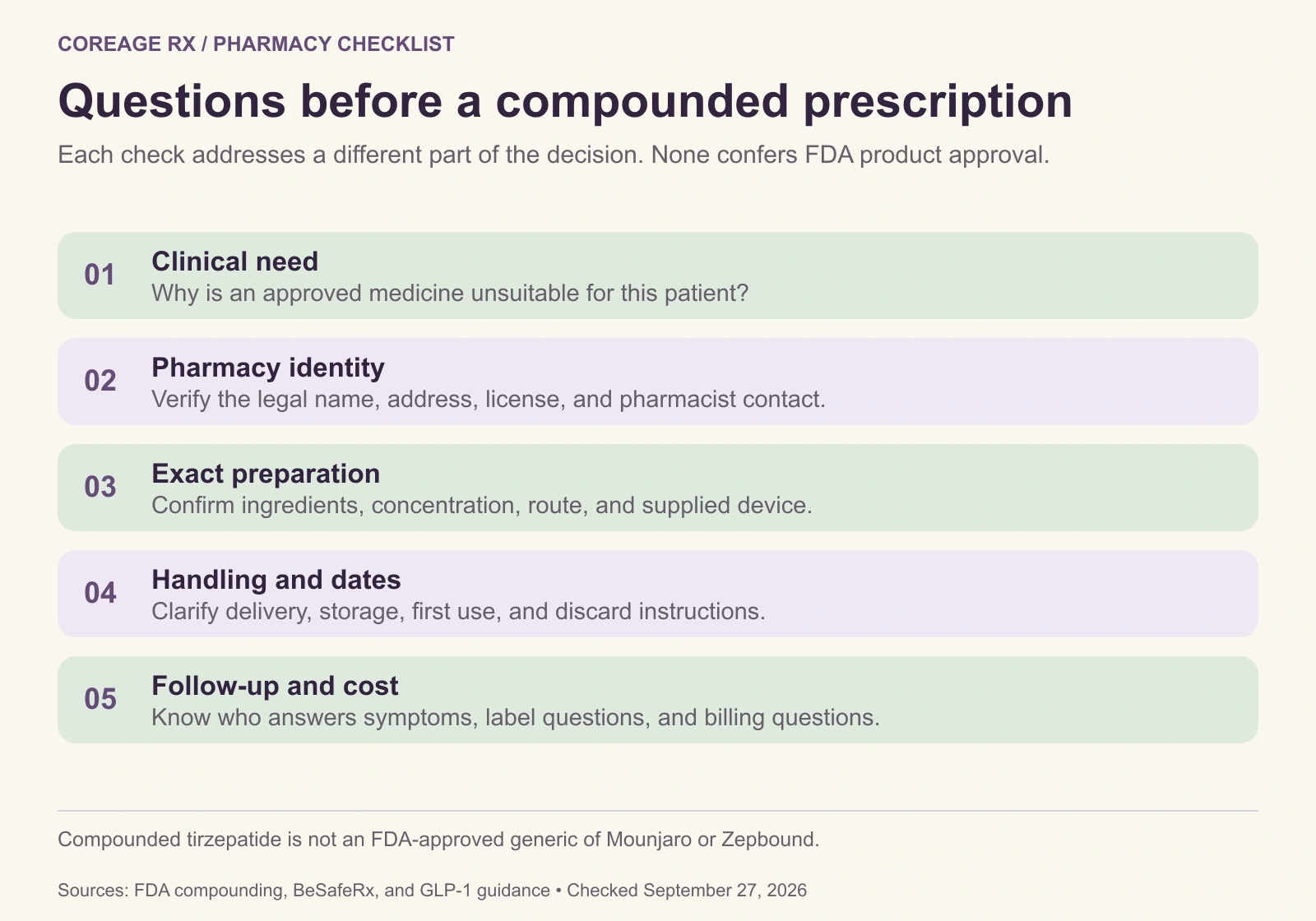
A concise checklist before proceeding
You should be able to identify the clinical reason for compounding, the prescriber, the licensed pharmacy, the exact preparation, and the full recurring cost. You should also understand measurement, storage, first-use limits, and how to get help.
If an answer is vague, ask a focused follow-up: “Which pharmacy will dispense this prescription?” or “Please show me how the concentration matches my supplied syringe.” Those questions are more useful than asking whether a provider is simply “the best.”
A pharmacy ranking can become outdated and may rely on incomplete information. A careful, current review of the particular prescription gives you a firmer basis for discussing treatment with a qualified clinician.
Educational information for adults; individual treatment decisions require a qualified clinician. Sources checked September 27, 2026. Original AI-generated article illustrations depict fictional people and objects, not patient outcomes. Other editorial images are illustrative. Graphics summarize the cited sources.