
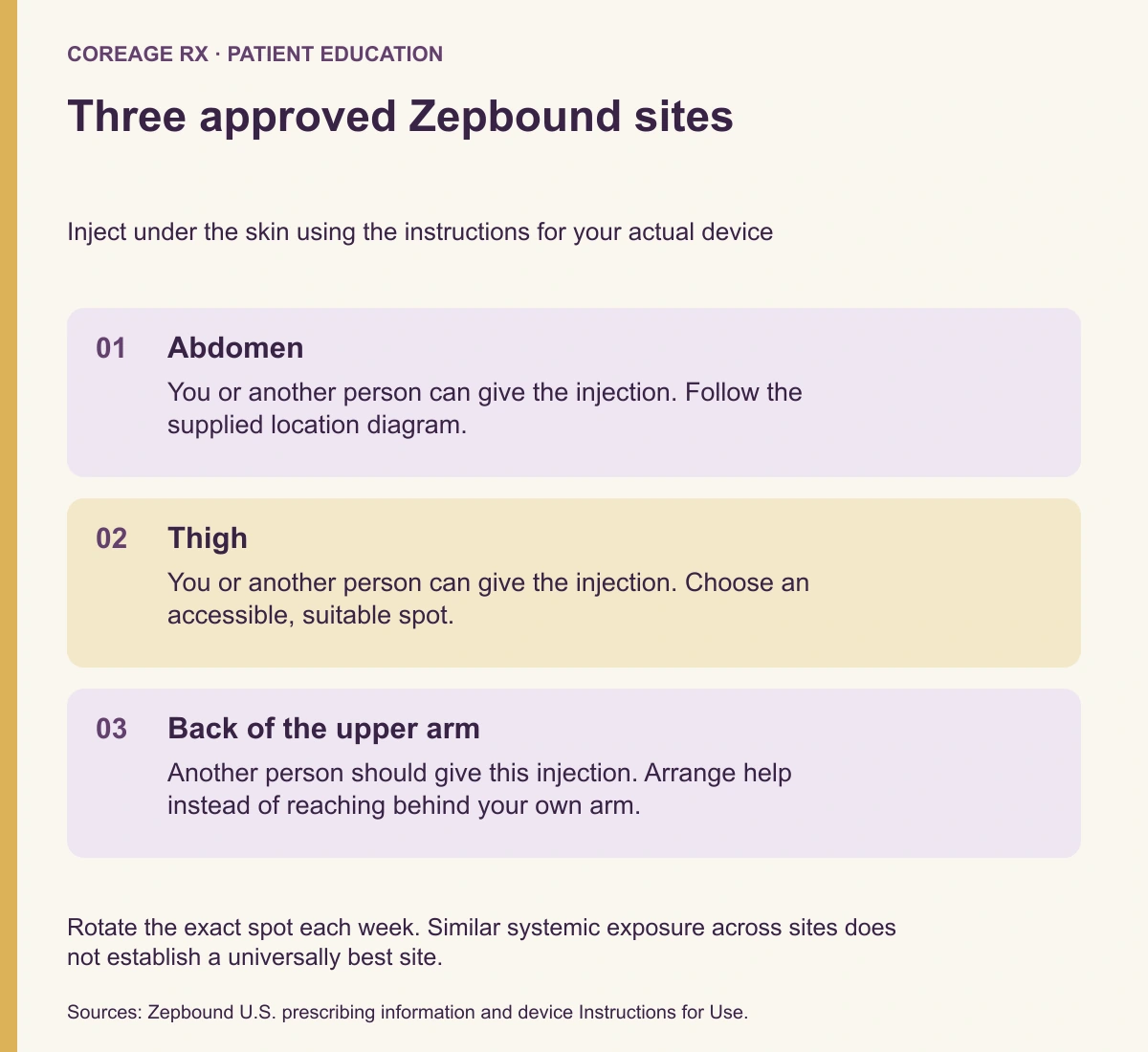
Zepbound is injected under the skin of the abdomen, thigh, or back of the upper arm. The upper-arm injection should be given by another person. Rotate the injection location each week and follow the instructions supplied with your particular device.
There is no established “best” body site that reliably produces more weight loss or fewer digestive side effects for everyone. The more useful choice is an approved site you can reach and use correctly, with appropriate skin and a clear understanding of the device in your hand.
Where can Zepbound be injected?
The current Zepbound prescribing information identifies three subcutaneous sites. Subcutaneous means into the tissue beneath the skin, rather than into a muscle or vein.
| Approved area | Who can give the injection? | Practical point |
|---|---|---|
| Abdomen | You or another person | Use the area described in your device instructions and change the exact spot each week |
| Thigh | You or another person | Choose a position that lets you see and reach the site comfortably |
| Back of the upper arm | Another person | Arrange help rather than trying to reach the back of your own arm |
The KwikPen instructions specify an abdominal location at least two inches from the belly button. Check the diagram and wording supplied with your own presentation rather than applying a cropped social-media diagram to every pen or vial. Source: Zepbound KwikPen Instructions for Use.
Ask a clinician or pharmacist to demonstrate the site selection if you are uncertain. Reading an overview can help prepare questions, but it does not confirm that a particular spot or technique is correct for you.
Is the stomach more effective than the thigh?
The prescribing information reports similar systemic exposure after injection in the abdomen, thigh, or upper arm. Systemic exposure describes how much medicine reaches the circulation over time; it is not a promise that every injection will feel identical.
That evidence does not support ranking the approved sites as universally best for weight loss. Nor does it establish that switching to the thigh will reliably eliminate nausea. A person’s symptoms can vary alongside dose changes, meals, other medicines, illness, and the course of treatment.
If symptoms are the reason you want to switch sites, tell the care team what happened and when. Our Zepbound side-effects guide and GLP-1 nausea-duration guide cover related questions. A new injection site should not be used to postpone assessment of severe symptoms.
How should you rotate injection sites?
Choose a different exact injection location each week. The single-dose pen instructions allow use of the same general body area as long as the spot within that area changes. You do not need to invent a rigid abdomen-thigh-arm cycle to follow the rotation instruction.
A simple note can help: record the date, general area, and approximate spot. The purpose is to avoid repeatedly using the same location, not to calculate a site that supposedly increases the dose’s effect.
Check the skin-selection directions in the supplied instructions and ask about any area that is sore, damaged, inflamed, or otherwise unsuitable. If another injectable medicine is part of your care, have the clinician explain how to keep its injection site separate. Do not mix medicines together or combine injections into one syringe without explicit product-specific instructions.
First identify which Zepbound presentation you have
Zepbound instructions are not identical across presentations. A single-dose auto-injector, a four-dose KwikPen, and a vial require different handling. Looking only at the brand name is not enough.
| Presentation | Important distinction |
|---|---|
| Single-dose pen | One injection per device, with an integrated hidden needle |
| KwikPen | One person’s pen containing four fixed weekly doses; a compatible new pen needle is attached for each injection |
| Vial presentation | Requires the correct syringe, needle, and presentation-specific instructions from the dispensing team |
Read the full label on the carton and the Instructions for Use before the first injection. If a refill arrives in a different presentation, arrange fresh instruction. Familiarity with one device does not automatically teach you the other.
The Zepbound versus Mounjaro guide explains the branded treatment distinction. Even when products share tirzepatide as an ingredient, you should use the actual instructions supplied with the prescribed product.
What is different about the single-dose pen?
The single-dose pen has a gray base cap, a lock mechanism, a clear base, and a purple injection button. Its instructions describe placing the base against the skin, unlocking the pen, and holding the button for up to ten seconds. The first click signals the start; the second click and a visible gray plunger help confirm completion.
This summary is not a replacement for the manufacturer’s illustrated steps. In particular, do not unlock or remove the cap at an inappropriate point, or use the device after conditions that the instructions say make it unsuitable. Check the medicine, strength, expiration, and appearance first. Source: single-dose pen Instructions for Use.
The instructions say warming the pen to room temperature is not necessary. Do not heat it to make the injection feel different. Follow the storage rules and ask the pharmacist if freezing, excessive heat, damage, or a questionable appearance may have affected the product.

What is different about the KwikPen?
The KwikPen contains four fixed weekly doses and is for one patient. Compatible pen needles are not included in the package. A new needle is used for each injection, and the device is primed before each weekly dose according to the manufacturer’s instructions.
Its injection routine includes a five-second hold. That is different from the single-dose pen’s instructions. Do not count clicks to create a smaller dose, reuse another patient’s pen, or transfer a device routine from a different medicine. Source: KwikPen Instructions for Use.
Remove and safely discard the needle after use as directed; do not store the pen with the needle attached. Discard the pen after four weekly doses or 30 days after first use, whichever comes first. Remaining liquid is not an extra dose to withdraw with a syringe.
What needle size do I need?
For the single-dose pen, the needle is integrated into the device. It is not a separate needle you choose at the pharmacy. For KwikPen, ask the pharmacist to confirm a compatible pen needle and demonstrate attachment and removal.
For a vial, the syringe and needle must match the actual product and prescribed administration instructions. Do not use a general online needle-size recommendation as a substitute for that confirmation. A syringe marking, a volume in milliliters, and a drug amount in milligrams are different measurements.
This distinction matters particularly when a person moves between branded and compounded preparations. A compounded vial may have a different concentration and instructions. The compounded GLP-1 guide explains why the brand’s device directions are not a universal conversion guide.
What if the injection hurts or leaves a small drop?
For a skin change, our guide to Zepbound rash and injection-reaction questions distinguishes local observations from serious-allergy symptoms, reviews what to report and explains why photos and trial percentages cannot diagnose a rash.
Some discomfort can occur, and no approved site is guaranteed to be painless. Ask the care team to review technique if pain is recurring or makes you reluctant to take treatment. A difficult injection is a reason to get instruction, not to improvise a new depth or location.
The single-dose pen instructions note that a small drop of liquid or blood may appear. They advise gentle pressure with gauze or cotton rather than rubbing. This observation alone does not tell you to repeat the dose.
Report a substantial or worsening local reaction. Seek urgent help for trouble breathing, swelling of the face or throat, fainting, or other signs of a serious allergic reaction. A local injection question and a systemic reaction require different responses.
What if I am unsure the dose went in?
Check the completion indicators described for the exact device. With the single-dose pen, the gray plunger is an important indicator. If it is not visible or you remain uncertain, the manufacturer’s instructions direct you to seek help rather than assume the injection was complete.
Do not immediately give another full dose, attempt to recover medicine from a used device, or combine leftover liquid. Contact the pharmacist, prescriber, or manufacturer with the product name, device, strength, time of use, and what you observed. Keep the device safely away from others if it is needed to answer a product question.
An uncertain injection is different from forgetting a scheduled dose. Our Zepbound dosage guide discusses the labeled schedule, but an incomplete or malfunctioning device needs its own assessment.

Build a routine you can follow
Before each dose, confirm the correct medicine, strength, device, storage condition, and injection day. Have the required supplies and sharps-disposal plan ready. Arrange a helper if you intend to use the upper arm.
The tirzepatide questions guide connects dosing, side effects, and follow-up topics. If you are considering CoreAge Rx’s tirzepatide care information, confirm the actual preparation and pharmacy instructions rather than assuming it uses the same device as branded Zepbound.
Frequently asked questions
Can I inject into the same thigh every week?
The instructions allow the same general area with a different spot each week. Review the supplied site diagram and avoid repeatedly using one exact location.
Can I inject the back of my own upper arm?
The label instructs another person to give an upper-arm injection. Use an approved site you can manage correctly or arrange appropriate help.
Does changing sites justify changing the dose?
No. Site selection does not create a new prescribing plan. Discuss dose changes with the clinician and follow the prescribed schedule and device instructions.
Educational information for adults; individual treatment decisions require a qualified clinician. Sources checked September 27, 2026. Original AI-generated article illustrations depict fictional people and objects, not patient outcomes. Other editorial images are illustrative. Graphics summarize the cited sources.