
Wegovy injection commonly causes digestive side effects, including nausea, diarrhea, vomiting, constipation, and abdominal discomfort. The frequency depends on the study, dose, and population. Its current U.S. label also includes important warnings and separate safety data for the 7.2 mg injection and oral tablets.
The useful distinction is between symptoms to discuss during follow-up and warning signs needing prompt assessment. A side effect is not evidence that weight treatment is working better, and severe symptoms should not be dismissed as an unavoidable part of reaching a target dose.
What were the common effects with 2.4 mg injections?
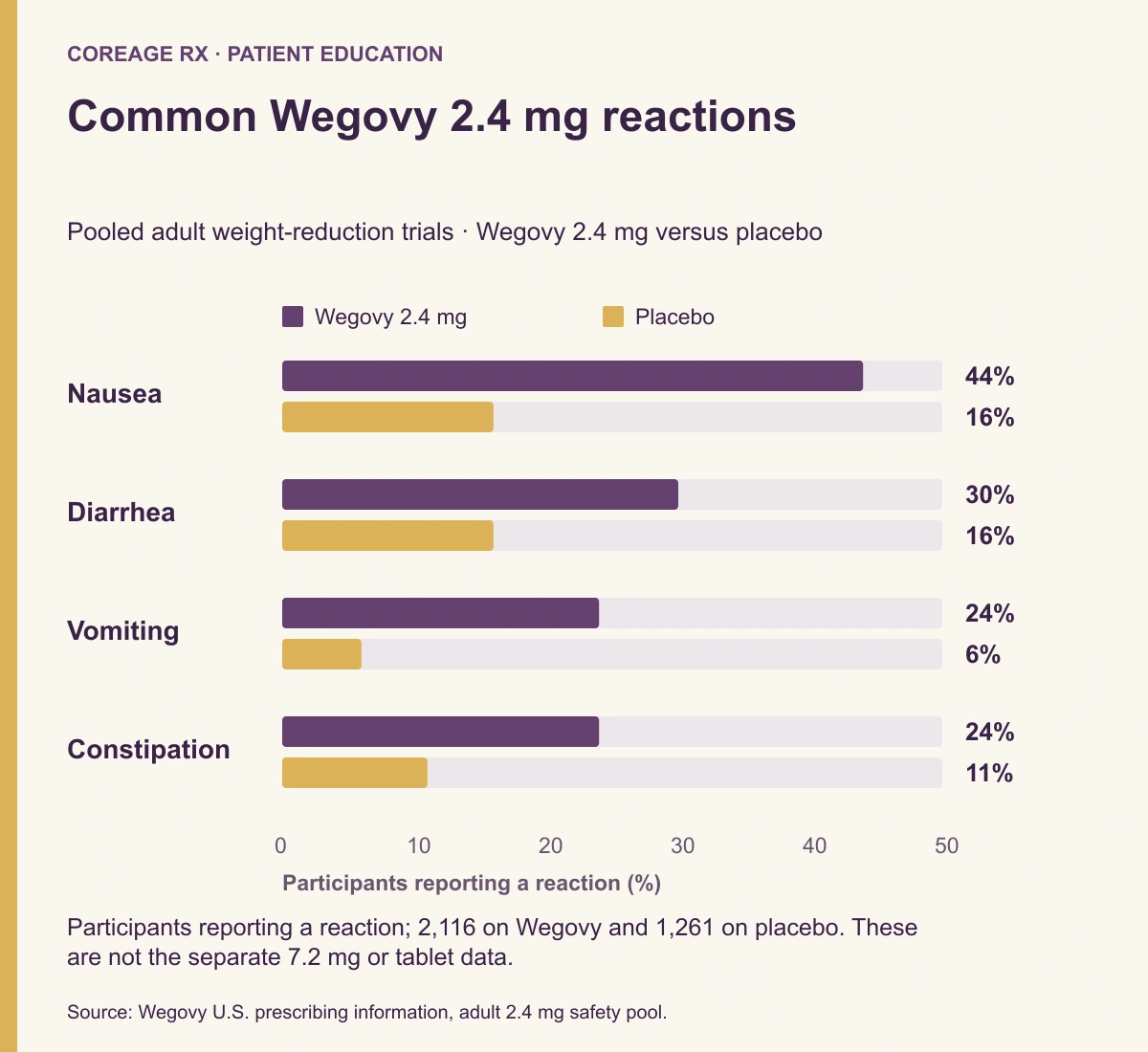
The current Wegovy prescribing information reports a pooled analysis of three adult weight-reduction trials involving 2,116 people receiving Wegovy 2.4 mg and 1,261 receiving placebo. Treatment lasted up to 68 weeks, followed by a seven-week off-drug follow-up.
| Reported adverse reaction | Wegovy 2.4 mg | Placebo |
|---|---|---|
| Nausea | 44% | 16% |
| Diarrhea | 30% | 16% |
| Vomiting | 24% | 6% |
| Constipation | 24% | 11% |
| Abdominal pain | 20% | 10% |
| Headache | 14% | 10% |
| Fatigue | 11% | 5% |
These are proportions of participants reporting reactions in that trial pool. They do not describe how many days a symptom lasted or predict the exact experience of someone starting treatment today. The figures should not be assigned to every Wegovy dose, formulation, age group, or indication.
In the same trials, 6.8% of Wegovy participants and 3.2% of placebo participants permanently stopped treatment because of adverse reactions. That is another reminder that tolerability is part of the treatment decision, not a problem everyone can necessarily overcome by waiting.
The current 7.2 mg data need their own context
Wegovy’s label now contains separate safety findings from two 72-week trials of the 7.2 mg injection. Those studies included 1,311 participants assigned to 7.2 mg, 304 to 2.4 mg, and 303 to placebo.
In those studies, nausea was reported in 39%, 35%, and 13% of the respective groups. Vomiting occurred in 22%, 16%, and 6%. A grouped reaction called dysesthesia, covering altered or uncomfortable skin sensations, occurred in 22%, 6%, and 0%. Source: Wegovy label, 7.2 mg safety data.
Do not compare the 35% nausea figure from these studies with the 44% figure from the earlier trial pool as though the same patients were studied under identical conditions. Study populations and designs differ. The 7.2 mg amount is also not a starting dose or a universal next step for every indication. See the Wegovy dosage guide for the labeled context.
What does altered skin sensation mean?
The label’s dysesthesia grouping includes terms such as skin sensitivity, burning sensations, pain of the skin, and related sensory symptoms. A study category does not diagnose the cause of a new symptom in an individual patient.
Report new, persistent, or troublesome sensations, including where they occur and their timing relative to treatment changes. Do not assume that every episode of tingling or burning is a harmless medication effect. Other symptoms or medical conditions can require a separate assessment.
This is a useful example of why older summaries of Wegovy side effects may be incomplete. A current review should identify the actual dose and formulation rather than relying exclusively on one familiar list of percentages.
When do digestive symptoms happen?
Digestive reactions often become relevant when treatment begins or the dose increases. The stepwise introduction is intended to improve tolerability, but it does not guarantee that symptoms will be brief or mild.
Record the current dose, how long you have taken it, when the symptoms started, and whether they interfere with fluids, meals, sleep, or ordinary activity. Tell the prescriber before a planned increase if symptoms remain significant. The next step should account for response and tolerance, not only the date on a calendar.
Our semaglutide nausea and vomiting guide and GLP-1 nausea-duration guide explain related questions. No single study’s median symptom duration provides a safe waiting period for someone with severe symptoms.
Which symptoms need prompt assessment?
Seek prompt medical care for severe or persistent abdominal pain, repeated vomiting with inability to keep fluids down, fainting, marked dehydration, or signs of a serious allergic reaction. Trouble breathing or swelling of the face or throat requires emergency help.
Wegovy’s label includes warnings about pancreatitis, gallbladder disease, kidney injury related to volume depletion, severe gastrointestinal reactions, and serious hypersensitivity. Those conditions cannot be distinguished reliably through a symptom checklist alone. Tell the evaluating clinician the medicine, dose, last injection date, and other treatments you use. Source: Wegovy warnings and precautions.
Do not wait for a routine online message response if the symptoms are severe. A follow-up service should explain which concerns it can handle remotely and which need timely local assessment.

Diarrhea, vomiting, and dehydration
Losing fluid through diarrhea or vomiting can become important even when the digestive symptom initially seems manageable. Watch for reduced urination, pronounced thirst or dry mouth, dizziness, weakness, and difficulty maintaining fluid intake.
NIDDK recommends replacing lost fluids and electrolytes during diarrhea but advises people with diabetes, kidney disease, or other medical conditions to discuss the appropriate rehydration solution and amount with a clinician. A generic instruction to drink as much as possible does not fit every medical situation. See NIDDK diarrhea treatment.
If diarrhea is the main problem, our Wegovy diarrhea article provides additional questions to bring to the care team. Do not repeatedly use an over-the-counter medicine to hide worsening symptoms without discussing the cause and suitability of that treatment.
Constipation and abdominal discomfort need context too
Constipation was also common in the 2.4 mg trial pool. Report its duration, the change from your usual pattern, and any associated pain, vomiting, or inability to tolerate food. Severe or persistent symptoms should not be managed simply by adding more supplements.
Ask the clinician or pharmacist about an appropriate plan based on the complete medication list and symptoms. A general recommendation suitable for occasional constipation may not be suitable when severe abdominal pain or vomiting is present.
Our semaglutide questions guide links the broader treatment topics. It is useful to describe the actual problem—frequency, discomfort, intake, and timing—rather than using “stomach issues” as the only information available to the care team.
What about the thyroid warning?
Wegovy has a boxed warning based on thyroid C-cell tumors observed in rodents. Whether it causes these tumors in humans is unknown. The label contraindicates use in people with a personal or family history of medullary thyroid carcinoma or MEN2.
Discuss that specific history before treatment. A general history of a thyroid condition is not enough to classify the problem accurately, and the clinician should clarify the diagnosis. A neck lump, persistent hoarseness, or trouble swallowing also deserves medical assessment.
The warning should neither be dismissed nor rewritten as proof that every user develops thyroid cancer. The current label explains the evidence and contraindications.
Other medicines and health conditions matter
People using insulin or a sulfonylurea may need particular attention to low blood sugar. Diabetic retinopathy, significant digestive disease, kidney problems, and previous pancreatitis or gallbladder problems also belong in the history review.
Tell the prescriber about all medicines and supplements. Wegovy should not be combined with another semaglutide-containing product or another GLP-1 receptor agonist under the label’s limitations of use. A treatment “stack” promoted online is not a substitute for medication reconciliation.
Pregnancy and pregnancy plans need a separate discussion. Weight-management treatment is not appropriate during pregnancy, and the label advises stopping Wegovy at least two months before a planned pregnancy. If surgery, anesthesia, or deep sedation is planned, tell the procedural team and follow its individualized instructions rather than choosing a universal stop interval yourself.
Are the tablets gentler than injections?
An oral route does not guarantee fewer side effects. Wegovy tablets have their own administration routine and safety data, and the milligram amounts cannot be compared directly with weekly injections.
Read the Wegovy pill side-effects guide and oral semaglutide versus injections if you are considering a route change. Do not add tablets to an injection or substitute one formulation without a new plan from the prescribing team.

Make follow-up useful
Bring a concise record of symptoms, fluids and food intake, prescribed doses, and other medication changes. Ask how response and tolerance will determine the next step, who answers questions between visits, and what requires urgent care.
If you are exploring CoreAge Rx’s semaglutide care information, identify the exact preparation rather than assuming every semaglutide offer is branded Wegovy. The relevant label, concentration, device, and pharmacy instructions depend on what is actually prescribed.
Frequently asked questions
Does having no nausea mean Wegovy is not working?
No. A side effect is not a required marker of treatment benefit. Review the agreed health goals and response with the clinician rather than using nausea as a target.
Should everyone eventually use the highest dose?
No. Labeled maintenance options depend on the indication, and treatment decisions consider response and tolerability. Do not escalate to match another person’s prescription.
Can I rely on a friend’s side-effect experience?
It may suggest questions, but it cannot predict your response. Their dose, formulation, health history, other medicines, and treatment duration may differ.
Educational information for adults; individual treatment decisions require a qualified clinician. Sources checked September 27, 2026. Original AI-generated article illustrations depict fictional people and objects, not patient outcomes. Other editorial images are illustrative. Graphics summarize the cited sources.