Lemonaid Health’s weight-loss price is made up of more than one charge. Its public service FAQ reviewed September 30, 2026 advertises a free first month of membership, followed by $49 per month, with medication charged separately. Extended commitment options have different billing terms. The amount you actually authorize at checkout matters more than a headline “starting at” price. Lemonaid weight-loss service.
This guide focuses on that weight-loss service, rather than assuming every Lemonaid visit or specialty has the same price. It explains the recurring fee, medication examples, upfront commitments, cancellation and questions that make comparisons more useful. Prices and offers can change, and a public webpage does not guarantee that a particular medicine will be prescribed.
What does the membership cost?
The reviewed service FAQ separates the introductory membership offer from the ongoing fee. A free first membership month does not mean the first medication shipment is free. It also does not establish the price for every later treatment period.
Write down the offer you are actually shown, including its eligibility, length and renewal. If the checkout description differs from a banner or older review, resolve that difference before paying. A price attached to another service should not be used to estimate weight-loss membership costs.
The May 4, 2026 weight-loss terms describe an automatically renewing service. They also explain that membership and certain medication costs may be included together in an extended commitment arrangement. That means a calculation for the ordinary monthly option should not automatically be applied to an extended package. Lemonaid weight-loss terms.
Membership and medicine are separate questions
An ongoing membership charge pays for access to the services described in the applicable terms. It is not the same thing as the price of the prescribed medicine. Ask which costs are included, which are additional, and when each payment occurs.
The service FAQ reviewed for this article lists these examples. They are Lemonaid’s displayed medication prices at the review date, not guaranteed national prices or recommendations to choose a particular prescription.
| Displayed option | Medication price in the reviewed service FAQ | Important distinction |
|---|---|---|
| Compounded semaglutide, ordinary monthly option | $299 per month | Membership is stated separately for this option. |
| Compounded tirzepatide, ordinary monthly option | $299 per month | The actual prescription and product source still need clinical review. |
| Ozempic | $1,199 per month | A branded medicine with its own indication; not the compounded option. |
| Wegovy | $1,599 per month | A displayed service quote, not a universal manufacturer or pharmacy price. |
| Metformin | $90 for three months | A different medicine and supply interval, not a GLP-1 price. |
Lemonaid’s service FAQ and price examples.
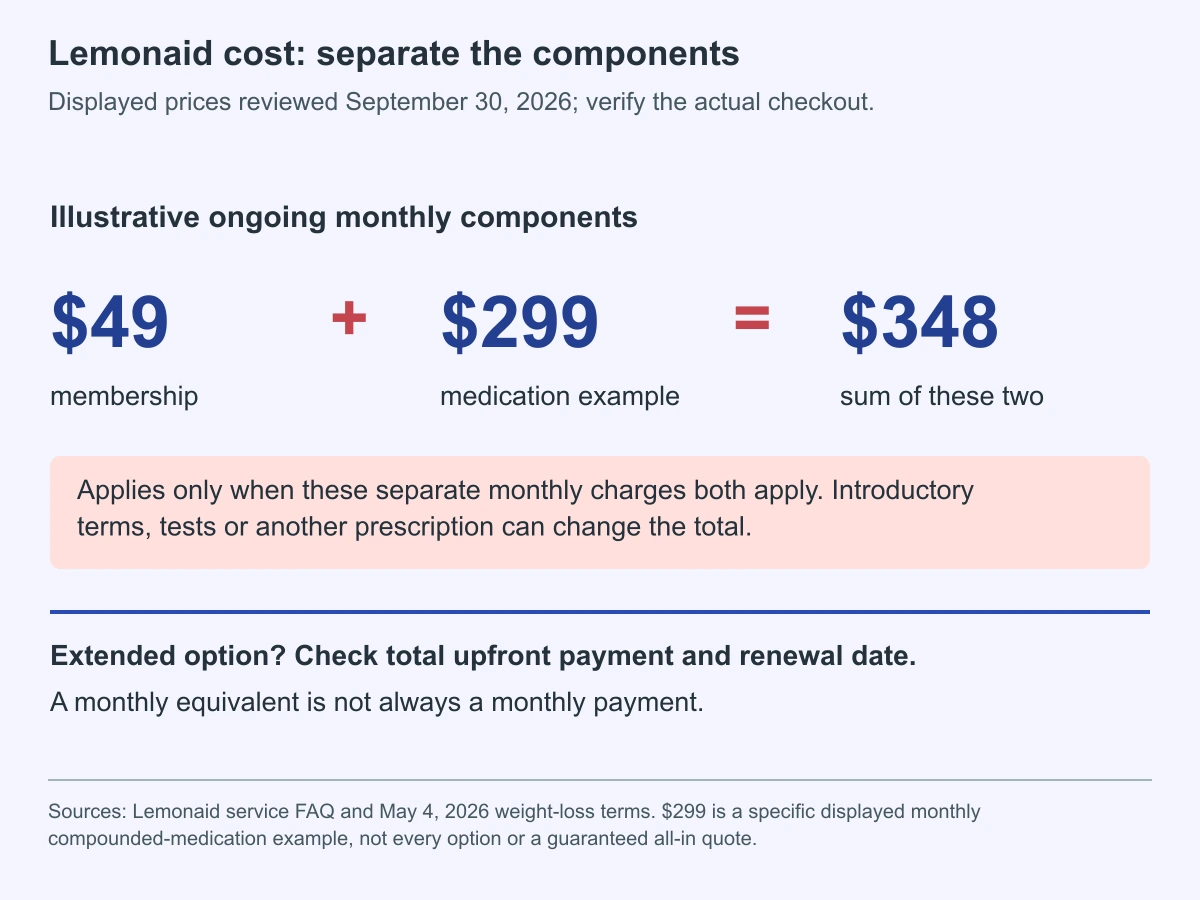
For a monthly option where the displayed $299 medication charge and $49 recurring membership both apply, those two components add to $348. That is arithmetic for the stated components, not a verified checkout quote or a promise that every fee is included. Introductory periods, another prescription, additional tests or an extended arrangement can change the amount.
Why “per month” needs a billing interval
A displayed monthly equivalent can be useful for comparing budgets, but it does not always mean you can pay that amount one month at a time. Check whether the full commitment is charged upfront and when the next renewal occurs.
Lemonaid’s reviewed weight-loss terms describe extended options renewing every 80, 160 or 332 days, associated with 12, 24 or 48 weeks of medication and supplies for eligible members. They specify payment in full in advance and follow-up evaluations before medication shipments. These unusual intervals should be read directly in the terms and checkout rather than silently treated as three, six or twelve ordinary monthly payments. Extended commitment terms.
For any package, ask for three figures: the total charge now, the period it covers, and the next charge if you continue. Also ask what happens if the clinician changes the treatment plan, if a medicine becomes unavailable, or if you no longer want the service. A lower advertised monthly equivalent can still involve a larger immediate commitment.
Does Lemonaid accept insurance for this service?
The reviewed weight-loss FAQ describes the service as cash pay and says insurance is not accepted for its membership, medication or medical fees. That statement is about this particular service. Do not assume the answer applies to every unrelated pharmacy transaction or every Lemonaid specialty. Weight-loss service payment FAQ.
If you hope to use insurance for a branded medicine, verify how the prescription would be filled and billed before starting a cash-pay service. Ask your own plan about the actual product, indication, pharmacy network and approval requirements. The GLP-1 insurance guide explains those checks, and the Cigna coverage article illustrates why an insurer’s name is not a personal approval.
Do not count a hoped-for reimbursement as money already recovered. A membership receipt does not establish that an insurer will pay it. Likewise, a manufacturer’s savings program has its own eligibility rules; it should not be assumed to apply to every cash-pay arrangement.
What about labs and follow-up?
The weight-loss terms describe secure messaging and consultations, access to prescribed medications, and certain routine laboratory blood draws subject to provider discretion and geographic limits. They specifically identify lab-benefit restrictions for members using the service in New Jersey, New York and Rhode Island. Additional tests may involve additional expense. Membership service and laboratory terms.
The useful question is what your care plan would require and what is included for your location. Ask where tests are obtained, how results reach the clinician, and whether a repeat test would cost extra. Do not assume that “labs included” means every possible test is covered indefinitely.
Follow-up matters independently of price. Ask how you obtain advice about symptoms, how refill reviews work, and what happens when you need care outside the service’s scope. The terms describe a weight-loss-focused service rather than a replacement for primary or specialty care. A subscription should fit into a workable care arrangement.

What happens if you are not eligible?
The reviewed weight-loss terms state that a person found ineligible for treatment, or not prescribed medication through the service, is not charged for the initial telehealth visit and is not enrolled in the automatically renewing weight-loss membership. That is different from assuming a refund is available after an eligible person’s membership has begun. Eligibility and enrollment terms.
If your evaluation needs additional records or test results, ask whether enrollment has started and whether any charge has been authorized. Keep the answer and the checkout terms available. Do not interpret completion of an online questionnaire as proof that a prescription has been approved.
Our online weight-loss prescription guide covers preparation for assessment. Clinical suitability should be established before comparing medication doses or treating a subscription price as a reason to choose treatment.
How does cancellation work?
For the weight-loss service, the reviewed terms say cancellation notice should be provided at least 48 hours before the membership renewal or medication-order date to avoid future charges. They distinguish a timely cancellation from a request made within that window. Extended commitments continue to the end of their period. Weight-loss cancellation terms.
Check both the membership renewal and medication processing dates. Stopping one recurring component should not be assumed to stop every other component unless the service confirms that. Use the account’s cancellation process and retain the confirmation and effective date.
Cancellation is also separate from a medical plan for stopping or changing treatment. If a medicine is already prescribed, coordinate the care decision with the clinician. Avoid treating the end of billing as instructions for changing a dose, restarting later or transferring a prescription.
Is cancellation the same as a refund?
No. Cancellation generally concerns future service or charges; a refund concerns money already paid. Lemonaid’s reviewed weight-loss terms state that membership and medication-order fees are non-refundable once paid. Its public refund policy also describes restrictions and directs people with a suspected prescription or billing error to support. Weight-loss terms, Lemonaid refund policy.
Before selecting an extended option, consider whether you can accept the upfront payment and its stated refund limits. Do not assume that using only part of the period automatically creates a partial refund. If a billing error occurs, describe the actual transaction and contact the service through its verified support channel.
This guide summarizes public service information; it does not decide a particular billing dispute. Your saved checkout terms, receipt, cancellation confirmation and service communications are the useful records for resolving one.
Compare the same things across providers
A comparison is more useful when it separates treatment from marketing. List the membership, exact medicine, supply interval, shipping, laboratory needs, refill review and cancellation. A bundled fee and a separate-fee arrangement cannot be compared reliably by looking at one headline number.
Also identify the medicine’s regulatory status. FDA-approved branded products and compounded preparations should not be treated as interchangeable evidence or quality categories. FDA explains that compounded GLP-1 medicines are not FDA approved. FDA unapproved GLP-1 information.
CoreAge Rx’s semaglutide and tirzepatide pages describe assessment-based compounded service options. Review the current total price, dispensing source, included care and renewal directly with the service. A different provider’s offer does not establish a CoreAge Rx price or guarantee that the same medicine is appropriate for you.

A practical cost worksheet
Before enrolling in any weight-loss service, fill in these details from the actual checkout and terms:
- Today: What is the exact total being charged now?
- Ongoing: What recurring membership and medication charges follow the introduction?
- Interval: Does “monthly” describe a payment or an equivalent within an upfront package?
- Care: Which appointments, messages and tests are included for my location?
- Refills: What clinical follow-up is needed, and who bills and ships the medication?
- Changes: What happens if the prescription, availability or eligibility changes?
- Exit: What date and process prevent the next charge, and what refund limits apply?
You can compare those answers without choosing the lowest advertised number automatically. The goal is treatment that is clinically suitable, understandable and financially workable over its actual duration.
Common questions
Is the free first month an all-in medication offer?
The reviewed FAQ calls the membership’s first month free and states medication costs separately. Read the exact offer you receive; do not assume the drug or every additional expense is free.
Is a cheaper medication always the better option?
No. Metformin, semaglutide and tirzepatide are different treatments. Their indications, risks and follow-up are clinical questions. Price can inform a decision after the clinician identifies suitable options.
Can I rely on an old comparison article?
Use it to identify questions, then verify current service terms. Promotional offers, medicine availability and billing packages change. Save the dated terms attached to your own enrollment rather than relying on another person’s screenshot.
Educational information for adults; individual treatment decisions require a qualified clinician. Sources reviewed September 30, 2026. Original AI-generated article images depict fictional people and objects, not patient outcomes. Other editorial images are illustrative. Graphics summarize the cited sources.