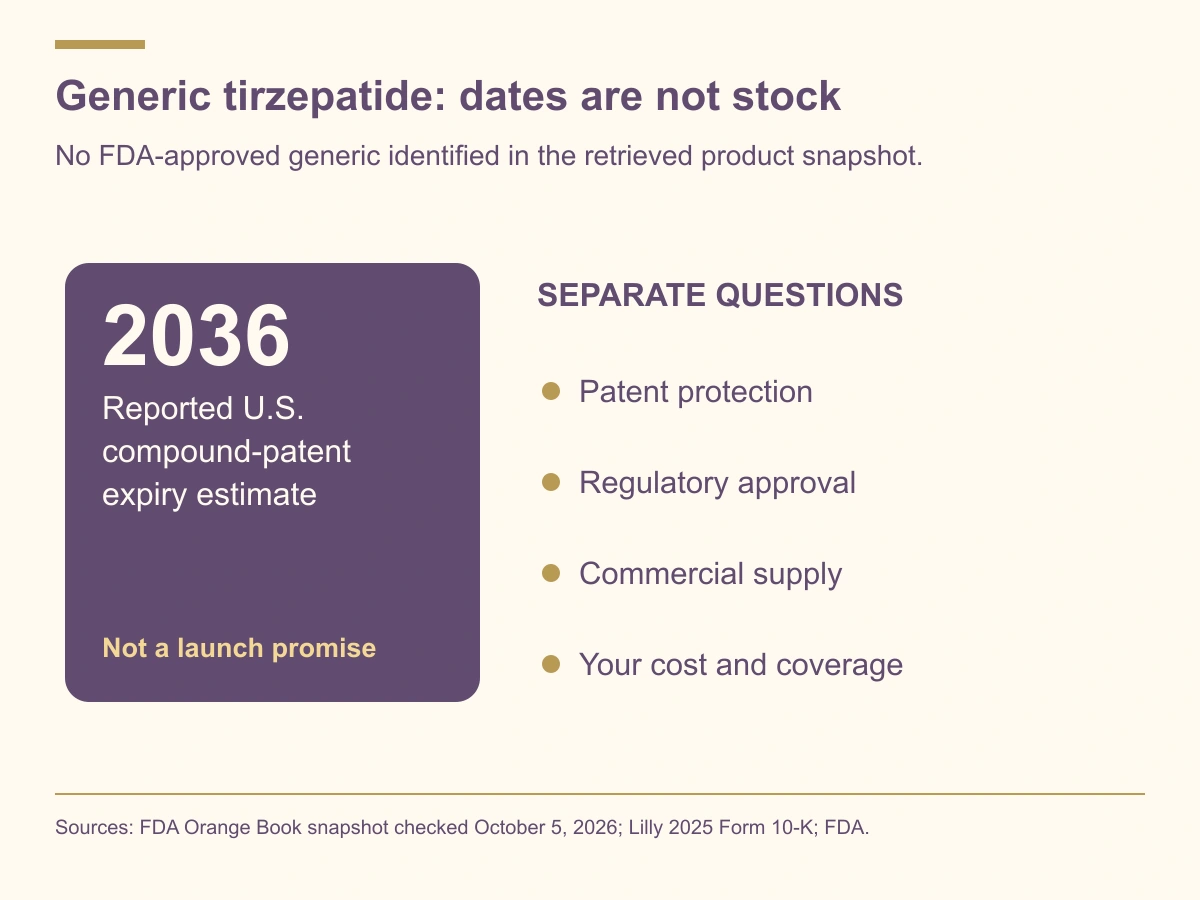
There is no FDA-approved generic tirzepatide identified in the Orange Book product data retrieved for this October 5, 2026 review. Lilly’s 2025 annual report lists an estimated 2036 U.S. compound-patent expiry for Mounjaro and Zepbound. That date is useful context, but it is not a confirmed generic approval or pharmacy-launch date.
Tirzepatide is an ingredient name, not proof of a generic product
Tirzepatide is the nonproprietary name of the active ingredient in Mounjaro and Zepbound. People sometimes call any non-brand ingredient name a “generic name.” That usage can cause confusion when discussing whether an FDA-approved generic medicine is available.
An approved generic is a specific product that has met FDA requirements. A vial labeled “tirzepatide,” an online research powder, and a future approved generic are not interchangeable categories. The ingredient name alone does not tell you which one you are looking at.
Our compounded tirzepatide versus Zepbound guide explains that practical distinction. Start with the identity and approval status of the actual preparation before comparing prices or making assumptions about substitution.
What the current FDA records show
For this review, the complete downloadable Orange Book product file was filtered for tirzepatide. The retrieved records identified Lilly products under the Mounjaro and Zepbound names and their presentations; they did not identify an abbreviated new drug application, or ANDA, for a generic tirzepatide product. FDA Orange Book downloadable data.
This is a dated finding from the retrieved regulatory snapshot. FDA says its downloadable Orange Book files are updated monthly. A future approval would require a new check, and an approval record still would not guarantee that every pharmacy has stock. FDA Orange Book overview.
If a seller currently advertises “generic Mounjaro” or “generic Zepbound,” ask for the exact manufacturer, product, and FDA approval record. A pharmacy license, certificate of analysis, or ingredient name does not by itself establish generic-drug approval.
What does the 2036 date mean?
Lilly’s annual report for the year ending December 31, 2025 lists Mounjaro/Zepbound’s estimated U.S. compound-patent expiry as 2036. The same table lists U.S. data protection as 2027 and different dates for other territories. The report cautions that market exclusivity may not last exactly until the estimated date. Lilly 2025 Form 10-K, patent-protection discussion.
A compound patent concerns intellectual-property protection associated with the drug molecule. It is not a scheduled delivery appointment for a generic manufacturer. The existence of other patents, regulatory requirements, disputes, settlements, manufacturing readiness, and commercial decisions can affect access.
The defensible statement is that the manufacturer reports that estimated patent milestone. It is not defensible to convert the table into a guarantee that an inexpensive substitute will be available at your pharmacy on a particular day in 2036.
Patents and exclusivity are different
FDA explains that patents and regulatory exclusivity arise under different systems and may overlap without having the same duration. Patents are granted by the U.S. Patent and Trademark Office. Regulatory exclusivity can delay or restrict certain competitor approvals under applicable drug law. FDA patents and exclusivity FAQ.
This explains why a data-protection date earlier than a compound-patent date does not, by itself, establish immediate generic availability. It also explains why “the patent” can be an oversimplification when a product has more than one listed patent or form of protection.
| Milestone | What it can tell you | What it does not establish |
|---|---|---|
| Reported patent expiry | A stated protection milestone | A guaranteed generic launch. |
| Regulatory exclusivity expiry | A change in a regulatory barrier | That all other barriers have ended. |
| FDA generic approval | A specific product met approval requirements | Immediate stock at every pharmacy. |
| Commercial launch | A manufacturer begins supplying a product | Your insurer’s coverage or your final price. |
| Pharmacy quote | The price and availability offered for a prescription | Permanent nationwide pricing. |
This article explains the distinction for patients. It does not predict the outcome of patent litigation or provide a legal conclusion about a proposed manufacturer’s launch rights.
Why an exact launch forecast is unreliable
A forecast needs more than a single year from a table. A potential competitor must develop a product, meet applicable regulatory requirements, resolve relevant access barriers, and decide how and when to supply it. Those events can change over time.
Patent challenges or settlements may affect timing. Additional product-specific issues can also matter. A confident online prediction such as “generic in 2036, half-price in 2037” can sound precise while combining several unverified assumptions.
For treatment planning, separate a long-term possibility from an option you can obtain now. Someone who needs ongoing diabetes or obesity care should not be left with a plan that depends entirely on an uncertain future launch.

Would an approved generic work like the brand?
FDA requires an approved generic to meet standards concerning active ingredient, strength, dosage form, route, quality, and bioequivalence, among other requirements. The agency describes approved generics as providing the same clinical benefit and risks as their brand-name counterparts. FDA Generic Drug Facts.
Those statements apply to products that have actually received the relevant approval. They should not be used as a shortcut to claim that every compounded or research-labeled preparation is equivalent.
If a generic becomes available in the future, the pharmacist can help identify the exact product and substitution rules. Device instructions, package presentation, and the prescription should still be checked. “Equivalent” does not mean you should ignore how to use the actual medicine supplied.
Is compounded tirzepatide a generic?
No. Compounded drugs are not FDA-approved generic drugs. FDA does not review their safety, effectiveness, and quality before marketing in the same way it reviews approved products. The agency also identifies concerns involving unapproved GLP-1 products, including dosing errors and misleading marketing. FDA unapproved GLP-1 information.
The fact that a preparation contains a named ingredient does not establish equivalence to the finished approved medicine. Concentration, ingredients, formulation, directions, and quality controls need specific review. A lower price does not answer those questions.
Our tirzepatide pharmacy-selection guide and tirzepatide vial guide organize the questions to ask. Neither a shortage headline nor a future patent date creates a blanket conclusion about an individual compounded prescription.
What about products sold for research?
A product advertised for laboratory research is not a patient-ready generic prescription. FDA warns about companies selling unapproved GLP-1 ingredients under research-related language. Do not treat a purity percentage or laboratory certificate as evidence of approval for human treatment. FDA safety information.
A legitimate medication discussion should identify the prescriber, the actual pharmacy or manufacturer, the preparation, and the instructions appropriate to that product. If the seller cannot clearly explain what is being supplied, the word “tirzepatide” on a website does not resolve the uncertainty.
Avoid trying to convert a research purchase into a home injection regimen. The compounded GLP-1 overview explains why medicine identity and instructions must be settled before administration questions.
Could a generic be cheaper?
Generic competition often lowers prices, but the amount and timing vary. FDA’s general information describes the role of competition; it does not provide a future tirzepatide retail price. The number of suppliers, manufacturing costs, coverage arrangements, and pharmacy pricing would all be relevant. FDA generic-drug explanation.
Do not plan a treatment budget around a promised percentage discount from an unapproved future product. Even after a launch, your out-of-pocket amount could differ from a headline cash price.
For options available now, the Mounjaro cost guide and Zepbound cost guide separate insurance, cash offers, and other fees. Obtain a current quote for the exact prescribed presentation rather than applying an old price to a different pen or vial.
What can you do while generics remain unavailable?
Discuss clinically suitable current options with the prescriber. The right comparison may include the indication, contraindications, previous response, monitoring, insurance benefit, and total ongoing cost. It should not be based only on which online offer has the lowest headline number.
Our Mounjaro alternatives guide and GLP-1 insurance guide help prepare that conversation. If cost causes interruptions, ask for a plan that addresses the interruption and any restart instead of stretching or splitting doses on your own.
The CoreAge Rx tirzepatide service page describes assessment-based compounded care. Review its actual clinical scope, source, follow-up, and payment terms. It should not be described as an approved generic or as automatic eligibility after an insurance denial.

A checklist for evaluating a “generic” claim
- What is the exact finished product and who manufactures or compounds it?
- Is there an FDA approval record for that product?
- Is the seller using “generic name” merely to describe the ingredient?
- Does the claim confuse a patent year with an approved launch?
- Is the price for the medicine alone or the complete care arrangement?
- What monitoring and product-specific administration training are included?
If the answer remains vague, pause the comparison until the identity is clear. A useful quote concerns a clearly identified treatment, not an ambiguous label.
Common questions
Does 2027 data protection mean generic tirzepatide launches in 2027?
No. The manufacturer’s table lists separate protections, and an exclusivity milestone is not a launch announcement. Patent and regulatory questions must be considered separately.
Is 2036 a guaranteed release year?
No. It is the estimated U.S. compound-patent expiry reported in the reviewed annual report. It does not guarantee approval, supply, price, or coverage.
Are generic availability dates the same worldwide?
No. Patent, regulatory, and commercial circumstances differ by country. A report about another market should not be used to establish U.S. availability.
How should I check again later?
Use current FDA product records and ask a pharmacist about the exact prescription and available approved products. Keep the date of the check with the answer.
Educational information for adults; individual treatment decisions require a qualified clinician. Sources reviewed October 5, 2026. Original AI-generated article images depict fictional people and objects, not patient outcomes. Other editorial images are illustrative. Graphics summarize the cited sources.