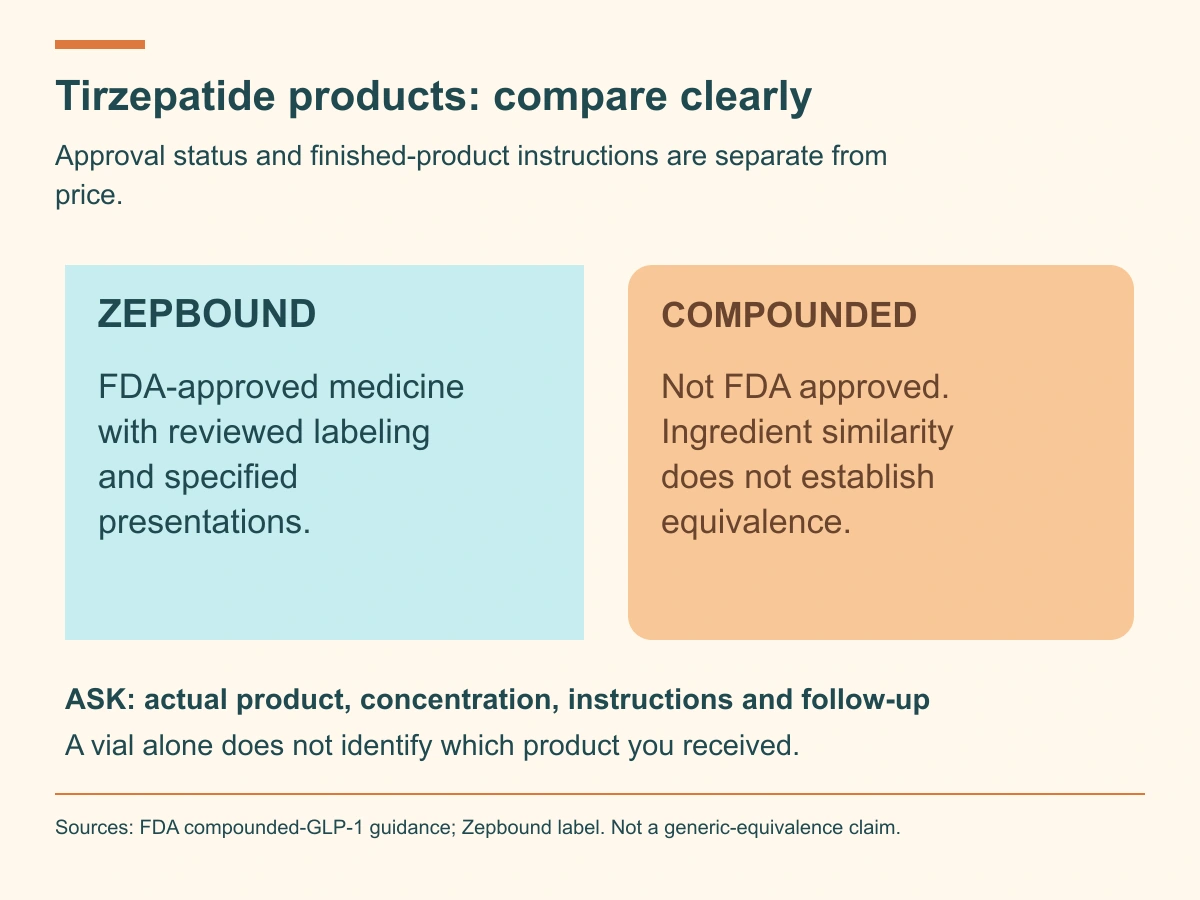
Zepbound is an FDA-approved tirzepatide medicine with reviewed labeling and specified presentations. Compounded tirzepatide is not FDA approved and does not undergo the same premarket review for safety, effectiveness, and quality. Sharing an ingredient name does not establish that a compounded preparation is an approved generic, has demonstrated equivalence, or should use the same device and storage instructions.
The practical comparison starts with your medical need, the actual dispensed product, and the prescribing and pharmacy instructions. Price is one part of that conversation, but it cannot answer the questions about formulation, quality, dose measurement, or appropriate use.
What is the central difference?
FDA explains that compounded drugs may meet a patient’s medical need that an approved drug cannot meet, but they are not FDA approved. The agency recommends a prescription from a clinician and dispensing through a state-licensed pharmacy. FDA’s current GLP-1 guidance.
Zepbound’s prescribing information specifies indications, dose schedules, warnings, presentations, and handling instructions. Its current uses include weight management in eligible adults and treatment of moderate to severe obstructive sleep apnea in adults with obesity. Zepbound prescribing information.
These are different regulatory and product situations. A claim that compounded tirzepatide is “the same as Zepbound” skips important evidence and quality-review distinctions. Ask the seller and prescriber to describe the actual product accurately.
Compare products using specific questions
| Question | Zepbound | Compounded tirzepatide |
|---|---|---|
| FDA approval | Approved branded medicine | Not FDA approved |
| Product instructions | Current manufacturer label and matching device instructions | Exact prescription and pharmacy-specific preparation instructions |
| Presentation | Several labeled pen and vial presentations | Depends on the particular preparation |
| Evidence for the finished product | Reviewed in the approval and labeling process | Ingredient similarity does not establish finished-product equivalence |
| Storage and use limits | Follow the exact labeled presentation | Follow current FDA guidance and clarify actual pharmacy instructions |
| Who answers a product question? | Prescriber, dispensing pharmacy, and manufacturer as appropriate | Prescriber and the pharmacy that actually prepared it |
The comparison does not establish which product is appropriate for you. It shows which information you need before making that decision with a clinician.
Our compounded GLP-1 overview covers semaglutide and tirzepatide together. This article focuses on what the Zepbound comparison changes in a real prescription conversation.
The same molecule name is not proof of an interchangeable product
A finished medicine includes more than the active-ingredient name. Concentration, ingredients, preparation, container, delivery system, and instructions affect the product someone actually uses.
An approved generic is also a specific regulatory category. Calling a compounded preparation “generic Zepbound” can imply an approval or equivalence finding that has not been established by that description.
Ask whether added ingredients are present and why. A differently colored preparation or a formula containing another substance should be identified from the pharmacy’s records, rather than judged by appearance. Our tirzepatide color and B12 guide explains those product-identity questions.
A medicine’s appearance cannot prove concentration, sterility, authenticity, or appropriate use. If the label is unclear, contact the dispensing pharmacy before using it.
Current Zepbound is not limited to one pen format
The reviewed U.S. label lists single-dose pens, single-dose vials, multidose vials, and a single-patient-use KwikPen. The instructions and contents depend on the presentation. Zepbound label, section 16.1.
This matters because the statement “brand medicine uses a pen and compounded medicine uses a vial” is incomplete. A vial can be a manufacturer-labeled product or a compounded preparation; the container alone does not tell you which.
Check the name, manufacturer or compounding pharmacy, strength, concentration, and device instructions. Ask how many prescribed doses the supply contains and which supplies you need.
Our Zepbound storage guide distinguishes the current branded presentations. The compounded tirzepatide storage guide addresses a different product pathway. Do not copy a storage allowance from one to the other.
Why concentration and syringe instructions need attention
A dose in milligrams, a liquid volume in milliliters, and markings on a syringe describe different things. The amount of active ingredient in a measured volume depends on the labeled concentration.
FDA has received reports of dosing errors with compounded GLP-1 products, including errors involving measurement or calculation. Some required medical attention. The agency advises discussing how to measure and administer the intended dose with the prescriber or compounder. FDA compounded-product dosing concerns.
Ask the pharmacy to show the exact prescribed dose using the actual concentration and supplied measurement tool. If a refill changes concentration, do not assume the previous syringe marking still applies.
This article does not provide a generic units chart. Such a chart cannot verify a preparation or replace missing instructions. Our tirzepatide reconstitution guide also explains why a total amount on a vial does not define a preparation recipe.

Storage, shipping, and the opened-vial question
Current FDA consumer guidance recommends discarding multidose compounded GLP-1 vials within 28 days after first use, even if medicine remains and the compounder’s instructions allow longer. It also advises using new sterile needles and syringes for each dose. FDA multidose-vial guidance.
That advice should be discussed alongside the actual preparation’s unopened storage and other limits. Do not extend a beyond-use date simply because the liquid looks unchanged. Ask the pharmacy how to reconcile unclear or conflicting instructions before continuing to use the supply.
FDA also advises against using injectable GLP-1 medicine that arrives warm or inadequately refrigerated. Keep the shipment details and contact the pharmacy about the actual temperature event rather than guessing from the ice pack’s appearance alone.
The manufacturer-labeled Zepbound presentations have their own storage instructions. An allowance for a branded single-dose pen does not establish stability for a compounded multidose vial.
How should you assess the pharmacy and seller?
Confirm who prescribed the medicine, who actually compounded or dispensed it, and how to contact that pharmacy. Check that the label matches the pharmacy’s identity and that a licensed clinician is available for follow-up questions.
FDA identifies red flags including misleading equivalence claims, missing instructions, questionable pharmacy information, and medicine sold without a proper prescription process. FDA telehealth and pharmacy red flags.
Our tirzepatide compounding-pharmacy checklist provides questions to bring to a consultation. A professional-looking website, favorable testimonial, or laboratory document does not substitute for the actual prescription and product review.
Do not use “research only” labeling as a patient-treatment shortcut. FDA warns against unapproved GLP-1 products sold directly to consumers under research-use claims. The quality and clinical use of those products are not established by a downloadable dosing chart.
What about cost and insurance?
Compare the actual quoted prescription and services, rather than an advertised starting price. Ask which product, quantity, follow-up, supplies, and fees are included. Also ask what happens if you need a different dose or the treatment plan changes.
For an approved medicine, insurance coverage depends on your plan, indication, formulary, and any authorization requirements. The GLP-1 insurance guide and Aetna Zepbound guide explain why approval and out-of-pocket cost are separate questions.
A lower quote does not establish equivalence or clinical suitability. Likewise, an expensive product is not automatically the right choice. Ask the prescriber to explain the medical reason for the proposed treatment and the alternatives available to you.
Can you switch between compounded tirzepatide and Zepbound?
A switch needs a prescribing plan. Identify the prior product, concentration, actual dose used, timing of the last dose, side effects, and the intended new presentation. Do not convert from an old syringe marking to a new device yourself.
Our semaglutide and tirzepatide switching guide explains why a treatment transition includes more than choosing an ingredient. A change between tirzepatide preparations still requires an exact-product review.
The Zepbound label does not recommend combining it with another tirzepatide-containing product or a GLP-1 receptor agonist. Keep the transition explicit so that old supply is not accidentally used alongside the new prescription. Zepbound limitations of use.
Ask what to do with remaining medicine, when the new treatment begins, and whom to contact for new symptoms. Do not use leftover supply to create an overlap or a faster escalation.
Side effects still require clinical attention
A compounded product is not a way to remove the ingredient’s potential adverse effects. It can also introduce product-specific concerns that require separate investigation.
Persistent vomiting, severe abdominal pain, dehydration concerns, or a suspected dosing error should be assessed by the care team. Our compounded tirzepatide side-effects guide explains how symptom and product questions fit together. Zepbound’s label likewise includes serious gastrointestinal and other warnings. Zepbound safety information.
When reporting a problem, include the product label, pharmacy, lot if available, dose information, and timing. Avoid assuming that every symptom proves poor quality—or that the ingredient name makes a product-quality concern irrelevant.

Questions people commonly ask
Is compounded tirzepatide an FDA-approved generic?
Our guide to generic tirzepatide, patents and FDA approval explains why an ingredient name or a patent date does not establish an approved interchangeable product.
No. Compounding does not create an FDA-approved generic product. Discuss the actual preparation and the medical need it is intended to address.
Does a vial mean the medicine is compounded?
No. Current branded Zepbound labeling includes vial presentations. Identify the manufacturer or compounding pharmacy and the exact product, rather than categorizing it by container.
Can I follow Zepbound’s instructions for my compounded vial?
Do not assume so. The concentration, measurement tool, storage, and preparation instructions may differ. Review the current FDA guidance and your pharmacy’s actual instructions with the prescriber.
Does added B12 make a preparation more effective?
An added ingredient does not establish superior weight-management results or finished-product equivalence. Ask why it is present and what evidence supports its intended role for you.
Where can I begin a CoreAge Rx treatment discussion?
The CoreAge Rx tirzepatide information page can help you ask about the service, actual product, prescribing process, and follow-up. It does not establish that every offering is branded Zepbound or appropriate for every patient.
Make the comparison about the actual prescription
Ask about the medical need, approval status, preparation, concentration, instructions, and follow-up. A clear product-specific answer gives you more useful information than a claim that two medicines are interchangeable because they share an ingredient name.
Educational information for adults; individual treatment decisions require a qualified clinician. Sources reviewed October 5, 2026. Original AI-generated article images depict fictional people and objects, not patient outcomes. Other editorial images are illustrative. Graphics summarize the cited sources.