
Aetna coverage for Zepbound depends on your exact plan, the reason for treatment, the requested product, and any authorization rules. An Aetna logo on an insurance card or a public clinical policy does not establish that your prescription will be covered. Ask for a benefits check and the current criteria that apply to your member plan before relying on a quoted price.
There is also a separate Medicare GLP-1 Bridge pathway operating in 2026. It has its own eligibility and product rules, so it should not be confused with an Aetna commercial benefit or ordinary Medicare Part D coverage. This guide explains the questions to ask, the limits of the public Aetna document reviewed here, and how to organize an accurate coverage conversation.
Start with your specific plan
Use the member-services contact and pharmacy-benefit information on your insurance card or member account. Have the plan name, member details, and prescription information available when speaking with the insurer or pharmacy. Avoid putting personal identifiers into a public comment or an unverified website.
Ask the representative to identify the current prescription benefit and the document that governs the requested treatment. If the first answer is simply “Zepbound requires prior authorization,” ask whether the drug is an eligible benefit for your plan and indication in the first place.
Write down the date, the representative’s reference number, and where you can obtain the applicable written information. A saved response makes it easier to distinguish a general explanation from a decision on a submitted request. Recheck if your coverage changes; an earlier answer may describe a different benefit period.
Our GLP-1 insurance guide provides a broader framework for these conversations. It is useful preparation, but your own plan’s current documents and claim response are needed to resolve your coverage.
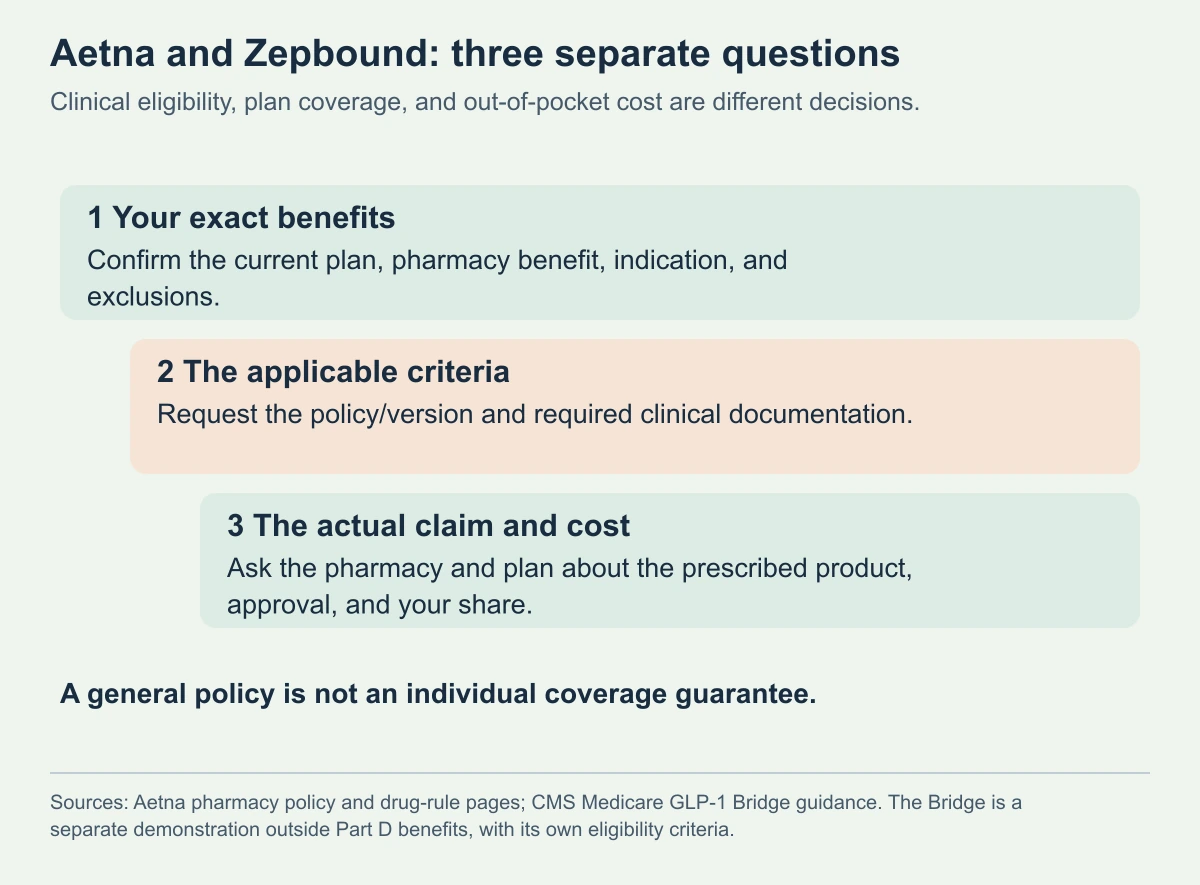
Three separate questions: benefit, criteria, and cost
Treat coverage as a sequence of questions rather than a single yes-or-no search result.
| Question | What to ask for |
|---|---|
| Is the requested treatment an eligible benefit? | The current formulary and any relevant benefit exclusion for your plan and indication. |
| What conditions must be met? | The applicable authorization criteria, required records, and submission process. |
| What will this fill cost? | A pharmacy claim or benefits estimate for the exact product, quantity, pharmacy, and benefit period. |
These questions help locate the problem. Missing records require a different follow-up from an excluded benefit. A clinical approval also does not supply a universal dollar amount for every pharmacy fill.
Aetna’s Medicare resources describe formularies, prior authorization, step therapy, quantity limits, and a process for requesting an exception. Those resources concern Medicare plans; they do not establish the benefit details of an employer or other commercial plan. Aetna Medicare drug information
What does the public Aetna Zepbound policy show?
The public non-Medicare bulletin reviewed for this article is titled “Zepbound PA with Limit 6192-C P08-2024_R.” It ends with a December 19, 2024 date and cites October 2024 Zepbound prescribing information. It describes documentation, continuation, and quantity conditions for weight management. Dated Aetna bulletin
That document illustrates the kinds of records a coverage review can involve. It does not verify the current 2026 rules for every Aetna member. Its location in a commercial-policy directory does not resolve your plan’s benefits, and its labeling reference predates the current prescribing information reviewed below.
Ask the plan to supply the currently applicable version and confirm its effective date. If a clinic quotes an exact required program length, response percentage, or authorization duration, ask which policy and benefit that number comes from. This article does not present the older bulletin’s numbers as universal current Aetna requirements.
Does the reason for prescribing Zepbound matter?
Yes. The current U.S. Zepbound label includes long-term weight reduction and maintenance for eligible adults and treatment of moderate-to-severe obstructive sleep apnea in adults with obesity. Both indications include a reduced-calorie diet and increased physical activity. Zepbound prescribing information
Clinical suitability and insurance eligibility are separate decisions. A licensed clinician evaluates whether treatment fits your health needs. The insurer applies the relevant benefit and coverage process. Being prescribed a medicine does not itself establish coverage.
Tell the clinician and insurer the actual reason for treatment. Do not ask someone to label a weight-management prescription as sleep-apnea treatment when that is not the diagnosis and purpose. If sleep apnea is part of your medical history, ask which records and pathway apply; a symptom or online questionnaire alone should not be used to invent a diagnosis.
Our tirzepatide questions guide explains related treatment questions, and our guide to choosing a GLP-1 medicine can help organize a clinical discussion before focusing on a brand or price.

What should the prescriber ask about prior authorization?
Before submitting, the office should confirm the correct destination and current requirements. Ask which clinical records are needed, whether the request is for initial treatment or continuation, and how the decision will be communicated.
A useful preparation list is:
- The exact prescribed brand, presentation, and quantity.
- The treatment indication and relevant clinical records.
- The current plan criteria and effective date.
- Any requested treatment-history or follow-up documentation.
- The submission reference and a way to check its status.
This list is a conversation tool, not a declaration that every item is required by every Aetna plan. Supply accurate records that match the actual request. If you previously used another treatment, tell the prescriber; do not reconstruct a starting measurement or treatment history from memory when a record is needed.
Ask who will handle follow-up if information is missing. A coordinated office, pharmacy, and member conversation is easier to act on than repeated submissions without knowing why the first request was returned.
What if the request is denied?
Read the written decision and identify its stated reason. Ask whether the issue is a benefit exclusion, an unmet criterion, missing information, a product or quantity mismatch, or another claim requirement. The correct next step depends on that explanation.
If information is incomplete, ask the prescriber what can be corrected. If you disagree with a coverage decision, ask the plan for the applicable review or appeal instructions and deadlines. Aetna’s Medicare resources discuss provider-supported exceptions; use the process for your actual plan rather than transferring Medicare instructions to a commercial benefit. Aetna Medicare resources
Keep the decision, submission records, and dates together. Ask whether another covered treatment is clinically appropriate, while recognizing that a formulary alternative still requires an individual medical assessment. Do not change medicines, doses, or the documented indication simply to bypass a denial.
Does an approval explain the monthly price?
Ask the pharmacy to evaluate the exact prescription through the applicable benefit. Request a breakdown of the medication charge and any separate clinic, membership, laboratory, or follow-up charges. Confirm whether a quote is for one fill, a particular presentation, or a continuing service.
If a deductible, tier, quantity rule, or pharmacy requirement affects the estimate, ask the plan to explain it using your current benefit. Check any assistance offer against its own eligibility terms before including it in your budget. An advertised starting price cannot establish what an Aetna claim will cost you.
Our Zepbound cost guide covers the difference between medication and care expenses. The Wegovy cost guide may also help when discussing alternatives. Comparing total costs is more informative than comparing two headline prices with different quantities or services.
What changed for Medicare in 2026?
CMS describes a temporary Medicare GLP-1 Bridge demonstration running from July 1, 2026 through December 31, 2027. It operates outside the ordinary Part D benefit flow for certain eligible people with qualifying Medicare drug coverage. It is a separate pathway, not a statement that all Aetna plans now cover Zepbound. CMS provider guidance
The program requires a provider’s authorization process and specific clinical eligibility. Its listed thresholds include a BMI of at least 35, or lower specified thresholds paired with particular conditions. A general weight-management indication does not by itself establish Bridge eligibility. Ask the provider to review the complete current criteria and the correct pathway for your diagnosis.
For Zepbound, the Bridge lists KwikPen only; single-dose pens and single-dose vials are excluded from that program. CMS states a $50 monthly copayment for qualifying program prescriptions. That figure is not a universal commercial-insurance or ordinary Part D price. Medicare’s patient explanation
CMS distinguishes people whose treatment has a Part D-coverable indication, including the relevant sleep-apnea indication, from the Bridge pathway. The provider should determine the appropriate route rather than treating the programs as interchangeable. Confirm the presentation before the prescription is sent.

Is tirzepatide through another service the same coverage request?
The brand, presentation, dispensing arrangement, and benefit matter. A request for Zepbound cannot be assumed to cover every product advertised as tirzepatide. FDA explains that unapproved compounded GLP-1 medicines do not undergo its review for safety, effectiveness, and quality. FDA information on unapproved GLP-1 drugs
Ask any service to identify the actual medicine, pharmacy, total charges, and whether it bills your insurance. Do not assume an advertised cash service establishes an Aetna benefit, or that a compounded preparation is interchangeable with an FDA-approved brand.
The CoreAge Rx tirzepatide page and semaglutide page provide service information to discuss with a clinician. They do not verify an Aetna Zepbound approval. Review the actual offering and clinical suitability before deciding how it fits your care and budget.
Common Aetna and Zepbound questions
Does meeting a BMI threshold guarantee approval?
No. The relevant benefit, indication, current criteria, and complete request still need review. A clinical or historical-policy threshold is not an individual coverage decision.
Can an older approval be used after a plan change?
Ask the new plan and pharmacy what applies. Keep your earlier authorization and treatment records, but do not assume they establish the new benefit or authorization period.
Is Mounjaro interchangeable with Zepbound for insurance?
Do not assume the same active ingredient creates the same covered prescription. Discuss the actual indication and product with the prescriber. Our tirzepatide and semaglutide comparison helps frame the treatment conversation without promising that a different brand will be covered.
What should you have ready for a benefits call?
Have your current member information, the exact prescription details, the real treatment indication, and any decision or submission reference. Ask for the current written rules, the next action, and who is responsible for it. That produces a usable answer to “Does Aetna cover Zepbound for me?”
Educational information for adults; individual treatment decisions require a qualified clinician. Sources reviewed September 30, 2026. Original AI-generated article images depict fictional people and objects, not patient outcomes. Other editorial images are illustrative. Graphics summarize the cited sources.