
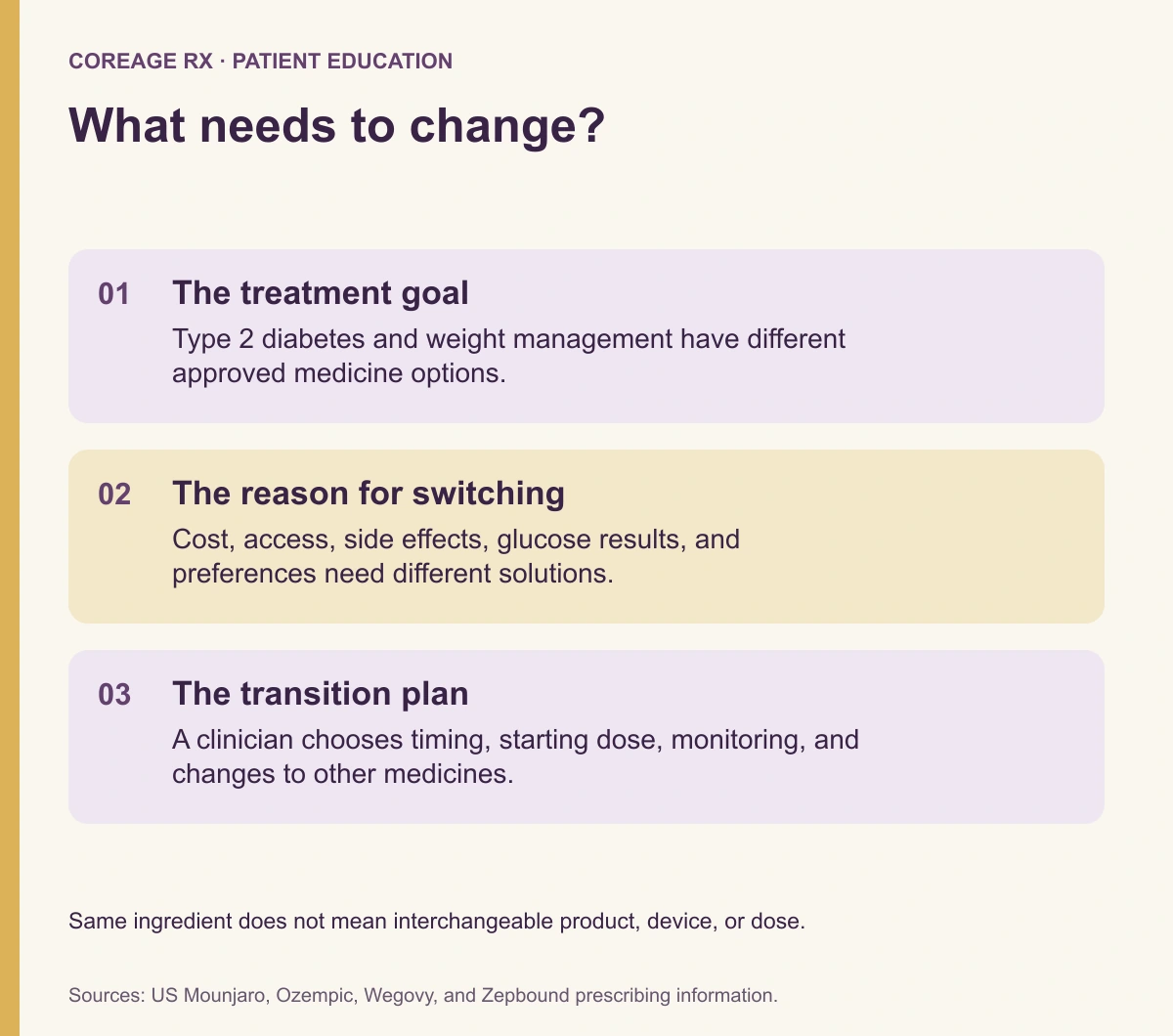
The best alternative to Mounjaro depends on why you use it and what needs to change. A person treating type 2 diabetes may need an alternative that fits glucose, heart, and kidney goals. A person seeking weight-management treatment may need a product approved for that purpose. Cost, availability, side effects, and a preference for tablets can each lead to a different conversation.
Mounjaro contains tirzepatide. The current U.S. label includes glucose control in adults and children age 10 and older with type 2 diabetes and a cardiovascular risk-reduction indication in certain adults with type 2 diabetes. This guide focuses on adult decisions. It is a framework for a prescribing discussion, not a recommendation to switch on your own. Source: Mounjaro prescribing information.
First identify the problem you are trying to solve
“Alternative” can mean several things:
| Main concern | A useful first question |
|---|---|
| The monthly cost is difficult | What approved products does my plan cover, and what is the full recurring cost? |
| The medicine is unavailable | Can the prescriber or pharmacist identify an available presentation or a clinically appropriate replacement? |
| Digestive symptoms are persistent | Does the current plan need a tolerance review before considering another medicine? |
| Glucose remains above target | How does the whole diabetes regimen need to change? |
| The main goal is weight management | Which products are approved for my condition and fit my history? |
| I prefer a tablet | Which approved oral options are appropriate, and what are their administration requirements? |
These questions prevent a common mistake: choosing a medicine by a headline price before confirming that it addresses the intended health need.
Zepbound: the same ingredient with different approved uses
Zepbound also contains tirzepatide, but its approved indications differ from Mounjaro’s. It is used for weight reduction and long-term maintenance in eligible adults and for moderate to severe obstructive sleep apnea in adults with obesity. Mounjaro’s diabetes indication should not be treated as if it automatically applies to Zepbound, or vice versa. Source: Zepbound label.
For someone whose main reason for treatment is obesity, the clinician may discuss a weight-management product and its coverage requirements. That is a different question from whether the ingredient is familiar. Insurance rules may depend on the diagnosis and branded product, and a prescription does not guarantee coverage.
Do not assume that having used one tirzepatide product makes another device, concentration, or schedule interchangeable. Confirm the transition, presentation, and instructions. Our Zepbound dosage chart and Zepbound side-effects guide explain the product-specific information.
Ozempic or another diabetes treatment
Ozempic injection contains semaglutide, a GLP-1 receptor agonist. Its current label includes glucose control in adults with type 2 diabetes and specific cardiovascular and kidney indications in defined populations. It does not have the same ingredient, dose, device, or complete indication list as Mounjaro. Source: Ozempic label.
A clinician choosing diabetes treatment also considers medicines outside the GLP-1 family. The right combination can depend on glucose levels, other health conditions, side-effect risks, cost, and the person’s ability to follow the plan. An alternative is not always a one-for-one substitution. Some people need several medicines, and insulin requirements should not be changed without a clinical plan. Source: NIDDK’s diabetes-treatment overview.
Bring glucose records and a full medicine list when discussing the change. Ask what the replacement is expected to improve, what monitoring is needed, and whether another medicine’s dose must change. Our Mounjaro low-blood-sugar article explains why appetite changes and combination treatment deserve attention.
Wegovy and other approved weight-management options
Wegovy contains semaglutide and has weight-management indications along with other specific approved uses. The current U.S. label includes injectable and oral presentations, with different schedules and formulation-specific details. It should not be treated as a higher-dose version of any semaglutide product you happen to have at home. Source: Wegovy prescribing information.
Other approved weight-management medicines work through different mechanisms. Examples include liraglutide, phentermine/topiramate, naltrexone/bupropion, and orlistat. They have distinct contraindications, interactions, side effects, and eligibility requirements. A lower price does not make a medicine suitable for someone whose history conflicts with its warnings. Source: NIDDK’s weight-management medication overview.
A useful discussion compares the expected benefit, route, routine, medical fit, tolerance, and sustainable cost. Our tirzepatide versus semaglutide article explains how to read weight-loss evidence without treating trial averages as individual promises.
What if I want a pill instead of an injection?
Approved oral options now make this a more specific conversation than “all GLP-1 treatment requires a weekly shot.” Wegovy tablets contain semaglutide. Foundayo contains orforglipron and was approved in 2026 for long-term weight management in eligible adults alongside a reduced-calorie diet and increased physical activity. Source: FDA’s Foundayo approval announcement.
These medicines have different dosing and administration instructions. For example, oral semaglutide has specific fasting and water requirements, while FDA’s Foundayo announcement describes an oral option that does not require an empty stomach. A tablet’s milligram amount is not a conversion from an injection’s milligram amount.
A tablet can also cause adverse effects and requires clinical screening. “No needle” does not mean “no monitoring.” Ask which product fits your diagnosis, what the daily routine involves, and whether other oral medicines or health conditions affect suitability.
Read oral semaglutide versus injections for a more detailed explanation. Be cautious with unapproved drops, dissolving products, or “research” medicines advertised as equivalent to approved oral products.

A compact comparison of treatment categories
| Option | Ingredient or category | Main comparison question |
|---|---|---|
| Mounjaro | Tirzepatide, dual GIP/GLP-1 activity | Is the current diabetes-focused plan meeting its goals with acceptable tolerance? |
| Zepbound | Tirzepatide, dual GIP/GLP-1 activity | Is the treatment goal within its weight-management or sleep-apnea indications? |
| Ozempic injection | Semaglutide, GLP-1 activity | Does its diabetes and relevant cardiovascular or kidney evidence fit the person? |
| Wegovy | Semaglutide, GLP-1 activity | Which formulation and approved indication apply? |
| Foundayo | Orforglipron, oral GLP-1 activity | Is this adult weight-management option appropriate and practical? |
| Other prescription classes | Different mechanisms | Do their benefits, warnings, and costs fit better? |
This is not a ranking. The best choice can differ for two people with the same weight because their diagnoses, other medicines, symptoms, and preferences differ.
When side effects are the reason for switching
A change may be reasonable, but first describe the symptoms precisely. Which symptom is occurring, how severe is it, when did it start, and did it follow a dose increase or another change? Can you eat and drink adequately? Are glucose readings or blood pressure also changing?
Medicines with related mechanisms can share digestive effects. Switching from one to another does not guarantee that nausea or constipation disappears. Conversely, a poorly tolerated plan should not be continued indefinitely simply because a trial showed strong average results.
Our Mounjaro side-effects guide explains common symptoms and warning signs. Severe persistent abdominal pain, repeated vomiting with inability to keep fluids down, or signs of a serious allergic reaction require prompt medical care rather than routine comparison shopping.
Comparing costs without being misled by a teaser price
Use the exact product, formulation, and expected prescription when asking for a quote. List the consultation charge, medication cost, follow-up charges, tests, supplies, and shipping separately if they are not included. Ask whether the price changes with the dose or after an introductory period.
For insurance, ask about the covered diagnosis, prior authorization, deductible, preferred products, and the estimated patient cost at the dispensing pharmacy. For a manufacturer savings program, verify current eligibility and restrictions directly; a displayed “as low as” figure is not a promise that everyone qualifies.
For cash-pay care, compare equivalent time periods. Four weekly doses and a calendar-month membership are different billing units. Prepayment may reduce the displayed monthly amount while creating a larger upfront commitment and separate refund conditions.
We avoid naming one universally cheapest option because the answer changes with the person’s coverage, eligibility, dose, and location. Our semaglutide versus tirzepatide cost guide and TrimRx public-information review show questions to use when comparing offers.
Is compounded tirzepatide an alternative to Mounjaro?
It is a different category of product and should not be called FDA-approved generic Mounjaro. Compounded drugs have not undergone the same FDA review for safety, effectiveness, and quality. FDA advises that compounded GLP-1 medicines should be used only when a patient’s medical needs cannot be met by an approved drug. Source: FDA’s current GLP-1 guidance.
If a clinician proposes a compounded preparation, ask why it is appropriate, which pharmacy will dispense it, what the concentration is, and how to measure and store it. A schedule for a branded pen does not establish syringe units for a compounded vial. Claims that every compounded preparation produces the same outcome as a brand trial should be questioned.
CoreAge Rx’s tirzepatide and semaglutide pages provide product information to discuss with the team. Confirm the exact preparation and care arrangement rather than assuming those pages describe branded Mounjaro or Ozempic.

What a switching plan should include
A clinician-directed transition should identify the final dose of the old medicine, the start date and initial dose of the replacement, required monitoring, and changes to other medicines. It should also explain what to do if symptoms occur or the replacement is delayed.
Do not overlap products, combine GLP-1 medicines, or choose a new starting dose using an internet equivalence chart. Milligram numbers from different ingredients are not a shared potency scale. Our switching from semaglutide to tirzepatide guide illustrates why the transition deserves its own instructions.
If you have had a long gap, a recent illness, severe symptoms, a planned procedure, or pregnancy-related concerns, mention those before restarting or switching. A previous tolerance history does not answer every current safety question.
Frequently asked questions
Is Zepbound just generic Mounjaro?
No. They are distinct branded products containing tirzepatide with different approved indications. Confirm which product and instructions apply to the prescription.
Is a supplement a cheaper substitute?
A supplement marketed for GLP-1 support is not an FDA-approved replacement for diabetes or obesity treatment. Read our GLP-1 supplement evidence guide before assuming the same clinical effect.
Can I choose the medicine with the largest trial weight loss?
Trial results are only one part of the decision. The population, dose, duration, adverse effects, diagnosis, and personal treatment fit matter. A group average does not predict an individual’s result.
What should I bring to the appointment?
Bring the reason for wanting a change, the exact current prescription, other medicines, relevant glucose records, symptom notes, and insurance or cash-pay constraints. Those details make it easier to choose a treatment you can use consistently with appropriate follow-up.
Educational information for adults; individual treatment decisions require a qualified clinician. Sources checked September 26, 2026. Original AI-generated article illustrations depict fictional people and objects, not patient outcomes. Other editorial images are illustrative. Graphics summarize the cited sources.