
A supplement labeled “GLP-1 support” is not a GLP-1 receptor agonist medicine. The name may describe a marketing focus on gut or metabolic pathways, but it does not establish the same mechanism, clinical effect, or weight-loss result as a prescribed treatment.
To evaluate a product, start with the exact ingredients, amounts, bacterial strains if applicable, storage instructions, and human evidence. Those details matter more than whether the front label uses a familiar medical term.
What CoreAge Rx’s product lists
The GLP-1 Support page lists three bacterial species: Akkermansia muciniphila, Bifidobacterium infantis, and Clostridium butyricum. It also lists 211 mg chicory inulin and 100 mg potato resistant starch. The front product image states a 36 mg proprietary blend and 30 capsules.
The page describes a delayed-release vegetarian capsule, taken once daily with 8 oz water, with or without food, and refrigerated after opening. Check the current bottle for the full instructions before use.
Species, strains, and amounts are different
| Label detail | What it tells you |
|---|---|
| Species name | Which broad microorganism is named |
| Strain designation | The more specific identity needed to match many studies |
| CFU count | An estimate of viable microorganisms when appropriately reported |
| Blend milligrams | Weight, not a viable-organism count |
| Expiration and storage | Conditions relevant to the product’s usable life |
The public material reviewed here does not disclose strain IDs or a CFU count. A 36 mg blend is not “36 billion CFUs.” The NIH probiotic guidance explains why effects depend on the specific microorganisms and amounts, and why a larger count alone does not establish a better product.

What the research can tell us
There is human research on particular preparations of these bacteria, but it should be read carefully. A 2019 Akkermansia pilot study found improvements in some metabolic measures using a defined preparation. Its body-weight difference was not statistically significant. A 2025 trial found no significant overall between-group difference in body weight or HbA1c, while reporting more promising findings in a subgroup with low baseline Akkermansia.
Those are research findings about particular interventions and populations. They do not prove that a different, undisclosed-strain combination produces the same result. The Akkermansia article explains the distinction in more detail.
Prebiotic amounts also need context
The listed inulin amount is 0.211 g, and the resistant-starch amount is 0.1 g. These are not the same as a full daily dietary-fiber intake. A study using grams of a specific fiber cannot automatically be applied to a product containing a much smaller listed amount alongside other ingredients.
Read inulin as a prebiotic and resistant starch before interpreting those names as a promised digestive or weight-loss effect.
Who should ask for advice first?
People who are seriously ill, immunocompromised, have a central venous catheter, or have significant digestive disease should discuss bacterial supplements with their care team. NCCIH’s probiotic overview explains that risks are not identical across populations.
If you already use a GLP-1 medicine, show the product label to your prescriber or pharmacist. A supplement should not replace treatment, justify a dose change, or delay assessment of severe or persistent gastrointestinal symptoms.
A reasonable decision process
Define the goal, ask for missing strain and quantity information, and compare the evidence with the actual formula. If your clinician supports a trial, agree on what to monitor and when to reassess. The product ingredient guide gathers the disclosed details in one place.

Begin with the reason you are considering the product
A person may be interested in a product called GLP-1 Support because they use a prescription medicine, have read about the microbiome, or want help with a digestive symptom. Those are different starting questions. The name of the supplement does not establish which question it can answer.
Write down the outcome you care about in plain language. Examples include understanding a label, discussing a persistent symptom with a clinician, or evaluating whether a bacterial supplement fits an existing plan. Avoid using “metabolic support” as a substitute for naming the actual goal.
This step helps prevent a familiar medical term from creating an expectation of prescription-like results. A supplement may contain ingredients discussed in metabolic research while remaining a different intervention with different evidence and regulatory status.
Follow the evidence from the study to the bottle
A useful comparison begins with the study’s microorganism or preparation, amount, participants, duration, and measured outcome. Then ask whether those details match the product. A species name shared by a study and a label is only one part of that chain.
For example, research on a defined pasteurized Akkermansia preparation cannot automatically establish a result from an unspecified live-or-inactivated blend. Likewise, research on a particular Bifidobacterium strain cannot be assigned to every product using a broader species name.
The NIH probiotic guidance emphasizes this specificity. The comparison can still be informative when details differ, but the differences must remain visible. They should not disappear when the findings are summarized in a product description.
Keep four kinds of numbers separate
The front image’s 36 mg proprietary-blend statement measures weight. It is not a viable-microorganism count. The 211 mg inulin and 100 mg resistant starch amounts describe separate listed ingredients. The number of capsules describes the container or serving format, not the amount of any bacterial strain.
For the listed fibers, the conversions are 0.211 g inulin and 0.1 g resistant starch. Together, their listed weights total 0.311 g. That arithmetic does not make them equivalent to a multi-gram fiber intervention or establish a complete daily dietary-fiber contribution from the finished product.
Do not use any of these numbers to infer a missing strain count or to calculate extra capsules. A higher serving would change the entire formula. The reviewed directions specify one capsule daily, and a study of one ingredient is not a dosing calculator for the combination.
Read the formulation and storage details together
The public page describes a delayed-release vegetarian capsule and refrigeration after opening. Those details help explain intended use, but they do not establish that every microorganism survives in a particular amount or that the finished product reproduces a study outcome.
Storage is part of the product decision. If refrigeration is required after opening, consider whether that fits your home and travel routine. Ask the manufacturer about unresolved temperature or handling questions instead of assuming all probiotic products have the same requirements.
The page allows the daily capsule with or without food and specifies 8 oz water. Use the current bottle for final instructions. A popular timing rule from another probiotic should not override this product’s directions or relevant medicine advice.
Put digestive symptoms in the appropriate clinical context
If you are using a GLP-1 prescription and develop persistent nausea, constipation, diarrhea, or poor intake, discuss the symptoms with the prescriber. The supplement’s name does not establish that it prevents or treats those effects.
Severe or worsening abdominal symptoms, repeated vomiting, or inability to maintain fluids should not be managed by adding more capsules. A clinical assessment may need to consider the medicine, dose changes, food intake, and other causes.
People who are seriously ill, immunocompromised, or have a central venous catheter should review bacterial supplements with their care team before use. NCCIH’s safety overview explains why the risk discussion differs across populations.
Ask for the missing information that matters to your goal
| Question | Why it is useful |
|---|---|
| Which strains are included? | Allows a closer comparison with strain-specific studies |
| Are the preparations live, inactivated, or otherwise specified? | Clarifies what intervention is actually supplied |
| How is the amount of each microbial component reported? | Distinguishes weight from appropriate organism measurements |
| Is relevant quantity information supported through expiration? | Connects the label with usable-life claims |
| Was the finished formula studied for the proposed outcome? | Separates product evidence from ingredient evidence |
| What handling conditions apply? | Makes the routine practical and reviewable |
An unanswered question does not prove a negative result. It means that the reviewed information cannot support a confident claim on that point. Keeping the uncertainty explicit is part of an honest product comparison.
Frequently asked questions
Is GLP-1 Support an alternative to semaglutide or tirzepatide?
It is a dietary supplement and should not be treated as a replacement for prescribed treatment. The name does not establish the same mechanism, eligibility, monitoring, or clinical outcome as a GLP-1 receptor agonist medicine.
Does the 36 mg statement mean 36 billion live organisms?
No. Milligrams measure weight, while CFUs estimate viable organisms under test conditions. The reviewed public material does not provide a conversion or a CFU count. Do not substitute one unit for the other.
Does combining bacteria and fibers prove synergy?
No. A combination may have a practical rationale, but greater benefit from the combination requires suitable evidence. The presence of multiple components does not establish that the finished formula has demonstrated every ingredient-related claim.
How should I judge a trial of the product?
If your clinician supports use, agree on the goal, label-directed routine, observations, and review point. Do not interpret every day-to-day change as proof of effectiveness. Keep meals, medicines, and other changes visible when assessing the experience.
Explore GLP-1 Support™
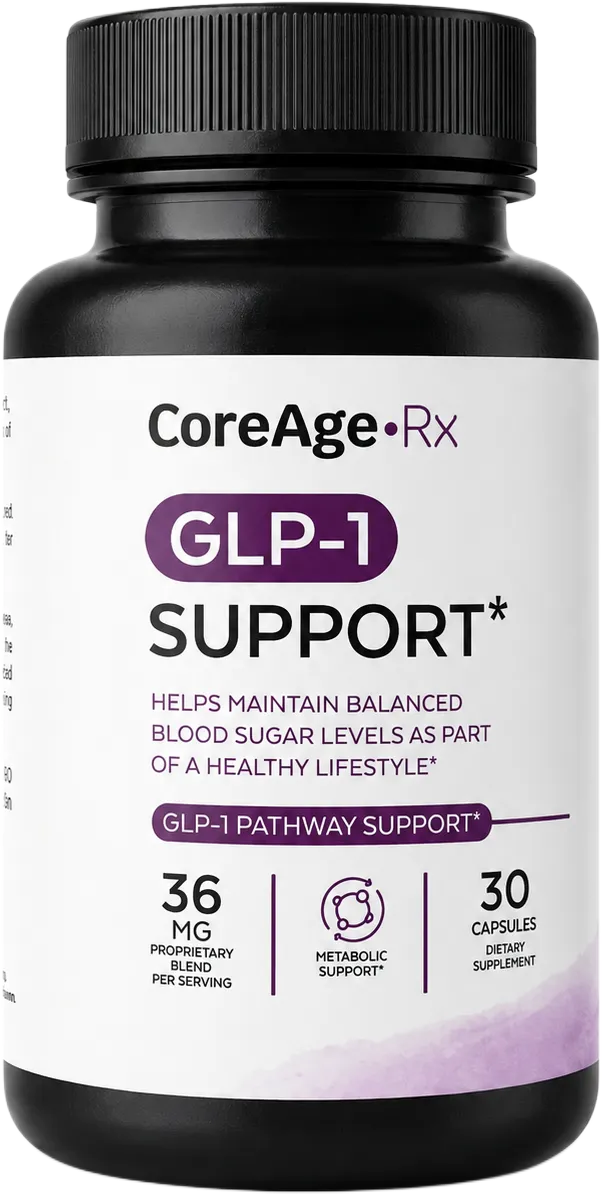
CoreAge Rx GLP-1 Support combines the three listed bacterial species with chicory inulin and potato resistant starch. It is a dietary supplement; it does not replace a GLP-1 prescription. See the current GLP-1 Support™ page and check the bottle you receive before use.
Read the complete probiotics and gut health series
- Probiotics vs. Prebiotics: How They Differ
- How to Read a Probiotic Label: Strains, CFUs, and Storage
- Akkermansia Muciniphila Supplements: What Human Research Shows
- Bifidobacterium Infantis: Why the Exact Strain Matters
- Clostridium Butyricum in Supplements: Strains, Research, and Safety
- Inulin as a Prebiotic: Benefits, Amounts, and Tolerance
- Resistant Starch and Gut Health: Foods, Supplements, and Amounts
- Can You Take Probiotics While Using a GLP-1 Medication?
- Probiotics for Weight Loss: Why Results Do Not Apply to Every Product
- Probiotics and Bloating: What to Watch After Starting
- When Should You Take a Probiotic?
- Do Probiotics Need Refrigeration? Follow the Product Label
- Probiotics After Antibiotics: Timing, Evidence, and Safety
- CoreAge Rx GLP-1 Support: An Ingredient and Label Guide
- How fiber supplements differ from probiotic products
Educational information, not individualized medical advice. Product information and linked research checked September 15, 2026. Ingredient research does not establish identical effects for a finished supplement.