Probiotics are not automatically necessary after every antibiotic course. Some specific preparations have evidence for reducing antibiotic-associated diarrhea in particular populations, but that does not mean every product restores the microbiome or prevents all digestive problems.
Define the goal first
Preventing diarrhea during antibiotic treatment, managing symptoms afterward, and changing the microbiome are different questions. A trial designed around one goal does not establish the others. The NIH probiotic review describes evidence that depends on the strain, amount, age group, and clinical setting.
Ask your prescriber whether a probiotic is appropriate for your circumstances and, if so, which preparation and duration have relevant evidence. “Any probiotic from the store” is not a precise treatment plan.
Timing belongs with the prescription plan
Some protocols begin a particular probiotic during the antibiotic course rather than waiting until afterward. That does not establish one rule for every antibiotic or organism. Ask the pharmacist whether separation is needed and what timing is practical for your specific medicines.
Do not skip or stop an antibiotic to accommodate a supplement. If you are having side effects, contact the prescriber. A probiotic should not substitute for completing or changing treatment under medical guidance.

Do not overlook significant diarrhea
Diarrhea during or after antibiotics can have several causes and sometimes needs testing or treatment. Seek advice for persistent or severe diarrhea, fever, blood in stool, significant abdominal pain, or dehydration. Do not keep adding probiotic servings while delaying assessment.
NCCIH’s overview discusses both potential uses and limitations. People who are seriously ill or immunocompromised need a more careful safety review before using live microbial supplements.
Does GLP-1 Support match antibiotic studies?
CoreAge Rx lists Akkermansia muciniphila, Bifidobacterium infantis, and Clostridium butyricum, plus inulin and resistant starch. The reviewed public material does not disclose strain IDs or CFUs and does not establish that this finished formula prevents antibiotic-associated diarrhea.
The presence of a familiar species name is not enough to match a studied product. Bring the full current label to the clinician instead of assuming the product’s general gut-health positioning answers the antibiotic question.
Build a clear follow-up plan
If a specific probiotic is recommended, record the product, serving, timing, duration, and symptoms that should prompt a call. Avoid continuing indefinitely simply because a course of antibiotics occurred months ago. Reassess the reason for use.
The strain-and-CFU guide helps compare labels, while bloating and side effects helps organize a useful symptom record. The most important distinction is between a product supported for your situation and a general promise to “rebuild” the gut.
Define whether you mean during treatment or after it
“After antibiotics” can mean after each daily dose, after the full course, or after symptoms began. These are different questions. Clarify the timing and the intended goal before seeking a product or schedule.
If the goal is preventing or managing antibiotic-associated diarrhea, the relevant evidence concerns particular preparations and clinical situations. If the goal is a general microbiome reset, ask what outcome that phrase actually describes and how it would be assessed.
The NCCIH probiotic overview discusses evidence and limitations across uses. It does not establish that every person needs a probiotic after every antibiotic or that every commercial blend is interchangeable with a studied preparation.

Keep the antibiotic instructions unchanged unless the prescriber advises otherwise
Follow the prescribed antibiotic course and its food, timing, and administration instructions. Do not skip doses, shorten treatment, or move doses into an unsuitable schedule to make room for an optional supplement.
If side effects make the medicine difficult to take, contact the prescriber or pharmacist. The solution should be based on the treatment and symptoms, not an assumption that a probiotic will make any reaction acceptable.
When asking about a supplement, provide the exact antibiotic name and formulation, the prescribed schedule, and the current supplement label. A general question about separating “good bacteria” from an antibiotic is not detailed enough for every product and medicine.
Understand why strain and preparation still matter
Research may evaluate a particular bacterial strain, a yeast preparation, or a defined combination. These interventions should not be collapsed into a single category-wide effect. The organism, amount, population, and outcome need to match the claim.
A blend listing three bacterial species without strain IDs or CFUs cannot automatically be described as the same product used in an antibiotic-related trial. The NIH probiotic guidance explains the broader importance of product specificity.
This is relevant to GLP-1 Support. Its reviewed materials identify species and small amounts of inulin and resistant starch, but do not establish equivalence to a specific preparation studied for antibiotic-associated outcomes. The product name does not answer that separate evidence question.
Do not use a probiotic to postpone assessment of significant diarrhea
Diarrhea during or after antibiotic treatment can require medical review, especially when it is severe, persistent, accompanied by fever or blood, or interferes with hydration. Tell the clinician about the antibiotic and when symptoms began.
Do not assume all diarrhea is a mild temporary imbalance that should be treated by adding more microbial products. A clinical assessment may need to consider specific causes and appropriate testing or treatment.
Likewise, repeated vomiting, severe abdominal pain, or a significant change in health should not be managed as a supplement-timing issue. Seek prompt advice according to the severity of the symptoms. A product trial is not a substitute for evaluating an active illness.
Ask for a schedule rather than inventing a universal gap
A pharmacist can review whether the proposed product should be used, how it fits with the antibiotic, and whether any spacing is appropriate. The answer depends on the actual medicine and microbial preparation, not merely on the word probiotic.
If an interval is recommended, write it down alongside the prescription schedule. Include what to do if a supplement cue is missed. Do not double the product or rearrange the medicine to maintain a supplement streak.
After the antibiotic course ends, ask whether the product should continue and for what purpose. A completed course does not automatically create an indefinite probiotic requirement. The follow-up plan should identify a reason and a review point.
Review suitability in higher-risk circumstances
People who are seriously ill, immunocompromised, have a central venous catheter, or are under complex medical care should discuss microbial supplements with the treating team before use. Recent hospitalization and significant digestive disease may also be relevant to that review.
The risk-benefit discussion in these circumstances can differ from that for a generally healthy adult. A product being available without a prescription does not make it appropriate for every patient receiving antibiotics.
Bring the complete label and intended serving. If key identity or quantity information is unavailable, tell the care team that rather than assuming the missing details match a familiar study. Accurate uncertainty helps the clinical decision.
Keep recovery nutrition practical
After an illness, ordinary meals and fluids may need attention, especially if appetite or bowel habits have changed. A capsule does not replace the energy, protein, and variety missing from poor intake. Review foods that are manageable and seek guidance when symptoms limit eating.
Avoid adding several prebiotic, probiotic, and fiber products at once in an attempt to rebuild the microbiome quickly. The combined change can make symptoms harder to interpret. A simple plan coordinated with the care team is easier to assess.
The probiotic-versus-prebiotic guide explains the different components, while the bloating guide helps organize a symptom record if a new routine is being reviewed.
Questions for the pharmacist or prescriber
| Question | Why it helps |
|---|---|
| Is a probiotic appropriate for my actual goal? | Avoids assuming a routine is universally needed |
| Which preparation has relevant evidence? | Keeps strain and formulation specific |
| Does this exact product match that evidence? | Prevents category-level substitution |
| How should it fit with the antibiotic? | Produces a medicine-specific schedule |
| Which symptoms need a call or urgent care? | Keeps active illness ahead of supplement use |
| When should use be reviewed or stopped? | Prevents an indefinite routine without purpose |
Frequently asked questions
Does everyone need probiotics after antibiotics?
No universal requirement follows from the evidence reviewed here. The goal, medicine, product, health circumstances, and symptoms should guide the discussion with a qualified professional.
Can GLP-1 Support be assumed equivalent to an antibiotic-study probiotic?
No. The reviewed public material does not disclose the strain and quantity details needed to establish that match. Ask for product-specific information and relevant evidence.
Should I stop the antibiotic if I develop diarrhea?
Contact the prescriber about the symptom and follow individualized advice. Do not independently change treatment or rely on a supplement to manage significant symptoms without assessment.
How long should I continue a probiotic after the course?
There is no single duration established for every product and situation. Ask what purpose continued use serves and when to reassess. A routine should be connected to evidence and the actual clinical context.
Explore GLP-1 Support™
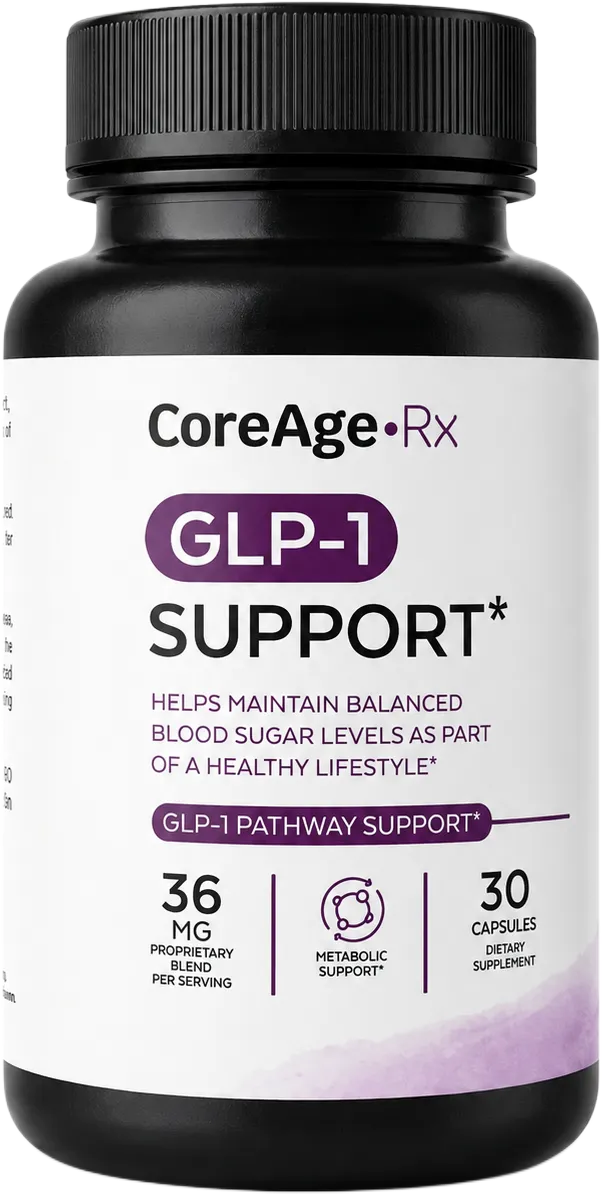
CoreAge Rx GLP-1 Support combines the three listed bacterial species with chicory inulin and potato resistant starch. It is a dietary supplement; it does not replace a GLP-1 prescription. See the current GLP-1 Support™ page and check the bottle you receive before use.
Related reading
- GLP-1 Support Supplements: Ingredients, Evidence, and Expectations
- Clostridium Butyricum in Supplements: Strains, Research, and Safety
- Probiotics and Bloating: What to Watch After Starting
- How fiber supplements differ from probiotic products
Educational information, not individualized medical advice. Product information and linked research checked September 15, 2026. Ingredient research does not establish identical effects for a finished supplement.