
There is no single number that answers every version of “How many people take Ozempic?” A count of Ozempic users, a survey of all GLP-1 medicines, and the number of prescriptions dispensed measure different things. The population, date and definition of use need to stay attached to the statistic.
Two useful U.S. sources describe broader GLP-1 use: a government estimate based on the 2024 National Health Interview Survey and a nationally representative KFF poll conducted in late 2025. Neither establishes a current, Ozempic-only global user total. This article explains what their numbers mean and how to avoid misleading comparisons.
The numbers at a glance
| Source | Population and collection period | What was measured | Reported estimate |
|---|---|---|---|
| NCHS Data Brief 537 | U.S. adults with diagnosed diabetes, 2024 NHIS | Current use of non-insulin GLP-1 injectable medicines at interview | 26.5%, estimated 6.9 million adults |
| KFF poll published November 14, 2025 | U.S. adults; surveyed October 27–November 2, 2025 | Self-reported current GLP-1 use for weight loss, diabetes or another condition | 12% |
| Same KFF poll | Same all-adult survey population | Self-reported ever use of a GLP-1 medicine | 18% |
The NCHS report and original KFF poll report are dated estimates with specific scopes. The 26.5% and 12% figures are not competing answers to the same question. One uses adults with diagnosed diabetes as its denominator; the other uses U.S. adults more broadly.
The review date for this article is October 2, 2026. That is not the year in which either survey collected its observations. Presenting a 2024 or 2025 survey as a real-time 2026 count would change the meaning of the evidence.
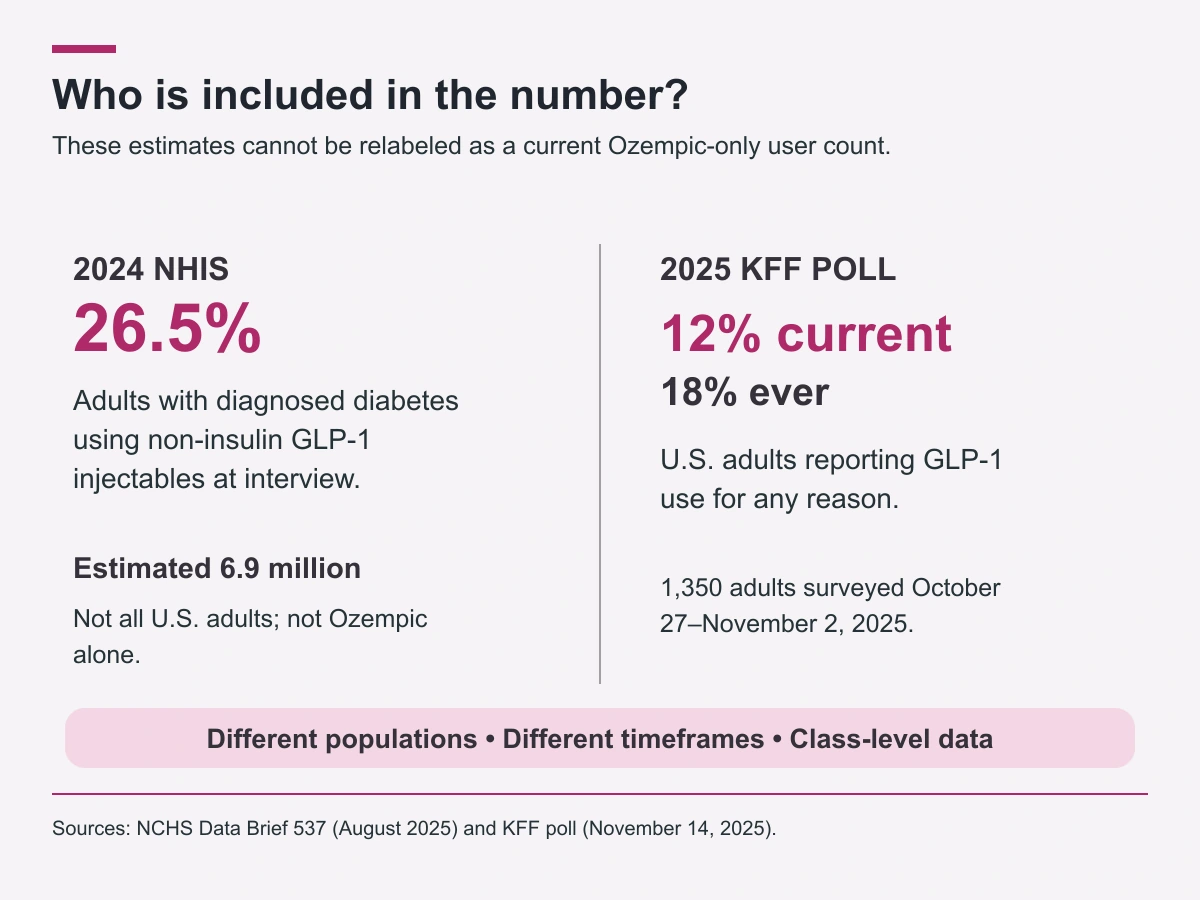
What the 2024 government estimate measures
NCHS reported that 26.5% of adults with diagnosed diabetes were using a non-insulin GLP-1 injectable medicine when interviewed in the 2024 NHIS. It estimated that this represented 6.9 million adults. The reported 95% confidence interval for the percentage was 24.7%–28.5%.
Several parts of that sentence are essential. The population was adults with diagnosed diabetes, rather than every U.S. adult. The measure concerned non-insulin GLP-1 injectables, rather than every oral and injectable medicine in today’s market. It described use at interview, rather than whether someone had ever tried a medicine.
It also was a class measure. The estimate cannot be relabeled “6.9 million Ozempic users.” Doing that would assign the entire measured category to one brand, which the reported statistic does not support.
The source is a survey estimate for the civilian, noninstitutionalized population, with the limitations of its sampling and self-reported information. It is not a complete registry of every prescription, pharmacy fill or individual clinical decision.
What the 2025 KFF poll adds
KFF surveyed 1,350 U.S. adults from October 27 through November 2, 2025. The nationally representative survey used online and telephone interviews in English and Spanish. The report gave a full-sample margin of sampling error of plus or minus three percentage points; subgroup estimates have larger margins.
Twelve percent of adults said they were currently taking a GLP-1 medicine, while 18% said they had ever taken one. These were broader class-level questions concerning use for weight loss, diabetes or another condition.
The gap between current and ever use does not by itself explain why each person stopped. Cost, side effects, a treatment change and other circumstances require their own measures. Do not turn that gap into a universal discontinuation rate or a claim that treatment “failed” for everyone no longer using it.
Similarly, the poll’s historical insurance and affordability findings describe that survey period. They do not automatically describe every plan’s current 2026 benefits. Our GLP-1 insurance coverage guide explains why the exact plan, indication and effective date matter when someone asks about access today.
Why these figures cannot show a simple trend
A tempting comparison is to place 26.5% beside 12% and conclude that use fell. That would be a mistake because the populations and definitions differ.
Imagine two questions asked at the same time: “How many adults with diabetes use this injectable class?” and “How many adults overall use this broader medicine category?” Both answers could be accurate and still have very different percentages. The difference can arise from who is included, rather than a change over time.
A defensible trend needs comparable questions, populations, methods and time points. If a source changes the medicines included, expands to oral products or changes from current to ever use, the comparison needs explanation.
The same caution applies to international comparisons. Age limits, diagnoses, prescribing systems and access differ. A U.S. percentage cannot simply be multiplied by the world population to create a global count.

Ozempic, semaglutide and the GLP-1 category
Ozempic is a brand, semaglutide is an active ingredient, and GLP-1 is a broader medicine category. Those terms should not be substituted for one another in a statistic.
The current Ozempic injection label describes product-specific indications and use. Wegovy also contains semaglutide but has its own prescribing information, routes and indications. Tirzepatide products such as Mounjaro and Zepbound involve a different active ingredient and product-specific labeling.
A survey may group medicines in a way that serves its research question. Read that source’s definition instead of assuming that every grouped participant took the same brand or formulation.
Our GLP-1 overview explains the terminology. The tirzepatide versus semaglutide guide also helps readers separate ingredients, study results and individual treatment decisions. Category popularity does not make products interchangeable.
Prescriptions are not unique patients
A prescription or dispensing total can be useful, but it does not necessarily count unique users. A person receiving several fills during a year may appear several times in a prescription total. A person switching products may appear in more than one product category.
The reporting unit also matters. A source might count prescriptions written, paid claims, pharmacy fills, packages or treatment starts. Those are not automatically the same as people currently using a medicine.
Before interpreting a prescription statistic, ask whether the source identified unique patients, how it handled refills and switching, and what portion of the market it captured. A dataset covering selected pharmacies may be informative without being a complete national census.
Do not combine several datasets into a single user count unless their populations and counting rules support that calculation. Adding them can count the same person more than once.
Sales and searches answer other questions
Sales revenue does not establish how many people take a medicine. Price, package sizes, payment arrangements and geography affect revenue. Even a count of units sold needs a clear definition before it can become an estimate of treatment use.
Search interest is further removed from a clinical count. Someone may search for Ozempic because they are curious, comparing prices, helping a family member, studying side effects or reading news. A search is not a verified prescription or a statement that the person takes the medicine.
Social-media posts and celebrity discussions can make a drug seem ubiquitous. They still cannot establish population prevalence. Appearance also cannot identify someone’s medication use.
If you are looking for practical information rather than a popularity measure, our Ozempic cost guide and Ozempic pen guide answer more specific questions about price comparisons and the identified injection presentations.
Does widespread use mean the medicine is right for you?
Use statistics describe groups. They do not establish your diagnosis, eligibility, likely benefit, side-effect risk or appropriate dose.
A clinician needs your medical history and the exact treatment goal. Diabetes management, weight management and other labeled uses are not the same question. The fact that many people take a medicine does not remove its precautions or establish that you should start it.
The NIDDK’s information about prescription weight-management medicines discusses treatment in the context of individual evaluation and ongoing care. If you are exploring options, semaglutide product information can help you prepare questions about the specific formulation, eligibility and follow-up. It is not a substitute for that evaluation.
For day-to-day questions, see our semaglutide questions guide. Asking what treatment would involve is more useful than choosing it solely because a survey suggests it is common.

A checklist for reading the next headline
When you encounter a large number, pause before sharing it. Find the original report and identify these details:
- Population: All adults, people with diabetes, insured members or another group?
- Geography: A country, region, health system or selected dataset?
- Medicines: Ozempic alone, semaglutide products or a broader class?
- Time: Current use, ever use, annual prescriptions or treatment starts?
- Collection date: When were observations gathered, rather than when the headline appeared?
- Uncertainty: A survey estimate, administrative count or model-based projection?
Then write the conclusion using those same limits. “In a late-2025 U.S. adult poll, 12% reported current GLP-1 use” is a different and more supportable statement than “12% of people take Ozempic now.”
If the report does not supply enough detail to answer those questions, treat the number as incomplete. A precise-looking figure can still be poorly defined.
Frequently asked questions
How many Americans take Ozempic specifically?
The reviewed NCHS and KFF sources do not establish a current Ozempic-only national total. They measure broader categories with different populations and dates. A brand-specific estimate would need an appropriate source that identifies the brand and explains its counting method.
Does the 6.9 million figure include everyone using a GLP-1 for weight loss?
No. It describes adults with diagnosed diabetes using non-insulin GLP-1 injectables at interview in the 2024 NHIS. It cannot be expanded to everyone using these medicines for every reason.
Are 12% current use and 18% ever use inconsistent?
No. Someone can have used a medicine previously and no longer be taking it. The two questions describe different timeframes; the difference alone does not explain each person’s reason for stopping.
Is there a reliable worldwide Ozempic counter?
The sources reviewed here do not establish one. A global estimate would require country coverage, brand-specific definitions, a common timeframe and a method that avoids duplicate counting. Search volume or company revenue cannot provide that by itself.
Should I choose a medicine because it is popular?
Popularity is not a prescribing criterion. Discuss the diagnosis, goals, exact product, risks, access and monitoring with a clinician. A survey describes what groups reported; it does not predict your own outcome.
Educational information for adults; individual treatment decisions require a qualified clinician. Sources reviewed October 2, 2026. Original AI-generated article images depict fictional people and objects, not patient outcomes. Other editorial images are illustrative. Graphics summarize the cited sources.