
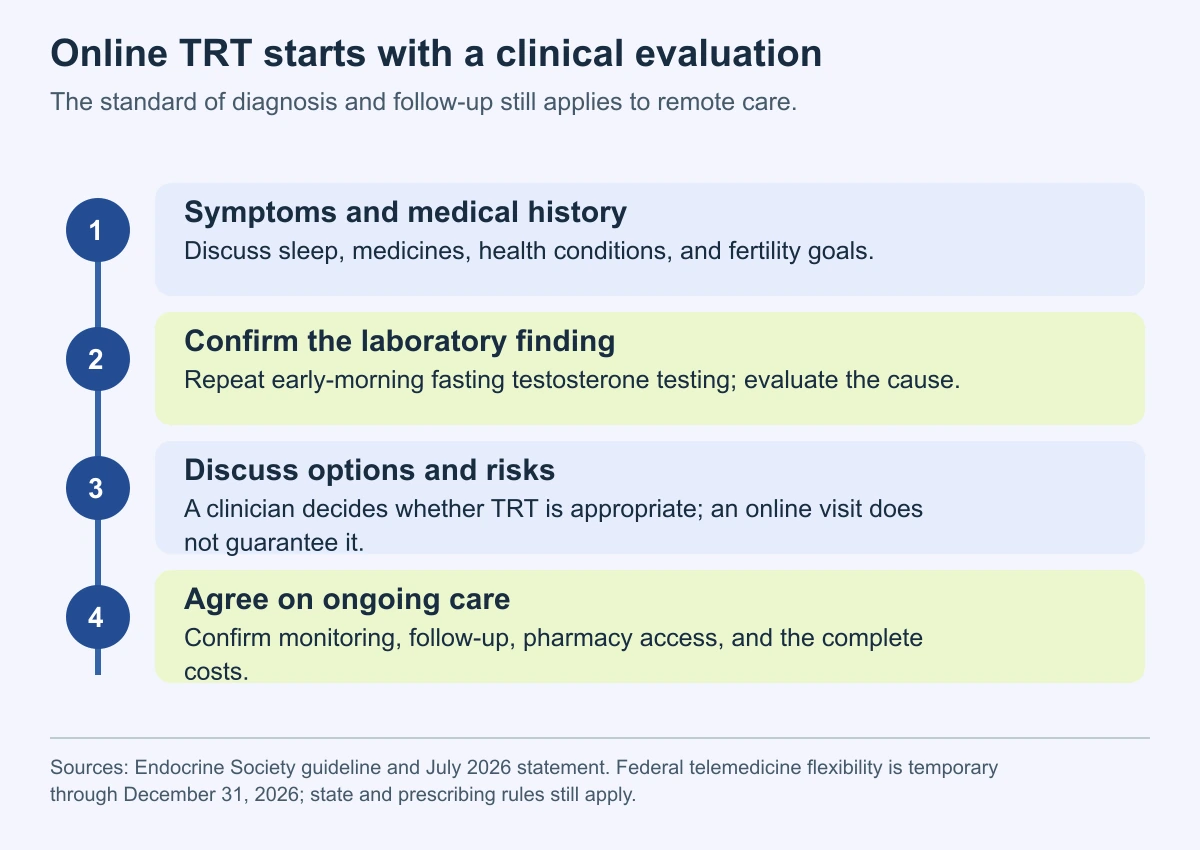
An online TRT prescription may be possible after an appropriate clinical evaluation, but booking a telehealth visit does not guarantee that testosterone will be prescribed. A qualified clinician still needs to assess symptoms, confirm laboratory findings, evaluate the cause, discuss fertility and risks, and arrange follow-up. Prescribing also has to meet current federal and state requirements.
If you are comparing online clinics, the useful question is whether they can provide complete care for your situation. A low advertised monthly price or a quick questionnaire cannot answer that. This guide explains what to expect, what to ask before paying, and how the temporary federal telemedicine rules apply as of September 30, 2026.
What does TRT treat?
TRT stands for testosterone replacement therapy. The Endocrine Society recommends diagnosing hypogonadism in men who have compatible symptoms or signs and consistently, clearly low testosterone concentrations. The evaluation also needs to identify the reason for the deficiency. Clinical guideline
That differs from assuming testosterone is the answer to tiredness, a lower libido, difficulty changing body composition, or normal aging. Those concerns can have multiple contributors. The Society’s July 2026 statement emphasizes accurate diagnosis and assessment of reversible contributors, including some medications and obesity. 2026 statement
Our testosterone replacement guide gives the broader treatment context. The low-testosterone symptoms and testing guide explains why the symptom history and laboratory result have to be interpreted together.
Can you get testosterone prescribed entirely online?
The current federal extension permits certain controlled-substance prescribing through telemedicine without a prior in-person evaluation when its conditions are satisfied. HHS states that this fourth temporary extension runs from January 1 through December 31, 2026. It does not remove requirements for a legitimate medical purpose, licensed practitioners, or compliance with federal and state law. HHS announcement
The operative rule also retains conditions concerning the practitioner’s prescribing authority, the required telecommunications encounter, and other controlled-substance prescription requirements. It is a temporary federal framework rather than a promise that every clinic can treat every patient remotely. Federal Register rule
DEA’s clarification describes audio-video encounters for Schedule II–V medications. Its separate audio-only provision concerns specified narcotic medications for opioid-use-disorder treatment. That provision should not be presented as a general audio-only testosterone rule. DEA clarification
Before booking, ask the clinic which requirements apply where you will physically be located for the visit and whether an in-person assessment could be needed. Also ask how it plans to handle follow-up as temporary rules change. An article dated 2026 cannot establish the rules for a visit after the extension expires.
What should happen before a prescription decision?
A useful evaluation includes more than recording a testosterone number. Be prepared to discuss the concern that brought you to care, when it started, your medical history, sleep, medication and supplement use, previous hormone treatment, and plans for having children.
Examples of details worth bringing include:
- Previous testosterone results, including the laboratory report, collection time, and reference range.
- Prescription medicines, over-the-counter products, supplements, and any hormones obtained elsewhere.
- Known sleep apnea, urinary symptoms, heart or clotting conditions, and relevant cancer history.
- Fertility goals, including future goals rather than only an immediate pregnancy plan.
- The outcome you hope treatment would improve and how it could be assessed.
These details help the clinician decide what needs further evaluation. They do not function as a checklist that automatically qualifies someone for TRT. If a clinic cannot explain who makes the diagnosis or what happens when the evaluation points toward another cause, ask for that information before committing to a subscription.
Which lab tests are needed for online TRT?
The Endocrine Society recommends confirming a low finding with repeat morning fasting total testosterone measurement and using accurate assays and appropriate reference ranges. Its 2026 statement describes diagnosis based on at least two early-morning fasting testosterone tests, interpreted by a health professional. Guideline, 2026 diagnostic statement
A single result, a symptom quiz, or a laboratory flag by itself does not establish the diagnosis. Further testing may be appropriate depending on the initial findings. The guideline recommends measuring luteinizing hormone and follicle-stimulating hormone to help distinguish a testicular cause from a pituitary or hypothalamic cause in men with hypogonadism.
Ask how the clinic orders and reviews testing, whether you can use a local laboratory, and what the quoted price includes. If you already have results, ask whether they meet the clinician’s requirements rather than assuming they replace all new testing. Do not try to manipulate sleep, food intake, or medications to create a lower result. Follow the laboratory and clinician’s preparation instructions.

Why does fertility need its own conversation?
The Endocrine Society recommends against starting testosterone therapy in men planning fertility in the near term. Fertility goals therefore belong in the initial discussion, before choosing a formulation or paying for an ongoing medication plan. Guideline recommendations
Testosterone therapy can decrease sperm production. A treatment that improves some symptoms can consequently conflict with a person’s reproductive goals. Endocrine Society patient information Our TRT and fertility guide explains that issue in more detail.
Ask what the clinic will do if having children matters to you now or later. A responsible answer may involve additional evaluation or referral, rather than simply adding another medication to the package. Do not assume that an advertised combination protocol guarantees fertility preservation or recovery. Keep the reproductive plan part of ongoing care if your circumstances change.
Who might need a different approach or additional evaluation?
The guideline lists circumstances in which it recommends against starting testosterone, including elevated hematocrit, untreated severe obstructive sleep apnea, certain prostate or breast cancer findings, uncontrolled heart failure, recent myocardial infarction or stroke, and thrombophilia, among other conditions. Some findings require additional specialist evaluation. Endocrine Society guideline
That list is not a self-diagnosis tool and does not replace a clinician’s review. It explains why a brief intake form cannot establish suitability for everyone. It also shows why a clinic may reasonably ask for records, repeat testing, or an in-person examination before deciding.
The 2026 Society statement notes that weight loss is typically the first approach for appropriately diagnosed hypogonadism associated with overweight or obesity when no other cause is identified. That is a clinical assessment, not a reason to assume every person with a higher BMI should start a weight-loss medicine or avoid testosterone. Current Society statement
Should you choose injections or gel?
Start with suitability and the exact product, rather than choosing a route from a social-media comparison. Daily routines, handling requirements, costs, access, monitoring, and individual preferences can affect the discussion. A route of administration does not eliminate the need for a diagnosis or ongoing care.
Ask the clinician to explain why a proposed formulation fits your circumstances, how it will be used, and how treatment will be assessed. If the pharmacy dispenses a different presentation, clarify the instructions before using it. An online subscription name is not a substitute for the prescription label.
Our injections versus gel comparison covers these practical differences. This article does not supply a testosterone dose, injection schedule, or conversion between products; those decisions depend on the actual prescription and evaluation.
What should follow-up include?
The guideline recommends evaluating people after treatment begins to assess response, adverse effects, and whether treatment is being followed. Appropriate prostate-risk discussion and monitoring are also part of care for relevant patients. The Society’s 2026 statement emphasizes continued screening and monitoring because important long-term safety questions remain. Guideline, 2026 statement
A useful clinic conversation covers both measurements and symptoms. Ask who reviews laboratory results, how changes are communicated, which symptoms should prompt a message, and how urgent concerns are handled. Ask what happens if the medicine does not provide the expected benefit or follow-up identifies a problem.
Do not judge a clinic solely by whether it offers a higher dose or pursues a particular testosterone number. Your care plan should define the intended benefit, the safety review, and the circumstances that would change treatment. Our TRT side-effects and monitoring guide explains why follow-up is more than an automatic refill.

What is the actual cost of online TRT?
The full cost can include evaluation, repeat laboratory testing, medication, pharmacy charges, supplies, shipping, and follow-up. A monthly headline price may include some of those items, all of them, or none beyond a membership fee. The written terms are what clarify the comparison.
| Ask before paying | Why the answer matters |
|---|---|
| Does the initial fee include a clinician evaluation? | A membership is not necessarily a completed consultation. |
| Which baseline and repeat tests are included? | Testing costs can differ from the medication charge. |
| What happens if TRT is not appropriate? | Understand charges and refund terms before the evaluation. |
| Is the medication included, and which exact product? | Different presentations and dispensing arrangements affect the bill. |
| How are follow-up and prescription changes charged? | Ongoing care is part of treatment. |
| What are the cancellation and transfer procedures? | Records and continuity matter if you change clinics. |
Our TRT cost guide discusses the full bill. CoreAge Rx’s TRT product page currently displays “Coming soon,” as checked September 30, 2026. Check that page for availability updates and terms; this educational article does not confirm service eligibility in a particular state or promise a prescription.
Questions people commonly ask
Does a low at-home test guarantee an online TRT prescription?
No. The clinician must consider symptoms, test quality, repeat findings, possible causes, and risks. Ask whether the clinic accepts that testing method and what confirmatory evaluation is required. A number obtained outside its evaluation process may not be sufficient.
Can an online clinic renew another clinician’s prescription automatically?
Do not assume it can. Ask what records and evaluation it requires, whether it can legally provide care in your location, and how it handles continuity. Plan a transfer before you run out; a new clinic’s appointment does not guarantee a renewal on a particular date.
Is the cheapest clinic the best choice?
Price is one part of the decision. Compare what is included, the clinician’s evaluation process, access to monitoring, pharmacy arrangements, and support when problems arise. A complete written quote makes that comparison clearer than a promotional headline.
What should you do before your first appointment?
Gather your records, medication list, laboratory reports, and fertility goals. Ask the clinic about current location-specific prescribing requirements and its testing process. Our questions before starting TRT can help organize the clinical discussion. The aim is to reach an appropriate treatment decision and a workable follow-up plan, including when the best decision is further evaluation or another approach.
Educational information for adults; individual treatment decisions require a qualified clinician. Sources reviewed September 30, 2026. Original AI-generated article images depict fictional people and objects, not patient outcomes. Other editorial images are illustrative. Graphics summarize the cited sources.