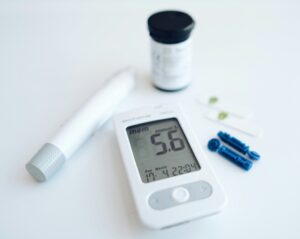
The most important labeled Ozempic interaction questions involve insulin or medicines that increase insulin release, and medicines taken by mouth. Insulin and sulfonylureas can increase the risk of low blood glucose when used with Ozempic. Delayed stomach emptying can also affect how oral medicines are absorbed, so the actual medication list needs review. Ozempic prescribing information.
These warnings do not mean every combination must be avoided. Some medicines are intentionally prescribed together with monitoring or an adjustment by the clinician. The useful next step is a product-specific review that explains what each medicine does, which symptoms to watch for, and who will make any changes.
Start with a complete list
Include prescriptions, over-the-counter pain and cold products, vitamins, supplements, and medicines taken only occasionally. Write the actual name, strength, route, and usual schedule. “A blood-pressure pill” or “a weight-loss shot” may not identify the relevant interaction.
Bring the Ozempic package or a clear image of its label. A compounded semaglutide vial, a semaglutide tablet, and an Ozempic injection are different products. The instructions and evidence for one should not be copied automatically onto another.
Our Ozempic pen and syringe guide explains product identification. If several clinicians prescribe medicines, make sure each can see the full list, including a recent start, stop, or dose change from another service.
Insulin and sulfonylureas need a glucose plan
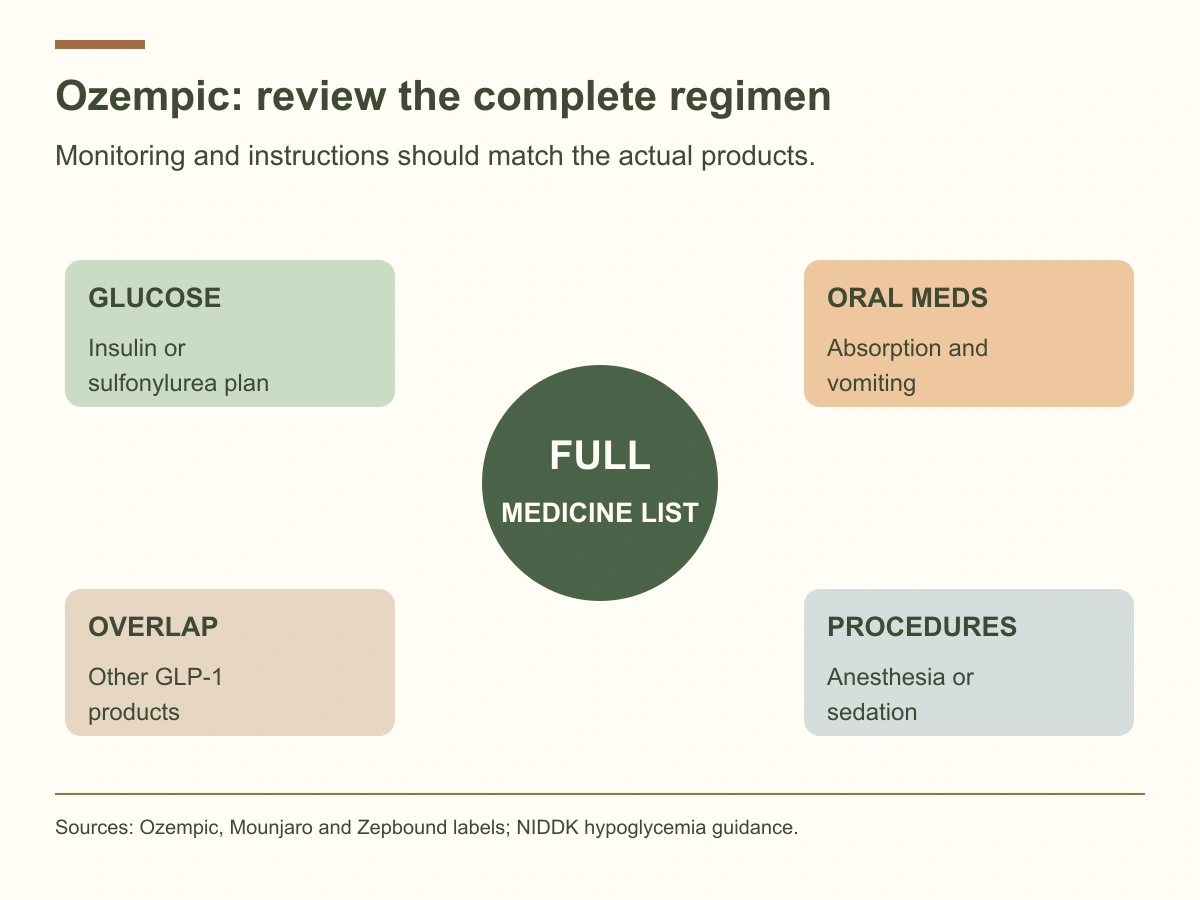
Ozempic’s label warns about increased hypoglycemia risk when it is combined with insulin or an insulin secretagogue such as a sulfonylurea. Examples of the latter class include glipizide. The label says the clinician may consider reducing the concomitant medicine to lower risk. Ozempic interaction and hypoglycemia warnings.
That is a prescribing decision, not an instruction to reduce insulin or a tablet yourself. The team needs glucose information, the treatment indication, eating patterns, kidney health, and other factors. Ask what readings should prompt a call and how the plan changes during illness or reduced intake.
NIDDK identifies skipped or delayed meals, fasting, and insufficient carbohydrate intake as possible contributors to low glucose with relevant diabetes medicines. A new loss of appetite therefore belongs in the medication review. NIDDK hypoglycemia guidance.
Our Ozempic, metformin, and glipizide guide explains why adding a sulfonylurea changes the conversation. Metformin and glipizide are not interchangeable examples of the same interaction risk.
Can Ozempic and insulin be injected together?
They may be prescribed together, but the Ozempic label directs separate injections and says never to mix the products. The same general body region may be used, but the sites should not be adjacent. Follow the training for both actual products. Ozempic administration instructions.
Do not combine them in one syringe to reduce the number of injections. Also avoid changing the insulin schedule based solely on the day Ozempic is given. The glucose-management plan should specify how each prescription is used and how readings are reviewed.
If a dose is uncertain, a product was mixed, or an extra amount may have been taken, contact the pharmacist or prescribing team promptly for specific advice. Do not attempt to correct the event by guessing a compensating dose.
What does delayed stomach emptying mean for oral medicines?
Ozempic delays gastric emptying, which creates the potential to affect absorption of medicines taken by mouth. The label also states that clinical pharmacology studies did not find an effect on oral-drug absorption to a clinically relevant degree, while still advising caution. Both parts of the label matter. Ozempic oral-medication section.
This is not a universal instruction to separate every tablet from the injection by a fixed number of hours. The injection has effects beyond the moment it is administered, and each oral medicine has its own requirements. Ask the pharmacist for a schedule that accounts for the specific products.
Persistent vomiting or inability to retain tablets is another problem that needs assessment. A reassuring interaction-study result does not tell you whether a medicine stayed down during an illness. Report the timing of vomiting and the medicines involved rather than automatically repeating tablets.
Which oral medicines were studied?
The label presents pharmacokinetic information for metformin, warfarin, digoxin, atorvastatin, and an ethinylestradiol/levonorgestrel oral contraceptive. It distinguishes studies performed at steady state from single-dose assessments. Those details limit how broadly the findings should be applied. Ozempic pharmacokinetic information.
The evidence does not imply that every medicine in the same general category has been tested under every circumstance. Nor does it remove the need for usual monitoring of a medicine such as warfarin. Diet changes, illness, other prescriptions, and adherence can also affect treatment.
Our Ozempic and blood-thinners guide explains the difference between a controlled interaction study and an individual monitoring plan. Bring the exact anticoagulant name; not all blood thinners use the same laboratory test.

Use a review table, not a universal avoid list
| Medicine or situation | Main question | What the plan should clarify |
|---|---|---|
| Insulin or a sulfonylurea | Is low-glucose risk changing? | Monitoring, symptoms, and clinician-directed adjustments |
| Oral medicines | Could absorption or vomiting matter? | Product-specific timing and what to do if a dose is not retained |
| Another GLP-1 or tirzepatide product | Is this duplicate or overlapping treatment? | A coordinated switch or treatment plan rather than self-combination |
| Pain, cold, or nausea products | What are the actual ingredients and precautions? | Appropriate use and whether symptoms need assessment first |
| Supplements or multi-ingredient drinks | Is the whole ingredient list known? | Relevant medical history, interactions, and symptom review |
| Surgery or deep sedation | Does delayed stomach emptying affect the procedure plan? | Instructions from the procedural and prescribing teams |
The table organizes questions for review. It is not a statement that every listed product is prohibited or a complete screening tool for all possible interactions.
Does Ozempic have the same birth-control warning as tirzepatide?
Do not copy one product’s contraceptive instructions onto another. The Ozempic label includes data for the studied ethinylestradiol/levonorgestrel combination. Tirzepatide labeling separately advises people using oral hormonal contraceptives to switch to a nonoral method or add a barrier method for four weeks after initiation and four weeks after each dose escalation. Ozempic label, Mounjaro oral-medication warning.
That distinction does not answer every contraception question. Vomiting, missed contraceptive pills, other medicines, and the specific contraceptive can create separate instructions. Ask the reproductive-health clinician or pharmacist to review the actual situation.
Our tirzepatide and birth-control guide explains the tirzepatide-specific precaution. If you are switching products, make sure the transition plan addresses contraception and pregnancy intentions explicitly rather than relying on the previous routine.
Can Ozempic be combined with Wegovy or Zepbound?
Do not add another GLP-1 or tirzepatide product independently. Ozempic and Wegovy contain semaglutide, while Zepbound contains tirzepatide. A different brand name does not automatically mean the therapies should be used together.
Zepbound’s current label states that coadministration with another tirzepatide-containing product or any GLP-1 receptor agonist is not recommended. A clinician-directed transition should specify which medicine ends, which begins, and the follow-up plan. Zepbound limitations of use.
The GLP-1 medication-choice guide helps organize the comparison around indications, tolerability, and access. There is no universal milligram-for-milligram conversion or leftover-medication schedule that an online article can safely assign.
What about pain relievers, antibiotics, or nausea medicines?
The answer depends on the exact product and why it is needed. A new symptom can require evaluation before another medicine is added. Severe abdominal pain, repeated vomiting, or a serious allergic reaction should not be managed only by finding an over-the-counter product that lacks a flagged interaction.
Consider ingredient overlap, liver or kidney history, dehydration, drowsiness, and other prescriptions where relevant. For example, two different cold and pain products can contain the same active ingredient. An interaction with Ozempic is only one part of checking the combination.
Our Tylenol and Ozempic guide and antibiotics with Ozempic guide address those specific situations. Ask the pharmacist to review the actual package rather than a general category such as “cold medicine.”
Tell the procedural team before anesthesia or sedation
The Ozempic label warns about rare reports of pulmonary aspiration during general anesthesia or deep sedation in people receiving GLP-1 medicines. It notes that available data are insufficient to establish a universal strategy for reducing that risk. Patients should inform healthcare providers before planned procedures. Ozempic procedural warning.
Do not choose a stop date or fasting schedule from a generic interaction chart. The procedural and prescribing teams need the exact medicine, last dose, recent escalation, and digestive symptoms. Our semaglutide and anesthesia guide explains the coordinated conversation.
This is a good example of why a medication review extends beyond which pills can be swallowed together. The treatment’s effect on the body can matter even when the other intervention is a procedure.
Keep the product and follow-up plan clear
Before leaving the review, ask which medicines continue as prescribed, whether any change is needed, what to monitor, and when to call. Write down who is responsible for changes when more than one clinician is involved.
CoreAge Rx’s semaglutide page describes offered compounded care. Compounded semaglutide is not FDA-approved Ozempic, and its specific preparation and instructions require their own review. A shared ingredient name does not establish finished-product equivalence. FDA compounding explanation.
Frequently asked questions
Is there one list of medicines everyone must avoid with Ozempic?
No short list can replace a review of the actual products, doses, conditions, and symptoms. Some combinations are used intentionally with monitoring, while others require a different plan.
Should I stop an interacting medicine before calling?
Do not independently change necessary prescriptions based on an online interaction flag. Contact the prescribing team or pharmacist for a specific plan. Seek urgent help for severe symptoms rather than waiting for routine advice.
Does taking tablets at another time eliminate the interaction?
Not necessarily. A fixed separation interval is not a universal solution to delayed stomach emptying or low-glucose risk. Follow instructions tailored to the actual products.
Should supplements be on the list too?
Yes. Include the ingredient label and amount used, even if the product is marketed as natural. Multi-ingredient products can make the review more complicated, so the exact label is helpful.
Educational information for adults; individual treatment decisions require a qualified clinician. Sources reviewed October 5, 2026. Original AI-generated article images depict fictional people and objects, not patient outcomes. Other editorial images are illustrative. Graphics summarize the cited sources.