Whether an antibiotic can be used with Ozempic depends on the exact antibiotic, the infection, your other medicines, and how well you are eating and drinking. Ask the prescriber or pharmacist to check the complete regimen. Ozempic’s label advises caution with oral medicines because it delays stomach emptying; it does not provide blanket clearance for every antibiotic or a universal timing gap. Ozempic prescribing information
An infection can also change diabetes management independently of a drug interaction. New vomiting, diarrhea, reduced intake, or unusual glucose readings deserve a plan for the illness rather than a simple yes-or-no answer about two medicine names. CDC diabetes sick-day guidance
Start with the name of the antibiotic
If methotrexate is also on your list, see methotrexate, Ozempic and weight changes for regimen-specific monitoring, fluid-loss concerns and why antibiotics and pain relievers belong in the complete review.
“Antibiotics” describes many medicines. The pharmacist needs the actual name, strength, formulation, prescribed schedule, and reason it was prescribed. A tablet, liquid, topical preparation, and intravenous medicine raise different questions. Do not substitute the instructions for one product for another.
Tell the infection prescriber that you use Ozempic even if another practice prescribed it. Tell the Ozempic prescriber about the infection, particularly if symptoms are affecting your intake or medication routine. This allows the team to review both the treatment and the illness.
Bring the prescription label or an accurate photo of it to the conversation. Include medicines taken only occasionally, such as a pain reliever, antacid, supplement, or cough preparation. A third medicine can matter even when the original question concerns only Ozempic and an antibiotic.
For a related tirzepatide question, see Mounjaro and amoxicillin. That article provides context for asking better questions; it cannot clear an Ozempic combination or replace an antibiotic-specific review.
What does delayed stomach emptying change?
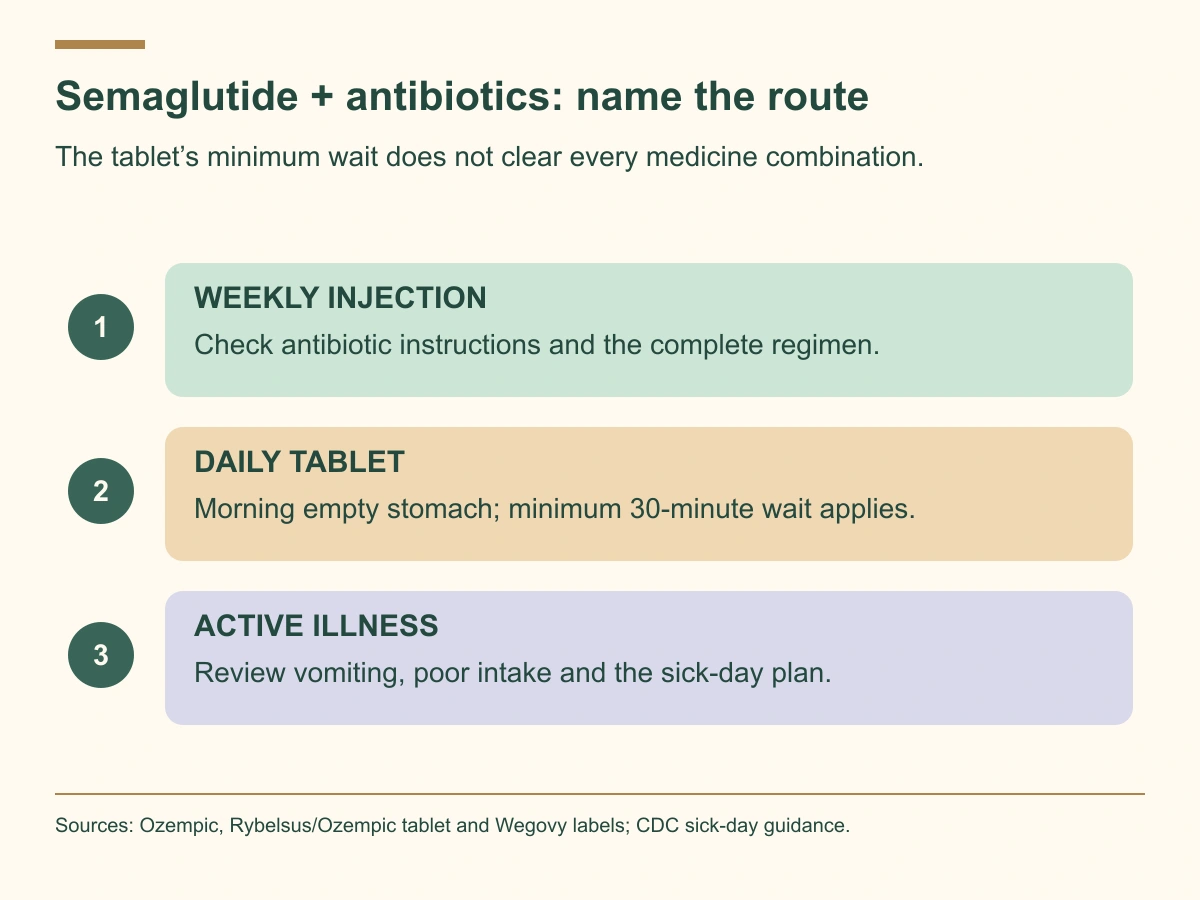
Ozempic slows gastric emptying, meaning the movement of stomach contents onward through the digestive tract. Its label says this has the potential to affect absorption of oral medicines. In the clinical pharmacology trials described in the label, semaglutide did not affect absorption of oral drugs to a clinically relevant degree, but caution with oral medicines is still advised. Ozempic oral-medicine interaction section
That passage does not mean antibiotics universally stop working. It also does not establish that every antibiotic has been individually tested with Ozempic under every condition. The exact prescription and your ability to take it as directed remain important.
Ask whether the antibiotic has food, drink, supplement, or other medicine instructions of its own. Follow the pharmacist’s product-specific guidance. Do not invent a two-hour or four-hour gap based solely on the fact that Ozempic delays gastric emptying. Injectable Ozempic can be used at any time of day, with or without food, under its administration instructions; that does not erase another medicine’s instructions.
Does this also apply to Wegovy and other semaglutide products?
The medicine name alone is not enough to organize the schedule. Semaglutide is available in different branded formulations, including weekly injections and daily tablets. Wegovy and Ozempic also have distinct approved uses. Tell the antibiotic prescriber the exact brand, route, and strength, and show the actual prescription label. Wegovy prescribing information; Ozempic prescribing information
Wegovy’s label also discusses delayed gastric emptying and potential effects on absorption of oral medicines. That warrants a product-specific review; it does not establish that every antibiotic is unsuitable or that every combination has been tested. The infection, digestive symptoms, other medicines, and the antibiotic’s own instructions still matter.
A compounded preparation requires its own accurate label and pharmacy instructions. FDA explains that compounded GLP-1 drugs are not FDA approved and highlights dosing and quality concerns. Do not translate instructions between a compounded vial and a branded pen or tablet by ingredient name alone. FDA compounded GLP-1 information
Oral semaglutide has its own morning instructions
The reviewed Rybelsus and Ozempic tablet label instructs patients to take the tablet in the morning on an empty stomach with water, up to 4 ounces, swallow it whole, and wait at least 30 minutes before eating, drinking other beverages, or taking other oral medicines. The Wegovy tablet label also includes an empty-stomach morning routine and a minimum 30-minute wait. Rybelsus and Ozempic tablet instructions; Wegovy tablet instructions
This is a minimum administration requirement for the semaglutide tablet. It does not override an antibiotic’s own food, drink, antacid, mineral, or timing instructions. A pharmacist should make the complete daily schedule workable, especially if the antibiotic is prescribed more than once a day.
For example, telling someone only “take everything at breakfast” may conflict with the semaglutide tablet’s instructions. Telling everyone to separate all medicines by four hours invents a rule that may also be inappropriate. The correct approach is to reconcile the actual labels and prescription times, not select a universal gap from a social-media post.
| Formulation question | What to clarify with the pharmacist |
|---|---|
| Weekly semaglutide injection | The antibiotic’s own instructions and the full interaction review |
| Daily oral semaglutide | Empty-stomach administration, the minimum wait, and the antibiotic’s separate requirements |
| Vomiting after an oral dose | Whether that particular dose should be repeated or handled another way |
| Several morning medicines | A written schedule that satisfies the actual products’ instructions |
What if the antibiotic instructions seem to conflict?
Contact the pharmacist or prescriber before improvising. Have both labels available and explain meal timing, work hours, and any nausea or difficulty swallowing. The team may be able to clarify the schedule or determine whether a treatment change is needed. Do not crush semaglutide tablets, change the antibiotic interval, or skip prescribed doses to create room in the morning without advice.
If vomiting makes it impossible to keep oral treatment down, a timing chart is no longer the whole problem. The infection and hydration need reassessment. Ask for prompt guidance about the dose already taken and the next one; uncertainty about absorption is not a reason to automatically take an extra tablet.
The semaglutide nausea and vomiting guide explains related symptoms. If you also use an over-the-counter pain medicine while ill, the ibuprofen and Wegovy guide shows why dehydration and the full medication list matter beyond a two-drug interaction search.
Why illness and side effects can overlap
Ozempic’s common adverse reactions include nausea, vomiting, diarrhea, abdominal pain, and constipation. If a digestive symptom begins during an infection or after a new prescription, timing is useful evidence, but it is not proof of which factor caused the symptom. Ozempic adverse reactions
Record the onset of the illness, the first antibiotic dose, the most recent Ozempic dose, and any recent dose change. Also note whether symptoms were present before the antibiotic began. This makes the discussion more useful than describing every symptom as an interaction.
If vomiting prevents you from keeping an oral antibiotic down, contact the prescriber or pharmacist. Ask what to do about the particular dose and whether the treatment route or plan needs reassessment. Do not automatically repeat a dose when absorption is uncertain, and do not double the next dose to compensate.
The Ozempic side-effects guide provides broader symptom context. It should support communication with the care team, rather than encourage you to attribute a new illness to the injection automatically.
Diabetes sick-day planning is a separate issue
CDC explains that illness can raise blood glucose through the body’s stress response. Eating or drinking less can also make glucose harder to manage. People taking insulin may need a different plan during illness, and the care team may recommend more frequent glucose checks. CDC sick-day guidance
Do not interpret this as an instruction to stop all diabetes medicines or to change insulin on your own. Ask for an individualized sick-day plan that says what to continue, when to call, how to monitor, and which symptoms require emergency care. The plan should reflect all of your diabetes medicines and health conditions.
Ozempic’s label identifies increased low-glucose risk with insulin or an insulin secretagogue such as a sulfonylurea. Reduced food intake can be particularly relevant when a medicine already lowers glucose. Ozempic hypoglycemia warning, NIDDK low-glucose causes
For combination context, see Ozempic with metformin and glipizide. Metformin, a sulfonylurea, and insulin are not interchangeable names for the same risk profile.
A practical antibiotic-and-illness checklist
| Topic | What to tell the team | Decision to clarify |
|---|---|---|
| Antibiotic prescription | Exact product, schedule, and infection | Whether the complete regimen is appropriate |
| Digestive symptoms | Vomiting, diarrhea, pain, onset | Whether symptoms need assessment or a treatment change |
| Intake | What fluids and food you can keep down | A suitable hydration and sick-day plan |
| Diabetes medicines | Insulin, sulfonylureas, and other prescriptions | Monitoring and clinician-directed adjustments |
| Kidney or heart care | Disease history or fluid limits | Whether ordinary fluid advice needs modification |
| Other medicines | Antidepressants, antacids, supplements, pain medicines | Product-specific interaction and timing instructions |
Keep any glucose readings with their dates, times, symptoms, and meal context. If your team has given a specific threshold for calling or checking ketones, follow it. Do not replace those instructions with a generic chart from someone else’s care plan.
Why antidepressants should be mentioned
An antibiotic review should include an SSRI such as Lexapro or Zoloft if you take one. Their labels specifically warn about the antibiotic linezolid because it is also a monoamine oxidase inhibitor, or MAOI. Starting these SSRIs in someone receiving linezolid is contraindicated in the reviewed labeling, and urgent situations require clinician-managed decisions. Lexapro contraindications and warnings, Zoloft serotonin-syndrome warning
This example shows why “no interaction with Ozempic” would be an incomplete review. The relevant problem may involve two other medicines. Do not stop an antidepressant, use a timing gap, or change an antibiotic yourself to resolve it.
See Ozempic with Lexapro or Zoloft for the difference between semaglutide’s oral-medicine caution and an antidepressant’s own warnings. Tell both prescribing practices about the full list so that one team can coordinate the plan.
When should you seek urgent medical help?
Trouble breathing, severe allergic symptoms, fainting, or severe persistent abdominal pain warrants urgent attention. Ozempic warns about serious hypersensitivity reactions, pancreatitis, severe gastrointestinal reactions, and dehydration-related kidney injury. Ozempic warnings
CDC’s diabetes sick-day page identifies emergency circumstances including trouble breathing, ketones in urine, inability to keep liquids down for more than four hours, and vomiting or severe diarrhea for more than six hours. These are general public-health instructions for people with diabetes; follow any more specific or earlier action threshold your own team gives you. CDC emergency sick-day guidance
Do not wait for the next weekly injection day if you are deteriorating. The urgency comes from the symptoms and illness, not from how recently the medicine was administered.
If a fever accompanies upper abdominal pain, yellowing of the skin or eyes, or other concerning symptoms, report the whole pattern. Read Ozempic and fever for why fever should not automatically be dismissed as an ordinary digestive side effect.
Should you change the Ozempic schedule during antibiotics?
An antibiotic course does not, by itself, provide a universal rule to skip, delay, or repeat Ozempic. Ask the prescriber how the current illness and intake affect your next dose. A decision may depend on symptoms, the indication, other medicines, and your ability to follow the plan safely.
If a dose is missed, use the instructions for your actual prescription and confirm any uncertainty with the care team. The Ozempic dosage guide helps explain routine scheduling, but an illness-related decision is broader than a calendar calculation.
Also ask how to restart if treatment is interrupted and who will confirm the plan. Do not use an old supply, a different semaglutide product, or someone else’s instructions as a substitute. Keep the written advice with the antibiotic label so the schedules remain clear.
Questions to ask at the pharmacy
Ask these questions in one conversation:
- Have you checked this exact antibiotic against all my medicines and supplements?
- Does it have its own food, antacid, supplement, or timing instructions?
- What should I do if I vomit after a dose or cannot keep it down?
- Which symptoms should lead me to call the prescriber today?
- Who should advise me about the next Ozempic dose while I am sick?
- What should my diabetes monitoring plan be during this illness?
If the answer depends on the prescribing clinician, ask the pharmacy to identify what needs clarification. You should leave with a usable plan, not just an unexplained interaction-alert label.

Frequently asked questions
Can I take amoxicillin with Ozempic?
Give the pharmacist the exact prescription and complete medicine list. The Ozempic oral-medicine passage is not a universal antibiotic clearance. The infection, kidney history, other medicines, and symptoms still need consideration.
Should I separate my antibiotic and injection by a few hours?
There is no universal antibiotic-separation rule in the reviewed Ozempic labeling. Follow the antibiotic’s actual instructions and any individualized guidance from your pharmacist or prescriber.
Does diarrhea mean the antibiotic and Ozempic cannot be combined?
Diarrhea alone cannot establish the cause or the suitability of the combination. Report severity, duration, fever or pain, and ability to drink. Persistent or severe symptoms need assessment.
Where can I learn about semaglutide treatment?
The CoreAge Rx semaglutide information page introduces care questions. It does not clear an antibiotic combination, manage an infection, or establish equivalence to Ozempic.
Sources checked for this update
Ozempic source; Wegovy source; Oral Semaglutide source; Sick Days source; Hypoglycemia source; Lexapro source; Zoloft source; Compounding source.
Educational information for adults; individual treatment decisions require a qualified clinician. Sources reviewed October 5, 2026. Original AI-generated article images depict fictional people and objects, not patient outcomes. Other editorial images are illustrative. Graphics summarize the cited sources.