
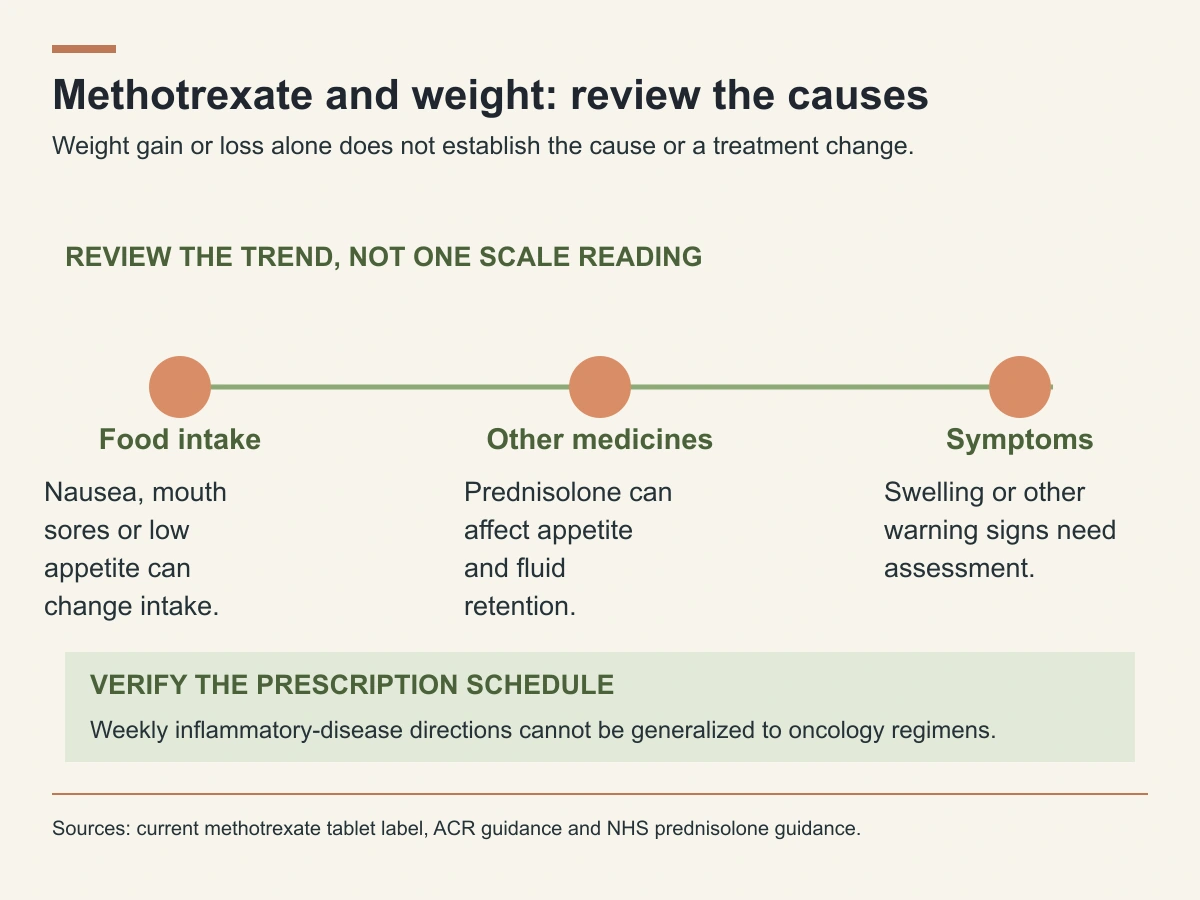
Weight gain or loss during methotrexate treatment should be reviewed in context rather than automatically blamed on the medicine. Appetite changes, nausea, the condition being treated, other prescriptions, and fluid changes can all affect the questions your clinician asks. A scale reading alone cannot identify the cause.
Some changes need prompt attention. The current methotrexate tablet patient information lists weight loss and reduced appetite among possible liver-problem symptoms, and weight gain with swelling or urine changes among possible kidney-problem symptoms. Those are reasons for assessment, not proof that a complication has occurred.
This guide explains what to track, how to distinguish different issues, and why the exact methotrexate prescription matters. Methotrexate is not a weight-loss medicine.
Start with why methotrexate was prescribed
Methotrexate has several clinical uses. In rheumatology, it is a disease-modifying antirheumatic drug used to treat conditions such as rheumatoid arthritis. The American College of Rheumatology explains that it can reduce arthritis pain and swelling and help prevent joint damage and long-term disability. It is also used in other inflammatory conditions and in specific cancer regimens. ACR methotrexate patient guidance, Methotrexate tablet prescribing information.
These uses do not share one general dosing schedule, treatment goal, or risk context. An online account from a person receiving chemotherapy cannot be assumed to describe a weekly rheumatology prescription, and the reverse is also true.
Tell the clinician the condition being treated, the formulation, the prescribed schedule, and whether other medicines changed at the same time. “I take methotrexate” is a starting point, but it does not provide enough information to interpret a weight trend.
Also describe what you mean by a change. A gradual change over months, a sharp change over a few days, swelling, and difficulty eating represent different patterns that may need different assessments.
Does methotrexate commonly cause weight gain?
The reviewed tablet label’s common adverse-reaction discussion emphasizes effects such as nausea, abdominal distress, mouth sores, and blood-count changes. It does not present routine weight gain as a simple, expected explanation for every patient whose weight rises. Methotrexate tablet prescribing information.
That does not mean a new increase should be ignored. The patient information specifically asks patients to report possible kidney-problem symptoms, including weight gain, swelling of the legs, ankles, or feet, changes in urine output, shortness of breath, and tiredness.
If weight rises quickly and you notice swelling or a marked change in urination, contact your clinician promptly. A weight increase with these symptoms needs an assessment of fluid balance and other possible causes rather than an assumption that it represents body-fat gain. Methotrexate patient information.
For ordinary scale interpretation, our water weight versus fat loss guide explains why short-term changes are not the same as changes in fat. That educational distinction does not replace evaluation of new swelling or other concerning symptoms.
Can methotrexate affect appetite or lead to weight loss?
Gastrointestinal symptoms are a recognized issue during methotrexate treatment. The current tablet label describes nausea, vomiting, diarrhea, and mouth sores, and NHS patient guidance includes loss of appetite among common side effects. These symptoms can interfere with intake. Methotrexate prescribing information, NHS methotrexate side-effect guidance.
If you are eating less because of nausea or mouth discomfort, tell the treating team what you can manage and how long the problem has lasted. Unwanted weight loss is a reason to review nutrition and treatment tolerability, not evidence that methotrexate is an effective weight-management strategy.
The tablet patient information also includes weight loss and reduced appetite among possible liver-problem symptoms, together with signs such as nausea, weakness, easy bleeding or bruising, swelling, itching, and jaundice. A symptom list identifies reasons to report a problem; it does not diagnose liver disease from a single weight measurement. Methotrexate patient information.
Contact your clinician about persistent symptoms or an unexplained trend. Seek urgent help if you are severely unwell, cannot maintain fluids, have significant bleeding, or have severe abdominal pain.
Other prescriptions can be part of the explanation
People receiving methotrexate may also receive other medicines for the same condition or for unrelated health needs. Review the whole list instead of assigning every change to the most familiar drug name.
For example, NHS guidance on prednisolone explains that it can increase hunger and cause the body to retain more water. The amount and duration of treatment matter. That is information about prednisolone, not proof that it caused your particular weight change or a rule for every corticosteroid. NHS prednisolone side-effect guidance.
If a steroid was started, changed, or stopped around the same time, give the clinician those dates. Do not abruptly stop a steroid or methotrexate to test which medicine is responsible. Each prescription has its own instructions and treatment purpose.
Include supplements and nonprescription medicines as well. Methotrexate’s label describes clinically important interaction considerations. A new product may affect the treatment review even if it was not prescribed by the same clinician. Methotrexate prescribing information.
The condition and daily routine also matter
Ask how active disease, pain, fatigue, and changes in routine fit the assessment. If symptoms affect shopping, meal preparation, or activity, describe the actual difficulty. If treatment has improved your ability to do those things, describe that too.
This is not a claim that improvement must cause a particular weight change. It is a way to give the clinician information beyond the number on the scale. Disease control, nutrition, function, and adverse effects are related questions, but one measurement cannot answer all of them.
The treatment goal in rheumatoid arthritis includes reducing symptoms and preventing joint damage. A weight change alone does not establish whether methotrexate is controlling the disease, whether it should be increased, or whether it should be stopped. ACR methotrexate patient guidance.
Ask which measures will be used to review treatment response and what changes should prompt an earlier appointment.

A practical comparison of weight-change patterns
| What you notice | Information to report | Why assessment matters |
|---|---|---|
| Reduced appetite with nausea or mouth sores | Duration, what you can eat, vomiting or diarrhea, weight trend | Symptoms may interfere with nutrition and tolerability |
| Rapid gain with swelling or urine changes | Timing, swelling location, urine output, breathlessness | The label identifies these among possible kidney-problem symptoms |
| Weight loss with jaundice, unusual bruising, or marked weakness | Associated symptoms and medicine history | The label identifies possible liver and other serious problems |
| Gradual change after another prescription changes | Names, doses, dates, appetite and routine | The full medicine list may change the explanation |
| A change without an obvious pattern | Comparable measurements and relevant health changes | The scale alone cannot determine the cause |
The table does not diagnose the pattern or list every possible cause. It shows the details that make a clinical review more informative. Methotrexate prescribing and patient information.
The weekly-prescription warning is important
Methotrexate used for rheumatoid arthritis and similar inflammatory treatment is commonly prescribed on a weekly schedule. The current tablet label warns that medication errors have caused deaths, most often when patients took a prescribed weekly regimen daily. Methotrexate prescribing information.
Follow the exact written prescription. Confirm the day, tablet strength, number of tablets or injection amount, and any explicitly prescribed split-dose instructions with the pharmacist. A schedule used for another condition or another patient is not a substitute.
If you think you have taken a weekly prescription daily, taken an extra dose, or misunderstood the directions, seek urgent professional advice. Do not wait to see whether your weight changes or whether symptoms appear before asking what to do.
Cancer regimens require their own oncology instructions. The weekly-rheumatology discussion here should not be transferred into a general schedule for every methotrexate use.
Nutrition support should fit the problem
If appetite is low, ask the treating team for help maintaining intake rather than applying a restrictive weight-loss plan. NHS guidance suggests smaller, more frequent meals and nutritious snacks when loss of appetite makes eating difficult. Persistent or worsening symptoms still need review. NHS methotrexate side-effect guidance.
Our balanced meal guide and protein breakfast ideas can help generate food questions, but they do not establish your personal targets. Someone with unwanted weight loss, poor intake, or active illness may need a different plan from someone intentionally managing weight.
Folic acid is another prescription-specific issue. A rheumatology clinician may prescribe it to reduce methotrexate side effects. The tablet label separately describes considerations for cancer treatment, where folate products should not be added without the treating clinician’s direction. Do not copy a supplement regimen from a different treatment setting. ACR methotrexate guidance, Methotrexate prescribing information.
For broader ingredient questions, see our supplement review guide. Its GLP-1 discussion does not supply a methotrexate-specific supplement prescription.
Monitoring includes more than body weight
The methotrexate label calls for blood-count, liver, and kidney monitoring before and during treatment as appropriate. ACR also emphasizes regular laboratory monitoring. Keeping a weight record does not replace those checks. Methotrexate prescribing information, ACR methotrexate guidance.
Report fever or other infection symptoms, new cough or breathing difficulty, persistent or worsening mouth sores, significant gastrointestinal symptoms, unusual bleeding, or jaundice. The label describes serious blood, liver, lung, kidney, gastrointestinal, and other risks that need their own assessment.
If you are pregnant, think you could be pregnant, or are planning pregnancy, contact the treating team promptly. Methotrexate has important pregnancy-related risks and product-specific requirements. Do not use a weight-change discussion as a substitute for reviewing that issue. Methotrexate prescribing information.
Ask how you will receive laboratory results, which symptoms should trigger a call, and who provides instructions if illness affects the next scheduled dose.

What to bring to a weight-change appointment
Bring the prescription, a complete medicine and supplement list, and a short timeline of symptoms and weight measurements. Comparable measurements are more useful than readings taken under very different conditions.
Explain whether the change was intended, whether appetite has changed, and whether you have swelling, pain, vomiting, diarrhea, mouth sores, or difficulty maintaining fluids. Include changes in other treatment, especially steroids.
If you also use a weight-management medicine, tell both treating teams. Our semaglutide questions guide and tirzepatide questions guide can help organize that part of the list. They do not establish the safety of a particular combination with methotrexate.
Common questions about methotrexate and weight
Does methotrexate cause weight gain or weight loss?
Either trend can occur during treatment, but the trend alone cannot establish the cause. Appetite and gastrointestinal symptoms, other medicines, fluid changes, and the underlying health situation deserve review. The label’s specific warning symptoms should not be ignored.
Is sudden weight gain with swollen ankles just ordinary weight gain?
Do not assume that. Methotrexate’s patient information identifies weight gain, swelling, and urine changes among possible kidney-problem symptoms. Contact your clinician promptly for assessment. Methotrexate patient information.
Should I stop methotrexate to see if my weight returns to normal?
Do not make an unsupervised change based on the scale. Contact the treating team about the trend and any symptoms. Urgent problems need prompt assessment and product-specific instructions.
Can I use methotrexate to lose weight?
No. It is prescribed for specific inflammatory and cancer-related uses, not as a weight-loss medicine. Reduced intake or unwanted weight loss during treatment is a clinical concern to assess.
Does taking it weekly mean every methotrexate regimen is weekly?
No. Follow the exact prescription for your condition. A weekly prescription taken daily can cause serious or fatal harm, while oncology schedules require their own instructions. Confirm any uncertainty with the treating clinician or pharmacist. Methotrexate prescribing information.
Educational information for adults; individual treatment decisions require a qualified clinician. Sources reviewed October 2, 2026. Original AI-generated article images depict fictional people and objects, not patient outcomes. Other editorial images are illustrative. Graphics summarize the cited sources.