Tirzepatide vials are not all the same. The current U.S. Mounjaro and Zepbound labels list ready-to-use liquid single-dose and multi-dose vials, with different dose volumes and storage instructions. A compounded prescription has its own dispensing label and cannot be measured using a universal internet syringe chart.
If your question is how to reconstitute tirzepatide, first identify the product. The manufacturer vials discussed here contain a liquid solution; they are not powders that require you to add mixing water. A product sold as research powder is a separate quality and safety issue, not another presentation of the approved liquid vial.
This guide explains the distinctions to confirm with the prescriber and pharmacist. Start with our tirzepatide questions guide for the broader treatment discussion.
Identify the product before discussing the vial
Tirzepatide is the active ingredient in Mounjaro and Zepbound, but those brands have their own approved treatment uses and prescribing information. The name of the ingredient does not identify the brand, container, concentration, or instructions you received. Mounjaro prescribing information, Zepbound prescribing information.
Check the carton and dispensing label for the product name, strength, volume, expiration or beyond-use information, pharmacy, and prescribed directions. Also identify whether the container is single-dose or multi-dose.
A multi-dose vial and a single-patient-use KwikPen may both contain four weekly doses in the current labels, but they are different devices. A pen’s controls are not a vial syringe scale. Do not use a pen tutorial to decide how much liquid to draw from a vial.
Our Zepbound versus Mounjaro guide explains the brand distinction. The vial question comes next, after the prescription has been identified.
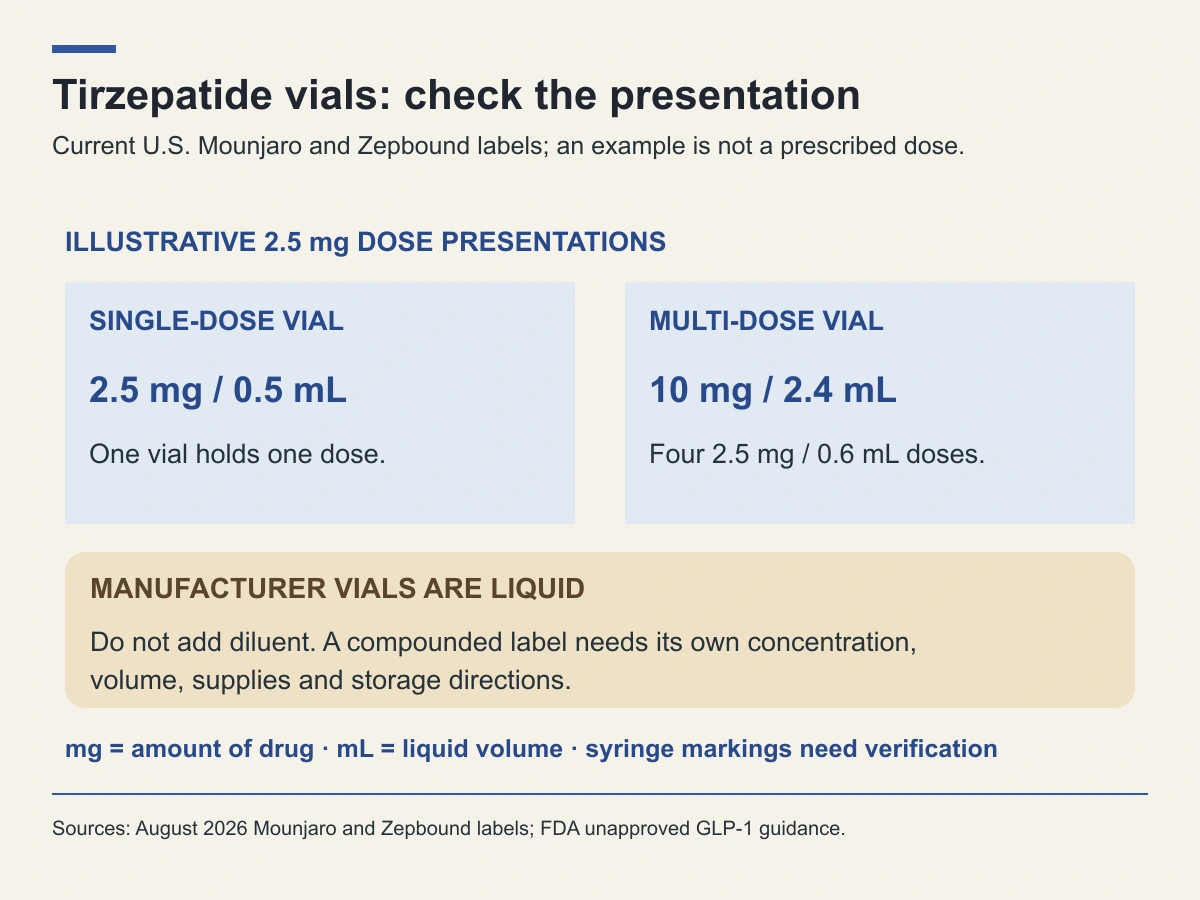
Single-dose and multi-dose manufacturer vials
The August 2026 U.S. Mounjaro and Zepbound labels list these vial presentations. The table describes labeled product types, not a promise that every strength or presentation is stocked at every pharmacy. Mounjaro prescribing information, Zepbound prescribing information.
| Labeled vial type | Product description | Volume of each labeled dose | Key distinction |
|---|---|---|---|
| Mounjaro single-dose vial | One dose at the labeled strength | 0.5 mL | Not a vial to keep for repeated weekly withdrawals |
| Zepbound single-dose vial | One dose at the labeled strength | 0.5 mL | Follow the single-dose presentation’s instructions |
| Mounjaro multi-dose vial | Four weekly doses at the labeled strength | 0.6 mL | Total vial amount is not the amount of one dose |
| Zepbound multi-dose vial | Four weekly doses at the labeled strength | 0.6 mL | Four-dose container with its own in-use limits |
Both labels list dose strengths from 2.5 mg through 15 mg across these presentations. The milligram strength changes by product strength even when the presentation’s dose volume stays the same.
The difference between 0.5 mL and 0.6 mL is important. “I used that amount with my last vial” is not enough information to confirm the next vial’s dose. Recheck the presentation whenever the pharmacy supplies a different container.
The same milligram dose can have a different volume
For a concrete label example, a manufacturer single-dose 2.5 mg vial is labeled 2.5 mg/0.5 mL. The current multi-dose presentation containing four 2.5 mg doses is labeled 10 mg/2.4 mL, with each dose described as 2.5 mg/0.6 mL. Mounjaro prescribing information, Zepbound prescribing information.
Those labels describe the same milligram amount per dose in different volumes. The total 10 mg in the multi-dose vial is not a direction to inject all 10 mg at once.
This example also shows why a concentration, a total vial amount, and a prescribed dose should not be treated as interchangeable numbers. Ask the pharmacist to point out each on your own label and explain the exact measuring instructions.
Do not use this comparison to change your prescribed dose. It is an explanation of the named presentations and why copying a measurement from another container can be wrong.
Milligrams, milliliters, and syringe units
Milligrams describe drug amount; milliliters describe liquid volume. Syringe markings are a measurement scale. They do not independently state the amount of tirzepatide in the liquid.
The basic concentration relationship is dose in milligrams divided by concentration in milligrams per milliliter to obtain volume in milliliters. But the product must be correctly identified, the concentration must be interpreted accurately, and the pharmacist’s written measuring directions should be confirmed before use.
A chart saying “this dose equals this many units” cannot apply to every compounded concentration or every syringe. If the concentration or measuring device changes, the previous number may no longer fit.
Our tirzepatide milligrams, milliliters, and units guide explains the terms in more detail. FDA has received reports of dosing errors with compounded GLP-1 medicines and urges patients to discuss measurement and administration with the prescriber or compounder. FDA unapproved GLP-1 safety guidance.

Do tirzepatide vials need reconstitution?
The current Mounjaro and Zepbound manufacturer labels describe a clear, colorless to slightly yellow injectable solution. The vials discussed here are supplied as liquid and do not require the patient to add a diluent. Mounjaro prescribing information, Zepbound prescribing information.
Do not add bacteriostatic water or another liquid to one of these ready-to-use manufacturer vials. Adding a liquid changes the product and does not follow the presentations described in the labels.
If you have received a powder or have unclear mixing instructions, pause and contact the dispensing pharmacist and prescriber to identify what was supplied. Verify that it is the intended human-use prescription, who prepared it, and what written instructions apply. An online reconstitution calculator cannot establish those facts.
FDA specifically warns against products sold directly to consumers for human use while labeled “for research purposes” or “not for human consumption.” The agency describes their quality as unknown and advises consumers not to purchase them. This article does not supply a home recipe for using those products. FDA unapproved GLP-1 safety guidance.
What is different about a compounded vial?
A compounded vial should be reviewed according to its own prescription and dispensing information. Its concentration, ingredients, volume, measuring directions, and beyond-use information should not be inferred from a Mounjaro or Zepbound carton.
FDA explains that compounded drugs are not FDA-approved and do not undergo the approval process’s premarket verification of safety, effectiveness, and quality. Compounding can serve a patient need in appropriate circumstances, but it is not the same as an approved generic drug. FDA compounding questions and answers.
Ask whether your medical need can be met by an approved product and why the specific compounded formulation was prescribed. Confirm the state-licensed dispensing pharmacy and how to contact it with questions about the label or supplies. FDA unapproved GLP-1 safety guidance.
The compounded GLP-1 guide covers ingredient and quality questions. Do not assume a clear or colored liquid identifies the formulation; our tirzepatide color guide explains why appearance is only part of product assessment.
Which needles and syringes are needed?
The vial presentation requires appropriate injection supplies and training. Current Mounjaro and Zepbound labels give a 1 mL syringe capable of measuring the relevant 0.5 mL or 0.6 mL dose as an example of an appropriate syringe, and direct use of a new syringe and needle for each injection. Mounjaro prescribing information, Zepbound prescribing information.
Ask the pharmacy to confirm the supplies for your exact vial and demonstrate the intended measurement. A different medicine’s pen-needle specification does not answer which supplies you need for this presentation.
The single-dose prefilled pen has its own integrated injection mechanism; the KwikPen uses separate pen needles. Neither should be treated as a vial. When a presentation changes, the manufacturer labels call for training appropriate to the new presentation.
Our Mounjaro injection-site guide and Zepbound injection-site guide cover site and device questions. Use them with the Instructions for Use supplied for the prescribed presentation, rather than as a universal injection tutorial.
Storage and discard limits depend on the container
The current manufacturer labels direct refrigeration at 36°F to 46°F, protection from heat and light, and no use after freezing. Their single-dose pens and vials have a room-temperature allowance up to 86°F for a total of 21 days. Mounjaro prescribing information, Zepbound prescribing information.
For the listed manufacturer multi-dose vials, the labels specify different limits. Opened containers are discarded after a total of 30 days at room temperature, 30 days after first use, or after four weekly doses, even if medicine remains. These are distinct limits; do not choose the one that keeps a vial longest.
Compounded multi-dose GLP-1 vials require separate attention. FDA’s current safety page advises discarding them within 28 days after first use, even if medication remains and even if the compounder supplies a longer in-use instruction. That FDA advice should not be replaced with the manufacturer multi-dose product’s 30-day allowance. FDA unapproved GLP-1 safety guidance.
Mark the first-use date, track relevant temperature exposure, and ask about unclear instructions before the next dose. For travel and product distinctions, see Zepbound storage and refrigeration.

What if the vial, label, or shipment seems wrong?
Contact the dispensing pharmacy if the label is missing, the concentration is unclear, the container differs from what you expected, or the supplies do not match the directions. Do not resolve an uncertainty by using your previous syringe marking.
FDA advises against using an injectable GLP-1 medicine that arrives warm or with inadequate refrigeration and highlights concerns about fraudulent labels. Tell the pharmacy what arrived and ask for a product-specific resolution before use. FDA unapproved GLP-1 safety guidance.
The manufacturer labels also direct patients not to use solution with visible particles or discoloration. A visual inspection does not verify potency or sterility, but a concerning appearance is a reason to contact the pharmacist rather than proceed. Mounjaro prescribing information, Zepbound prescribing information.
Common questions about tirzepatide vials
How do I reconstitute a Mounjaro or Zepbound vial?
The manufacturer vials described in the current labels are ready-to-use liquid solutions. They do not require adding mixing water. If the product you received is a powder or unclear, contact the dispensing pharmacist and prescriber rather than applying an internet recipe.
Is every vial dose 0.5 mL?
No. The listed manufacturer single-dose vials use 0.5 mL per dose, while the listed multi-dose vials use 0.6 mL. Compounded prescriptions can have different concentrations and directions. Confirm your own presentation.
Can I keep leftover medicine for another dose?
Follow the container’s discard instructions. A single-dose vial is not a multi-dose supply, and manufacturer multi-dose vials are discarded at the specified limits even when medicine remains. Do not combine leftovers or invent additional doses.
Can a vial’s total milligrams be my weekly dose?
Not necessarily. A multi-dose vial contains several doses. Identify the prescribed amount per injection separately from the total amount in the container.
Where can I review treatment options?
Read the tirzepatide questions guide and CoreAge Rx’s tirzepatide service information. Ask the clinician which exact product and presentation are being prescribed, why it fits your needs, and how measurement, supplies, storage, and follow-up will be explained.
Educational information for adults; individual treatment decisions require a qualified clinician. Sources reviewed October 2, 2026. Original AI-generated article images depict fictional people and objects, not patient outcomes. Other editorial images are illustrative. Graphics summarize the cited sources.