
Lipo-B and Lipo-C are names used for injectable nutrient blends. The names alone do not tell you the ingredients, the concentration, or whether the product has been shown to help people lose weight. Before comparing prices or booking an injection, compare the actual pharmacy label and the evidence for the exact formulation.
The most useful distinction is between correcting an identified nutritional problem and buying a blend advertised to increase metabolism. Those are different clinical decisions. A nutrient can have an essential role in the body without an extra injection producing additional fat loss.
What do Lipo-B and Lipo-C mean?
There is no single standardized formula that applies to every product sold under either name. A clinic might use a similar name for a different combination, while a pharmacy might change the concentration or available presentation. Do not assume that a letter in the name identifies every ingredient.
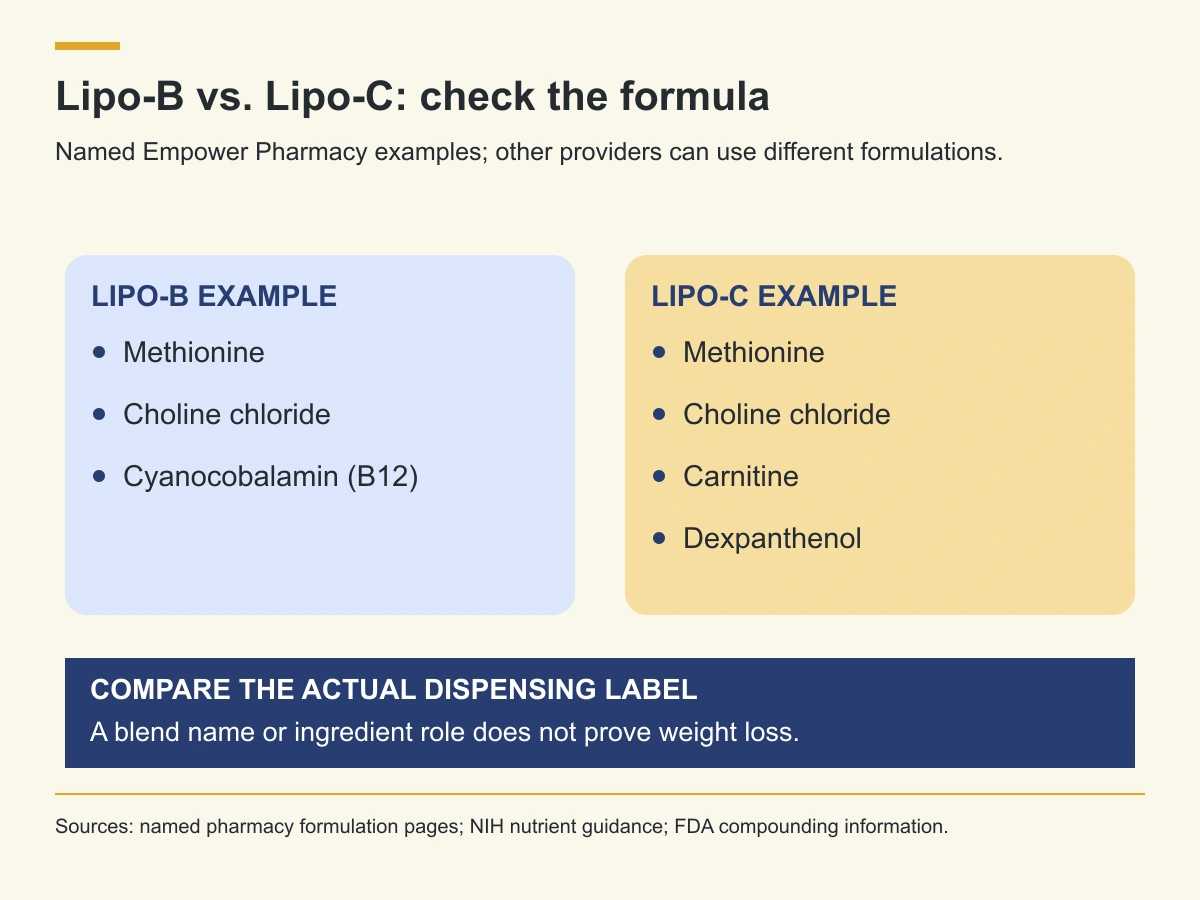
For example, Empower Pharmacy’s published Lipo-B page lists methionine, choline chloride, and cyanocobalamin, a form of vitamin B12. Its Lipo-C page lists methionine, choline chloride, carnitine, and dexpanthenol. These are examples from one named pharmacy, rather than definitions for all Lipo-B and Lipo-C injections. In that Lipo-C example, neither vitamin C nor B12 is listed in the ingredient combination. Empower Lipo-B formulation, Empower Lipo-C formulation.
Ask for the full dispensing label before deciding that one blend has more ingredients, is stronger, or is equivalent to another clinic’s offering. A longer ingredient list also does not establish a better clinical result.
| Comparison question | What the name can tell you | What you still need to verify |
|---|---|---|
| Does it contain B12? | A marketing name may suggest it | The ingredient list and form of B12 |
| Does it contain carnitine? | Some Lipo-C formulations do | The exact formulation from the dispensing pharmacy |
| How concentrated is it? | The name does not answer this | The labeled amount of each ingredient per volume |
| Has it demonstrated weight loss? | Neither name proves an outcome | Human research on the actual blend, route, and use |
| How should it be used? | A name is not a prescription | Individual instructions from the prescriber and pharmacist |
Our Lipo-C injections guide explains the broader category. This comparison focuses on the questions to ask when two differently named products are offered side by side.
Why the ingredients sound relevant to weight management
Choline helps support normal cell structures and the handling of fats in the body. Carnitine participates in transporting fatty acids into mitochondria, where cells produce energy. Most healthy people make enough carnitine for their needs. These biological roles explain why the nutrients appear in metabolism-related marketing, but they do not demonstrate that injecting a blend increases weight loss. NIH choline fact sheet, NIH carnitine fact sheet.
Think of the difference between describing a component and testing a treatment. Knowing what a car part does does not show that adding another part will make the whole car faster. Similarly, describing fat transport does not measure changes in body fat, health, or function after an injection.
The NIH review describes mixed weight-management findings for carnitine supplements. The research discussed includes oral products and different patient populations. It does not validate a specific intramuscular Lipo-C blend. A supplement study cannot supply an injection dose, prove a particular clinic’s claim, or establish that adding several nutrients improves results.
When you see a claim such as “supports fat metabolism,” ask what outcome was actually measured. Was it a laboratory marker, a subjective feeling of energy, or sustained weight change compared with an appropriate control group? The answer determines how useful the claim is for your decision.
B12 deficiency is a separate question
Vitamin B12 supports normal blood cells, nerves, and DNA. Deficiency can cause symptoms that deserve assessment and treatment. However, NIH notes that B12 does not improve energy or endurance in people who already get enough. That makes an identified deficiency a different situation from choosing a B12-containing injection for general weight loss. NIH vitamin B12 information.
Fatigue alone does not identify the cause. Sleep problems, reduced food intake, medicine effects, anemia, and other conditions may need consideration. Tell your clinician what has changed, how long it has been happening, and whether you have numbness, weakness, digestive symptoms, or other concerns.
Your medication list also matters. Metformin and medicines that reduce stomach acid can affect B12 status in some people. That is a reason to discuss evaluation, rather than an automatic reason to buy a blend. A documented B12 treatment plan may use a different product, route, and follow-up than a marketed lipotropic injection.
The supplements while taking GLP-1 medications guide can help organize that conversation without treating every symptom as a supplement deficiency.

Are these FDA-approved weight-loss medicines?
An individual compounded preparation is not FDA-approved. FDA does not review compounded drugs for safety, effectiveness, and quality in the same way it reviews an approved product before marketing. Compounding can meet specific patient needs, but that does not make a compounded nutrient blend an approved weight-loss treatment. FDA compounding questions and answers.
This distinction should be clear in the consultation and on the information you receive. “Contains ingredients your body uses” and “has been shown to treat obesity” are different statements. A pharmacy’s formulation page can help identify what it compounds; promotional explanations on that page are not a substitute for a controlled clinical trial.
If prescription weight management is your main goal, start with an assessment of the available treatments and their risks. CoreAge Rx’s semaglutide service information and tirzepatide service information describe separate care pathways. They are not evidence that a lipotropic blend is equivalent to an approved branded medicine. Our compounded GLP-1 medication guide explains the additional product distinctions.
Safety questions before an injection
Safety depends on the actual ingredients, route, preparation, medical history, and administration. A nutrient’s presence in food does not establish the safety of injecting a combined preparation. Likewise, reassurance about oral B12 cannot be extended to every ingredient or to the sterility of an injectable blend.
Bring these questions to the clinician and dispensing pharmacy:
- What is the intended clinical reason for this product in my situation?
- What ingredients and concentrations are on the label?
- What allergies, diagnoses, medicines, or supplements could change the decision?
- Who prepares the product, and how can I contact that pharmacy?
- What storage, beyond-use, and handling instructions apply to this vial?
- What symptoms should prompt a call, urgent assessment, or emergency help?
Do not borrow another person’s instructions or use a syringe chart from a different product. A volume in milliliters and an amount of an ingredient in milligrams are different measurements. With a blend, more than one ingredient is delivered in the same volume, so changing the volume changes several amounts at once.
For trouble breathing, swelling of the face or throat, collapse, or another severe reaction, seek emergency help. New or worsening symptoms after an injection should be assessed rather than dismissed as a normal “detox” response.
How to compare the real cost
An advertised price per injection is only one part of the decision. Ask whether evaluation, administration, supplies, laboratory work, shipping, and follow-up are included. Find out whether you are buying one appointment, a vial, or a recurring plan, and what cancellation terms apply.
Cost comparisons should also include the proposed outcome. Paying less for a product with an unclear goal is not necessarily better value. Ask how the clinician will judge whether the treatment is useful and when the plan will be reviewed. Avoid paying for a long series because a salesperson predicts a particular number of pounds lost.
You can record each option on a simple comparison sheet: exact product, intended reason, evidence offered, expected review date, total cost, and contact person. If one provider cannot supply those details, that uncertainty belongs in the comparison rather than being filled in by assumptions.

What supports a more useful weight-management plan?
Start by identifying the issue you are trying to solve. Persistent hunger, difficult meal planning, poor sleep, a nutritional deficiency, and a weight plateau may require different approaches. An injection does not answer all of them.
For everyday eating, our balanced meals guide describes ways to build meals around foods you enjoy. The calorie intake guide explains why an individual daily pattern matters more than a single advertised metabolism booster. A clinician or dietitian can help adapt those ideas when illness, appetite changes, or medication effects make adequate eating difficult.
If you are already using a prescription treatment, discuss the whole plan before adding another product. Report the actual blend, not simply “a vitamin shot.” Keep your prescriber informed about injections obtained elsewhere so that symptoms, laboratory results, and changes in intake can be interpreted together.
Frequently asked questions
Is Lipo-C stronger than Lipo-B?
The names do not provide a meaningful strength ranking. Different ingredients cannot be reduced to one universal measure of strength. Compare the labeled formulation and the intended clinical use, then ask whether there is evidence that the proposed difference improves an outcome you care about.
Does every Lipo-B contain inositol?
Do not infer an ingredient from an acronym or a clinic’s general description. The named Empower example discussed above lists methionine, choline chloride, and cyanocobalamin. A different preparation may have a different list. Your own dispensing label is the relevant starting point.
Does Lipo-C always contain vitamin C?
No ingredient should be assumed from the letter C. The Empower Lipo-C example contains carnitine and dexpanthenol alongside methionine and choline chloride; it does not list ascorbic acid in that combination. Verify your particular product.
Can I use either blend with semaglutide or tirzepatide?
A general comparison cannot clear that combination for you. Share the full formulation, medical history, and reason for adding it with your prescriber and pharmacist. Ask what benefit is expected and whether symptoms or intake changes should be evaluated first.
How many injections do I need to lose weight?
There is no validated universal series that can be supplied from these marketing names. A promised injection schedule is not proof of a weight-loss effect. This article does not provide a dosing protocol or a predicted pounds-lost result.
Should I choose a B12-only product instead?
That depends on whether you need B12 treatment and why. A clinician can assess a suspected deficiency and select an appropriate product and follow-up. Choosing between deficiency treatment and a marketed multi-ingredient blend requires more than comparing their names.
Educational information for adults; individual treatment decisions require a qualified clinician. Sources reviewed October 2, 2026. Original AI-generated article images depict fictional people and objects, not patient outcomes. Other editorial images are illustrative. Graphics summarize the cited sources.