
A useful probiotic label identifies the microorganism clearly, states the amount appropriately, and explains storage and expiration. Species names, strain IDs, CFUs, and milligrams each describe different things. Understanding them makes it easier to compare a product with a study.
Read the full microorganism name
A name such as Bifidobacterium infantis identifies a species-level label. A strain designation adds a more specific identity, often a combination of letters and numbers. Studies commonly evaluate a particular strain and preparation.
The NIH probiotic guidance explains why findings cannot simply be transferred to all organisms sharing a species name. If a strain is not identified, that is a missing comparison detail—not an invitation to assume the best-known strain is present.
Understand CFUs
CFU stands for colony-forming unit, a way of estimating viable microorganisms under test conditions. It is not the same as milligrams of bacterial material. A product can weigh a certain amount without revealing how many live organisms it contains.
Look for whether a count is stated through the expiration date or only at manufacture. Also check whether it applies to each strain or the total blend. Higher counts alone do not establish greater benefit; the relevant amount depends on the strain and use.

A five-point label worksheet
| Detail | Question to ask |
|---|---|
| Identity | Are genus, species, and strain disclosed? |
| Quantity | What is supplied per serving, and how is it measured? |
| Evidence | Does a human study match the strain, amount, and goal? |
| Expiration | Is the stated quantity supported through the usable life? |
| Storage | What conditions are required before and after opening? |
Some microbial preparations are inactivated rather than live. Ask which form is supplied instead of assuming that every bacterial ingredient should be evaluated by a viable CFU count in the same way.
Apply the worksheet to GLP-1 Support
CoreAge Rx’s page lists three species, and the front image states a 36 mg proprietary blend. The reviewed public material does not disclose strain IDs or CFUs. Thirty-six milligrams is not 36 billion CFUs.
The page does provide a refrigeration-after-opening instruction and a one-capsule daily routine. Those details help with use, but they do not fill in the missing strain or viable-count information. Ask for the current full label and any relevant finished-product documentation.
Match the product to your circumstances
NCCIH’s safety overview notes that serious illness and weakened immune function can change the risk discussion. A well-organized label is necessary information, but it does not by itself establish that a product is appropriate for every person.
Use the GLP-1 Support product guide and storage article to complete the comparison. The goal is enough information to evaluate a specific product, not choosing whichever bottle has the largest number.
Read the organism identity from broad to specific
A microbial name can include a genus, species, and a more specific strain designation. The strain may be represented by letters, numbers, or a combination. Those extra characters can be important because research often studies a specific strain or defined preparation.
When a label provides only the species, do not assume it contains the best-known strain discussed online. Several preparations can share a species name while differing in characteristics and evidence. A missing identifier remains a missing identifier.
This is especially useful when comparing a bottle with an article. If the article’s claim depends on a named strain but the bottle does not disclose it, the comparison is incomplete. The NIH guidance explains why probiotic effects should be interpreted with that specificity.

Understand what CFUs measure and what they leave out
Colony-forming units estimate viable microorganisms capable of forming colonies under the test conditions used. The count is useful information when appropriately reported, but it is not a universal score of quality or clinical effectiveness.
A larger count does not automatically mean a better result. The relevant amount depends on the microorganism, preparation, and goal. A product with a lower count that matches suitable evidence may answer a particular question more clearly than a larger count attached to an unspecified blend.
Also ask whether the count applies to the total formula or to each strain. A large total can leave individual amounts unknown. Without those details, the label may not support a precise comparison with a study that used a specified strain amount.
Check the time point attached to the count
A quantity stated at manufacture and a quantity supported through expiration answer different questions. Storage conditions can matter to the usable life of a microbial product. Read any qualification attached to the number rather than isolating the largest figure on the front panel.
Look for the expiration information and directions before and after opening. If the product requires refrigeration after opening, include that in the decision about whether you can use it as intended. A count on a label does not cancel the handling conditions associated with it.
If information is unclear, ask the manufacturer how the quantity claim is defined and supported. A general assurance that the product is potent is less useful than a clear explanation tied to the actual formula and usable life.
Distinguish live and inactivated preparations
Some microbial interventions studied in research are inactivated, such as certain pasteurized preparations, rather than live. They should not automatically be evaluated using the same viable-count expectations as a live product. The preparation needs to be identified first.
This is relevant to Akkermansia research, where studies have examined different forms. A product listing the species without stating enough preparation detail cannot be assumed identical to a live or pasteurized intervention from a particular study.
Ask what the product actually supplies and how its quantity is appropriately described. Do not interpret an absent CFU count as proof of a particular form; it is an unanswered question until suitable information is provided.
Apply the checklist to CoreAge Rx GLP-1 Support
The reviewed public material lists Akkermansia muciniphila, Bifidobacterium infantis, and Clostridium butyricum. It does not disclose strain IDs or CFUs. The front image states a 36 mg proprietary blend, which is a weight rather than a viable-organism count.
The page does provide a daily capsule routine, 8 oz water, use with or without food, and refrigeration after opening. Those details support preparation and storage planning. They do not supply the missing strain identities, per-organism amounts, or live-versus-inactivated information needed for some study comparisons.
Record both sides of the review: which details are available and which are not. That produces a fairer assessment than either assuming the missing information matches a study or concluding that an undisclosed detail proves the opposite.
Build a study-to-label comparison table
| Research detail | Product detail to look for |
|---|---|
| Exact microorganism or preparation | Full identity and relevant strain designation |
| Live or inactivated form | Clear preparation information |
| Amount used | A comparable quantity and measurement method |
| Duration and storage | Directions consistent with intended use |
| Participants | A population relevant to the user’s circumstances |
| Outcome | The same goal the product is being considered for |
If the table has several blank entries, the research may still provide background, but it cannot honestly be presented as direct proof for the finished formula. The Akkermansia guide demonstrates this comparison with human trials.
Use label quality alongside personal suitability
A complete label helps with evaluation, but it does not establish that every person should take the product. Serious illness, weakened immune function, a central venous catheter, or significant digestive disease can change the risk discussion.
Bring the full product information to the care team when those circumstances apply. NCCIH’s overview explains why safety findings in one population should not be generalized indiscriminately. Clear information is a prerequisite for a better discussion, not a substitute for it.
Frequently asked questions
Is 36 mg the same as 36 billion CFUs?
No. The units describe different measurements. The reviewed GLP-1 Support material does not establish a CFU count from the blend weight, and no universal conversion should be invented.
Does a higher CFU number always work better?
No. The appropriate amount depends on the strain, preparation, evidence, and intended use. More organisms on the label do not automatically produce a larger or more relevant clinical benefit.
Can I assume a familiar strain is present when only the species is listed?
No. Ask for the strain information. A species-only entry does not identify the particular strain used in a cited study.
Does refrigeration prove a product is more effective?
No. Refrigeration is a handling requirement for some products. It does not establish superior clinical outcomes compared with every product stored differently. Follow the exact label and evaluate evidence separately.
Explore GLP-1 Support™
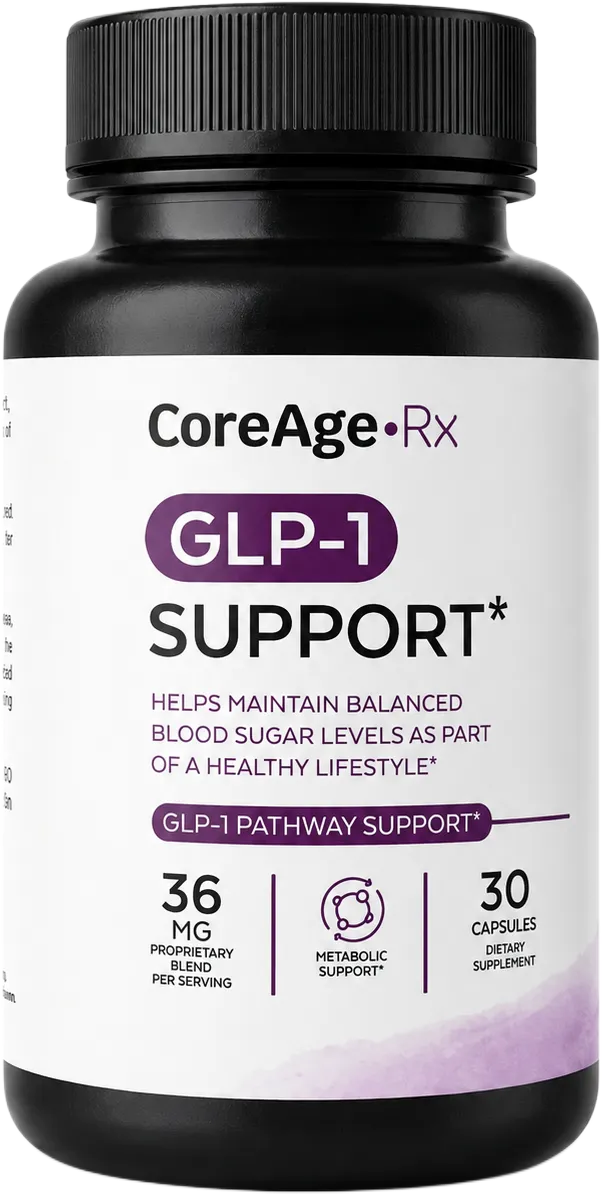
CoreAge Rx GLP-1 Support combines the three listed bacterial species with chicory inulin and potato resistant starch. It is a dietary supplement; it does not replace a GLP-1 prescription. See the current GLP-1 Support™ page and check the bottle you receive before use.
Related reading
- GLP-1 Support Supplements: Ingredients, Evidence, and Expectations
- Akkermansia Muciniphila Supplements: What Human Research Shows
- Bifidobacterium Infantis: Why the Exact Strain Matters
- How fiber supplements differ from probiotic products
Educational information, not individualized medical advice. Product information and linked research checked September 15, 2026. Ingredient research does not establish identical effects for a finished supplement.