
Probiotics and prebiotics are different. Probiotics are live microorganisms that provide a health benefit when used in an appropriate amount. Prebiotics are substances used by microorganisms in ways that can benefit the host. One is the organism; the other is a substrate it may use.
A practical comparison
| Term | What it describes | Important limit |
|---|---|---|
| Probiotic | A defined live microorganism with evidence for a benefit | Effects are not shared automatically by every strain |
| Prebiotic | A substrate selectively used by microorganisms with a demonstrated benefit | Not every fiber automatically qualifies for every claimed effect |
| Combination product | A formula containing microbial ingredients and substrates | The finished combination still needs its own evaluation |
NCCIH’s overview explains these distinctions. Fermented foods and bacterial ingredients also should not automatically be described as proven probiotics for every health goal.
Why the label needs more than a category
For a probiotic, look for the specific strain, amount, relevant human evidence, and storage instructions. For a prebiotic, look for the exact ingredient and quantity. The NIH probiotic guidance emphasizes that a species name or a high CFU number alone is not enough to predict a result.
Two products can both say “gut health” while containing very different ingredients. Comparing their front labels is like comparing recipes by the word “food”: it leaves out the details that determine what you actually receive.

The GLP-1 Support example
CoreAge Rx lists Akkermansia muciniphila, Bifidobacterium infantis, and Clostridium butyricum, plus chicory inulin and potato resistant starch. The listed prebiotic-fiber amounts are 211 mg and 100 mg, respectively.
The public material reviewed does not provide strain IDs or viable CFU counts. It also does not establish that the finished combination has been tested for every benefit associated with any individual ingredient. Read the label guide for the questions this leaves open.
More ingredients are not automatically better
A combination may be convenient, but the presence of both bacterial species and fiber does not prove synergy or a larger benefit. The amount of each component and the outcome measured still matter.
Avoid starting several prebiotic and probiotic products at once. If gas or discomfort follows, it can be difficult to tell what changed. A clear purpose and a simple routine are easier to evaluate with your clinician.
Keep food in the picture
Ordinary fiber-containing foods and fermented foods can be considered within a varied eating pattern. That does not require matching every food to a branded supplement. If your main question is dietary fiber, start with the fiber supplement guide and your usual meals.
For ingredient-specific detail, read inulin and resistant starch. Use the terms precisely so a category name does not become an unsupported promise.

Use the terms to identify different parts of a system
A probiotic refers to an appropriately defined live microorganism with evidence of benefit in an adequate amount. A prebiotic refers to a substrate used by microorganisms in a way that benefits the host. One describes the organism-based intervention; the other describes material that microorganisms can use.
This distinction is helpful because products often place both terms under the same “gut health” heading. A bacterial ingredient and a fiber ingredient do not provide the same information or need the same label questions. The category should guide the review rather than replace it.
Also distinguish a named microorganism from a demonstrated probiotic for a specific purpose. Evidence, preparation, amount, and the intended outcome matter. A microbial name alone is not a universal benefit claim.
Compare the information needed for each category
For a bacterial product, identify the full organism or preparation, strain when relevant, quantity, storage requirements, and human evidence for the goal. For a prebiotic ingredient, identify the substrate, amount, and evidence connecting its use with the claimed benefit.
A CFU count is relevant to viable microorganisms when appropriately reported. It is not the unit used to describe grams of inulin. A fiber weight is not a measure of bacterial viability. Keeping the units separate prevents numbers from appearing more informative than they are.
The NIH probiotic guidance and NCCIH overview explain why these details matter. A product with both categories should answer both sets of questions, rather than using one impressive number to stand in for the entire formula.
Work through the GLP-1 Support example
CoreAge Rx’s reviewed page lists three bacterial species, plus 211 mg chicory inulin and 100 mg potato resistant starch. The bacterial entries identify species-level names. The fiber entries identify ingredients and weights.
The inulin converts to 0.211 g and the resistant starch to 0.1 g. Those amounts can be compared with the amounts used in relevant research, while recognizing that the finished product is a combination. The reviewed material does not disclose strain IDs or viable CFUs for the microbial components.
The front image’s 36 mg blend statement cannot fill those missing details. It is a weight statement, not a strain identity or organism count. The label-reading article explains how to organize the known and unknown information.
Do not assume a combined product has proved an added effect
Including a substrate with microorganisms may have a formulation rationale. But a rationale is different from evidence that the combination produces a greater clinical benefit than its components or another approach. The amount and behavior of each component still matter.
If a seller describes a product as working synergistically, ask which finished formula was studied and what outcome improved. An ingredient list containing both categories is not enough to establish that claim.
This also applies when people combine separate products at home. Taking a probiotic, a prebiotic powder, and a fiber capsule together does not automatically produce a better plan. It adds ingredients and makes tolerance harder to interpret if several changes begin at once.
Keep foods in the discussion without over-labeling them
Fiber-containing foods and fermented foods can fit a varied eating pattern. Their roles should be evaluated as foods, with attention to portions, nutrients, preferences, and tolerance. You do not need to assign every food a supplement-like claim for it to be useful.
Not every fermented food should automatically be described as a proven probiotic intervention for every health goal. Likewise, not every fiber should be assumed to provide the same prebiotic effect at any amount. Terms remain useful when they are applied precisely.
If your main concern is low dietary fiber, review meals and the actual intake gap. The food-fiber guide offers practical ways to start. A microbial supplement does not supply a missing meal or a complete daily fiber intake.
Match the next step to the actual concern
For a label question, collect the full panel and ask the manufacturer for missing details. For persistent digestive symptoms, seek a clinical assessment rather than cycling through product categories. For a nutrition gap, a dietitian can help identify food and supplement options that fit the person.
If a product is appropriate for a trial, keep the goal and routine clear. Avoid starting several bacterial and fermentable-fiber products simultaneously. Record the main changes and any symptoms so a later discussion has useful context.
People with serious illness, weakened immune function, or other higher-risk circumstances should discuss bacterial products with their care team first. The general idea that microbes or fibers can be beneficial does not establish that every product is suitable for every person.
Frequently asked questions
Is a prebiotic just a weaker probiotic?
No. They are different categories, not stronger and weaker versions of the same product. One concerns microorganisms, while the other concerns substrates used by microorganisms with a demonstrated benefit.
Do I need both in the same capsule?
Not automatically. The need depends on the goal, ingredients, amounts, evidence, and health circumstances. A combined format may be convenient, but convenience does not prove a greater clinical effect.
Does a fiber ingredient guarantee better bacterial survival?
Do not assume that from the ingredient list alone. Claims about survival or a beneficial interaction need appropriate evidence for the formula and conditions. The presence of inulin or resistant starch does not answer every product-performance question.
Can I compare milligrams with CFUs?
They measure different things. Milligrams describe mass; CFUs estimate viable organisms under test conditions. There is no universal conversion that can be applied to a product’s blend weight.
Which category should I choose for bloating?
Persistent bloating deserves a specific assessment. Ingredient type, amount, other changes, and the underlying cause matter. A category name alone does not identify the appropriate treatment or guarantee tolerance.
Explore GLP-1 Support™
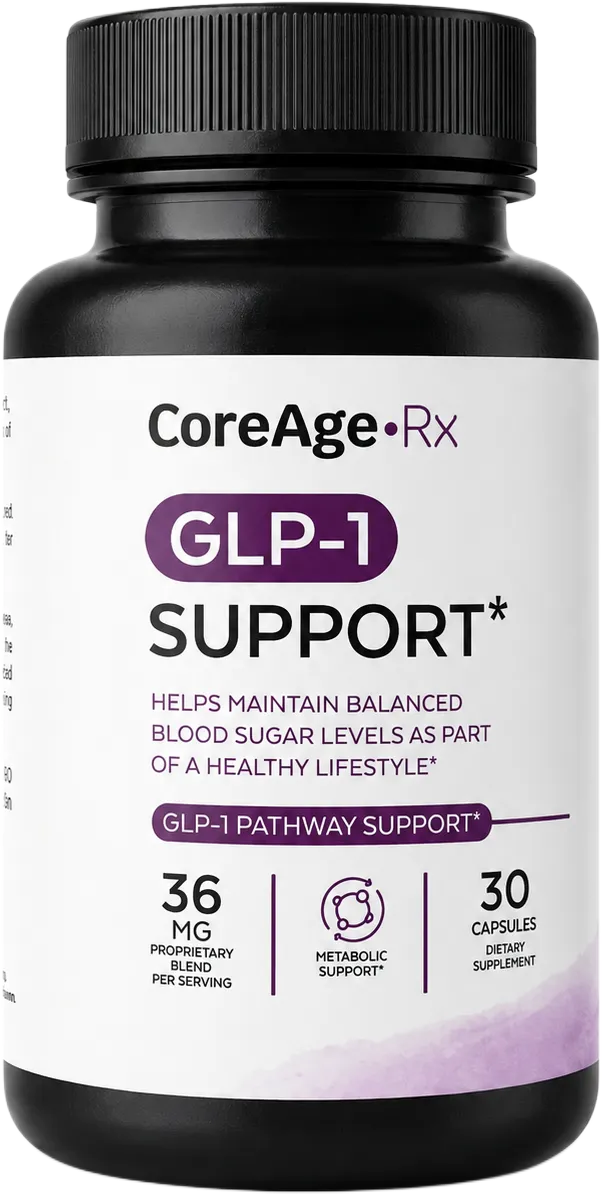
CoreAge Rx GLP-1 Support combines the three listed bacterial species with chicory inulin and potato resistant starch. It is a dietary supplement; it does not replace a GLP-1 prescription. See the current GLP-1 Support™ page and check the bottle you receive before use.
Related reading
- GLP-1 Support Supplements: Ingredients, Evidence, and Expectations
- How to Read a Probiotic Label: Strains, CFUs, and Storage
- Inulin as a Prebiotic: Benefits, Amounts, and Tolerance
- How fiber supplements differ from probiotic products
Educational information, not individualized medical advice. Product information and linked research checked September 15, 2026. Ingredient research does not establish identical effects for a finished supplement.