
Resistant starch is starch that escapes digestion in the small intestine and can reach the colon, where microbes may use it. It occurs in different foods and preparations. The source, processing, and amount matter when interpreting a supplement claim.
Food context and supplement context differ
A food containing resistant starch also brings other nutrients and a particular portion size. A supplement may use an isolated ingredient in a measured amount. These should not be treated as identical interventions because they share the term “starch.”
The review of food fiber explains why effects associated with fiber-containing foods should not automatically be transferred to isolated supplements. Preparing a meal is a broader nutritional choice than adding one ingredient to a capsule.
What a recent human trial shows
A 2024 randomized crossover trial studied resistant-starch supplementation for eight weeks in 37 adults with overweight or obesity and reported improvements in weight and insulin resistance under the study conditions.
That result is specific to the tested intervention and population. It does not establish that any resistant-starch ingredient, at any amount, produces the same outcome. Findings about associated microbes in a study also do not show that a different bacterial blend will reproduce the result.

Read the amount on GLP-1 Support
CoreAge Rx’s product page lists 100 mg potato resistant starch, or 0.1 g. It should not be counted as several grams of daily fiber or treated as a substantial food portion. The page does not establish a finished-product weight-loss outcome from that amount.
Do not multiply capsules to approximate a separate fiber study. The product contains multiple bacterial ingredients and inulin as well, so that would change the entire regimen. Follow the current label and seek advice for any proposed adjustment.
Ask four comparison questions
| Question | Why it matters |
|---|---|
| Which resistant starch was studied? | Types and preparations differ |
| How much was used? | Milligrams and grams are not interchangeable |
| What else did participants do? | Meals and other study conditions affect interpretation |
| What outcome changed? | Microbiome changes are not automatically clinical benefits |
The NIH probiotic guidance provides additional context for evaluating claims about microbes and weight-related outcomes. A biological association is not enough to promise a result from a commercial combination.
A practical next step
If you want to improve your fiber pattern, review ordinary meals with a dietitian when needed. If you are considering GLP-1 Support, evaluate the complete label and the purpose of use. Read inulin as a prebiotic and probiotics versus prebiotics to distinguish the different components rather than treating all gut-health ingredients as one category.
Start with what makes the starch resistant
Resistant starch is defined by its resistance to digestion in the small intestine, allowing some to reach the colon. The term covers different sources and preparations. It should not be treated as one uniform ingredient with one universal effect.
Food structure and processing can affect the resistant-starch context, while a supplement may provide an isolated preparation. Those differences matter when comparing a food, a powder, and a capsule. Sharing the word starch does not establish the same amount or intervention.
For practical label reading, identify the source and listed quantity, then compare them with the research being cited. If the product does not provide enough preparation detail, keep that limit visible rather than assuming all resistant starches are interchangeable.

Read the human trial as a defined intervention
The cited 2024 randomized crossover trial studied 37 adults with overweight or obesity over eight-week supplementation periods and reported improvements in weight and insulin resistance under its study conditions. That is a human intervention result, which is more informative than a mechanism alone.
However, the result belongs to the tested preparation, amount, participants, and accompanying study conditions. It does not establish that every food or supplement containing a resistant-starch ingredient produces the same outcome.
The original trial also includes microbiome-related findings, but those findings should not be used to claim that taking a different bacterial blend reproduces the intervention. An association with a microorganism during a starch study is not the same experiment as administering that microorganism in a commercial capsule.
Compare the listed amount with the kind of claim
GLP-1 Support’s reviewed page lists 100 mg potato resistant starch, equivalent to 0.1 g. That is the amount disclosed for this ingredient. It should not be described as several grams of fiber or as a substantial portion of a starch-containing food.
The conversion makes the scale of the amount clear, but it does not establish a clinical result. A label can disclose an ingredient without proving that its amount in the finished formula delivers the outcomes reported in a different intervention.
Do not multiply capsules to chase a research dose. Every extra capsule changes the microbial components and inulin as well. The product’s one-capsule daily directions are separate from the protocols used to study isolated starch preparations.
Keep food context broader than one starch component
A food containing resistant starch also supplies other nutrients and contributes to a meal. Its role depends on the food, portion, preparation, and overall eating pattern. A capsule cannot be assigned the full nutritional contribution of the food source named on its label.
If the goal is a more varied fiber-containing diet, review meals you can repeat comfortably. Legumes, suitable whole-grain foods, fruits, vegetables, and other options can be discussed according to your needs. You do not need to optimize one laboratory-defined starch fraction in every meal to begin improving a narrow food pattern.
The food-fiber review provides context for why food findings and isolated-supplement findings should be interpreted separately. A dietitian can help when a medical condition or a specific nutrition target makes the comparison more complex.
Understand what a microbiome change can show
A study may report a change in the relative abundance of certain microbes or a shift in measured metabolites. These findings can help explore mechanisms. They do not automatically establish that every measured change is beneficial or that it predicts a particular symptom improvement in an individual.
Look for clinical outcomes alongside microbiome measures. Did the study assess a meaningful change in health, and was the comparison appropriately controlled? Were the findings consistent with the claim being made about the product?
Avoid translating a research association into a consumer instruction such as “increase this species at any cost.” The gut ecosystem is complex, and a general article cannot turn one measured association into a personalized treatment target.
Consider tolerance when several fermentable ingredients are added
If a new routine includes resistant starch, inulin, other fiber products, and multiple dietary changes, the total change matters. Record what was added and in what amounts where known. This can help a clinician or dietitian interpret gas, discomfort, or altered bowel habits.
Do not assume symptoms prove the microbiome is improving. Likewise, do not assume one reaction means all fiber-containing foods should be removed. The appropriate response depends on the symptom, severity, ingredients, and health context.
Persistent or significant symptoms deserve advice. If a product is part of a clinician-supported trial, agree on what to monitor and when to reassess. The bloating guide provides a practical record format.
Questions for a more accurate product comparison
| Question | Why it matters |
|---|---|
| Is the source and preparation identified? | Different resistant starches need not be equivalent |
| Is the amount stated clearly? | Milligrams and grams must be compared correctly |
| Does the claimed study use a matching intervention? | Prevents a shared name from standing in for equivalence |
| Was the finished blend studied? | Separates ingredient research from product evidence |
| What else is in each serving? | Explains why increasing capsules changes more than starch |
| What is the actual goal? | Keeps a label review tied to a useful outcome |
These questions can lead to a more informed decision even when some answers remain unavailable. The key is to preserve the uncertainty rather than inventing a match.
Frequently asked questions
Is 100 mg potato resistant starch the same as a potato serving?
No. A named source and a small isolated ingredient amount do not establish equivalence to the whole food. The food has a different portion, structure, and broader nutrient contribution.
Does the 2024 trial prove GLP-1 Support causes weight loss?
No. It studied a defined resistant-starch intervention under particular conditions, not this finished combination capsule. The product’s listed amount and formulation should not be assumed equivalent.
Can I take more capsules to match the trial?
Do not use an isolated-starch study to design a higher-serving regimen of a bacterial blend. Follow the current product directions and discuss the actual nutrition or symptom goal with a qualified professional.
Is a microbiome change automatically a health benefit?
No. A measured microbial change and a meaningful clinical outcome are different findings. Look for appropriate evidence connecting them rather than assuming every change is favorable.
Explore GLP-1 Support™
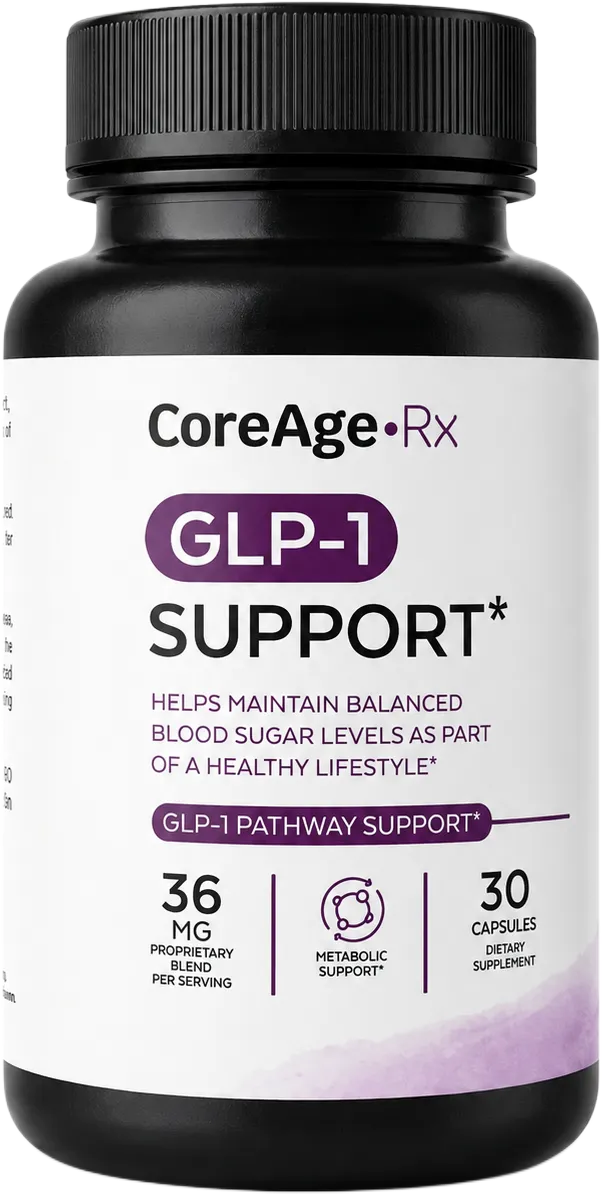
CoreAge Rx GLP-1 Support combines the three listed bacterial species with chicory inulin and potato resistant starch. It is a dietary supplement; it does not replace a GLP-1 prescription. See the current GLP-1 Support™ page and check the bottle you receive before use.
Related reading
- GLP-1 Support Supplements: Ingredients, Evidence, and Expectations
- Probiotics vs. Prebiotics: How They Differ
- Inulin as a Prebiotic: Benefits, Amounts, and Tolerance
- How fiber supplements differ from probiotic products
Educational information, not individualized medical advice. Product information and linked research checked September 15, 2026. Ingredient research does not establish identical effects for a finished supplement.