There is no single supplement stack that everyone needs while taking a GLP-1 medication. The useful starting question is what is missing or difficult in your current eating pattern? A protein drink, a fiber supplement, or a vitamin may have a role when it addresses a specific need. Buying several products because they say “GLP-1 support” does not establish that need.
This guide is for people already using or considering medicines such as semaglutide or tirzepatide. It separates nutritional support during treatment from supplements marketed as a replacement for treatment. For that second question, read our GLP-1 support supplement evidence guide.
Why nutrition deserves attention when appetite changes
GLP-1 medicines can reduce hunger and the amount of food a person eats. That can support the intended treatment goal, but smaller meals still need to provide adequate nutrients. Nausea, vomiting, food aversions, or a very narrow menu can make that harder.
The joint advisory from nutrition, lifestyle-medicine, and obesity organizations recommends nutritional assessment, individualized food guidance, attention to hydration, and strategies to preserve muscle and bone. It supports considering supplements for nutrients at risk, including vitamin D, calcium, and B12, based on individual needs. It does not establish a mandatory shopping list for every patient.
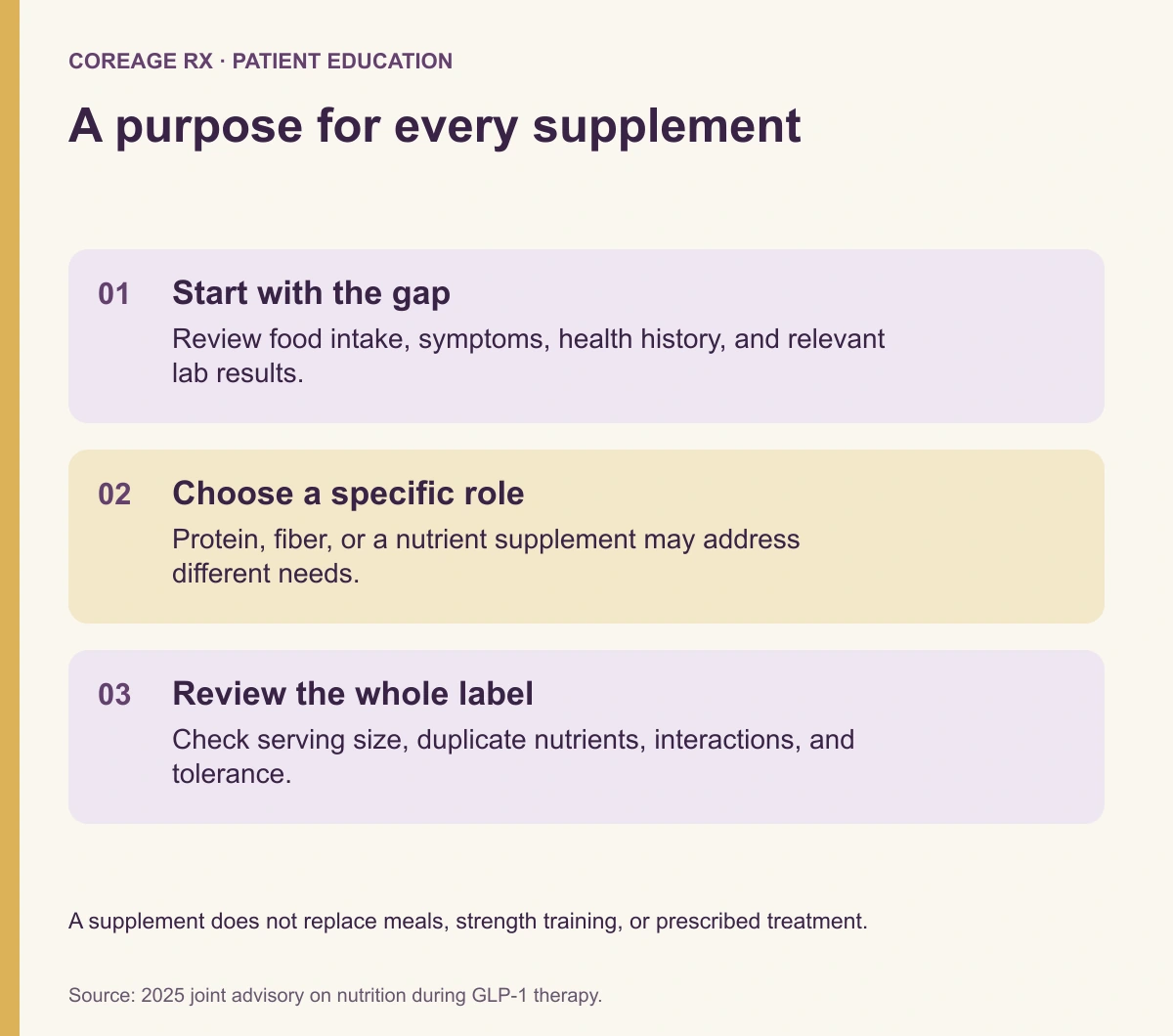
A useful review includes what you actually eat, why you sometimes miss meals, the symptoms that limit choices, relevant medical conditions, and any laboratory evidence of deficiency. A person eating a varied diet with good tolerance may need a different plan from someone vomiting frequently or avoiding most protein foods.
Start with a simple food-and-symptom review
Before buying a product, record a few representative days. Include meals, drinks, portions you could comfortably finish, symptoms, and supplements already used. Exact calorie counting is not required to identify a pattern such as missing lunch most days or eating almost no calcium-containing foods.
Bring that record to your clinician or registered dietitian. Ask which gaps matter, what can be improved through meals, and whether testing is appropriate. Laboratory tests should answer a clinical question; an extensive commercial nutrient panel is not automatically necessary.
Our balanced-meal guide, protein breakfast ideas, and meal preparation for busy schedules can help turn the findings into a routine.
A practical comparison of common options
| Option | A reason it might be considered | What it does not establish |
|---|---|---|
| Protein powder or ready-to-drink shake | A convenient way to help meet an agreed protein target when meals fall short | That everyone needs a shake, or that protein alone prevents muscle loss |
| Standard multivitamin | A clinician identifies limited variety or risk of inadequate intake | That it replaces food, protein, fiber, or individualized treatment of a deficiency |
| Vitamin D, calcium, or B12 | Intake, health history, or testing supports a particular need | That high doses improve GLP-1 weight-loss results |
| Fiber supplement | A specific fiber gap or bowel-management plan | That more is always better, especially with significant digestive symptoms |
| Creatine | A separate discussion about strength-training goals and suitability | That it is required with GLP-1 treatment or proven to prevent all treatment-associated muscle loss |
| Probiotic or prebiotic | A product-specific, evidence-based reason for use | That a “gut health” claim makes it a substitute for a prescription medicine |
The NIH Office of Dietary Supplements emphasizes that supplements cannot replace the variety of foods in a healthy eating pattern, may interact with medicines, and are not reviewed for effectiveness before marketing in the same way as drugs.
Protein: decide on a target before adding a scoop
Protein deserves attention during weight reduction, especially when appetite is low. Food sources can include fish, eggs, yogurt, cottage cheese, poultry, tofu, beans, and lentils. A smaller volume of a tolerated food may be easier than forcing a large meal.
Protein needs depend on body size, age, activity, kidney health, and other factors. A target based on actual body weight can overestimate needs in some people with obesity. The joint advisory discusses several approaches and acknowledges that no single calculation fits every patient. Ask the clinician or dietitian to translate the plan into a practical daily target.
A shake can fill a gap. Check grams of protein per serving, the serving size you actually drink, ingredients that trigger symptoms, and whether it displaces other foods. A product sold as a “nutrition shake” may contain different amounts of protein, fiber, and micronutrients than a plain protein powder.
Protein is also only part of protecting function. Appropriate strength training matters. Read our semaglutide protein and muscle guide, tirzepatide protein and muscle guide, and beginner strength-training article.
Multivitamins and individual nutrients
When eating becomes restricted, a standard multivitamin may be discussed as one way to cover some micronutrient gaps. It does not provide the energy, protein, fiber, or full range of food components needed for adequate nutrition. Nor is a multivitamin the same as treatment for a diagnosed deficiency.
Targeted supplementation can be more appropriate when a specific issue is identified. The relevant question might involve vitamin D and bone health, calcium intake, or B12 risk in a person with a particular diet or medical history. The amount, form, duration, and follow-up should match that question.
Avoid adding separate products without totaling overlapping ingredients. A multivitamin, greens powder, fortified drink, and hair supplement may all contain the same nutrients. More is not always useful or safe. NIH notes risks from excessive intake of some vitamins and minerals, including vitamin A and iron. Source: NIH supplement overview.

Fiber: choose the type and pace carefully
Fiber from food supports a varied eating pattern, but a supplement may be useful for a specific gap or bowel-management plan. The amount of fiber per serving matters more than the number of capsules or the size of the package.
People with nausea, significant bloating, constipation, or slowed gastric emptying may need a tailored approach. A large jump in fiber can add discomfort. Follow the product’s water instructions and ask a pharmacist about medication timing, especially with other oral prescriptions. Severe constipation with vomiting, marked abdominal swelling, or inability to pass gas needs evaluation, not additional fiber.
Our articles on food fiber versus supplements, fiber capsules versus powder, and fiber and medication timing explain these distinctions. If you are considering CoreAge Rx Full House, review its exact ingredients and serving amounts with the clinician rather than assuming all fiber products are interchangeable.
Does creatine belong in a GLP-1 plan?
Creatine is a separate supplement decision, usually discussed in the context of exercise and strength goals. It does not replace dietary protein, and using a GLP-1 medicine does not automatically create a need for it. Evidence for creatine in exercise settings should not be turned into a claim that it prevents every form of lean-mass loss during GLP-1 treatment.
Review kidney history, medicines, exercise goals, and product quality before starting. Changes in water held in muscle can also affect scale readings, which may be confusing during weight management. Our creatine during weight loss article explains that context, and creatine versus protein compares their different roles.
CoreAge Rx Strong Suit is a product to evaluate within that discussion, not a required companion to a GLP-1 prescription. Its label and suitability should be considered separately from claims about prescription treatment.
Probiotics, greens powders, and “GLP-1 boosters”
These product categories are not interchangeable. Probiotic effects depend on the exact organism, strain, amount, formulation, and outcome studied. A change in a gut biomarker does not by itself demonstrate clinically meaningful weight loss. A greens powder may contain plant ingredients while providing relatively little fiber or protein.
Do not assume that a product advertised to support GLP-1 recreates the effect of a prescription receptor agonist. Our probiotics while taking GLP-1 medicines guide, greens powder versus vegetables article, and GLP-1 supplement guide examine those evidence questions.
You can apply the same standards to CoreAge Rx GLP-1 Support and Green Scene: identify the purpose, inspect the current label, and discuss whether the product adds something useful to your plan. A supplement’s name does not establish an FDA-approved treatment effect.
For a closer look at a frequently marketed supplement, read our review of berberine with Ozempic or other GLP-1 medicines. It distinguishes supplement trials and a human enzyme study from evidence for the exact combination, and explains what to review with a pharmacist.
Electrolytes and hydration: symptoms come first
Someone drinking comfortably and eating regular meals may not need a daily electrolyte powder. Persistent vomiting or diarrhea is different: fluid and electrolyte losses can become clinically important and may require assessment and a specific rehydration plan.
If you cannot keep fluids down, urinate very little, feel faint, or become confused, seek prompt medical care. Do not use a sports drink as a substitute for evaluation. People with kidney disease, heart failure, or prescribed fluid restrictions should ask before substantially changing fluid or electrolyte intake.
The current Ozempic, Zepbound, and Mounjaro labels warn about kidney injury related to volume depletion. Our hydration and weight-management guide covers everyday habits, while persistent medication symptoms belong in a prescriber review.

A label checklist before you buy
- Name the purpose. What specific problem or nutritional gap is the product meant to address?
- Check the serving. How much of the active ingredient do you actually receive?
- Total duplicate nutrients. Include fortified foods, drinks, and other supplements.
- Review interactions. Bring the full list to a pharmacist or clinician.
- Look for meaningful quality information. Independent testing can assess aspects of quality, but a seal does not prove clinical effectiveness or suitability for you.
- Set a review point. Decide what benefit, symptom, or laboratory result will determine whether to continue.
Keep the list simple enough that you can tell what each item is doing. If a new product worsens nausea, bloating, diarrhea, or another symptom, tell the care team rather than automatically adding a second product to counteract it.
Our guide to ox bile, digestion and weight-loss claims distinguishes dietary fat absorption from stored-fat loss and explains why gallbladder removal does not establish an automatic supplement requirement.
Frequently asked questions
How much vitamin B12 should an adult take each day?
NIH lists an adult Recommended Dietary Allowance of 2.4 micrograms per day. This refers to total daily intake, including food and supplements; it is not an automatic supplement strength, injection regimen or deficiency-treatment dose. Pregnancy and lactation have different reference amounts. Dietary intake, absorption problems, testing when appropriate and medicines such as metformin or acid-suppressing drugs can change the assessment. A clinician should determine treatment for an identified deficiency rather than use the dietary allowance as a replacement regimen. Office of Dietary Supplements – Vitamin B12.
Does everyone on semaglutide need B12?
No universal requirement follows from the prescription alone. Diet, medicines, medical history, symptoms, and relevant testing can inform the decision. An injection is not automatically better than an oral product for every person.
Can supplements prevent all muscle loss?
No supplement provides that guarantee. Nutrition, strength training, the pace and amount of weight change, age, and underlying health all matter. Track strength and daily function as well as body weight.
Should I buy everything before the first dose?
Start with a nutrition and symptom plan, then add a product only when there is a clear reason. Our first month on semaglutide and first month on tirzepatide guides can help organize the initial discussion.
Can a supplement replace my medicine?
Do not replace a prescribed treatment on the basis of marketing claims. If cost, tolerance, or preference makes the current plan difficult, discuss alternatives with the prescriber. Medication selection and nutritional support are related but separate decisions.
Magnesium and dose-related questions
- Magnesium and weight-loss evidence — Separate supplement forms, elemental amounts, safety, and weight claims.
- GLP-1 microdosing evidence — Distinguish labeled treatment from nonstandard regimens and review measurement risks.
Educational information for adults; individual treatment decisions require a qualified clinician. Sources checked September 26, 2026. Original AI-generated article illustrations depict fictional people and objects, not patient outcomes. Other editorial images are illustrative. Graphics summarize the cited sources.