
More hair in the shower or a widening part can be unsettling when you are already adjusting to a new medicine. Hair shedding has been reported during GLP-1 treatment, but the explanation is not identical for everyone. Weight change, reduced food intake, an existing hair condition, and possibly direct medication effects all deserve consideration.
Mounjaro and Ozempic also should not be assigned the hair-loss percentages reported for Zepbound and Wegovy simply because they share an ingredient. This guide separates those products, explains what regrowth timelines can and cannot tell you, and outlines useful questions for a prescribing clinician or dermatologist.
Does Mounjaro cause hair loss?
Hair loss is not listed among the most common adverse reactions in the current Mounjaro prescribing information. That does not establish that a person taking Mounjaro cannot develop shedding or that a new symptom should be dismissed. It means the label should not be presented as containing a specific common hair-loss rate that it does not report. Source: Mounjaro prescribing information.
Zepbound contains the same active ingredient, tirzepatide, but has different approved uses and its own clinical-trial information. In pooled Zepbound weight-management studies, hair loss was reported in approximately 4%–5% of treated participants across the studied maintenance doses, compared with 1% receiving placebo. The label describes these events as associated with weight reduction. Source: Zepbound prescribing information.
Those figures describe the study groups. They are not a personalized prediction, proof of a particular biological cause, or a Mounjaro-specific percentage. The distinction is similar to the one discussed in our tirzepatide questions guide: the ingredient name does not replace the exact product, purpose, and evidence.
Does Ozempic cause hair loss?
Hair loss is not among the most common adverse reactions listed in the current Ozempic injection label. Someone who notices thinning while using it still needs an assessment of the timing, weight changes, food intake, other medicines, and the pattern of hair loss. Absence from a common-reaction list cannot determine the cause in an individual. Source: Ozempic injection prescribing information.
Wegovy also contains semaglutide, but its weight-management studies provide separate hair-loss data. The current label reports hair loss in 3.3% of adults receiving 2.4 mg injections in a pooled group of studies, versus 1% with placebo. Its newer 7.2 mg injection studies report a different rate. These findings should not be relabeled as the risk with every Ozempic dose, Wegovy tablet, or compounded preparation. Source: Wegovy prescribing information.
For broader brand distinctions, see semaglutide versus Ozempic. Understanding which medicine and formulation you use makes the discussion more precise than describing every product as “the weight-loss shot.”
Why might shedding happen during treatment?
The American Academy of Dermatology describes several possible explanations. Significant weight change can act as a physical stressor. Eating less may make it harder to obtain enough protein and other nutrients. A direct drug effect is also possible, and the mechanisms have not been fully resolved. Source: AAD guidance on GLP-1 effects on hair.
It is therefore too definite to say that GLP-1 medicines never affect hair directly, or that every case is caused by a vitamin deficiency. It is equally unhelpful to assume that the medication has permanently damaged the follicles. Both conclusions skip the assessment needed to distinguish possibilities.
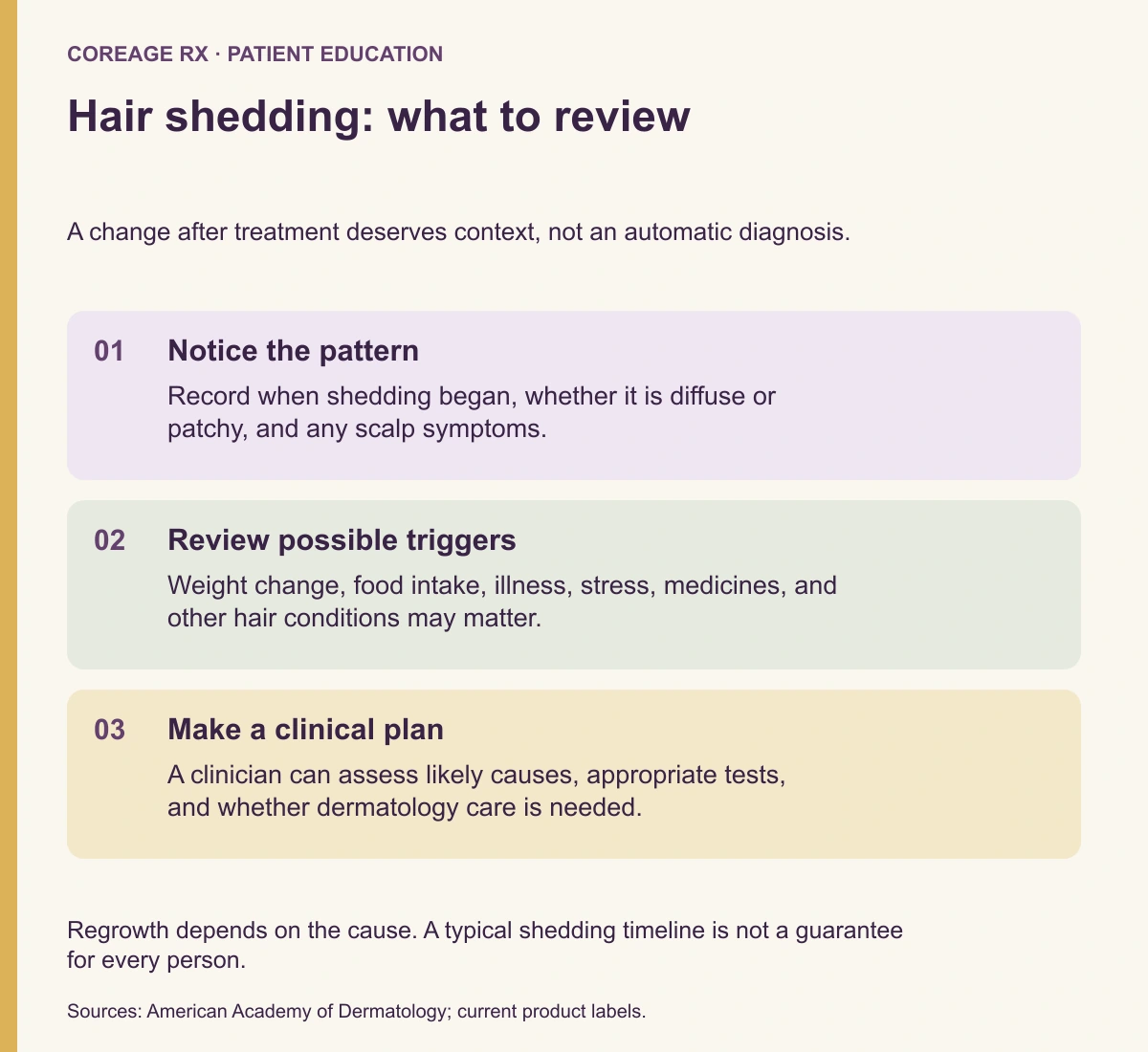
Think of the appointment as a review of several changes happening together. A person may have started treatment, lost weight, had an illness, changed contraception, and begun eating fewer meals within the same season. The most noticeable recent event is not automatically the only relevant one.
What is telogen effluvium?
Telogen effluvium is excessive hair shedding that can follow a stressor such as illness, surgery, childbirth, or substantial weight loss. It often becomes noticeable a few months after the trigger, which can make the timing confusing. The hair change may appear after the original event seems to have settled. Source: AAD: hair loss or hair shedding?.
A delayed onset does not prove that a particular dose increase caused the problem. Nor does shedding that began before treatment rule out another change later. A simple timeline is often more useful than trying to remember exactly how many hairs appeared on a single wash day.
Telogen effluvium is also not the only diagnosis. Pattern hair loss and excessive shedding can coexist. A clinician may need to distinguish shedding from breakage, a gradually changing hairline, or a condition affecting the scalp itself before recommending treatment.
Will GLP-1 hair loss grow back?
Regrowth depends on the cause and whether the trigger has resolved. The AAD notes that excessive shedding often improves as the body readjusts, with fullness commonly recovering over six to nine months. That is a general description of shedding recovery, not a countdown beginning on the day someone starts or stops a GLP-1 medicine. Persistent triggers can prolong shedding. Source: AAD shedding guidance.
Other hair conditions may require their own treatment and may not follow that pattern. A reassuring timeline from someone online cannot establish what will happen to your hair. It is reasonable to ask what diagnosis is most likely, what changes would support that diagnosis, and when the clinician wants to reassess it.
Photographs taken under similar lighting can help document the course without daily inspection becoming the main focus of treatment. Note the dates, hairstyle, and any change in the part or hairline. Bring those observations to follow-up rather than using them to make unsupervised medication changes.

What information should you bring to an appointment?
A useful record can be short. Include:
- The exact medication, formulation, starting date, and recent dose changes.
- When the shedding or thinning first became noticeable.
- Whether the change is diffuse, concentrated around the part or hairline, or patchy.
- Weight changes, appetite changes, and any difficulty maintaining meals.
- Recent illness, surgery, pregnancy-related changes, major stress, and other new medicines or supplements.
- Scalp symptoms such as pain, redness, scaling, or significant itching.
You do not need to diagnose yourself or arrive with a list of laboratory tests to request. The history and examination should guide whether testing is useful. A routine “hair panel” advertised online may not answer the question that matters for your situation.
Seek assessment sooner for rapidly changing or patchy loss, significant scalp symptoms, or hair changes accompanied by other concerning symptoms. These features are reasons to clarify the cause instead of assuming that waiting for weight stabilization will solve everything.
Can eating more protein prevent it?
Adequate nutrition matters during weight treatment, but protein is not a guaranteed prevention or regrowth treatment for every type of hair loss. The practical concern is whether reduced appetite is making the overall diet inadequate. Our semaglutide protein and muscle guide discusses maintaining nourishment when portions become smaller.
Start with what is happening at meals. Are you skipping breakfast because you feel full until midday? Has persistent nausea made most foods unappealing? Are you avoiding entire food groups because of something you read online? Those details give a clinician or dietitian something specific to address.
A joint professional advisory on nutrition during GLP-1 therapy emphasizes assessing intake and supporting nutritional adequacy. A plan may need to account for food preferences, medical conditions, gastrointestinal symptoms, and the ability to prepare meals. It should not be reduced to one supplement added to an otherwise inadequate routine. Source: GLP-1 nutrition advisory.
Should you take hair vitamins or extra supplements?
The fact that a product is labeled for “hair support” does not establish that it treats the reason for your shedding. A suspected deficiency and an adequately nourished person buying a high-dose supplement are different situations. Tell the clinician what you already take, including multivitamins, gummies, powders, and products marketed for energy or weight management.
Ask what a proposed supplement is intended to correct, how that need was identified, and when it will be reviewed. More ingredients are not necessarily more useful. Our guide to supplements during GLP-1 treatment explains how to review overlapping products and medication questions.
The AAD’s GLP-1 discussion highlights nutritional adequacy, while also acknowledging uncertainty about the causes of hair changes. It should not be turned into a promise that a particular gummy, collagen product, or vitamin combination will prevent medication-associated shedding. Source: AAD GLP-1 guidance.
Should you stop Mounjaro or Ozempic?
Do not make that decision from a hair-loss percentage alone. The medicine may be treating diabetes or another important health condition, and stopping or changing it affects the broader treatment plan. Discuss the concern with the prescriber and, when appropriate, a dermatologist.
The review can consider the likely hair diagnosis, nutritional intake, tolerability, response to treatment, and available alternatives. Continuing, adjusting, or changing treatment requires that context. Hair shedding does not automatically mean the dose is excessive, and changing injection sites is not an established hair-regrowth strategy.
If you are comparing care services, ask how new symptoms and follow-up are handled. CoreAge Rx’s tirzepatide information page describes its treatment offering; suitability and the exact prescribed preparation require individual clinical review.

Can minoxidil or finasteride help?
Hair-loss medicines should be matched to the diagnosis. They are not interchangeable treatments for every person who notices more shedding after weight loss. A dermatologist can explain whether a specific option fits the pattern, what evidence applies, and what monitoring or precautions are needed.
Our guides to oral minoxidil and finasteride side effects provide background for that conversation. Reading about them is not a reason to add another prescription before the cause of the hair change is understood.
What should you remember?
The most useful next step is to identify the pattern and its context. Brand-specific label information can show that hair loss was reported in particular studies, but it cannot diagnose an individual. Regrowth depends on the underlying cause, and nutritional support should respond to actual needs.
Bring a clear timeline, discuss eating difficulties early, and agree on a follow-up plan. That approach gives you more useful information than either dismissing the symptom or assuming that every GLP-1-related hair change is permanent.
Investigate the hair-loss pattern
- DHT and hair-loss assessment — Consider pattern loss alongside other causes of shedding and review treatment-specific evidence.
Educational information for adults; individual treatment decisions require a qualified clinician. Sources checked September 27, 2026. Original AI-generated article illustrations depict fictional people and objects, not patient outcomes. Other editorial images are illustrative. Graphics summarize the cited sources.