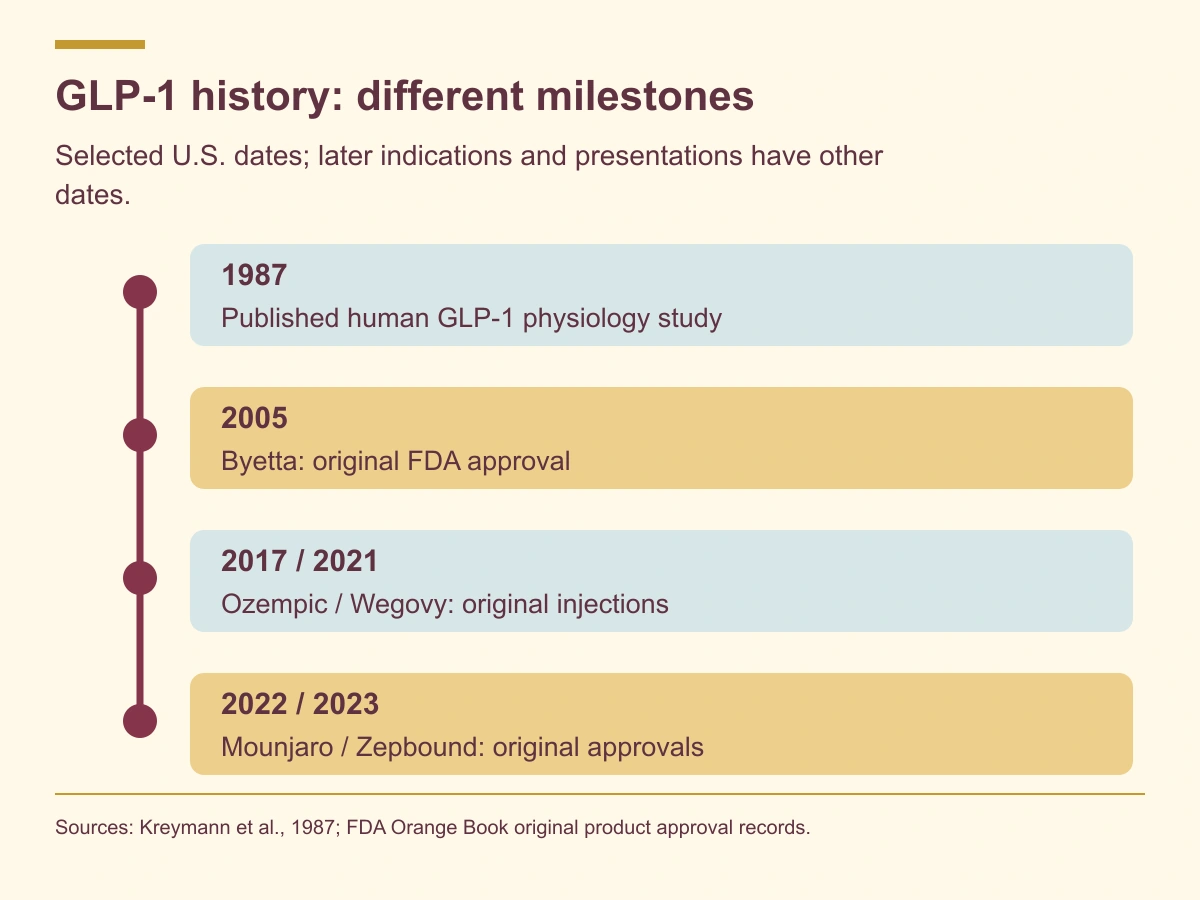
GLP-1 medicines are not a brand-new idea. Human research on the hormone was published in the 1980s, and the FDA approved Byetta, an exenatide medicine, on April 28, 2005. Newer products, weight-management indications, and delivery systems came later. The age of the drug class should not be confused with the history of one particular prescription.
There are several different starting dates
“How long have GLP-1s been around?” can mean the discovery of a hormone, the publication of an experiment, the first drug approval, or the arrival of a product in pharmacies. Those events answer different questions.
GLP-1 stands for glucagon-like peptide-1. The naturally occurring hormone is part of the body’s response to food. A GLP-1 receptor agonist is a medicine that activates the relevant receptor. The medicine’s formulation, duration of action, clinical evidence, and approved uses require their own study.
Tirzepatide adds another distinction: it activates both GIP and GLP-1 receptors. It is often discussed alongside GLP-1 medicines, but it should not be described as identical to a medicine acting only at the GLP-1 receptor. Our tirzepatide peptide guide explains that difference.
What did early human research show?
A 1987 paper by Kreymann and colleagues investigated GLP-1 7–36 in humans. The investigators observed changes after oral glucose and a test breakfast and examined an infusion in a small group of volunteers. The findings supported a role in insulin release and glucose regulation. Original 1987 paper.
This was physiology research, not a modern weight-management trial. It did not test today’s weekly semaglutide or tirzepatide products, establish their doses, or predict an individual’s long-term weight response. Its importance is that it helped characterize a biological pathway that later drug development could use.
Scientific development usually involves many contributions over time. One study date should not be presented as the moment every feature of the hormone or drug class was discovered. A useful timeline identifies a documented milestone and says what that milestone actually established.
Byetta’s 2005 approval
FDA’s Orange Book records list April 28, 2005 as Byetta’s original approval date. Byetta contains exenatide. As of this article’s October 2026 review, that approval is more than 21 years old. FDA Orange Book product records.
That date helps answer whether GLP-1 receptor medicines have a history extending beyond recent headlines. It does not mean every later product has 21 years of direct exposure data or the same clinical trial evidence.
Approval also differs from launch. A regulatory decision allows a product to be marketed under its approved conditions; the date it actually reaches pharmacies may be later. If an article gives a precise commercial launch date, it should identify a source for that different event.
A timeline of selected U.S. approvals
The following dates are selected original FDA product approvals from the retrieved Orange Book records. They do not include every GLP-1 medicine, every subsequent indication, or every new presentation.
| Date | Product and ingredient | What the date represents |
|---|---|---|
| April 28, 2005 | Byetta, exenatide | Original U.S. product approval. |
| December 23, 2014 | Saxenda, liraglutide | Original U.S. product approval. |
| December 5, 2017 | Ozempic, semaglutide | Original U.S. injection approval. |
| September 20, 2019 | Rybelsus, semaglutide | Original U.S. oral-product approval. |
| June 4, 2021 | Wegovy, semaglutide | Original U.S. injection approval. |
| May 13, 2022 | Mounjaro, tirzepatide | Original U.S. autoinjector product approval. |
| November 8, 2023 | Zepbound, tirzepatide | Original U.S. autoinjector product approval. |
Source: FDA Orange Book downloadable data, checked October 5, 2026. Later vial, pen, tablet, strength, or indication records can have different dates.
Why semaglutide has more than one history
Ozempic, Rybelsus, and Wegovy contain semaglutide, but their original product approvals occurred at different times. Route, formulation, dose, and intended use matter. A semaglutide timeline is therefore more complicated than a single date attached to the ingredient.
For example, the original Ozempic injection approval should not be used as the approval date for every subsequent tablet or delivery device. Likewise, the original Wegovy injection date does not describe every later Wegovy presentation.
Our Ozempic approval-history article examines those distinctions in more detail. The oral semaglutide versus injections guide explains why a shared ingredient does not make milligram amounts or administration instructions interchangeable.

Where tirzepatide fits
Mounjaro and Zepbound arrived later in the selected timeline and contain tirzepatide, a dual GIP/GLP-1 receptor agonist. Their original approvals should be distinguished from the earlier research program and from subsequent changes to their labels. Current Mounjaro prescribing information, current Zepbound prescribing information.
The tirzepatide approval-history guide separates research, product approval, and later indication milestones. This helps when someone asks whether a medicine is “new”: new compared with the entire class is different from new compared with its own first approval.
Current labels also matter more than a historical summary for today’s treatment. A product may gain an additional use or presentation after its original approval. Conversely, a historical use or package should not be assumed to describe the prescription a pharmacy supplies now.
Does a longer history mean a medicine is safer?
Longer use creates more opportunity to study benefits, risks, and patterns in different settings. It does not mean every risk is known, every patient is suitable, or the oldest product is automatically best. The relevant evidence must match the product and the question.
A randomized trial can compare defined treatments in a selected population for a particular duration. Postmarketing reports can identify possible safety signals in wider use, but a report alone does not prove causation or establish how often an event occurs. Different evidence sources contribute different information.
For your own assessment, ask about the current contraindications, important warnings, medical history, and monitoring plan. Our tirzepatide contraindications guide shows why “this class has been around for years” cannot replace a product-specific review.
Class history is not an individual forecast
A person considering treatment usually wants practical answers: Will it help the condition being treated? What side effects could occur? How will progress be assessed? What happens if treatment is stopped? A chronology can provide context, but it cannot answer those questions alone.
Average trial results apply to the population, regimen, duration, and support studied. They do not guarantee a particular person’s outcome, and they should not be transferred automatically between products or doses. The age of a drug class does not change those limitations.
The semaglutide questions guide and tirzepatide questions guide organize the clinical discussion around current care. Use history to understand development, then use current evidence to evaluate the proposed treatment.
Approved brands and compounded preparations have different evidence
A compounded preparation does not inherit FDA approval because its ingredient has a long research history. FDA explains that compounded drugs are not reviewed before marketing for safety, effectiveness, and quality in the same way as approved drugs. FDA information about unapproved GLP-1 products.
Likewise, a study of an approved product does not automatically establish equivalence for a different concentration, combination, route, or source. A claim such as “the ingredient has been used for decades” leaves the actual preparation unspecified.
Our compounded GLP-1 guide explains the questions to ask about the preparation. The CoreAge Rx tirzepatide service page describes assessment-based compounded care; it is not an FDA approval record or a substitute for reviewing the proposed medicine.
How to check a history claim yourself
Start with the product name and ingredient. Then identify the event: original approval, new indication, new device, commercial launch, or study publication. Look for a source that records that event rather than an article repeating a date without context.
FDA’s Orange Book helps verify approved products and related records. A prescribing label explains current uses and administration. An original paper documents the research it actually reports. A manufacturer announcement may establish a launch or company milestone, but promotional framing should be separated from the underlying record. Orange Book overview.
Be especially careful with a headline that combines multiple events into one sentence. “Approved in 2017” may refer to an injection, while the rest of the article discusses a newer tablet. Keeping route and product together prevents that kind of mistaken comparison.

What to ask at a treatment consultation
Ask which exact product is being considered, which condition it would treat, and what evidence supports that use in someone with your history. Ask how the clinician will assess benefit, nutrition, symptoms, and other medicines over time.
If the answer relies mainly on how long the class has existed, request the product-specific details. If the answer relies only on novelty, ask what has actually been demonstrated. Familiarity and newness are both incomplete ways to judge treatment.
Cost, availability, and follow-up also affect the decision. The GLP-1 insurance guide can help with access questions, while clinical suitability remains a separate assessment.
Common questions
Were GLP-1 medicines invented for recent weight-loss trends?
No. The pathway and medicines have a longer research and treatment history. The original 1987 human study and 2005 Byetta approval predate the recent public attention by many years.
Does every GLP-1 medicine have the same amount of long-term evidence?
No. Each product, indication, regimen, and population has its own evidence. Class history should not be substituted for direct evidence about the proposed prescription.
Is tirzepatide simply another name for semaglutide?
No. They are different active ingredients with different receptor activity and product labels. A timeline that discusses both should preserve that distinction.
Can I use an old label because the medicine name is unchanged?
Use the current instructions that match the product supplied. Names can remain familiar while indications, presentations, warnings, and instructions change.
Educational information for adults; individual treatment decisions require a qualified clinician. Sources reviewed October 5, 2026. Original AI-generated article images depict fictional people and objects, not patient outcomes. Other editorial images are illustrative. Graphics summarize the cited sources.