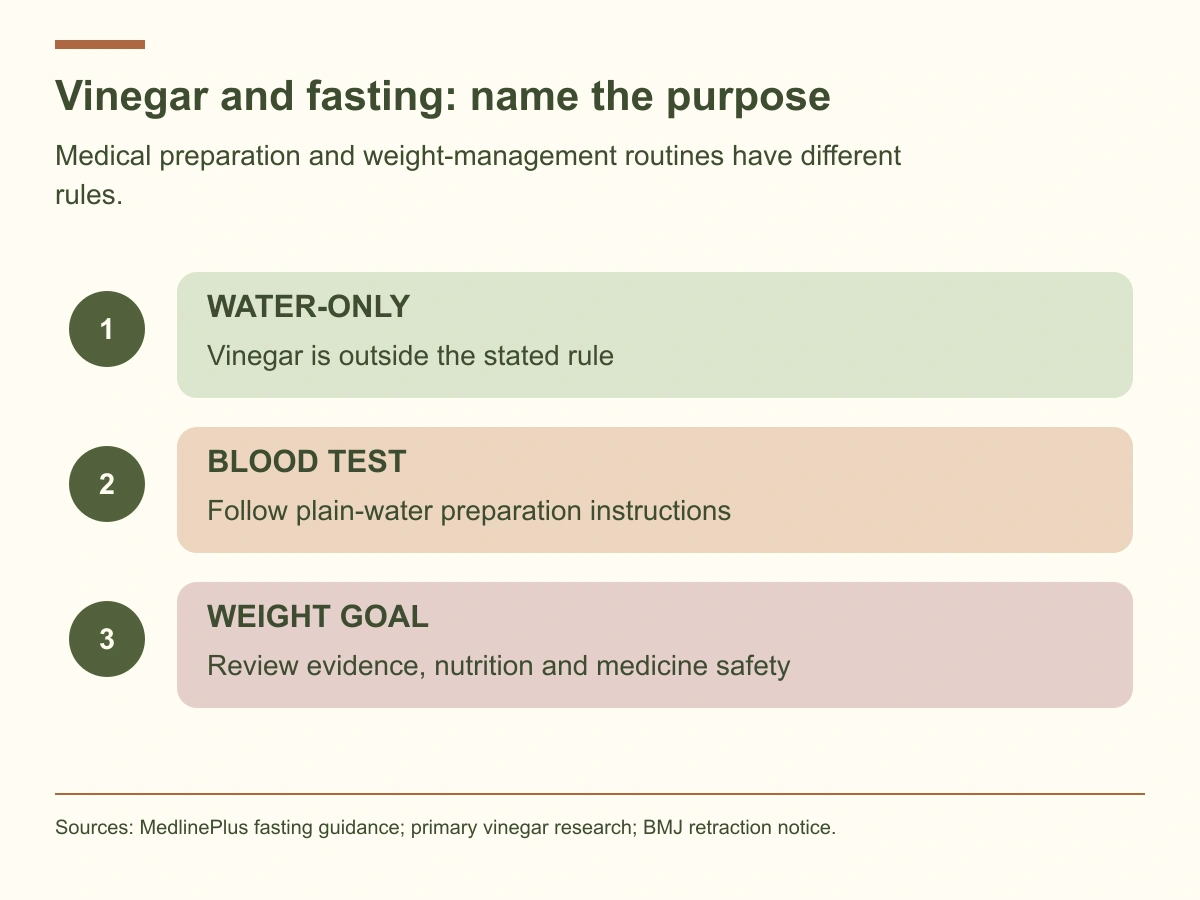
Whether apple cider vinegar “breaks a fast” depends on what the fast is for. For a strict water-only fast, vinegar is outside the rule. For weight management, the more useful question is whether the overall eating pattern is safe and sustainable. For a blood test or procedure, follow the clinical instructions instead of applying an internet calorie threshold.
Different fasts have different purposes
People use the word “fasting” for time-restricted eating, laboratory preparation, anesthesia preparation, religious practice, and other situations. These are not interchangeable. A drink permitted in one context may be inappropriate in another.
An intermittent-fasting routine for weight management usually defines an eating window. The person or program may also specify what is allowed outside that window. There is no universal clinical rule that a particular number of calories preserves every proposed fasting benefit.
Our water and fasting guide explains the broader distinction. Start by naming the purpose of your fast before deciding whether an ingredient belongs in it.
| Purpose | How to approach vinegar |
|---|---|
| Strict water-only fast | Vinegar is not plain water and is outside that stated rule. |
| Time-restricted eating for weight management | Review the actual plan, ingredients, intake, symptoms, and medicine safety. |
| Fasting blood test | Follow laboratory instructions; MedlinePlus describes plain water only when fasting is required. |
| Surgery or sedation | Ask the procedural team; do not classify a homemade drink yourself. |
| Religious observance | Follow the guidance of the relevant tradition and discuss health needs with the care team. |
For blood tests, plain water means plain water
MedlinePlus explains that fasting before a blood test generally means avoiding food and drinks other than plain water for the specified interval. It also says to ask about medicines and supplements rather than stopping them independently. Fasting for a blood test.
A vinegar drink is not plain water, even when heavily diluted or marketed as a low-calorie “fasting aid.” If you drank it before a test that required fasting, tell the testing team what and when you consumed. Let them decide whether the test can proceed or should be rescheduled.
Do not fast for a test unless you were instructed to do so. Unnecessary fasting can also complicate preparation, especially for someone taking glucose-lowering medicines. Ask in advance so the instructions and medicine plan are clear.
For procedures, use the team’s instructions
Preparation for anesthesia or deep sedation addresses risks that a weight-management fasting routine does not. Ingredients, timing, medicines, and the procedure all matter. Do not decide that a vinegar mixture counts as an allowed clear liquid because you can see through it.
If you take a GLP-1 medicine, tell the procedural team. Current product labels describe delayed gastric emptying and aspiration concerns, including reports despite reported adherence to fasting instructions. The team needs to coordinate the plan. Our semaglutide before surgery guide explains the questions to raise.
This is also why a social-media rule such as “anything under 50 calories is fine” should not be carried into medical preparation. The relevant instruction comes from the clinical team responsible for the test or procedure.
Does vinegar improve weight loss during intermittent fasting?
The evidence reviewed here does not establish that adding apple cider vinegar to an intermittent-fasting routine produces a reliable extra weight-loss benefit. A study of vinegar taken daily is not automatically a study of vinegar during a fasting window.
A 2009 randomized, double-blind trial in Japanese adults with obesity compared beverages containing different amounts of vinegar with a placebo beverage over 12 weeks. The primary abstract reported lower weight and several related measures in the vinegar groups. It did not test whether vinegar preserves a fast, establish a special time of day, or demonstrate durable long-term weight maintenance. Kondo and colleagues’ primary study abstract.
That study can be discussed as limited evidence about a particular intervention. It cannot justify a guaranteed number of pounds lost, a claim that all apple cider vinegar products are equivalent, or a recommendation to replace established treatment.
A widely shared trial was retracted
A separate 2024 apple cider vinegar weight-loss trial received extensive publicity. BMJ Group subsequently retracted it after concerns about its statistical analysis, data reliability, reporting, and trial registration. The publisher says its findings should no longer be used as evidence. BMJ Group retraction explanation.
This matters when evaluating dramatic claims online. An older article may still quote the original results, and a summary that pools studies may need to be reconsidered if it includes a retracted trial. The presence of a journal name or a large reported effect does not settle whether the finding remains reliable.
Do not use that retracted study to predict your result. The appropriate conclusion is uncertainty about the claimed benefit, not that vinegar has been proven to make fasting more effective.

Calories and ingredients still need context
Plain vinegar, a sweetened vinegar drink, a gummy, and a flavored “shot” can have different ingredients. Honey, juice, sugar, and other additions change the product. Read the serving size and Nutrition Facts or Supplement Facts rather than relying on the word “vinegar.”
FDA explains that serving size is not a personal intake recommendation and that nutrient amounts refer to the stated serving. FDA label-reading guide. A small labeled amount does not establish a clinically meaningful fasting benefit or prove that a product is suitable for repeated use.
Our apple cider vinegar powder article discusses why a powder or blended supplement should not be treated as an exact substitute for a liquid used in research. The preparation and amount of the relevant ingredients may differ.
What about autophagy and insulin claims?
A bottle label cannot establish a precise point at which human cellular processes switch on or off. The vinegar trials discussed here did not validate an at-home “autophagy-safe” vinegar dose or a universal calorie cutoff. Avoid treating a confident numerical rule as settled clinical evidence.
Similarly, a change in a post-meal glucose measurement is not proof of sustained fat loss or proof that a fasting window was preserved. These are different outcomes. A treatment plan for diabetes also depends on more than one glucose reading.
If your goal is weight management, focus on adequate nutrition, a workable eating pattern, sleep, movement, and appropriate clinical care. Our meal-timing guide can help frame those choices without promising a metabolic shortcut.
Acid exposure can affect teeth and symptoms
Vinegar is acidic. Frequent contact with acidic drinks can contribute to enamel erosion. The American Dental Association’s patient guidance explains that acid-related erosion is permanent and recommends discussing habits and symptoms with a dentist. ADA dietary-acid guidance.
An acidic drink may also be unpleasant for someone with reflux or upper digestive symptoms. NIDDK notes that food triggers vary and that timing may matter for nighttime reflux. NIDDK reflux guidance. Increasing the amount because a first dose did not change appetite is not an evidence-based solution.
There is no need to drink vinegar as a “shot” to pursue weight management. Using a familiar ingredient in an ordinary meal is a different exposure from repeatedly sipping an acidic beverage throughout a fasting period. If symptoms develop, stop treating discomfort as a sign that the routine is working.
Gastroparesis deserves particular caution
A small pilot study in ten people with type 1 diabetes and diagnosed gastroparesis found that vinegar further slowed gastric emptying. That specific population and small study do not establish the effect in everyone, but they are a reason to avoid casually recommending vinegar as a digestive aid. Primary gastroparesis study.
The study was not a trial in people using semaglutide or tirzepatide. It should not be presented as proof of a specific drug interaction. If you have gastroparesis, persistent vomiting, or a medicine that affects stomach emptying, ask the clinician about your actual symptoms and proposed routine.
Our tirzepatide nausea and reflux guide offers related questions. Adding another intervention is not a substitute for reviewing a treatment that is making adequate eating difficult.
Fasting and glucose-lowering medicines
Skipping meals or eating much less can increase low-glucose risk with insulin and some other diabetes medicines. NIDDK specifically identifies fasting and insufficient carbohydrate intake as possible contributors. NIDDK hypoglycemia guidance.
Vinegar is not a substitute for the carbohydrate needed to treat hypoglycemia, and protecting a fasting window is not more important than treating a low result. Follow the individualized plan you were given and obtain urgent help for severe symptoms.
Before changing meal timing, ask how medicines and monitoring should be handled. Do not independently omit insulin, reduce other treatment, or use vinegar to compensate. The question is how to maintain safe, consistent care through the proposed eating schedule.

A more useful decision checklist
First, identify the purpose of the fast. Second, list the exact product and any additions. Third, consider symptoms, dental concerns, diabetes medicines, and any history of disordered eating. Finally, decide whether the routine provides a practical benefit you can actually observe without compromising nourishment.
If vinegar is simply a flavor you enjoy, you can discuss using it in meals. If you are taking it because you expect guaranteed fat loss, the evidence does not support that certainty. You can pursue a useful eating pattern without buying a specialized fasting product.
For broader support, see balanced meals for weight management. If you are exploring CoreAge Rx semaglutide care, the assessment should review nutrition and medical history; the service describes compounded treatment, not a vinegar or fasting protocol.
Common questions
Is vinegar required for intermittent fasting?
No. None of the evidence reviewed here establishes it as a required component. A safe schedule and adequate nutrition matter more than adding a particular drink.
Is there a best time to drink it for fat loss?
The cited research does not establish a universal best time or prove a benefit from taking it during the fasting window. Do not confuse a study’s schedule with an individualized recommendation.
Do gummies preserve the same effects as liquid vinegar?
That cannot be assumed. Ingredients, amounts, and formulation differ, and a supplement label does not prove equivalence to a studied beverage.
Educational information for adults; individual treatment decisions require a qualified clinician. Sources reviewed October 5, 2026. Original AI-generated article images depict fictional people and objects, not patient outcomes. Other editorial images are illustrative. Graphics summarize the cited sources.