
Yes. Tirzepatide is a peptide medicine that activates both GIP and GLP-1 receptors. “Peptide” describes its molecular type; “dual receptor agonist” describes two targets it activates. Neither term tells you whether an unknown product is approved, authentic, appropriately prescribed or safe to use. Mounjaro prescribing information, Zepbound prescribing information.
Mounjaro and Zepbound are branded tirzepatide medicines with their own approved indications and instructions. Compounded tirzepatide and products sold as research peptides are separate product-quality and regulatory questions. A shared ingredient name does not establish interchangeable evidence or directions.
What does the word “peptide” mean?
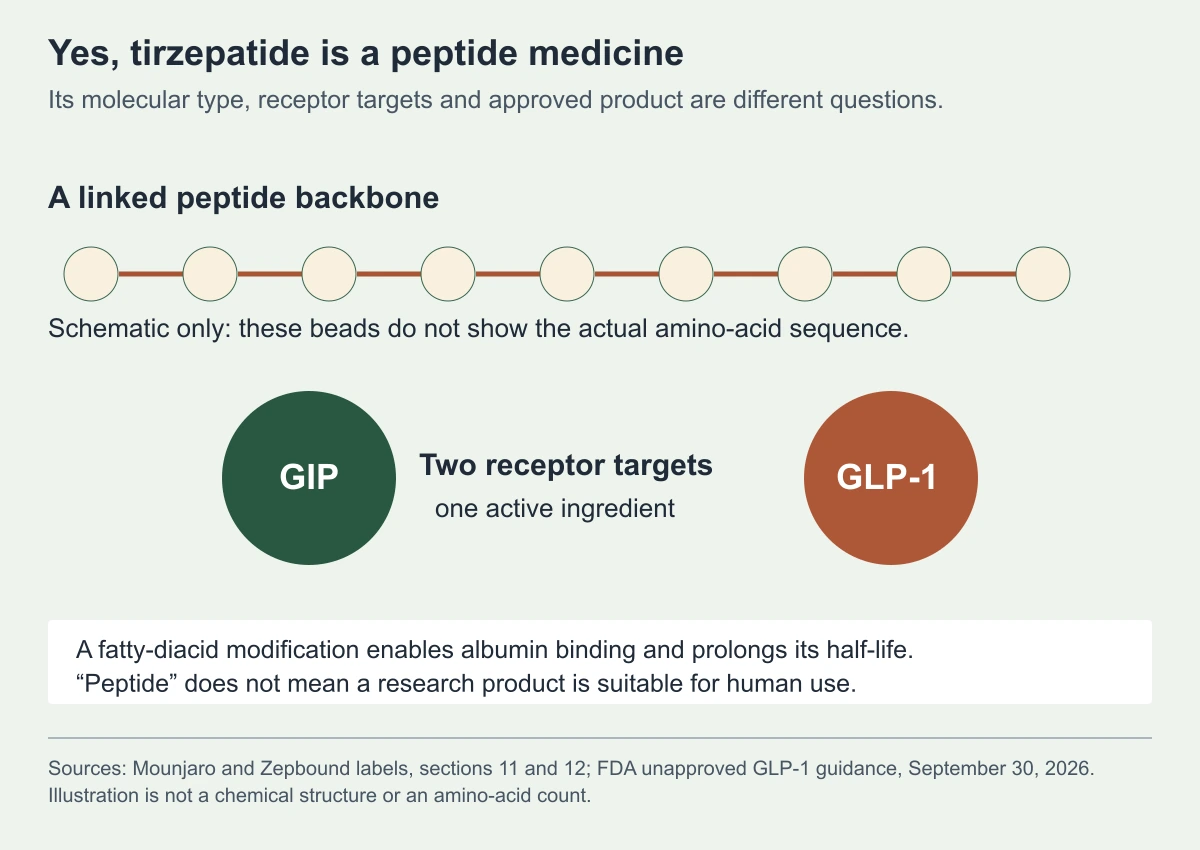
A peptide consists of linked amino-acid units. The term describes a kind of molecule rather than one treatment goal. Many different molecules can be called peptides while having different structures, receptor targets and clinical roles.
The Mounjaro label describes tirzepatide’s sequence-related modifications and a linked fatty-diacid component. It also refers to its peptide backbone when describing metabolism. These are molecular features, not instructions to make the drug, alter a vial or compare a decorative bead image with a chemical structure. Mounjaro description and pharmacology.
Calling a product a peptide does not make it automatically natural, harmless or appropriate for human treatment. It does not identify the amount in a vial or demonstrate that a seller’s material is tirzepatide. Those questions require verified product information and clinical evaluation.
Why is tirzepatide called a dual agonist?
Tirzepatide selectively binds to and activates GIP and GLP-1 receptors. GIP stands for glucose-dependent insulinotropic polypeptide; GLP-1 stands for glucagon-like peptide-1. Both are named in the labels as receptor targets. Mounjaro mechanism information.
“Dual” refers to two receptor targets. It does not mean that the medicine is a mixture of two separately prescribed drugs or that a patient should combine two products. Tirzepatide is one active ingredient with activity at both targets.
The label describes glucose-dependent effects on insulin secretion and glucagon levels, along with effects on food intake, body weight and gastric emptying. These effects help explain its clinical role, but receptor terminology alone cannot predict the response of a particular person. For the broader explanation, read how Mounjaro works.
How does the molecular design support weekly dosing?
The labels describe a C20 fatty-diacid modification that enables albumin binding and prolongs tirzepatide’s half-life. Albumin is a protein in the blood. The Mounjaro label describes an elimination half-life of approximately five days, which supports its once-weekly dosing schedule. Mounjaro clinical pharmacology.
Half-life describes how the amount of drug changes over time; it is not a countdown to a completely empty bloodstream. It also does not tell you how to correct a missed dose, change a schedule or convert an unfamiliar vial measurement.
Follow the instructions for the product actually prescribed. The Mounjaro dosage guide and Zepbound dosage guide explain branded-dose questions. A compounded preparation needs its own prescription and concentration information rather than assumptions copied from a branded device.
How is tirzepatide different from semaglutide?
Both medicines are associated with GLP-1 signaling, but their targets are not identical. The Ozempic injection label describes semaglutide as a GLP-1 receptor agonist. Tirzepatide’s labels describe both GIP and GLP-1 receptor activity. Ozempic label, Mounjaro label.
That difference is one part of a treatment comparison. It does not mean that two targets guarantee a better result for everyone, eliminate side effects or make the medicines safe to combine. Indication, product, tolerability, other medicines and follow-up also matter.
| Term | What it describes | What it cannot answer alone |
|---|---|---|
| Peptide | A molecular category. | Whether the supplied product is appropriate or verified. |
| GLP-1 receptor agonist | Activation of a particular receptor target. | The dose, device, indication or individual result. |
| GIP/GLP-1 dual agonist | Tirzepatide’s two named receptor targets. | Whether it should be combined with another treatment. |
| Brand name | A specific labeled medicine. | Whether the patient meets its treatment criteria. |
| Compounded prescription | A separately prepared medicine. | Equivalent FDA approval or evidence to an approved brand. |
The tirzepatide versus semaglutide results guide discusses comparisons with study context. Avoid choosing a medicine solely from a receptor count or a headline percentage.
Are Mounjaro and Zepbound the same treatment?
They contain tirzepatide, but their labeling and intended uses differ. The current Mounjaro label includes glycemic control alongside diet and exercise in people with type 2 diabetes within its specified age range, and cardiovascular risk reduction in adults with type 2 diabetes who are at high risk for those events. Those indications include important population details. Mounjaro current labeling.
Zepbound has its own weight-management and obstructive-sleep-apnea indications and criteria. Do not infer that any person with fatigue or a desire to lose weight is eligible. The tirzepatide and sleep-apnea guide discusses that defined treatment context. Zepbound label.
Devices, concentrations and storage instructions also need product-specific attention. An ingredient-level description cannot replace the carton, pharmacy label and training for the presentation supplied to you.

Does “peptide” mean a research vial is suitable for treatment?
No. FDA warns about unapproved drugs sold directly to consumers under research-only or non-human-use descriptions. Such products can have unknown quality and may be harmful. A website’s peptide terminology, claimed purity or suggested dosing does not turn the product into an approved prescription medicine. FDA guidance.
Do not attempt to prepare or administer a research material from instructions in a forum. A chemical name does not verify the vial’s identity, potency, sterility or handling history. The clinical and dispensing source matter.
FDA recommends obtaining a prescription from a clinician and filling it at a state-licensed pharmacy. The tirzepatide pharmacy-selection guide explains questions to ask about a compounded prescription. Appearance and molecular vocabulary should not replace those checks.
What is different about compounded tirzepatide?
Compounded drugs are not FDA approved and do not undergo the same premarket review for safety, effectiveness and quality as approved medicines. FDA advises that they should be used when a patient’s medical needs cannot be met by an approved drug. Its guidance describes concerns including quality, dosing errors and improper shipping conditions. FDA information.
Ask which ingredients are present, what concentration was dispensed and which instructions apply. Added ingredients do not inherit evidence of improved outcomes merely because tirzepatide is in the same preparation. Neither a different color nor the word “peptide” proves that a combination is stable or more effective.
The compounded GLP-1 guide provides the broader context. A branded trial, label or storage limit should not be copied to a compounded product without establishing that it actually applies.
Can a tirzepatide peptide be taken orally?
Do not assume that a molecule’s category establishes an effective oral product. The branded tirzepatide labels discussed here describe injections. A seller’s tablet, sublingual preparation or dissolving strip needs its own evidence and regulatory assessment.
The oral tirzepatide guide addresses that question separately. Studies of one formulation, delivery technology or research setting do not establish the effectiveness of every product marketed with an oral claim. Follow the instructions for the actual prescription rather than switching routes based on terminology.
If your reason for asking is difficulty with injections, discuss available alternatives with the clinician. A preference for another route is a useful part of the care conversation; it should not lead to buying an unverified preparation.
Should tirzepatide be combined with another peptide?
The category does not establish a combination’s benefit or safety. Zepbound labeling says coadministration with other tirzepatide-containing products or any GLP-1 receptor agonist is not recommended. More generally, tell the prescriber about every medicine, supplement and peptide-related treatment you are considering. Zepbound limitations.
The sermorelin guide and sermorelin versus other peptides article address a different therapy and its evidence questions. Their existence in the broader peptide conversation does not show that a combination with tirzepatide is appropriate.
When comparing CoreAge Rx’s sermorelin and tirzepatide service pages, ask about each product’s purpose, ingredients, evidence and monitoring separately. The offered compounded products require individual evaluation, and approval or trial outcomes from a branded medicine should not be assumed to apply to them.

Does the structure predict side effects or my result?
The molecular description helps explain receptor activity, but it cannot tell you whether a particular dose will be tolerable or how your weight and glucose will change. The labels contain separate safety information, contraindications and monitoring considerations. These require a review of the person, the actual product and other treatments, rather than a judgment based only on the word peptide. Mounjaro prescribing information, Zepbound prescribing information.
Before starting, ask how symptoms will be assessed and which changes should prompt contact with the care team. During treatment, discuss food intake and function as well as the scale. The tirzepatide first-month guide addresses follow-up questions, and the protein and muscle guide explains why nutrition deserves attention during weight management.
A product’s molecular category should not become a reason to ignore persistent symptoms or skip review. It is one part of understanding the treatment, alongside an accurate prescription, a verified dispensing source and a plan for assessing benefit and tolerability.
The tirzepatide color guide explains another common product-identification question: a liquid’s appearance does not prove its identity, quality or stability.
Questions that are more useful than a category label
Ask the prescribing team:
- Which exact product are we considering, and for what indication?
- What evidence applies to this product and my circumstances?
- Which other medicines or reproductive-health questions need review?
- What training, storage and pharmacy instructions will I receive?
- How will benefit, nutrition, symptoms and tolerability be assessed?
The tirzepatide questions guide and GLP-1 selection guide can help organize that discussion. Tirzepatide is indeed a peptide with two receptor targets. Understanding that fact is useful; verifying the product and deciding whether it belongs in your care requires considerably more information.
Educational information for adults; individual treatment decisions require a qualified clinician. Sources reviewed September 30, 2026. Original AI-generated article images depict fictional people and objects, not patient outcomes. Other editorial images are illustrative. Graphics summarize the cited sources.