
Zepbound normally belongs in the refrigerator, but its permitted time at room temperature depends on the presentation you have. The current U.S. label gives single-dose pens and single-dose vials a different limit from multi-dose vials and single-patient-use KwikPens. Identify the exact product before applying a storage rule. Zepbound prescribing information.
This guide reviews the label available on September 30, 2026. Your carton, Instructions for Use and pharmacist should guide handling of the actual prescription. A branded Zepbound limit does not automatically apply to compounded tirzepatide, another brand or a different medication.
Start with the package, not the ingredient name
“Tirzepatide” identifies an ingredient. “Zepbound” identifies a branded medicine. Neither word alone tells you whether the package contains a single-dose pen, single-dose vial, multi-dose vial or KwikPen. The distinction matters because the storage clocks are different.
Read the carton and pharmacy label before making a travel plan or assessing a refrigerator problem. Record the presentation, whether it has been opened or used, the expiration date and any time already spent unrefrigerated. If the package is unclear, ask the dispensing pharmacist to identify it.
Do not decide that a vial is multi-dose merely because you can see liquid remaining. The Zepbound dose-splitting article explains why leftover liquid and a labeled number of doses are separate questions. This storage guide does not provide instructions to divide doses or recover leftovers.
What temperature should the refrigerator maintain?
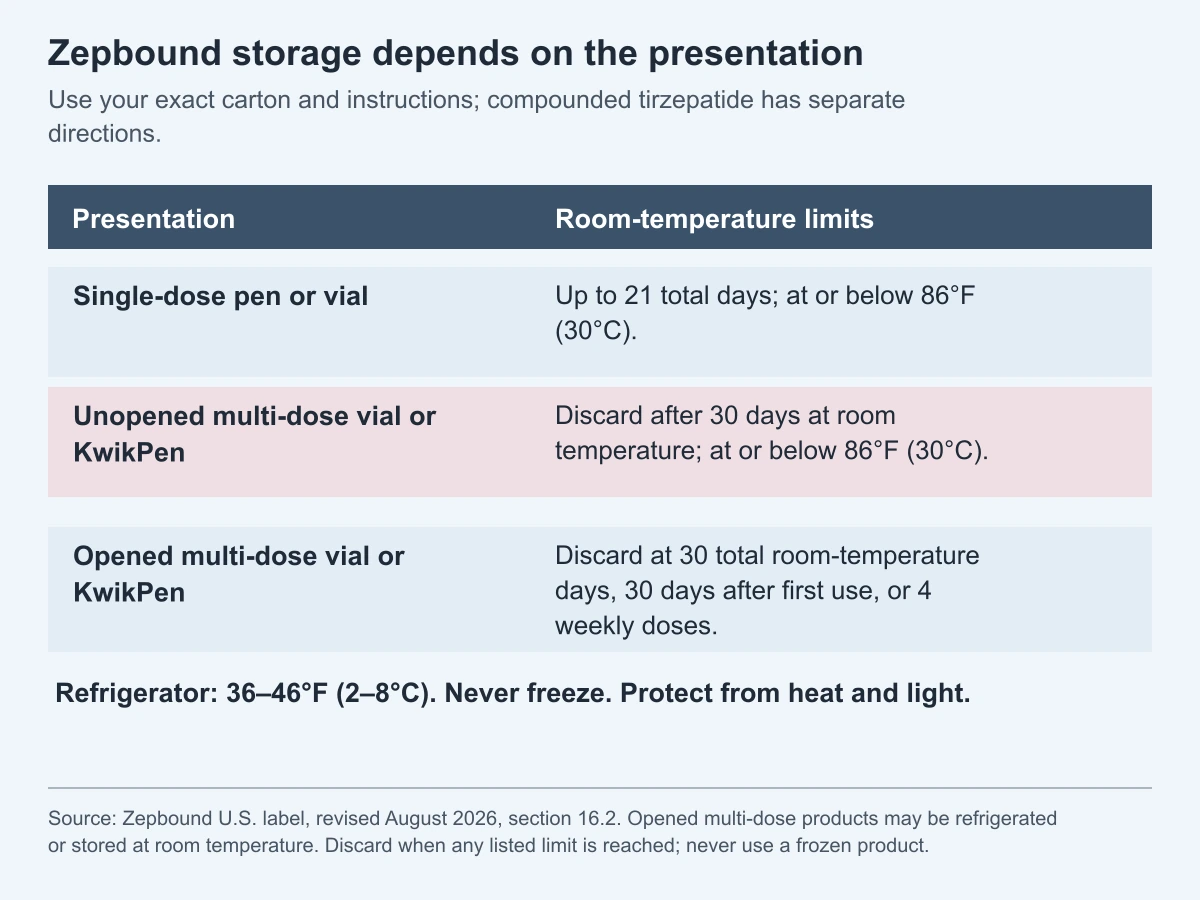
The labeled refrigerator range is 2°C to 8°C, equivalent to 36°F to 46°F. Zepbound should be protected from heat and light and kept in its original carton. It must not be frozen, and the label says not to use it if it has been frozen. Storage and handling information.
“In the refrigerator” is therefore more specific than placing it somewhere that feels cold. A refrigerator with a freezing area, a malfunction or an uncertain temperature history needs attention. If you do not know whether the medicine stayed within its permitted conditions, describe the situation to the pharmacist or manufacturer rather than treating its location as proof.
A clear-looking solution cannot establish that a temperature excursion was harmless. Inspection and temperature history answer different questions. Save the carton and dispensing information so the team can identify the product while reviewing what happened.
Single-dose pens and vials: the 21-day rule
The current label permits each single-dose pen or single-dose vial to remain unrefrigerated at temperatures no higher than 30°C, or 86°F, for up to a total of 21 days. It directs disposal after that total room-temperature period. Single-dose storage instructions.
Keep a record of when the medicine was first removed and subsequent time outside refrigeration. Do not assume that a later return to a refrigerator erases earlier exposure or creates a new full allowance. “Total” matters when you are reviewing several trips, deliveries or interruptions.
Room temperature also has an upper limit. A parked vehicle, sunlit window or hot bag may not meet the labeled conditions simply because the item was outside a refrigerator for fewer than 21 days. Time and temperature both need consideration.
Multi-dose vials and KwikPens: different clocks
For an unopened multi-dose vial or single-patient-use KwikPen kept refrigerated, the label allows use until the expiration date. If stored at room temperature up to 30°C/86°F, the unopened product must be discarded after 30 days. Multi-dose and KwikPen instructions.
After opening, the label permits refrigerator or specified room-temperature storage in the original carton. Disposal is required when any applicable limit is reached: 30 total days at room temperature, 30 days after first use, or completion of four weekly doses. Liquid remaining does not extend these limits. In-use storage instructions.
Write down the first-use date and the doses administered. Keep the room-temperature record separately; it is not necessarily the same as the first-use record. A device that was unrefrigerated before opening may already have accumulated time relevant to the total room-temperature limit.
| Zepbound presentation | Key storage distinction | Information to record |
|---|---|---|
| Single-dose pen or single-dose vial | Refrigerated storage; up to 21 total days within the permitted room-temperature range. | Unrefrigerated time, temperature concerns and expiration date. |
| Unopened multi-dose vial or KwikPen | Refrigerated until expiration; 30 days if stored within the permitted room-temperature range. | Presentation, expiration and time outside refrigeration. |
| Opened multi-dose vial or KwikPen | Several disposal limits apply, including first use and four weekly doses. | First use, doses taken and total room-temperature time. |
The Zepbound dosage guide addresses dose questions. A storage allowance does not authorize a different dosing interval or continued use beyond the presentation’s instructions.
What if Zepbound was left out overnight?
An overnight period is a situation to assess using the correct presentation and its remaining allowance. It is not automatically the same as exposure to excessive heat, and it does not by itself establish that the medicine is usable.
Check what was left out, whether it had been opened, the approximate conditions and any earlier unrefrigerated time. Compare those details with the actual label. If you cannot establish the temperature, believe the product became too hot or find conflicting instructions, ask the pharmacist or manufacturer before using it.
Avoid an internet shortcut such as “one night is always fine.” That statement leaves out the device, cumulative time and heat exposure. A product near its disposal limit and an unopened product with a different history are not the same case.

What if it froze or exceeded 86°F?
The label explicitly says not to use frozen Zepbound. Letting it thaw does not remove that instruction. Do not attempt to restore a frozen medicine by warming, shaking or otherwise changing it. Zepbound handling instructions.
For excessive heat or an uncertain excursion, contact the dispensing pharmacist or manufacturer with the details. This guide cannot supply an extra grace period beyond the label or validate a specific product after an unknown exposure. A photograph of the liquid is not enough to reconstruct its storage history.
If replacement is needed, ask the care team how to handle the treatment schedule. The tirzepatide questions guide helps organize broader medication questions, but a questionable supply should not lead to a self-directed dose adjustment.
What should I do during a power outage?
A power outage introduces uncertainty about actual refrigerator conditions. The duration of an outage alone does not tell you exactly when the medicine crossed a temperature threshold. Existing temperature information, the product’s history and its label all matter.
Record when the outage began, what you know about refrigerator temperature and whether the medicine was moved. Identify the presentation and remaining applicable time allowance. If its conditions cannot be established, ask the pharmacist how to assess the specific supply.
Do not improvise a cooling method that could freeze the medicine. A bag, pouch or cooler is not automatically a validated storage system. When preparing for an anticipated interruption, obtain practical handling guidance for your product from the dispensing team before it occurs.
Our expanded guide to medication travel, TSA and Zepbound planning separates airport declaration, cooling and storage, product-specific schedule questions, sharps disposal and official destination checks.
How can I prepare for travel?
Begin with the trip’s duration, the presentation supplied and the conditions you can maintain. A permitted room-temperature interval can be useful, but only when its temperature and time requirements are met. Do not assume that every destination or part of a journey stays below 86°F.
Keep the original packaging and instructions available. Bring your record of first use and unrefrigerated time if relevant. Ask the pharmacy about a suitable transport plan, especially when the journey may involve heat, prolonged delays or a need for refrigeration.
Confirm current travel and security requirements with the relevant airline or authority. This article does not establish a particular airport policy or certify a cooling pouch. Its travel image illustrates planning, not a demonstrated method for maintaining medication temperature.
Also consider access to your prescribing and dispensing teams. Knowing whom to contact if a bag is delayed or storage fails is more useful than relying on a generic social-media rule after something has happened.
What if a shipment arrives warm?
FDA describes concerns about injectable GLP-1 drugs arriving warm or with insufficient refrigeration and advises against using products that arrive under those conditions. Contact the pharmacy to report the delivery and obtain instructions rather than injecting first and asking later. FDA information on unapproved GLP-1 products and shipping concerns.
Keep the packaging and describe when the delivery was received, its apparent condition and any temperature information supplied. Ask the dispensing team to identify the product and address replacement or other next steps. Do not infer an acceptable shipping history solely from an intact box or clear liquid.
The tirzepatide compounding-pharmacy guide discusses pharmacy questions, including the importance of a verified dispensing source. It is relevant to evaluating a compounded prescription, whose handling directions need separate review.

Our guide to tirzepatide vial presentations and measurements separates ready-to-use manufacturer liquids, single-dose and multi-dose volumes, total vial content and compounded dispensing instructions. Storage clocks are only one part of identifying the exact product.
Are compounded tirzepatide storage limits the same?
Our guide to tirzepatide storage, shipping and travel distinguishes compounded-vial first-use guidance from current branded single-dose and multi-dose clocks, and explains what to do about warm shipments.
No universal transfer is justified. Compounded drugs are not FDA approved and may differ in concentration, ingredients, container and instructions. A Zepbound label should not be treated as stability evidence for a separately prepared prescription. FDA compounded GLP-1 guidance.
FDA also advises discarding compounded sterile injectable GLP-1 multi-dose vials 28 days after first use, even when a compounder provides a longer period. That guidance concerns compounded preparations; it should not be confused with the current branded Zepbound multi-dose/KwikPen instructions discussed above. FDA information.
Review the pharmacy label, beyond-use date, first-use directions and current FDA guidance with the pharmacist. The compounded GLP-1 article explains the broader regulatory distinction. CoreAge Rx’s tirzepatide service page describes an offered compounded treatment, requiring separate clinical evaluation; branded approval and storage evidence should not be assumed to apply to that preparation.
The tirzepatide appearance guide addresses clear, yellow and B12-related color questions. An expected appearance cannot replace the temperature and first-use record.
Can I use Ozempic storage advice for Zepbound?
Use the instructions for the medication actually dispensed. Shared discussion of GLP-1 medicines does not establish a common storage clock, device or expiration rule. The semaglutide storage and travel guide addresses a separate medicine and its formulation questions.
For Zepbound, identify the presentation first, then check refrigeration, total room-temperature exposure, opening or first-use status, doses used and expiration. If any part of the history is uncertain, obtain product-specific help. Clear records make that conversation more useful than a general question about whether “tirzepatide needs a fridge.”
Educational information for adults; individual treatment decisions require a qualified clinician. Sources reviewed September 30, 2026. Original AI-generated article images depict fictional people and objects, not patient outcomes. Other editorial images are illustrative. Graphics summarize the cited sources.