
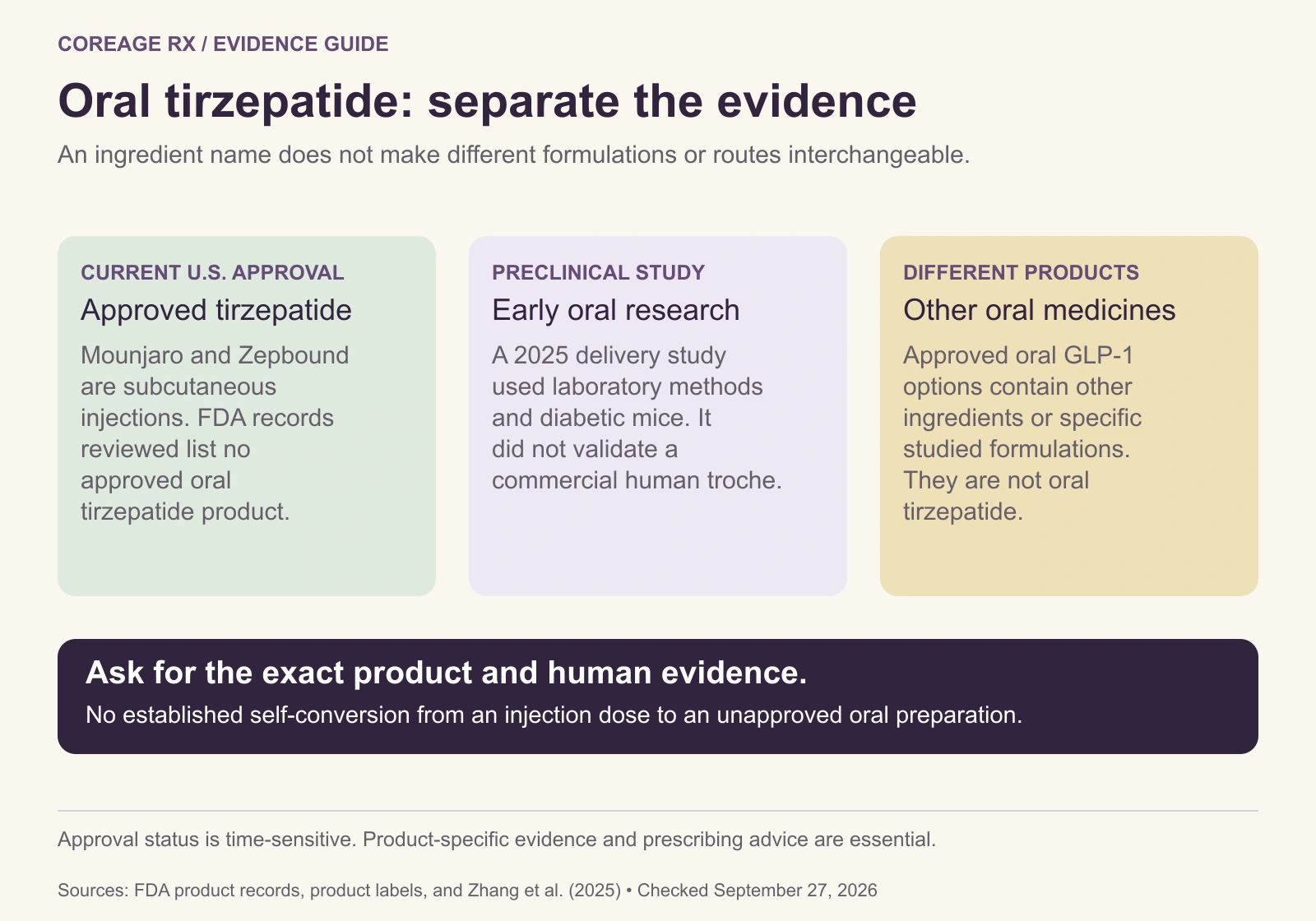
There is no FDA-approved oral tirzepatide product in the U.S. as of September 27, 2026. The approved tirzepatide medicines, Mounjaro and Zepbound, are given by subcutaneous injection. An advertisement for a tirzepatide pill, dissolving tablet, troche, or sublingual liquid therefore raises different evidence and product-quality questions from a prescription for either approved brand. FDA approved-product records
There are approved oral medicines in the broader GLP-1 category. They contain different active ingredients or use specifically studied formulations. Their approval does not establish that an oral tirzepatide preparation is effective, equivalent, or suitable for you.
What does “oral tirzepatide” mean in an advertisement?
The phrase is not specific enough to identify a medicine. A seller may mean a swallowed capsule, a tablet intended to dissolve under the tongue, a troche that dissolves in the mouth, or another compounded preparation. Those routes can expose a medicine to different absorption barriers.
Before considering an offer, ask for the exact active ingredients, dosage form, route, dispensing pharmacy, and prescribing clinician. “Needle-free GLP-1” does not answer those questions. It also does not tell you whether the product contains tirzepatide, semaglutide, another drug, or a mixture.
| Product description | What can be established from it? | What still needs checking? |
|---|---|---|
| Mounjaro or Zepbound injection | A named FDA-approved tirzepatide medicine | Appropriate indication, current device, prescription, and instructions |
| Compounded tirzepatide tablet or troche | A claimed ingredient and preparation type | Exact formulation, route-specific human evidence, pharmacy identity, and clinical rationale |
| An approved oral semaglutide medicine | A different active ingredient in a studied oral formulation | Its own approved uses and administration requirements |
| “GLP-1 drops” without a clear ingredient list | Very little about identity or effectiveness | The actual drug, regulatory status, route, source, and supporting evidence |
Our tirzepatide questions guide explains the established medication category. It should not be read as evidence for every product marketed with the same ingredient name.
Why does the route matter so much?
A medicine must reach the relevant tissues at an appropriate exposure to work as intended. For peptide medicines, swallowing introduces challenges including digestive degradation and passage across the gastrointestinal lining. A swallowed amount in milligrams does not tell you how much reaches the circulation.
Oral semaglutide illustrates why formulation matters. The Wegovy label describes tablets co-formulated with an absorption enhancer, SNAC, and explains that semaglutide absorption occurs predominantly in the stomach. That is a property of the studied formulation, not proof that any peptide mixed with an additive becomes an equivalent oral treatment. Wegovy prescribing information
Sublingual administration also needs its own evidence. Placing a product under the tongue does not automatically establish reliable absorption, clinical benefit, or a predictable dose. A formulation can be convenient in theory while still lacking the evidence needed to compare it with an approved injection.
Is there research on oral tirzepatide?
Yes, there is preclinical research. Saying that oral delivery has never been investigated would be inaccurate. However, early delivery research is different from demonstrating a safe and effective treatment in people.
A 2025 study investigated semaglutide and tirzepatide carried in small extracellular vesicles derived from milk. The researchers performed laboratory work and studied oral administration in diabetic db/db mice, reporting glucose-lowering effects in that model. It was not a human weight-management trial and did not validate a commercially advertised tirzepatide troche or sublingual product. Original oral-delivery study
To evaluate a seller’s claim, ask whether the cited study tested:
- The same active ingredient and formulation.
- The same route and dosing schedule.
- People with the condition being treated.
- Relevant outcomes, such as sustained glucose control or weight change.
- Adverse effects, discontinuations, and follow-up long enough to be informative.
A study of injected tirzepatide cannot answer all of those questions for a dissolving tablet. Likewise, a mouse delivery experiment cannot establish what dose a person should use.
What would convincing human evidence look like?
Several types of evidence answer different questions. A pharmacokinetic study measures drug exposure: how much reaches the bloodstream, how variable that exposure is, and how food or administration technique affects it. A clinical trial examines outcomes and adverse effects under a defined protocol.
Both are relevant to a new route. Demonstrating that some drug can be detected after a dose is not the same as showing dependable treatment benefit. A small uncontrolled report also cannot establish equivalence to Zepbound or Mounjaro.
Ask for the actual publication or trial record, rather than a claim that the product is “clinically backed.” Check which preparation was studied and whether the seller’s product matches it. If those details are unavailable, the uncertainty remains; testimonials cannot fill the gap.

Which oral GLP-1 medicines are actually approved?
The current U.S. landscape includes several oral options, but they are not oral tirzepatide:
| Medicine or formulation | Active ingredient | Important distinction |
|---|---|---|
| Wegovy tablets | Semaglutide | Approved uses and daily administration instructions are specific to this formulation |
| Rybelsus and Ozempic tablets | Semaglutide | Current labeling covers type 2 diabetes and specified cardiovascular risk reduction; the tablet products are not interchangeable milligram for milligram |
| Foundayo tablets | Orforglipron | A different GLP-1 receptor agonist with its own approved adult weight-management use and interaction precautions |
These distinctions come from the current manufacturer prescribing information. Wegovy label Rybelsus and Ozempic tablet label Foundayo label
An oral option may be worth discussing if injections are a major barrier. The discussion should include the indication, daily routine, other medications, tolerability, cost, and whether the particular product is appropriate. Our oral semaglutide versus injection guide explores some of those practical differences.
Is compounded oral tirzepatide FDA approved?
No. Compounded drugs are not FDA approved. FDA does not review a compounded preparation for safety, effectiveness, and quality before it is marketed, and a compounded drug is not an FDA-approved generic. Compounding can serve a patient whose medical needs cannot be met by an approved medication, but that role does not turn every advertised formulation into an established alternative. FDA compounding questions and answers
A pharmacy license or facility registration also does not confer product approval. Those details are relevant checks on the source; they do not supply missing evidence that a particular oral formulation works.
Read our guide to choosing a tirzepatide compounding pharmacy for questions about identity, licensing, labeling, and access to a pharmacist. An advertised low price should not replace those checks.
What side effects could oral tirzepatide cause?
The exact adverse-effect profile of a particular unapproved oral preparation cannot be assumed from the injection trials. Uncertain absorption does not mean that it is harmless. It can mean uncertainty about both benefit and exposure-related risk, alongside risks associated with ingredients, quality, and measurement.
The approved tirzepatide labels describe gastrointestinal adverse effects and warnings involving pancreatitis, gallbladder disease, volume depletion, severe gastrointestinal reactions, and other concerns. They also contain a boxed warning about thyroid C-cell tumors observed in rodents and contraindications involving a personal or family history of medullary thyroid carcinoma or MEN 2. Those labels guide the approved products; their trial percentages should not be copied onto an oral product as if it had been studied. Mounjaro label Zepbound label
If you have already taken an unfamiliar product and develop severe abdominal pain, persistent vomiting, fainting, breathing difficulty, or another severe reaction, seek urgent medical care and provide the packaging and ingredient information. Contact the prescriber and pharmacy about unexpected symptoms or an unclear label.
Can you convert an injection dose into an oral dose?
There is no established self-conversion from an approved tirzepatide injection to an unapproved oral tirzepatide preparation. Milligrams describe the amount of an ingredient, not identical absorption across routes.
Even some approved oral semaglutide products are expressly not substitutable on a milligram-for-milligram basis. That is a useful reminder that the same ingredient name does not make formulations interchangeable. Rybelsus and Ozempic tablet prescribing information
Do not swallow an injectable product, inject an oral preparation, combine an oral product with leftover injections, or use a seller’s generic conversion chart to change treatment. Bring the exact product details to a qualified prescriber.

Questions to ask before paying for an oral offer
Start with product identity and evidence, then discuss convenience and cost:
- What is the exact ingredient, formulation, and route?
- Is this product FDA approved, or is it compounded?
- What published human evidence applies to this exact preparation?
- Why is it being proposed instead of an approved option for my needs?
- Who prescribes it, which pharmacy prepares it, and who answers clinical questions?
- What happens if it is ineffective, poorly tolerated, or unsuitable after evaluation?
- What is the total ongoing charge, and when do cancellation or refund limits apply?
Our TrimRx alternatives comparison explains how to compare services without confusing a membership fee with a medication price.
Choosing the next step
If avoiding needles is the priority, discuss approved oral treatment options and the reasons injections feel difficult. A clinician can help separate device concerns, treatment eligibility, and daily administration preferences.
CoreAge Rx’s tirzepatide service page describes its current offering; it does not establish approval or evidence for oral tirzepatide. The decision should begin with the exact medicine and an appropriate clinical evaluation. A convenient delivery claim is useful only when you understand what product is being offered and what evidence supports it.
Educational information for adults; individual treatment decisions require a qualified clinician. Sources checked September 27, 2026. Original AI-generated article illustrations depict fictional people and objects, not patient outcomes. Other editorial images are illustrative. Graphics summarize the cited sources.