
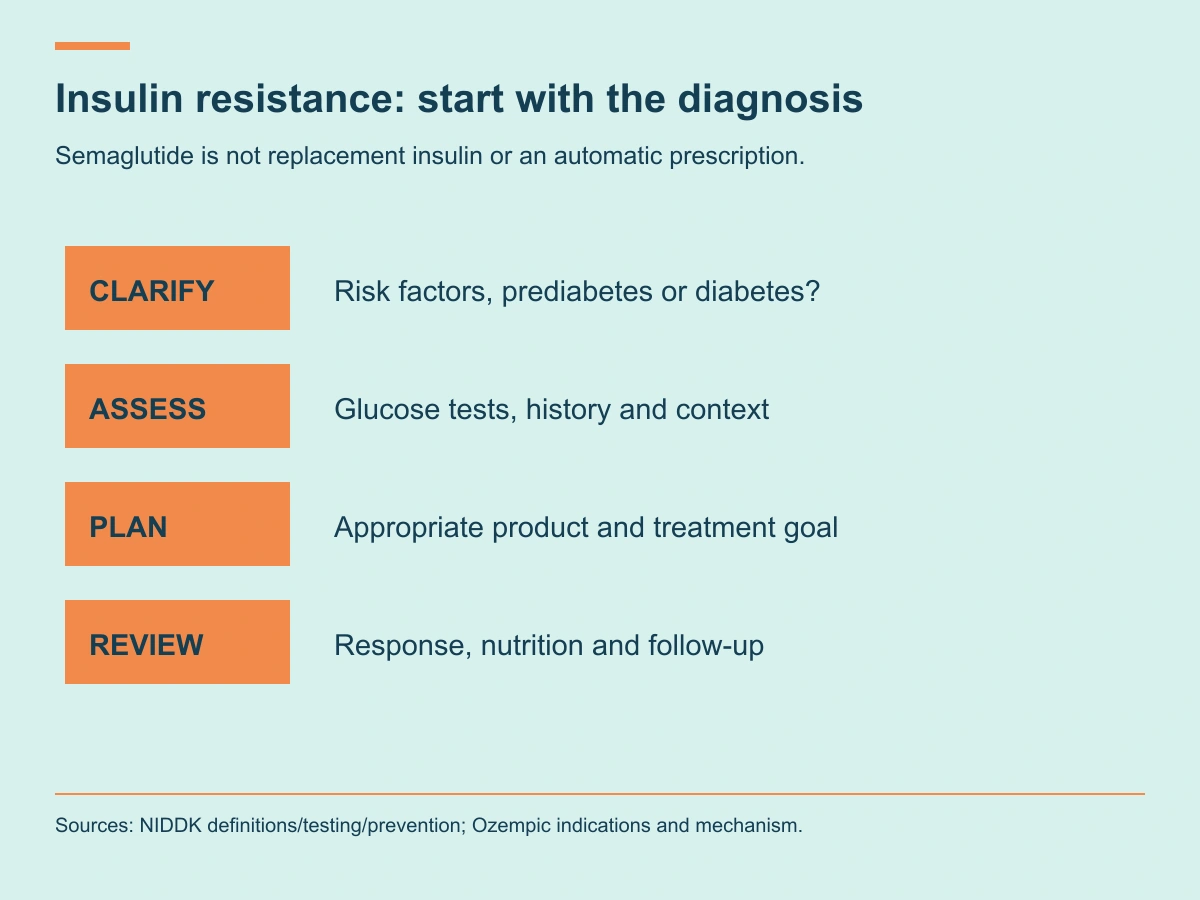
Ozempic can improve blood-glucose control in people for whom it is appropriately prescribed, but “insulin resistance” is not a complete diagnosis or an automatic reason to use it. The first questions are what your results mean, whether you have prediabetes or type 2 diabetes, and which treatment goal applies to you. Semaglutide is also different from insulin and should not be treated as a replacement for prescribed insulin.
This guide explains the relationship among insulin resistance, glucose testing, medication selection, and follow-up. It is useful preparation for an appointment, especially when an online advertisement or a single laboratory result has left you unsure what you actually need.
What insulin resistance means
Insulin is a hormone produced by the pancreas. It helps regulate glucose use and movement into cells. With insulin resistance, cells in tissues such as muscle, fat, and liver respond less effectively. The pancreas may compensate by producing more insulin; glucose can rise when that compensation is insufficient. NIDDK insulin resistance and prediabetes.
Insulin resistance, prediabetes, and type 2 diabetes are related terms, but they are not identical. Prediabetes describes blood-glucose levels above normal but below the diabetes range. A person can have risk factors or an insulin-resistance concern without having the same diagnosis as someone with established diabetes.
The insulin resistance and weight guide explains the broader relationship. Avoid diagnosing yourself from body shape, fatigue, food cravings, or a social-media symptom list. NIDDK notes that insulin resistance and prediabetes often have no symptoms.
Is semaglutide insulin?
No. Semaglutide is a GLP-1 receptor agonist. The Ozempic injection label describes glucose-dependent effects on insulin and glucagon secretion, along with a contribution from delayed gastric emptying. It is not a vial or injection of replacement insulin. Ozempic prescribing information.
That distinction matters for treatment. A clinician may sometimes prescribe medications together for different reasons. Do not stop insulin, change its amount, or assume a weekly semaglutide injection supplies the same role. Any change needs an individualized plan and appropriate monitoring.
The guide to how Ozempic works describes the mechanism in more detail. Mechanism explains how a medicine can influence glucose; it does not by itself establish who should receive it, which product to choose, or a guaranteed response.
How clinicians assess prediabetes
NIDDK explains that clinicians commonly use glucose-based tests rather than a specialized insulin-resistance test. Its guidance lists an A1C of 5.7%–6.4%, fasting plasma glucose of 100–125 mg/dL, or two-hour oral-glucose-tolerance result of 140–199 mg/dL as prediabetes ranges. A clinician must interpret the result and circumstances. NIDDK testing guidance.
A1C reflects glucose over roughly three months, while fasting glucose describes a measurement at a particular time. Certain conditions can affect how useful A1C is. Ask which test was used, whether fasting was required, and whether confirmation or a different test is appropriate.
An isolated insulin concentration or HOMA-IR calculation should not be treated as a universal diagnostic or prescribing threshold. NIDDK says specialized insulin-resistance testing is used mainly in research. Ask the ordering clinician what a particular measurement adds to your own assessment.
What an Ozempic indication tells you
The reviewed Ozempic injection label includes improving glucose control in adults with type 2 diabetes and cardiovascular or kidney risk reduction in defined adult diabetes populations. It does not create a general approved indication called “any insulin resistance.” Product and route matter when discussing the current prescription.
If a clinician considers treatment outside a labeled indication, ask why, which evidence applies, what alternatives are available, and how monitoring and coverage will work. Off-label consideration is a clinical decision, not automatic eligibility from a search term.
If weight management is the primary goal, a different product-specific assessment may apply. The semaglutide product and formulation guide explains why products sharing semaglutide still have different indications and instructions. Do not combine or substitute them yourself.
Can Ozempic reverse insulin resistance?
Treatment may improve glucose and related metabolic measures in appropriate settings, but “reverse” can imply more certainty than the evidence or an individual’s results provide. An improvement during treatment does not prove that an underlying tendency has permanently disappeared.
Discuss which outcome the team will follow: glucose, A1C, weight when relevant, symptoms, or another measure. Ask how long the assessment interval should be and what would change the plan. A favorable laboratory result is useful information, but it is not an instruction to stop treatment without review.
NIDDK describes lifestyle changes and, for some people, medicines such as metformin as ways to prevent or delay diabetes. It also explains that not everyone with prediabetes progresses to diabetes. Those facts support an individualized prevention discussion rather than a universal prescription for one drug.

Where PCOS fits
PCOS can be associated with insulin resistance, but it requires its own clinical assessment. A person may need care for menstrual symptoms, metabolic risk, fertility planning, or several concerns. Improving one measure does not automatically resolve all aspects of the condition.
The Ozempic and PCOS guide discusses relevant evidence and limits. The period-change guide addresses a different question: a new menstrual change during treatment. Neither article makes PCOS an automatic Ozempic indication or promises improved fertility.
If pregnancy is planned or possible, bring that into the medication discussion early. Diabetes management and pregnancy planning need coordination, not simply an assumption that a medicine associated with weight change is suitable throughout pregnancy.
Compare the available treatment paths
| Situation to clarify | Useful discussion | Avoid assuming |
|---|---|---|
| Risk factors without confirmed glucose abnormality | Appropriate screening and prevention plan | Symptoms alone diagnose insulin resistance |
| Prediabetes | Risk, lifestyle support, follow-up, and medicine when appropriate | Everyone needs Ozempic |
| Established type 2 diabetes | Glucose goals, complications, medications, and monitoring | All patients need the same combination |
| PCOS-related concerns | Reproductive and metabolic goals together | One drug treats every PCOS feature |
| Weight-management goal | Product-specific eligibility and long-term care | A diabetes brand is interchangeable with every weight product |
The metformin and weight guide can help you prepare questions about another medicine sometimes discussed in metabolic care. It should not be used to choose, add, or remove treatment without the prescribing team.
Food, movement, sleep, and practical support
NIDDK includes healthy eating, activity, weight management when appropriate, and adequate sleep in its prevention guidance. These are parts of care rather than proof that a person caused their condition or failed if they need medicine.
Choose changes that can fit your circumstances. For meals, consider what you can prepare, afford, and tolerate consistently. The balanced-meal guide offers examples without requiring one rigid menu. The walking after meals guide provides activity questions to discuss when movement is appropriate for you.
If a medication reduces appetite or causes nausea, adequate intake still matters. Report persistent difficulty eating, weakness, or repeated vomiting. A treatment plan should include practical nutrition support and review of symptoms, not only a lower number on the scale.
Follow-up is about more than weight
Agree on glucose targets and the timing of tests with the treating team. Share readings, symptoms, and medication changes when relevant. Ask what to do during illness, poor intake, or a prescription delay and who will respond outside routine appointments.
Low-glucose risk deserves particular attention when insulin or a sulfonylurea is part of the regimen. Follow the team’s glucose plan and ask which symptoms should trigger checking or urgent help. Do not interpret a glucose-dependent mechanism as a guarantee that low glucose cannot occur in a combination regimen.
The first-month semaglutide guide explains why early response varies. Your clinician can distinguish an expected treatment stage from inadequate response, a device problem, or a need to review the overall plan.

Insurance and product questions
Clinical suitability and insurance coverage are separate. A plan may require a specific diagnosis, product, authorization, or pharmacy. The phrase “insulin resistance” on a website does not establish what documentation your benefit needs.
Use the GLP-1 insurance guide to organize those questions. Ask for the exact prescribed formulation and total cost of visits, tests, and medicine. A lower advertised price does not establish equivalent preparation or follow-up.
For service information, CoreAge Rx’s semaglutide page describes an offering to review with a clinician. Confirm the actual preparation, current eligibility, and care arrangement. FDA explains that compounded drugs are distinct from approved products and are not approved generics merely because they share an ingredient name. FDA compounding explanation.
Common questions
Does Ozempic help with insulin resistance?
It can improve glucose control in appropriate treatment settings, but the diagnosis, goal, and exact product matter. An insulin-resistance concern alone does not establish eligibility or the best medicine for you.
Can I take it if I only have prediabetes?
Discuss prevention options and any proposed off-label use with a qualified clinician. Prediabetes does not automatically create an Ozempic indication or guarantee insurance coverage.
Is an insulin test enough to choose treatment?
No universal prescribing rule follows from one insulin result. Ask how glucose testing, history, risk factors, and the reason for ordering the measurement affect its interpretation.
Does improved A1C mean I can stop?
An improved value may reflect successful ongoing treatment. Discuss any change with the team and maintain follow-up. The stopping semaglutide guide explains why the original condition and monitoring plan still matter.
Can semaglutide replace my insulin?
Do not make that substitution yourself. They are different treatments. A clinician must coordinate any change, including glucose monitoring and the continuing management of diabetes.
What should I ask at the appointment?
Ask what diagnosis the results support, which outcomes matter, which treatment options fit, and when to reassess. Leave with a plan for medicines, nutrition, monitoring, affordability, and whom to contact if symptoms or results change.
Educational information for adults; individual treatment decisions require a qualified clinician. Sources reviewed October 3, 2026. Original AI-generated article images depict fictional people and objects, not patient outcomes. Other editorial images are illustrative. Graphics summarize the cited sources.