
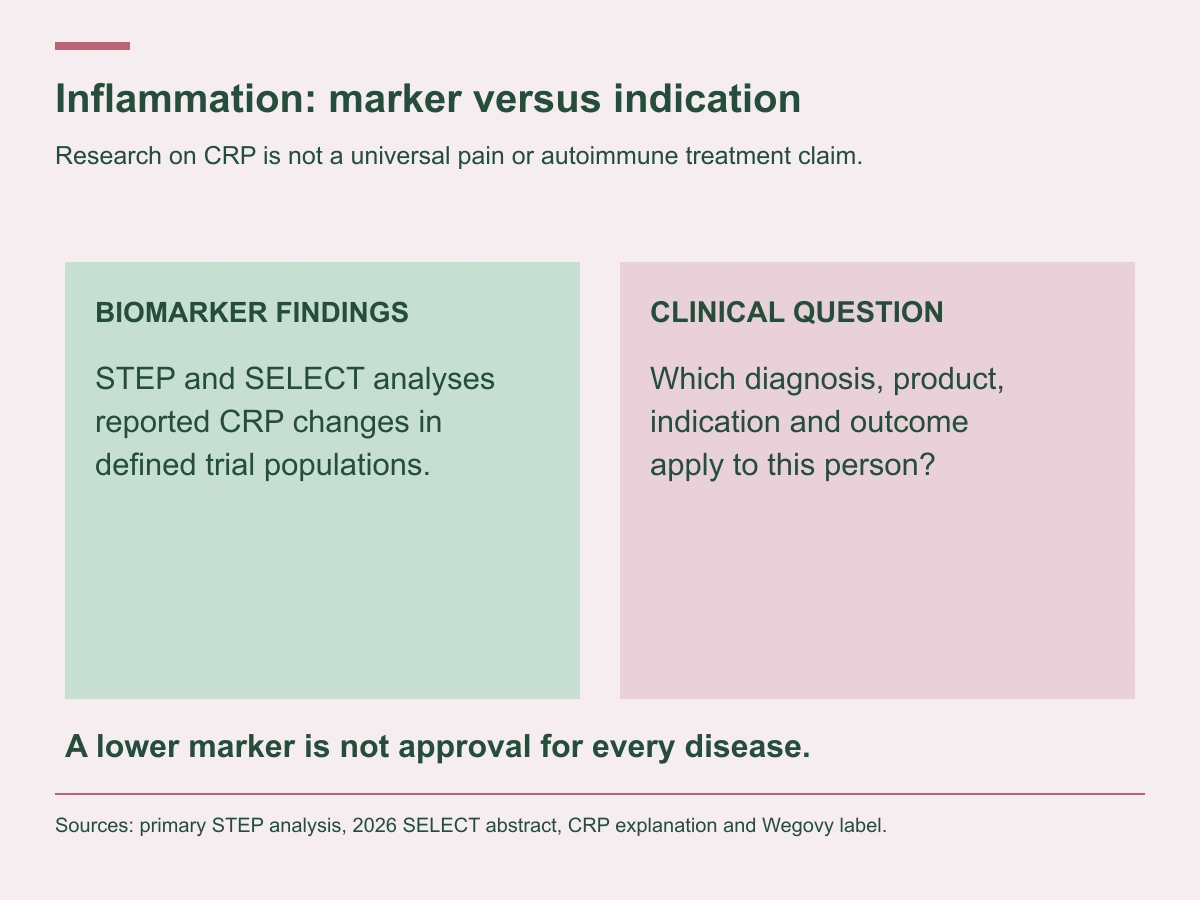
Research has found reductions in the inflammatory biomarker C-reactive protein during semaglutide treatment in selected trial populations. That is a meaningful finding, but it does not mean Wegovy treats every condition described as “inflammation,” explains every ache, or replaces care for autoimmune disease or infection. The clinical question is which diagnosis, product, and outcome are relevant to you.
This guide explains the primary STEP and SELECT biomarker findings, their limits, and how they differ from Wegovy’s actual indications. It also addresses a current liver-treatment indication that is specific to a defined form and stage of disease—not a broad approval for inflammation anywhere in the body.
What do people mean by inflammation?
The word can refer to a normal immune response, a chronic disease process, a blood-test finding, or a symptom people are trying to explain. Those are different starting points. A sore joint, a raised laboratory marker, and an established inflammatory condition do not automatically need the same treatment.
C-reactive protein, or CRP, is one marker clinicians may measure in blood. A higher result does not by itself identify the cause or location of inflammation. Interpretation depends on the reason for testing, symptoms, other results, and the broader medical history. MedlinePlus CRP test information.
“High-sensitivity CRP,” written hsCRP, is a test used in certain cardiovascular-risk contexts. A change in a marker can be useful research information without being a complete clinical outcome. Ask what your own result means and whether repeat testing or another assessment is appropriate.
What the STEP analysis found
A primary analysis of STEP 1, 2, and 3 reported lower CRP with semaglutide 2.4 mg than placebo at 68 weeks. The trials involved adults with overweight or obesity; STEP 2 included type 2 diabetes. CRP change was a prespecified secondary endpoint, and reductions occurred alongside weight loss. The paper reported Novo Nordisk funding. Primary STEP CRP analysis.
The finding supports investigation of inflammation-related effects in those settings. It does not establish that every person using semaglutide has an elevated CRP, needs CRP monitoring, or will experience relief of a particular pain condition.
Our inference from the endpoint is that a blood-marker change should not be treated as proof of recovery from an unrelated disease. To assess a claim about rheumatoid arthritis, bowel disease, or another condition, you would need evidence addressing that condition and a clinically meaningful outcome.
What the newer SELECT analysis adds
A 2026 prespecified SELECT analysis examined hsCRP in a trial population of 17,604 people with established atherosclerotic cardiovascular disease and overweight or obesity, without diabetes. The abstract reported a semaglutide-associated hsCRP reduction at 104 weeks and relationships among marker changes, weight loss, and cardiovascular events. Some reductions appeared before major weight loss. Primary SELECT abstract.
The authors used modeling to explore how inflammation might contribute to cardiovascular benefit. That is different from proving that a particular biological pathway explains every benefit or that reduced CRP directly caused an individual’s symptom improvement.
This review used the complete abstract, not the full paper. The population and analysis are explicit; detailed modeling assumptions and complete study limitations were not reviewed. Healthy adults with a mild ache should not assume that the same result predicts their response.
Does the effect happen only because of weight loss?
The reviewed research suggests a more complex relationship than a simple yes-or-no answer. STEP marker reductions occurred in parallel with weight changes. The SELECT abstract described early changes and modeling consistent with an inflammatory contribution to benefit.
Neither finding justifies a universal claim that the effects are entirely independent of weight loss or entirely explained by it. A model can explore relationships while still relying on assumptions and measured variables. Mechanism research and a prescribing decision are related but separate questions.
For readers, the useful conclusion is bounded: there are human biomarker findings worth discussing, especially in the studied cardiometabolic settings. There is no reason to invent a personal CRP target, increase a dose, or use a medication solely because an article says it is anti-inflammatory.
Cardiovascular indications are specific
Wegovy’s current U.S. label includes cardiovascular risk reduction in adults with established cardiovascular disease and overweight or obesity. The exact product, formulation, and clinical criteria matter. This is a defined risk-reduction use; it should not be described as treatment for every heart symptom or every elevated inflammation test. Wegovy prescribing information.
The heart-symptom guide explains why a long-term cardiovascular benefit does not rule out a heart attack or explain chest pain. New urgent symptoms still require the appropriate immediate assessment.
If a clinician recommends treatment for cardiovascular risk, ask how it fits with the existing plan for blood pressure, cholesterol, activity, and other medicines. Do not stop established care because one treatment has multiple possible benefits.

The MASH indication is not general inflammation approval
The label reviewed October 3, 2026 includes Wegovy injection for adults with noncirrhotic metabolic dysfunction-associated steatohepatitis, or MASH, with moderate to advanced liver fibrosis consistent with stages F2–F3. It describes accelerated approval based on improvement in MASH and fibrosis, with continuing approval potentially dependent on confirmation of clinical benefit.
That wording matters. It is not an indication for every abnormal liver test, all fatty liver, cirrhosis, or a self-diagnosis of “liver inflammation.” The tablets’ listed indications should not be assumed to include the injection’s MASH use.
If liver disease is part of your concern, ask how the diagnosis and fibrosis stage were established, which specialist or clinician will manage it, and what monitoring is needed. A single elevated blood result or online symptom list cannot establish the labeled disease stage.
A table for evaluating inflammation claims
| Statement | What to check | Why the distinction matters |
|---|---|---|
| “CRP decreased in a trial” | Population, comparator, timing, endpoint | A biomarker is not every clinical outcome |
| “May contribute to heart benefit” | Whether the claim comes from modeling | An inference is not proof of a universal mechanism |
| “Approved for MASH” | Product, diagnosis, fibrosis stage, approval conditions | Does not apply to every liver concern |
| “Treats my joint pain” | Evidence for that specific condition | Cardiometabolic research cannot be relabeled automatically |
| “I need a higher dose for inflammation” | Actual prescription goal and clinician assessment | A search result is not a dosing plan |
What if pain improves while taking it?
A symptom improvement is worth reporting. It may help the clinician understand function, activity, weight change, and the overall treatment response. It does not by itself prove a direct anti-inflammatory action or cure the underlying cause.
Describe what improved and what did not. For example, note whether walking is easier, stiffness is shorter, or a swollen joint remains. Keep other changes in view, including exercise, sleep, physiotherapy, or another treatment started around the same time.
For menopausal joint concerns, the menopause joint-pain guide discusses another clinical context. Do not merge every symptom under one hormone or inflammation explanation. Persistent or concerning symptoms need their own assessment.
Should everyone monitor CRP on Wegovy?
The trial endpoint does not establish a universal routine testing requirement. Ask whether testing would change your care and what the result would mean. Repeatedly measuring a marker without a clinical question can create numbers that are difficult to interpret.
If a result is elevated, ask about the timing, symptoms, and other factors the clinician wants to consider. Do not assume an increase means the medication failed or that a decrease means every medical problem has resolved.
Follow the monitoring plan for the condition being treated. The first-month semaglutide guide and plateau guide explain why treatment response involves more than one early measurement.

Nutrition and activity remain part of care
Wegovy’s indications include diet and activity context. A biomarker hypothesis should not turn into a reason to ignore food tolerance, muscle preservation, sleep, or appropriate movement. Ask for help if adverse effects make eating or drinking difficult.
The protein and muscle guide and balanced-meal guide provide practical questions for ongoing care. They do not prescribe a universal “anti-inflammatory” menu or guarantee a particular laboratory change.
If you are comparing services, CoreAge Rx’s semaglutide information describes an offering to review with a clinician. Confirm the preparation, indication, eligibility, and monitoring. A service using semaglutide should not be assumed to supply every Wegovy presentation or to inherit every branded-product indication.
Common questions about Wegovy and inflammation
Does Wegovy help with inflammation?
Primary semaglutide studies reported CRP or hsCRP reductions in defined populations. That supports a bounded discussion of biomarker effects, not a promise to treat every inflammatory condition.
Can it replace my autoimmune-disease medicine?
Do not make that substitution yourself. The reviewed cardiovascular and weight-related biomarker evidence does not establish an interchangeable treatment for your autoimmune condition. Discuss the specific disease and existing regimen with its treating clinician.
Does a lower CRP prove my pain should go away?
No. A blood marker and pain are different observations. Report both, and ask how the clinician will assess the cause and response.
Is Wegovy approved for all fatty liver?
No such broad conclusion follows from the label. The injection’s MASH indication specifies noncirrhotic disease and F2–F3 fibrosis in adults, with accelerated-approval conditions.
Is inflammation testing needed before a prescription?
That depends on the clinical question and assessment. A trial’s biomarker measurement is not a universal eligibility test. Ask which tests are appropriate for the condition being treated.
What is the most useful appointment question?
Ask, “Which diagnosis and treatment goal apply to me, and which outcomes will tell us whether the plan is helping?” That keeps an interesting research finding connected to a practical, individualized care decision.
Educational information for adults; individual treatment decisions require a qualified clinician. Sources reviewed October 3, 2026. Original AI-generated article images depict fictional people and objects, not patient outcomes. Other editorial images are illustrative. Graphics summarize the cited sources.