Cortexin is a peptide-containing product marketed in some countries for neurological conditions. It should not be treated as a single purified “brain peptide” with a universally established memory benefit. Understanding the product requires separating the manufacturer’s description, animal research, human clinical findings, and the regulatory requirements where care is provided.
This guide reviews the manufacturer’s product page, a preclinical ischemia paper, and the abstract of a 2025 stroke study. These sources answer different questions. None should be turned into a promise that Cortexin improves focus or memory in healthy adults, or into instructions for buying, mixing, or injecting it yourself.
What is Cortexin?
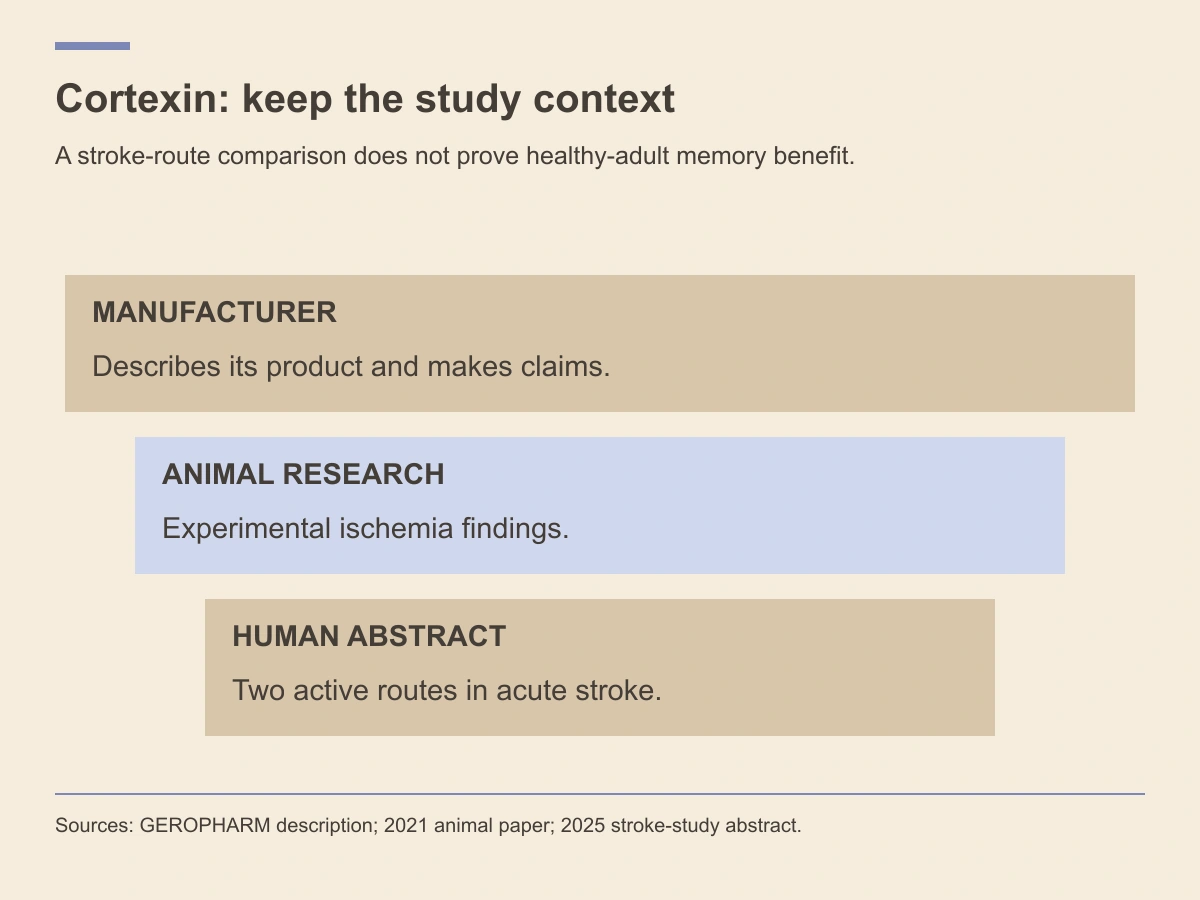
GEROPHARM describes Cortexin as a prescription lyophilized preparation containing a grouping of polypeptides derived from cattle cerebral cortex. It lists foreign registration information and broad neurological claims. This is the manufacturer’s account of its product, not an independent verification of every product sold online under the name. Manufacturer product information.
“Lyophilized” means prepared in a dried form through freeze-drying. It does not establish clinical effectiveness or make a preparation suitable for unsupervised use. A mixture also differs from a single molecule with one defined sequence.
If a reseller offers something called “Cortexin peptide,” ask whether it is the actual registered manufacturer’s product, another preparation, or a research supplier’s material. The name alone cannot establish origin, composition, sterility, or storage history. An online photograph of a box is not a verified supply chain.
Why a mixture matters when reading research
An effect described for a mixture cannot automatically be assigned to every ingredient or to an isolated peptide with a related name. Likewise, research on a different mixture is not necessarily evidence for the product being offered to you.
Look for a clear match among the product, route, study population, and claimed outcome. If one paper describes an animal preparation and another a commercial human product, ask how the connection was established. Small differences in descriptions should not be silently smoothed over as proof of identical material.
This is especially important when a website groups Cortexin with nootropics, injectable supplements, or other peptides. A marketing category is not a clinical equivalence group. It does not establish shared effects, interchangeable doses, or a common safety profile.
What the animal ischemia paper studied
The reviewed 2021 paper used animal models of acute and chronic cerebral ischemia and additional laboratory work. Its reported findings concerned those experimental conditions, including rats and mice, rather than a controlled trial of memory improvement in healthy adults. Primary preclinical paper.
Such research can help investigate biological hypotheses. It cannot by itself establish an effective human treatment, a safe regimen, or a reliable improvement in everyday concentration. An experimental endpoint in an animal brain is different from a person performing better at work or recovering function after a stroke.
Our inference is that translating those findings to a consumer “brain boost” would require additional matching human evidence. This article’s review covered the abstract, introduction, and initial animal methods; it does not claim a complete review of every experiment or all literature on the product.
What the 2025 human stroke abstract adds
A 2025 abstract described a randomized comparison in 490 adults with acute ischemic stroke, comparing intravenous and intramuscular Cortexin strategies. Both groups received active Cortexin treatment, with a double-dummy design to compare the routes. The abstract reported differences in a functional outcome at day 90, while a reported cognitive-score change did not differ statistically between groups. Primary stroke-study abstract.
The crucial design point is the comparator. Comparing two active-treatment routes does not provide the same evidence as comparing Cortexin against no Cortexin. Our inference is that this design cannot independently establish the product’s benefit over standard care without it.
The population also matters: adults experiencing acute stroke are not healthy adults looking for sharper memory. We reviewed the abstract, not the full paper. That limits what can be said about detailed methods, analysis choices, and longer follow-up.
Were adverse events absent?
No. The reviewed stroke abstract reported adverse events in both groups: 74 events in 60 participants in one group and 51 in 41 participants in the other. The difference was not statistically significant. These counts do not mean every event was caused by Cortexin, but they also do not support a claim that no events occurred.
The manufacturer’s page uses favorable safety language. That should be identified as a manufacturer statement rather than replacing clinical adverse-event reporting. An event count, a causality assessment, and a claim that a treatment has no side effects are different things.
Ask what safety data apply to the exact formulation, route, population, and duration being proposed. A short abstract cannot provide every answer. Lack of a reported problem in a testimonial or marketing page does not establish that a risk is impossible.

A practical evidence comparison
| Source | What it can help answer | Important limit |
|---|---|---|
| Manufacturer page | Product description and the company’s claims | Not independent confirmation of every claim or online seller |
| Animal ischemia paper | Experimental biological questions | Not a healthy-adult cognition trial |
| Human stroke abstract | Findings from the described route comparison | Both groups received active product; full paper not reviewed |
| Foreign registration information | A jurisdiction-specific product record | Not proof of U.S. approval |
| Online testimonial | One person’s reported experience | Cannot isolate cause, comparator, or product quality |
When a seller cites a paper, ask which row it belongs in. A long reference list can still leave the specific claim unsupported if every source addresses a different product, population, or outcome.
Foreign registration is different from U.S. approval
The registration information on a foreign manufacturer page should not be presented as U.S. FDA approval. Approval is specific to a product, jurisdiction, and applicable use. Ask for the actual approval record relevant to the location where the product would be prescribed and dispensed.
This article does not make a comprehensive current determination about every country’s registration or every possible import arrangement. It also does not provide an import workaround. A seller accepting an order or shipping a package does not settle the clinical or regulatory questions.
If a seller describes a product as compounded, that is another distinct category. FDA explains that compounded drugs do not receive the same premarket approval review as approved drugs. Compounding status should not be used as a substitute for evidence of neurological benefit. FDA compounding explanation.
Memory changes deserve their own assessment
If you are worried about memory, begin with the symptom and its effect on daily life. MedlinePlus explains that memory problems can have many causes, including medicines, injury, nutritional deficiencies, mental-health conditions, and neurological disease. A clinician may ask how quickly the change developed and whether family or friends have noticed it. MedlinePlus memory-loss information.
Bring examples: difficulty remembering recent conversations, missed medicines, navigation problems, or changes in familiar tasks. Also discuss sleep, mood, alcohol or other substance use, and the medication list. That history helps determine which examination or testing is appropriate.
Do not use a nootropic shopping list to explain a new neurological symptom. Sudden weakness, speech difficulty, confusion, or other possible stroke symptoms need emergency assessment: call 911. NHLBI stroke guidance. New or progressive memory problems should not be postponed while trying an unidentified product.
Comparing other “brain” and peptide claims
The NAD nasal brain-delivery evidence guide provides another example of why a delivery hypothesis is different from a demonstrated clinical result. The NAD focus and brain-fog guide discusses symptom assessment rather than promising a cognitive upgrade.
For broader peptide questions, the peptide-stack evidence guide explains why combining uncertain preparations does not produce a proven plan. The oral peptides versus injections guide separates route questions from efficacy claims.
You can also compare the PDA and BPC-157 evidence discussion, where product identity and a limited human study are separate questions. These links are reading paths for evaluating evidence, not recommendations to substitute or combine products.

Questions to ask a clinician or seller
Start with the diagnosed condition and the proposed clinical goal. Ask which human study matches that condition, exact product, and route. Request an explanation of the comparator and outcome, not just the conclusion copied into an advertisement.
Then ask about product origin, approval status where applicable, adverse-effect information, and who is responsible for follow-up. If a discussion cannot distinguish manufacturer claims from controlled human evidence, that uncertainty belongs in the decision.
A meaningful answer should also address established alternatives. The presence of a peptide study does not make a product preferable to appropriate neurological assessment, rehabilitation, or other evidence-based care.
Common questions about Cortexin
Is Cortexin one peptide?
The manufacturer’s description is a grouping of polypeptides, not a single purified molecule with one sequence. Verify the exact offered product rather than assuming every use of the name describes identical material.
Does it improve memory in healthy adults?
The sources reviewed here do not establish that. Animal ischemia work and an acute-stroke route-comparison abstract cannot be generalized to a healthy-adult memory benefit.
Did the stroke trial compare Cortexin with placebo alone?
The reviewed abstract describes two active Cortexin strategies in a double-dummy comparison. The route-matching placebo is different from an inactive treatment group receiving no Cortexin.
Are there no side effects?
That claim is not supported by the reviewed abstract, which reported adverse events in both groups. Those events require proper interpretation and are not all necessarily attributed to the product.
Does foreign registration mean FDA approval?
No. Ask for the relevant jurisdiction’s actual product record. A manufacturer registration statement, seller listing, and finished-drug approval are separate facts.
Can I use the manufacturer’s mixing directions myself?
This guide does not provide preparation or injection instructions. A product description or research method is not a personalized treatment plan. Start with qualified clinical care for the neurological concern and verify the exact proposed product and oversight.
Educational information for adults; individual treatment decisions require a qualified clinician. Sources reviewed October 3, 2026. Original AI-generated article images depict fictional people and objects, not patient outcomes. Other editorial images are illustrative. Graphics summarize the cited sources.