
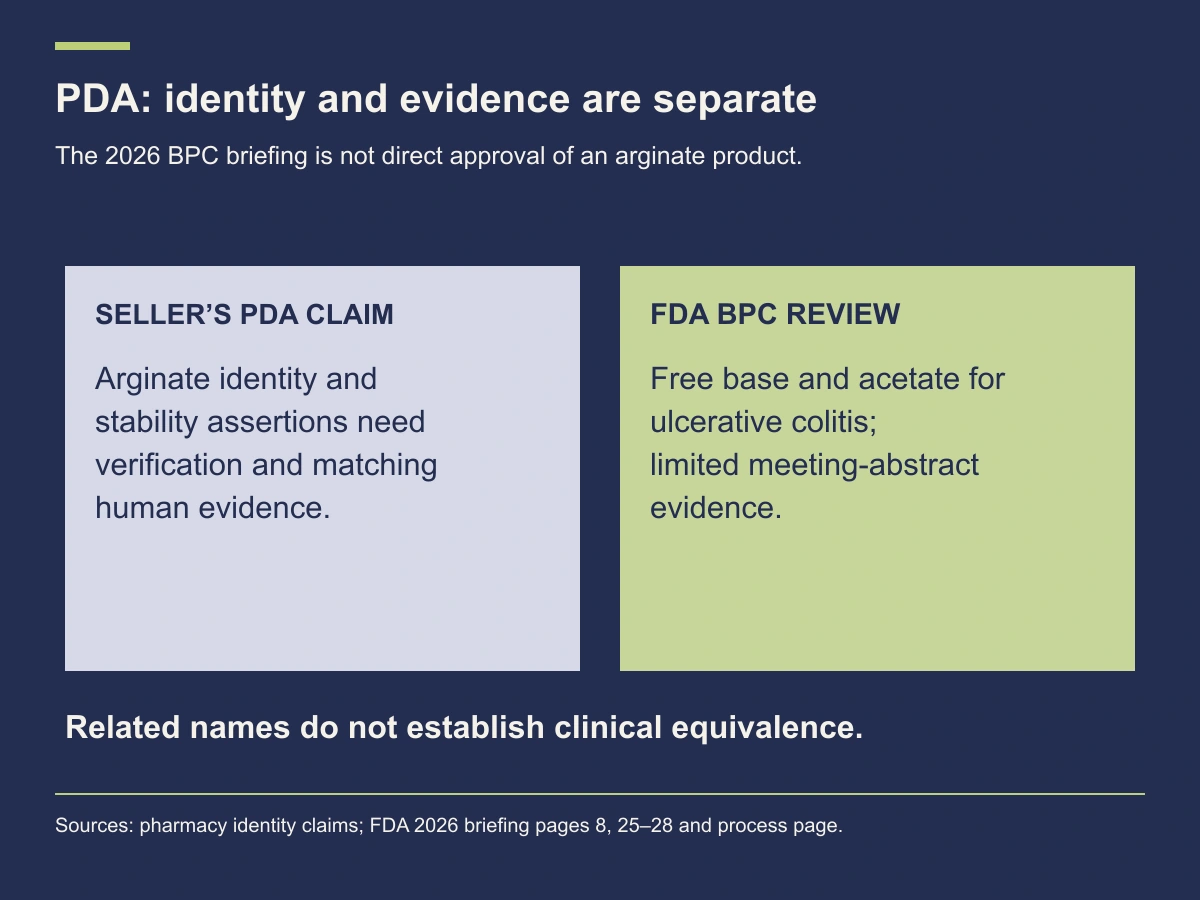
PDA peptide is a name used in marketing for pentadeca arginate, sometimes presented as an alternative to BPC-157. The important questions are what a specific product contains and whether human evidence actually supports the proposed use. A similar peptide name, a solubility claim, or a seller’s explanation of a sequence does not establish clinical equivalence, safety, or approval.
This guide reviews a pharmacy’s original PDA claims alongside FDA’s BPC-157 safety information and July 2026 advisory-committee briefing. The FDA material discussed free-base and acetate forms of BPC-157. It did not directly establish the identity or clinical performance of every product marketed as pentadeca arginate.
What does PDA mean in this context?
American Wellness Pharmacy describes PDA as pentadeca arginate and claims a connection to the 15-amino-acid BPC-157 sequence, with arginate intended to improve characteristics such as solubility or stability. The page also makes biological-benefit claims. Those are attributed seller statements, not an independent chemistry verification or a human efficacy finding. Pharmacy’s PDA description.
The name on a website is insufficient to establish the actual material in a vial, capsule, or other preparation. Ask for the exact chemical identity, active ingredient description, formulation, route, and dispensing source. If different sellers use the same shorthand, do not assume they mean identical products.
Distinguish three questions: what the seller says the ingredient is, what testing verifies about that specific material, and what clinical evidence supports its use. An answer to one does not automatically answer the others.
Does PDA work like BPC-157?
A claim of shared sequence or improved solubility does not prove equivalent effects in people. Formulation, route, exposure, impurities, and stability may matter. A clinician or researcher would need evidence connecting the exact preparation to the proposed outcome rather than relying on the product’s name.
“More stable” and “more bioavailable” also describe different questions. A chemical stability finding would not by itself prove that an oral product reaches a target tissue in useful amounts or improves symptoms. A measured blood concentration would not automatically establish injury healing or disease treatment.
Our inference is that studies of a different BPC-157 form or route cannot simply be relabeled as PDA trials. This is an evidence distinction, not a claim that every formulation is chemically unrelated or that no future research could establish a connection.
What the 2026 FDA briefing actually reviewed
The FDA briefing prepared for the July 23–24, 2026 Pharmacy Compounding Advisory Committee considered BPC-157 free base and BPC-157 acetate for ulcerative colitis. It treated those as distinct bulk substances. The reviewed sections did not assess pentadeca arginate as an interchangeable finished product. FDA briefing document.
The proposed condition matters. Ulcerative colitis is different from tendon injury, general digestive discomfort, Crohn’s disease, or a wellness goal. The briefing explained why several other nominated uses lacked enough information for its evaluation. That does not establish benefits for those uses by default.
The briefing was prepared before the meeting and explicitly was not a final agency determination. Avoid reading its existence as either a completed drug approval or a complete statement of the legal status of every product in October 2026.
There is limited human evidence, not a simple “zero studies” story
In the reviewed briefing, FDA identified one randomized ulcerative-colitis study reported as a meeting abstract. It involved 53 participants, with 46 completing a two-week comparison of a BPC-157 enema and placebo. FDA described missing or unclear methodological details, including outcome definitions and other features needed to judge the findings. FDA clinical-evidence discussion.
That is an important correction to the broad assertion that no human research has ever existed. It is equally important not to turn a small abstract into established efficacy. The briefing found insufficient evidence to conclude benefit for the proposed ulcerative-colitis use.
The route and population also limit relevance. A short enema study in ulcerative colitis does not establish the performance of a PDA capsule, an injected product for a tendon problem, or a wellness preparation. This article reviews the briefing’s description; it does not claim access to a complete peer-reviewed report of that study.
How to compare claims with evidence
| Claim you may see | Evidence needed to assess it | What the reviewed sources do not establish |
|---|---|---|
| Same sequence or related identity | Verified characterization of the exact material | Universal identity across all PDA products |
| Improved stability | Appropriate formulation and storage testing | Better clinical outcomes in people |
| Oral effectiveness | Human exposure and outcome studies for that route | Equivalence to a different route’s findings |
| Injury healing | Relevant controlled human trials | A benefit borrowed from another condition |
| Safe because it is compounded | Product and clinical safety evidence | FDA approval or absence of risk |
Ask a seller or prescriber which publication addresses the exact claim. A list of animal papers can be useful for a research hypothesis, but it should be identified as animal evidence. A testimonial can describe an experience without distinguishing natural recovery, other treatment, or expectation effects.
What FDA’s safety discussion adds
FDA’s bulk-substance safety resource identifies concerns for BPC-157 such as immunogenicity, peptide-related impurities, characterization, and limited safety information for proposed routes. The agency’s warning is relevant context for evaluating claims, but it should not be rewritten as direct testing of every arginate preparation. FDA bulk-substance safety information.
Immunogenicity refers to the possibility of provoking an immune response. Characterization concerns involve knowing what material is actually present. These questions are more specific than a general claim that all peptides are safe because the body uses peptides naturally.
“No side effects reported” is also different from a sufficiently designed safety study. The size of a study, follow-up duration, reporting method, and population affect what it could detect. An absence of a complaint in a testimonial is especially weak evidence for a product’s safety profile.
Advisory-committee review is different from approval
FDA states that advisory committees provide recommendations and that the agency is not legally bound by them. The July meeting concerned whether nominated bulk substances should be included in a particular compounding framework. That process is different from approval of a finished drug for a disease. FDA July 2026 meeting page.
Even a favorable recommendation would not mean every formulation, route, or commercial claim is approved. A committee discussion, nomination, pharmacy listing, and drug approval are separate events. This article does not assert a final committee vote or current final rule from an unreviewed secondary report.
For a real prescribing or dispensing decision, the professionals involved should check the current applicable requirements for the exact substance and setting. Do not rely on a social-media statement that a name change automatically makes a preparation lawful, approved, or clinically proven.
Compounding, quality, and online purchasing
FDA explains that compounded drugs do not receive the same premarket approval review as approved medicines. Quality failures can include contamination or incorrect active-ingredient amounts. The agency encourages identifying the compounder and checking online-pharmacy legitimacy. FDA compounding guidance.
Get the actual dispensing pharmacy’s identity and contact information. Ask about the label, beyond-use instructions, and the pharmacist’s role in resolving a problem. A telehealth platform, reseller, research supplier, and pharmacy may be different organizations.
A certificate or laboratory claim needs interpretation. Ask what it tested, whether it applies to the actual dispensed preparation, and what it does not assess. Chemical testing alone cannot establish clinical benefit or replace appropriate oversight. A research-use label is not patient-specific prescribing guidance.

Start with the health problem, not a peptide menu
Persistent pain, an injury, bowel symptoms, or slow recovery deserves an assessment of the condition itself. The useful question is which evidence-based options fit that diagnosis and what outcome to monitor. Choosing a product first can obscure why symptoms are occurring and what treatment they need.
Tell the clinician about prior care, medicines, functional limitations, and any preparation already used. Bring its actual label or documentation rather than only the abbreviation PDA. Ask how an uncertain product might affect the care plan and whether established options can meet the need.
The peptide-stack evidence guide discusses how combining products adds uncertainty. The oral peptides versus injections guide explains why route-specific evidence matters. For another example of ingredient identity, the tirzepatide peptide guide distinguishes molecular classification from approval and clinical evidence.
The Cortexin evidence guide offers another example of matching a product to its human study population. The sermorelin and other peptides guide explains why a broad peptide category does not establish interchangeable treatment.
Common questions about PDA peptide
Is PDA the same as BPC-157?
Some sellers claim a sequence relationship and describe an arginate form. That description does not establish universal product identity or clinical equivalence. The FDA briefing reviewed free-base and acetate forms, so it should not be presented as direct approval or testing of PDA.
Does the FDA briefing prove it heals tendons?
No. The reviewed clinical discussion concerned ulcerative colitis and a limited meeting-abstract study using a different route. It does not establish a PDA tendon-treatment benefit.
Is oral PDA better than injections?
The sources reviewed do not establish that comparison in people. Route, preparation, and outcome need matching evidence. This article does not provide a dosing or injection regimen.
Is pentadeca arginate FDA-approved?
Do not infer finished-drug approval from a pharmacy page, ingredient name, compounding nomination, or advisory meeting. Ask for the exact product’s approval information and current regulatory context. A compounded drug is not an FDA-approved generic by virtue of being compounded.
Are there no human BPC-157 studies at all?
That would be too broad. FDA’s 2026 briefing described a small ulcerative-colitis study reported as a meeting abstract, while explaining why it was insufficient to establish benefit. Limited human evidence and proven clinical efficacy are different conclusions.
Which question should I ask first?
Ask, “What exact preparation is proposed, for which diagnosed problem, and which human study supports that use?” A clear answer should identify the formulation, route, population, and outcome—and acknowledge when the evidence does not match.
Educational information for adults; individual treatment decisions require a qualified clinician. Sources reviewed October 3, 2026. Original AI-generated article images depict fictional people and objects, not patient outcomes. Other editorial images are illustrative. Graphics summarize the cited sources.