
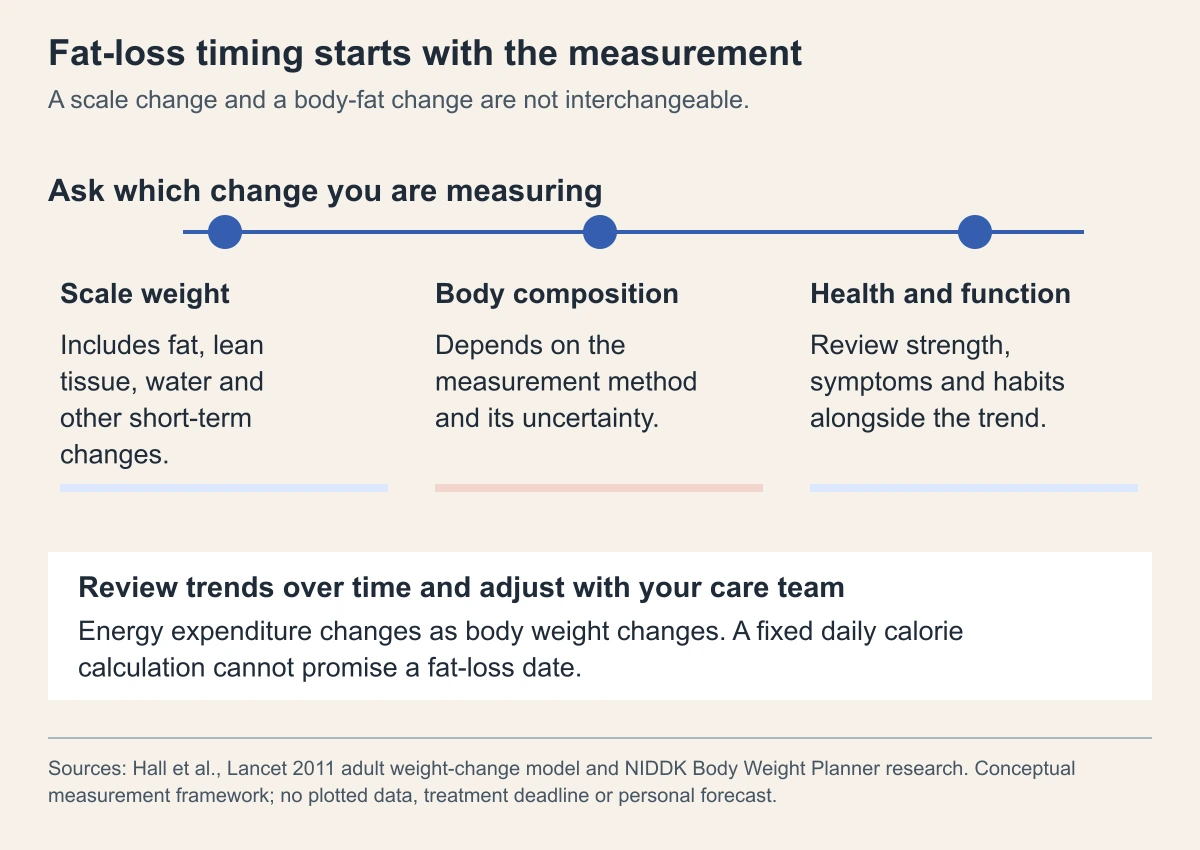
There is no universal number of hours or days between a workout and visible fat loss. A workout’s calorie estimate does not isolate fat used, and a change on the scale does not isolate body fat. Meaningful progress is assessed from repeated observations and the overall care plan, with attention to how energy intake, expenditure and body composition change over time.
That does not mean nothing is happening until the scale moves. It means that “using energy,” “losing weight,” “losing fat” and “noticing a visible change” are different questions. NIDDK’s adult weight-planning research uses a changing, or dynamic, model rather than promising a straight-line result from one calorie calculation. NIDDK Body Weight Planner research.
What are you trying to measure?
Start by choosing the question. If you want to know whether your body weight is changing, a comparable series of scale readings can help. If you want to know whether the change is specifically fat, body weight alone cannot provide that answer. If your concern is strength, stamina or a medical condition, those outcomes need their own assessment.
| Observation | What it can help describe | A limitation |
|---|---|---|
| Body weight | The combined weight of the body at the time of measurement. | It does not separate fat, lean tissue and water. |
| Waist measurement | Change in a consistently measured circumference. | It does not supply an exact amount of fat lost. |
| A body-composition result | An estimate produced by a particular measurement method. | Method, conditions and uncertainty matter when comparing results. |
| Strength and daily function | How the routine supports movement and ordinary tasks. | These are useful outcomes but are not a direct fat measurement. |
The water-weight versus fat-loss guide covers the scale distinction in more detail. Here, the timing question is about why these observations may tell different stories and how to avoid turning one reading into a deadline.
Does burning calories mean you immediately lose the same amount of fat?
No. An exercise display does not show how much stored fat has been lost from the body. Energy balance involves intake and expenditure across the complete period, and changes can be partitioned between fat and lean tissue. Hall and colleagues’ adult model explains why body composition and changing energy expenditure must be considered together. Original model research.
The measurement itself adds another uncertainty. A tracker estimates expenditure; it does not continuously weigh body fat. A workout can contribute to an activity routine without proving that the displayed calories became a matching net deficit for the day.
This distinction matters when someone expects a lower scale reading the morning after exercise. The workout and the scale answer different questions. Eating, drinking, the observation conditions and the rest of the day’s activity still belong in the picture. The calorie-intake guide helps frame intake and expenditure without assigning a guaranteed number of pounds to a session.
Why the first few scale changes can be misleading
A change in eating can affect body weight through more than fat alone. Hall’s research discusses stored glycogen and its associated water, as well as changes in fluid balance when diet composition changes. Those effects help explain why a rapid early change should not automatically be labeled pure fat loss. Hall and colleagues.
The opposite inference is also unreliable: one unchanged or higher reading does not prove that an activity or eating routine has had no effect. What was measured, when it was measured and how it compares with other observations matter.
Avoid attaching an exact fat-loss percentage to a few pounds lost in the first days of a new plan. Without appropriate measurement, that split is unknown. A dramatic short-term drop should not become a target to reproduce through dehydration or extreme restriction. Useful progress should be assessed alongside nutrition, symptoms and the ability to maintain the plan.
Why a fixed calorie rule cannot give a fat-loss date
The familiar pounds-per-calorie shortcut treats the body as if expenditure stays fixed while weight changes. The adult dynamic model shows why that assumption breaks down. A smaller body has different energy requirements, and changes in fat and lean tissue influence expenditure. A constant change in eating therefore does not produce the same weekly change indefinitely. Lancet model research.
This is a limitation of the forecast, not evidence that energy balance is meaningless. A calorie calculation can be a starting assumption, but the observed response and changing circumstances need review. Even careful planning has uncertainty about a free-living person’s starting energy requirements.
Do not interpret the model’s long-term timescales as a claim that fat loss cannot begin for a year. The research addresses the trajectory toward a new weight under specified assumptions. Onset of a biological change, reaching a long-term modeled weight and seeing a difference in the mirror are separate endpoints.
Do medication trial results tell me when I will notice fat loss?
They provide evidence about defined treatments in defined populations, not a personal date. For example, current Wegovy labeling describes weight-reduction trial exposure of up to 68 weeks for adults receiving 2.4 mg weekly injections. Zepbound labeling describes weight-reduction trials with treatment up to 72 weeks. Those observation periods are much longer than a first-day or first-week test. Wegovy label, Zepbound label.
Do not combine different trial doses, populations and products into a single expected timeline. A study’s body-weight outcome is also not automatically an isolated body-fat result. An average across participants does not mean that everyone follows the same course or achieves the same response.
Branded-product evidence should not be assumed to establish the same result for a compounded preparation. The compounded GLP-1 guide explains that product distinction. FDA does not review compounded medicines for safety, effectiveness and quality before marketing in the way it reviews approved medicines. FDA information.

How should I assess the first month of a treatment plan?
Use the follow-up plan agreed with your clinician. The first month may involve learning administration instructions, assessing tolerability, adjusting daily routines and reviewing nutrition. It should not become a race to reach another person’s visible result.
For people prescribed a GLP-1 medicine, the exact product and prescription matter. A starting phase and a maintenance phase are not interchangeable, and dose changes should follow the prescriber’s instructions. The semaglutide first-month guide and tirzepatide first-month guide address those practical questions.
Bring more than a scale number to follow-up. Discuss appetite, symptoms, meals, activity, sleep and how the plan fits ordinary life. If side effects are preventing eating or drinking adequately, obtain clinical advice instead of interpreting inadequate intake as desirable progress.
Can I use clothes or photos to tell when fat loss starts?
They may help you describe a perceived change, but they cannot establish an exact amount or starting date of fat loss. Clothing differs in fit, and photographs differ in pose, lighting and framing. Neither resolves the distinction between fat, lean tissue and fluid.
If those observations are useful to you, keep the approach consistent and avoid comparing yourself with promotional before-and-after images. A photograph cannot demonstrate which treatment caused a change or whether the routine was appropriate for that person.
You can also choose measures that matter more to your day-to-day goals, such as whether an activity feels more manageable or a clinician-measured health marker changes. Those outcomes deserve recognition as their own outcomes, rather than being forced into a claim about fat pounds.
What if progress slows after an early change?
An early scale drop is not a rate that must continue. Energy requirements, behavior and the observed mix of tissue and fluid changes can differ over time. NIDDK notes that metabolism and calorie needs change during weight loss and that maintaining a change can be difficult. NIDDK maintenance guidance.
Review whether the concern is a short fluctuation or a sustained trend. Ask how food intake is being assessed, what an activity metric includes and whether symptoms or other treatments changed. Avoid responding to uncertainty by sharply restricting intake or increasing a prescription dose yourself.
If you use medication, the semaglutide plateau guide or tirzepatide plateau guide can help organize the follow-up discussion. A clinician can review treatment goals, tolerability and possible contributors rather than deciding from one reading that the medicine has failed.
Why strength and nutrition belong in the timeline
The smallest possible scale number is not the only objective. Weight change can include lean tissue, and everyday function matters. A plan that leaves you persistently weak, unable to recover or struggling to eat needs review even if the scale decreases.
NIDDK recommends a sustainable eating pattern and appropriate physical activity. Its general activity guidance includes aerobic movement and muscle-strengthening activity for healthy adults, with adaptations for health and ability. NIDDK guidance.
The balanced-meal guide and semaglutide protein and muscle guide offer related questions to discuss. They are not a substitute for an individualized nutrition plan. Avoid adding supplements or pursuing a very low intake merely because an online timetable says results should already be visible.

Questions that make a follow-up visit more useful
- Are we measuring weight, body composition, a health marker or a functional goal?
- Are the observations comparable, and what uncertainty does the method have?
- Is the eating and activity plan sustainable and meeting my needs?
- What symptoms or medication changes should affect the next step?
- When should we reassess, and what would count as a reason to change the plan?
If you are considering medication, the GLP-1 selection guide explains the separate eligibility and treatment-choice questions. CoreAge Rx’s semaglutide and tirzepatide pages describe offered compounded care. A service page does not establish eligibility or convert branded trial averages into a promised outcome for that preparation.
For the activity side of the question, read the 400–800 exercise-calorie guide, which separates workout estimates from total daily expenditure.
How long should you expect it to take?
Expect the answer to come from the plan, the measurement and the observed response—not a universal countdown after exercise. Changes are often discussed over repeated follow-up periods, and the right interval depends on the treatment and your circumstances. Your clinician can help decide when a trend is meaningful and when symptoms require earlier assessment.
The useful question is whether the plan supports your agreed goals while maintaining nutrition and function. A precise-looking calorie equation, a single weigh-in or a promotional photo cannot supply a reliable personal fat-loss date.
Educational information for adults; individual treatment decisions require a qualified clinician. Sources reviewed September 30, 2026. Original AI-generated article images depict fictional people and objects, not patient outcomes. Other editorial images are illustrative. Graphics summarize the cited sources.