Ozempic injection was first approved by the U.S. FDA on December 5, 2017, for improving blood glucose control in adults with type 2 diabetes, alongside diet and exercise. That is the original FDA approval date, not a separately verified date of the first commercial sale or pharmacy shipment. Original FDA Ozempic approval package.
Its history is easier to understand when you separate the active ingredient, brand, formulation, and intended use. Semaglutide later appeared in other products, including oral Rybelsus and weight-management Wegovy. Current product information also includes later developments that cannot be dated from the 2017 injection approval alone.
When did Ozempic come out: approval or launch?
“Come out” can mean several things: regulatory approval, a manufacturer launch, first availability at a pharmacy, or the time a medicine became widely discussed. Those events need not happen on the same date.
For a reliable U.S. regulatory answer, use the original FDA document: December 5, 2017. This review does not establish a separate commercial launch date. A report describing another year may be using a different event, which should be identified and sourced before comparing it with the approval date.
The same care applies to international dates. A U.S. FDA approval is not a worldwide availability date. If you need another country’s history, use that regulator’s records rather than carry the U.S. date into a global claim.
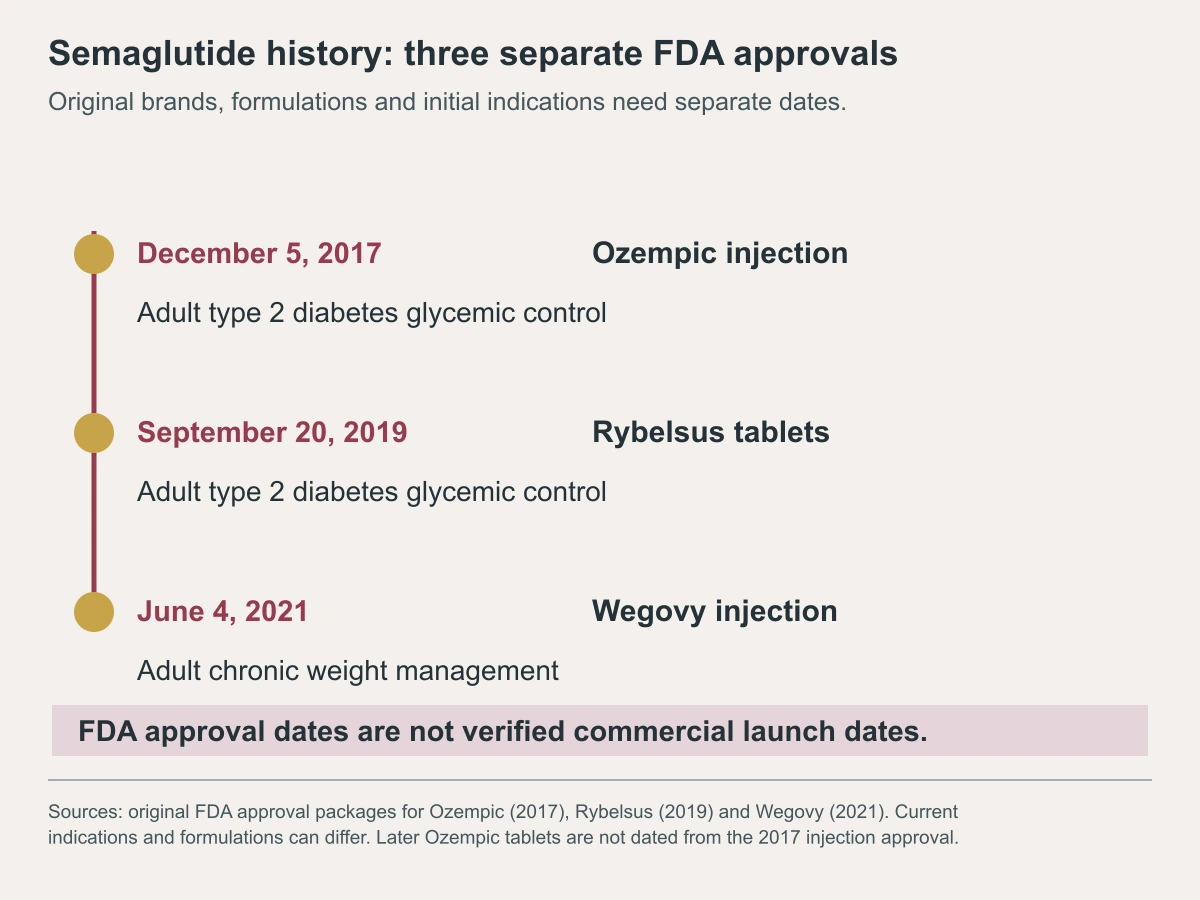
Three original approvals that answer different questions
| Original U.S. FDA approval | Product and formulation | Initial use in the approval document |
|---|---|---|
| December 5, 2017 | Ozempic injection | Glycemic control in adults with type 2 diabetes, alongside diet and exercise |
| September 20, 2019 | Rybelsus tablets | Glycemic control in adults with type 2 diabetes, alongside diet and exercise |
| June 4, 2021 | Wegovy injection | Chronic weight management in eligible adults under the original criteria |
Sources: original FDA approval packages for Ozempic, Rybelsus, and Wegovy.
These are historical entries. They do not reproduce every current indication, age group, formulation, device, or instruction. The original paperwork and the current prescribing information serve different purposes.
What was Ozempic originally approved for?
The 2017 approval addressed adult type 2 diabetes blood-glucose control. It was not an original approval for general weight management. Sharing an ingredient with a later weight-management product does not change the wording of that original document.
The current Ozempic injection label includes later uses in specified adult type 2 diabetes populations, including cardiovascular and chronic-kidney-disease contexts. Consult the current label for the actual criteria, limitations, and warnings rather than treat a history article as an eligibility checklist. Current Ozempic injection label.
Our Ozempic mechanism guide explains the broader treatment questions. The prescription guide helps organize evaluation, dispensing, and follow-up without assuming that a familiar brand name establishes personal suitability.
Why does Wegovy have a different date?
Wegovy has its own product application and initial indication. Its June 4, 2021 injection approval concerned chronic weight management under the criteria in the original document. It is a distinct regulatory event from the 2017 Ozempic injection approval. Original Wegovy approval.
The current Wegovy information includes injection and tablet formulations and later indication details. That makes it particularly important to identify the formulation and use when reading a current offer or article. Current Wegovy prescribing information.
If you want to discuss Wegovy now, our Wegovy prescription guide covers the practical conversation. A historical approval does not establish present stock, insurance payment, or whether a particular formulation is appropriate for you.
Where does Rybelsus fit?
Rybelsus was initially approved as oral semaglutide for adult type 2 diabetes on September 20, 2019. Its tablet history is separate from the original Ozempic injection history. Original Rybelsus approval package.
A tablet and an injection can contain the same active ingredient while having different formulations, strengths, administration instructions, and evidence. A numerical milligram comparison does not make them interchangeable.
Our oral semaglutide versus injection guide explains why the product comes before the comparison. Ask the pharmacist to identify the exact preparation and current instructions when a prescription or package changes.
Are there Ozempic tablets now?
The current manufacturer-served tablet label covers Rybelsus and Ozempic tablets. Its reference to an initial U.S. approval in 2017 reflects the active ingredient’s history; it should not be treated as proof that every later tablet brand and formulation was approved that year. Current tablet prescribing information.
FDA’s actual semaglutide tablet discontinuation entry has Novo Nordisk rows posted June 4, 2026 stating that manufacture of Rybelsus 3, 7, and 14 mg tablets was discontinued and replaced by Ozempic tablets. That record is about those product changes, not a new date for the original injection approval. FDA tablet entry.
This review does not assign an unverified separate approval date to the later Ozempic tablet formulations. Use the specific application and regulatory record when that date is needed.

Does “discontinued” mean all semaglutide disappeared?
No such conclusion follows from the particular tablet record. Read the active ingredient, formulation, manufacturer, status, and individual rows. The entry discussed above concerns specified tablet presentations.
It is also different from an injection-shortage determination. Our Wegovy supply guide explains the dated FDA search and why national shortage information does not predict local pharmacy stock.
This is a common problem with isolated search snippets. A word such as “discontinued” can sound much broader than the underlying entry. Open the source and identify exactly what changed before making a claim about the whole ingredient or brand family.
Was Ozempic approved for weight loss?
Do not confuse the original Ozempic approval with the separate Wegovy weight-management approval. Review the current Ozempic label for its approved uses and ask the clinician about the rationale for any proposed use outside that label.
FDA describes off-label use as use of an approved drug outside its approved labeling, which can involve the condition, route, or dose. A clinician’s decision does not mean FDA has established safety and effectiveness for that unapproved use. FDA explanation of off-label use.
Useful questions include what the medicine is approved for, what evidence supports the proposed use, what alternatives exist, and how benefits and risks will be monitored. Insurance coverage is another question; it does not automatically follow from a prescription or from the medicine’s age.
Off-label use and compounding are different concepts
An FDA-approved finished drug prescribed outside its label remains a different situation from a compounded preparation. FDA states that compounded drugs are not FDA approved. An active ingredient’s long regulatory history does not approve every compound containing it. FDA compounding information.
For GLP-1 compounds, identify the actual ingredient, pharmacy, concentration, directions, and clinical reason. Brand-name evidence cannot simply be assigned to another finished preparation. FDA unapproved GLP-1 information.
Our compounded GLP-1 guide provides a practical starting point. CoreAge Rx’s semaglutide service information describes a separate option to discuss with a clinician; it is not an extension of the original Ozempic approval or a promise of branded-product equivalence.
Does a longer history mean fewer risks?
Time on the market can add information, but the age of a medicine does not establish that it is suitable for everyone or free of important warnings. Current prescribing information reflects the actual product and its present safety guidance.
Bring the full medication list, relevant conditions, pregnancy plans if applicable, and previous treatment reactions to the evaluation. Do not choose a drug solely because it has been available longer or is more familiar from advertisements.
Our semaglutide questions guide can help prepare follow-up. The medication comparison guide considers treatment fit and evidence rather than ranking products by their approval year.
Approval does not establish current price or access
A 2017 approval date cannot tell you today’s insurance benefit, cash price, pharmacy stock, or service fees. Those need current, product-specific checks.
For Ozempic, ask the pharmacy and insurer for the quote tied to the actual prescription and benefit. Our Ozempic cost guide explains the difference between insurance and self-pay routes. The GLP-1 coverage guide covers formulary and authorization questions.
For a service comparison, retain the exact product and billing interval. A compounded-subscription price, branded-pharmacy price, and introductory promotion should not be treated as identical offers. The RemedyMeds public-information review shows one example of those distinctions.

How to verify a medication-history claim yourself
Use a short checklist when reading an article or product page:
- Name the product. Brand and active ingredient are different identifiers.
- Name the formulation. Injection and tablet histories may differ.
- Identify the event. Approval, launch, label expansion, discontinuation, and shortage are separate events.
- Check the country. A U.S. document gives U.S. regulatory information.
- Read the original source. Use the actual approval letter for a historical date and current labeling for present instructions.
If a page gives one date for an entire ingredient family, ask what event the date describes. Keeping those details attached to a claim makes the history more useful and reduces confusion when newer formulations appear.
Common Ozempic history questions
What year was Ozempic first FDA approved?
- The original injection approval document is dated December 5, 2017.
Is that the exact commercial launch date?
This review verifies the approval date, not the first commercial shipment or sale. A launch claim needs its own source.
Was the original approval for weight management?
No. It addressed adult type 2 diabetes glycemic control. Wegovy’s original weight-management injection approval came separately in 2021.
Did Rybelsus come before Ozempic?
The original U.S. injection approval for Ozempic was in 2017; the original Rybelsus tablet approval was in 2019.
Can I use 2017 as the approval date for every Ozempic tablet?
No. The active ingredient’s initial history does not date every later brand formulation. Identify the specific regulatory event.
Does the tablet discontinuation entry mean Wegovy injections are unavailable?
It does not establish that. Read the formulation and specific rows, and ask the pharmacy about the current prescribed product.
Does Ozempic’s history approve compounded semaglutide?
No. Approval of a finished drug and the status of a compounded preparation are separate questions.
Which document should I use for treatment now?
The current prescribing information and the instructions for the actual dispensed product, applied with your clinician and pharmacist. The original approval letter is useful for history, not a personal dosing plan.
Educational information for adults; individual treatment decisions require a qualified clinician. Sources reviewed September 30, 2026. Original AI-generated article images depict fictional people and objects, not patient outcomes. Other editorial images are illustrative. Graphics summarize the cited sources.