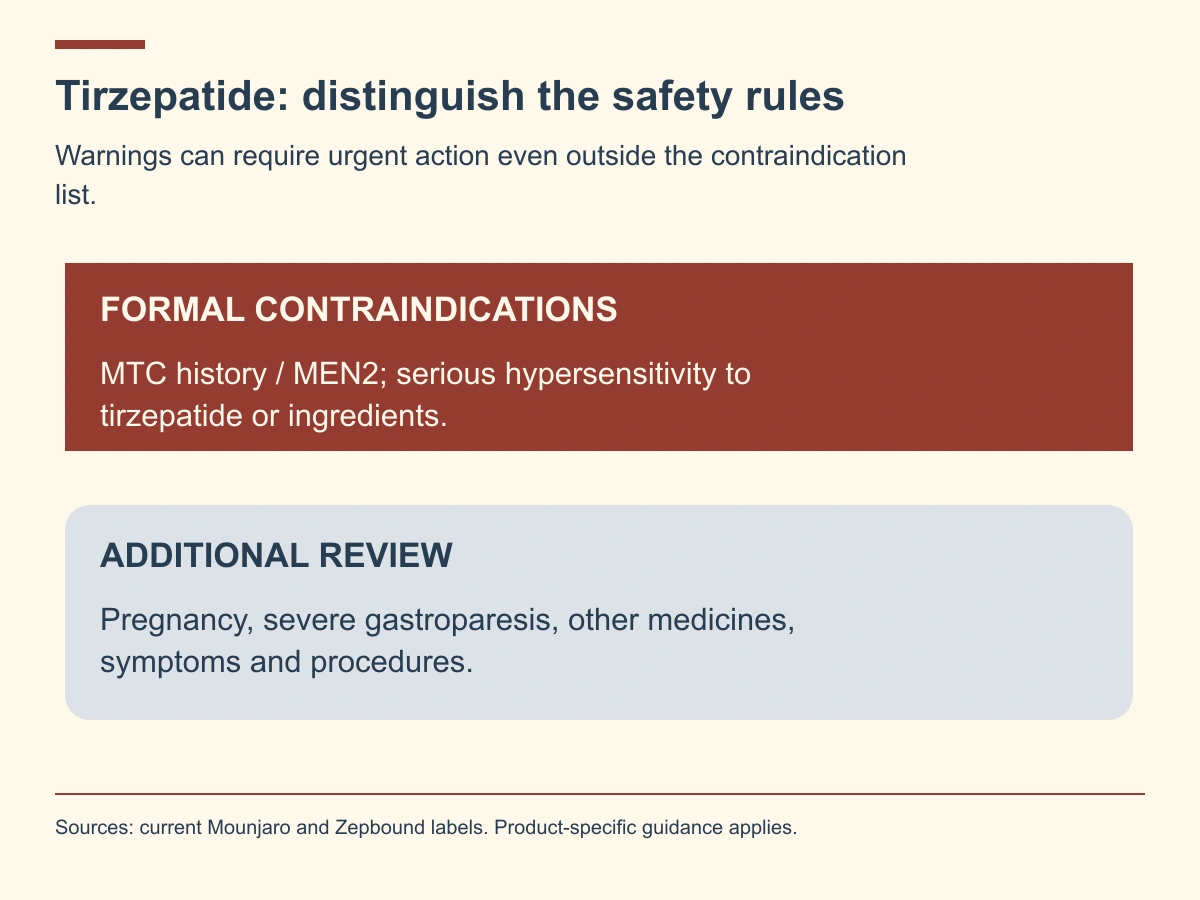
The U.S. Mounjaro and Zepbound labels list two main categories of contraindication: a personal or family history of medullary thyroid carcinoma or MEN2, and serious hypersensitivity to tirzepatide or the product’s ingredients. Other important situations—including severe gastroparesis, pregnancy, certain medicines, and planned anesthesia—require their own guidance rather than being placed on one undifferentiated “never take it” list.
First identify the product and treatment goal
Tirzepatide is the active ingredient in Mounjaro and Zepbound. The products have different approved indications, and a compounded preparation is a separate category. A useful safety assessment starts with the exact product, the intended purpose, your medical history, and your complete medicine list.
Read the current Mounjaro label or Zepbound label that matches the prescription. This article discusses adult safety questions; it does not determine individual eligibility, select a dose, or replace a prescriber’s assessment.
Our tirzepatide questions guide provides the wider treatment context. If an online questionnaire uses only the word “tirzepatide,” ask which preparation and indication the clinician is considering before assuming every instruction is interchangeable.
What does “contraindication” mean?
A contraindication is a circumstance in which the labeled medicine should not be used. A warning describes a risk requiring attention; some warnings mean avoiding treatment in a particular situation, while others call for monitoring, a medicine adjustment, or prompt action if symptoms develop.
These categories are not a ranking of how seriously you should take a symptom. A condition can require urgent care even if it is not listed under the heading “Contraindications.” Likewise, a monitoring recommendation is not permission to ignore the risk.
| Situation | How the labels address it |
|---|---|
| Personal or family history of MTC | Contraindication. |
| MEN2 | Contraindication. |
| Serious hypersensitivity to tirzepatide or product ingredients | Contraindication. |
| Severe gastroparesis | Treatment is not recommended. |
| Pregnancy | Product-specific pregnancy guidance; Zepbound should be discontinued when pregnancy is recognized. |
| Insulin or sulfonylurea use | Increased hypoglycemia risk; clinician review and possible adjustment. |
| Kidney impairment | Not automatically a contraindication; dehydration and kidney-function monitoring still matter. |
| Planned anesthesia or deep sedation | Tell the procedural team and obtain an individualized plan. |
Sources: current Zepbound and Mounjaro prescribing information.
MTC and MEN2: the history matters
Medullary thyroid carcinoma is a specific thyroid cancer. MEN2 is a hereditary syndrome associated with certain endocrine tumors. The label restriction includes a personal or family history of MTC and the presence of MEN2. It does not say that every thyroid diagnosis is equivalent to these conditions.
If a relative had “thyroid cancer,” find out which type if possible. If you had thyroid surgery, obtain the final pathology and ask your treating clinician to clarify the diagnosis. A normal thyroid-hormone blood test does not answer the cancer-history question.
The warning is based on thyroid C-cell tumors in rats; relevance to humans remains unknown. Avoid interpreting that as either a proven human outcome or a guarantee of no risk. The Zepbound after thyroid-removal guide explains why removing the gland does not erase the named history-based restriction.
Previous serious allergic reactions
A previous serious hypersensitivity reaction to tirzepatide or an ingredient in the product is a contraindication. Tell the clinician exactly which medicine was involved, what symptoms occurred, how soon they appeared, and what treatment was required. An allergy list that says only “injection reaction” may need clarification.
A small local skin reaction is not automatically the same as anaphylaxis, but it should not be self-diagnosed from a photograph. Trouble breathing, swelling of the face or throat, collapse, or other signs of a serious reaction require emergency help. The labels instruct discontinuation and prompt treatment when serious hypersensitivity occurs. Zepbound warnings.
The labels also advise caution after angioedema or anaphylaxis with another GLP-1 receptor agonist because susceptibility to a reaction with tirzepatide is uncertain. Bring any emergency-care record to the prescribing assessment.
Severe gastroparesis and digestive symptoms
Both labels say the medicine is not recommended in severe gastroparesis, a condition in which stomach emptying is markedly delayed. Occasional fullness after a large meal is not enough to diagnose gastroparesis, and an online symptom list cannot grade its severity.
Tell the team about a known diagnosis, recurrent vomiting, difficulty maintaining intake, or previous evaluation for delayed stomach emptying. Review symptoms before treatment rather than waiting until a dose increase makes them harder to manage.
Our tirzepatide nausea and reflux article distinguishes common digestive symptoms from problems that need assessment. Persistently being unable to eat or drink enough is not a treatment goal.
Pancreatitis and gallbladder history
The labels warn about acute pancreatitis and acute gallbladder disease. These histories deserve discussion even though they are not the two categories listed in the formal contraindications section. The clinical question includes what happened previously, whether the cause was identified, and whether there are ongoing symptoms.
Severe or persistent abdominal pain, sometimes extending to the back and occurring with or without vomiting, needs prompt assessment. The labels direct discontinuation and appropriate management when pancreatitis is suspected. Do not take another dose to see whether the pain settles. Mounjaro and Zepbound warnings.
A comparison of average trial percentages cannot diagnose an individual episode. Bring the symptom timing and medicine details, but seek care based on severity rather than trying to prove which organ is involved at home.

Pregnancy, planning pregnancy, and breastfeeding
The Zepbound label says weight loss offers no benefit during pregnancy and advises discontinuing treatment when pregnancy is recognized. Mounjaro’s pregnancy section discusses insufficient human data, potential fetal risks from animal studies, and the risks of poorly controlled diabetes. A diabetes-treatment transition requires prompt clinician coordination. Zepbound pregnancy section, Mounjaro pregnancy section.
If you are planning pregnancy, discuss the plan before trying to conceive. Do not use a general internet washout schedule in place of the prescriber’s advice. If pregnancy is recognized, contact the care team promptly for the product-specific next step and an appropriate ongoing care plan.
Breastfeeding also needs individual review. The current labels describe a small single-dose lactation study with low or undetectable measured milk concentrations, while noting missing information about infant effects and milk production. That is not proof of unrestricted safety. See our tirzepatide pregnancy and breastfeeding guide for the broader discussion.
Oral contraceptives and other oral medicines
Tirzepatide delays gastric emptying and may affect oral-medicine absorption. The labels advise patients using oral hormonal contraceptives to switch to a non-oral method or add a barrier method for four weeks after starting and four weeks after each dose increase. Non-oral hormonal contraceptives should not be affected by this absorption issue. Mounjaro interactions, Zepbound interactions.
Other oral medicines may require attention when reliable concentrations are important, including medicines with a narrow therapeutic range such as warfarin. The appropriate action may be monitoring rather than automatically stopping the medicine.
Bring prescriptions, over-the-counter products, supplements, and medicines used only occasionally. Tell the pharmacist about vomiting or difficulty taking tablets, because the actual ability to take and retain medicine is another practical issue.
Insulin, sulfonylureas, and low glucose
Insulin and sulfonylureas can increase the risk of hypoglycemia when used with tirzepatide. The clinician may adjust these medicines and the monitoring plan. Do not make changes independently or assume that eating very little makes the combination safer.
Ask what glucose range requires action, how to treat a low result, and whom to contact for repeated episodes. A symptom such as shakiness or sweating can have more than one cause, so follow your established monitoring and treatment instructions.
The first-month tirzepatide guide explains how to track appetite, intake, symptoms, and treatment questions. The purpose of follow-up is to make the regimen manageable, not simply to keep increasing the dose.
Kidney or liver disease is a separate assessment
The Mounjaro label does not recommend dose adjustment solely for renal or hepatic impairment, based on the evaluated pharmacokinetic findings. That should not be interpreted as “kidney disease does not matter.” Vomiting and diarrhea can lead to dehydration and acute kidney injury, and kidney-function monitoring may be needed. Mounjaro population and warning sections.
Tell the prescriber about kidney disease, fluid restrictions, diuretics, and recent dehydration. Reduced urine, inability to keep fluids down, or significant illness needs prompt attention. A generic instruction to drink large amounts of water may be unsuitable for someone with an individualized fluid limit.
Procedures, overlapping medicines, and compounded products
Tell the anesthesia or procedural team that you take tirzepatide before general anesthesia or deep sedation. The labels describe rare aspiration reports despite reported fasting and say evidence is insufficient to define a universal risk-reduction strategy. Obtain instructions specific to the procedure and your circumstances. Zepbound aspiration warning.
Zepbound’s limitations of use do not recommend combining it with another tirzepatide-containing product or a GLP-1 receptor agonist. A switch between treatments needs a written plan; overlapping leftover prescriptions is not a self-directed strategy.
A compounded product is not an FDA-approved generic. Review the actual ingredients, pharmacy instructions, and clinical rationale. FDA compounded GLP-1 guidance. The CoreAge Rx tirzepatide page describes assessment-based compounded care; it does not override contraindications or establish equivalence to a brand.

Questions before the first prescription
- Which product and indication are being considered?
- Is there a personal or family MTC history or MEN2?
- Have I had a serious drug allergy, pancreatitis, gallbladder disease, or severe gastroparesis?
- What changes are needed for diabetes medicines or oral contraception?
- How do pregnancy plans, breastfeeding, kidney disease, or procedures affect the plan?
- Which symptoms require urgent care, and who handles routine follow-up?
A useful assessment explains both why treatment may be appropriate and how risks will be managed. The absence of a named contraindication is the beginning of that discussion, not automatic clearance.
Common questions
Does hypothyroidism mean I cannot take tirzepatide?
Hypothyroidism is not the same as MTC or MEN2. Clarify the thyroid diagnosis and review the full medical history; absence of one named contraindication does not establish eligibility.
Is kidney disease always a contraindication?
No. The label separates renal impairment from the formal contraindications, but dehydration, current kidney function, other medicines, and monitoring remain important. Ask the prescriber how those details affect your plan.
Should I stop another medicine before the assessment?
Do not stop prescribed treatment on your own. Bring an accurate list and let the relevant clinicians coordinate any adjustment, including insulin, sulfonylureas, anticoagulants, and oral contraception.
Educational information for adults; individual treatment decisions require a qualified clinician. Sources reviewed October 5, 2026. Original AI-generated article images depict fictional people and objects, not patient outcomes. Other editorial images are illustrative. Graphics summarize the cited sources.