
Wegovy can delay gastric emptying, which means food leaves the stomach more slowly. That does not give everyone a fixed number of extra digestion hours, and it is not the same as measuring how long food takes to travel through the whole digestive tract. The useful questions are how you feel, whether you can eat and drink adequately, whether symptoms persist, and whether other medicines or a planned procedure need review.
What does “slows digestion” mean?
The phrase is often used loosely. Gastric emptying describes movement out of the stomach. Whole-gut transit concerns a longer journey through the intestines. Constipation, fullness, nausea, and reflux are symptoms; they are not interchangeable measurements of either process.
Wegovy’s U.S. prescribing information states that it delays gastric emptying. The same document describes appetite and calorie-intake effects. It does not provide a personal timer that tells you when every meal has been digested. Current Wegovy prescribing information.
Our how Wegovy works article explains the broader mechanism. Here, the focus is the practical digestion question: what the wording means, what symptoms deserve attention, and what you should tell your care team.
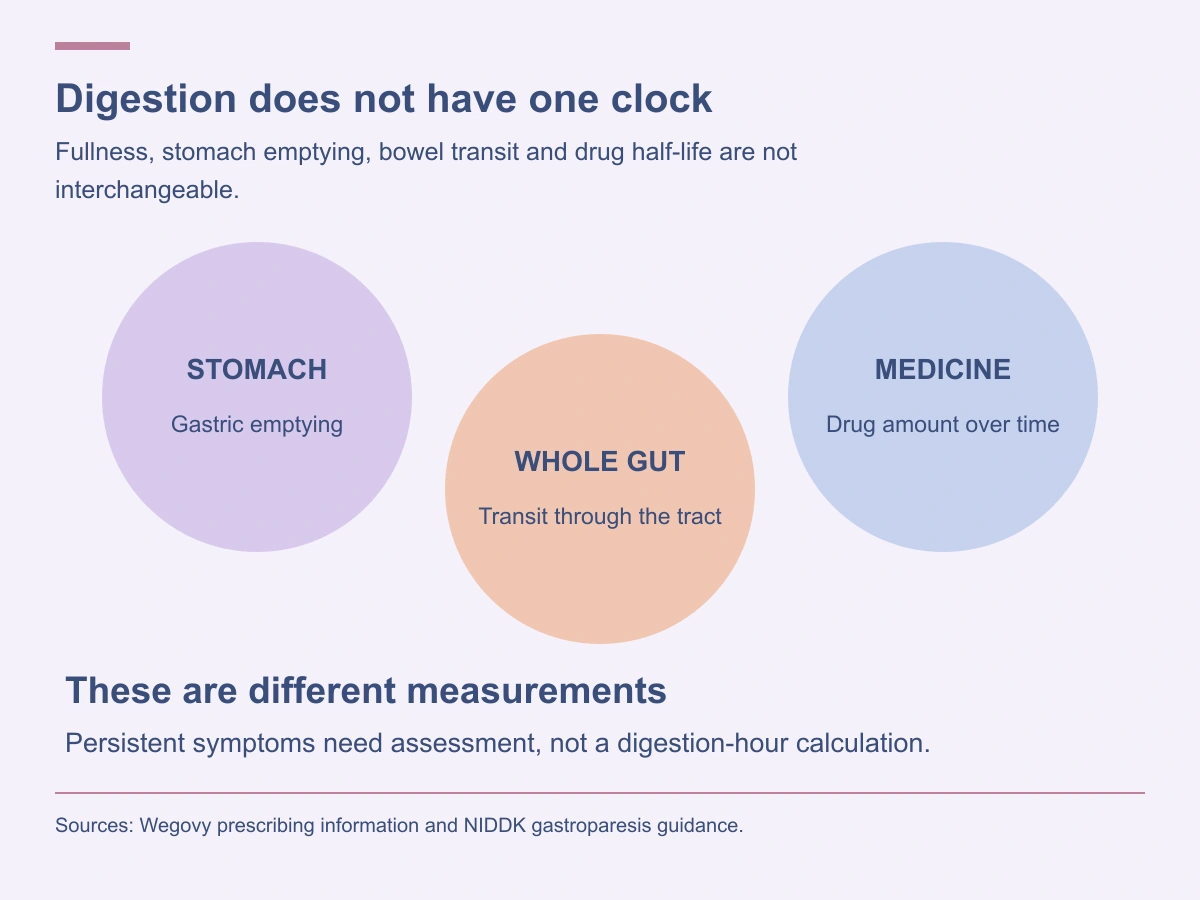
Why there is no universal digestion-hour answer
A meal’s composition, size, your health, and the method used to measure emptying all affect what a timing result means. Research measurements under defined conditions are not a direct estimate for your dinner. A medicine’s dose schedule also cannot be converted into the number of hours a meal remains in your stomach.
Likewise, the time a drug remains in the body is a different concept from stomach emptying. A long-acting medicine does not imply that a meal remains in the stomach for the same duration. Keeping those ideas separate prevents a common misunderstanding.
If you feel unusually full for a long time, describe the actual experience rather than trying to calculate it from a medication half-life. Note what you ate, when symptoms began, whether you vomited, and whether you can keep fluids down. Those details give the clinician something useful to assess.
| Term | What it describes | A common mistaken conclusion |
|---|---|---|
| Gastric emptying | Food moving from the stomach into the intestine. | Every meal stays in everyone’s stomach for a fixed extra number of hours. |
| Whole-gut transit | Movement through the broader digestive tract. | Constipation directly measures stomach emptying. |
| Drug half-life | How the amount of medicine changes over time. | Food takes that long to digest. |
| Fullness or nausea | A symptom that needs context. | A diagnosis can be made from the sensation alone. |
Does feeling full mean Wegovy is working?
Fullness is one observation, not a complete assessment of treatment benefit. Useful outcomes and tolerability should be discussed together. Being unable to eat adequately, repeated vomiting, or persistent pain is not a goal to achieve.
You also do not need a stronger uncomfortable sensation to justify a prescription. Do not increase a dose yourself because a meal feels easier to finish or because another person describes more intense appetite suppression. The treatment plan should take your response and side effects into account.
Our semaglutide side-effect guide discusses the broader symptom history to share. The precise product and instructions matter, particularly when comparing a branded prescription with a compounded preparation.
Practical eating questions during fullness or nausea
Ask the care team how to keep nutrition manageable if large meals feel difficult. A diary can help identify whether symptoms cluster around larger portions, particular foods, or a dose change. The goal is adequate, tolerable intake, not an increasingly narrow list of “safe” foods chosen without review.
Eating more slowly and avoiding a meal size that repeatedly causes discomfort may be useful topics to discuss. If you have diabetes, kidney disease, or another condition affecting food or fluid needs, include those requirements in the plan. A general meal suggestion should not override them.
The balanced-meal guide and protein during semaglutide treatment article offer planning questions. If solid foods are repeatedly difficult or intake is falling substantially, seek individualized advice rather than building a liquid-only routine yourself.
Slower emptying is not automatically gastroparesis
Gastroparesis is a clinical condition that requires evaluation. Symptoms can include early fullness, prolonged fullness, nausea, vomiting, bloating, and upper abdominal discomfort, but those symptoms can have several causes. A symptom checklist does not establish the diagnosis. NIDDK symptom overview.
The current Wegovy label says it is not recommended in severe gastroparesis. That is a reason to tell the prescriber about a previous diagnosis or substantial ongoing symptoms. It does not mean every episode of nausea proves gastroparesis, and it does not mean persistent symptoms should be ignored as an expected adjustment.
Avoid using a social media account of “food staying in the stomach” as proof of what is happening in your body. Give your clinician the exact medicine, formulation, dose history, other medicines, and symptom pattern. They can decide whether a workup is needed.

How clinicians investigate persistent symptoms
NIDDK describes a process involving medical history, examination, and testing that can exclude other causes, including obstruction. Tests of gastric emptying use defined conditions. For example, a gastric-emptying scan follows a specified meal over time; it is not the same as guessing from how full you feel after dinner. NIDDK diagnostic overview.
Testing is chosen for the clinical situation. Not every person with occasional nausea needs the same test, and an online article cannot determine the sequence for you. Ask what question the proposed test will answer and how the result would affect care.
Report how symptoms affect ordinary life: missed meals, waking at night, repeated vomiting, difficulty taking oral medicine, or trouble keeping fluids down. Functional details can be more informative than describing the symptom as simply mild or bad.
What symptoms need prompt help?
Persistent vomiting or inability to keep fluids down deserves prompt advice, especially with dizziness, weakness, or reduced urination. Severe or persistent abdominal pain also requires assessment. Do not assume it is routine delayed emptying.
Vomiting blood, fainting, breathing trouble, or feeling severely unwell can require urgent care. Tell the assessing clinician that you use Wegovy and provide your other medicines. The medicine history helps the evaluation, but it does not establish the cause.
If symptoms occur around a planned dose increase, contact the prescriber before following the next step automatically. Ask for instructions about the specific prescription and follow-up. Do not create your own dosing interval to solve a persistent problem.
Oral medicines need their own review
Because stomach emptying can affect the context in which oral medicines are taken, bring the complete list to your prescriber or pharmacist. Include medicines requiring close monitoring and those you use only occasionally. Tell them if vomiting makes it difficult to keep a tablet down.
Do not take an extra dose of an oral medicine because you think absorption was delayed. Whether a dose should be repeated depends on the exact drug, timing, and circumstances. Similarly, do not move all tablets to another hour based on a general rule about Wegovy.
The fiber supplement and medicine-timing guide addresses a related but separate issue. A supplement’s spacing instructions are not a universal solution for prescription-related stomach effects.
Tell the anesthesia team before a procedure
The current Wegovy label includes reports of pulmonary aspiration during general anesthesia or deep sedation in people using GLP-1 medicines. It also states that available information is insufficient to establish a universal mitigation approach based on changing fasting or temporarily stopping treatment. Tell the procedure team about the prescription and your symptoms well before the appointment.
Do not choose a holding interval from a blog comment or assume that fasting alone resolves every concern. The team needs the actual medicine, formulation, last dose, planned procedure, and gastrointestinal history. Follow the plan they provide and ask for clarification if different clinicians give conflicting instructions.
Our semaglutide surgery and anesthesia guide explains the discussion in more detail. Insurance approval for a procedure does not replace this clinical planning.

Injection and tablet instructions are different
The current Wegovy prescribing document includes more than one formulation. Route-specific instructions matter. A tablet’s administration requirements should not be copied to an injection, and matching a milligram number does not establish equivalent use.
If cost or availability prompts a proposed switch, ask the clinician to specify the new product, route, starting prescription, and timing. Our semaglutide and tirzepatide switching guide explains why a written plan is useful. Do not combine leftover products while waiting for an appointment.
The CoreAge semaglutide service page describes its own intake pathway. It does not promise branded Wegovy or establish that any preparation has identical labeling, device instructions, or clinical-trial evidence. FDA explains the distinction for compounded drugs.
Frequently asked questions
How many hours does Wegovy add to digestion?
There is no universal number for an individual meal. Gastric emptying depends on defined measurement conditions and personal factors. Report persistent symptoms rather than using a fixed-hour estimate to decide whether something is normal.
Does constipation prove food is still in my stomach?
No. Constipation and stomach emptying concern different parts of digestive function. Describe both symptoms if they occur, including timing and severity, so your clinician can assess the overall picture.
Should I stop eating fiber?
Do not eliminate broad food groups solely because the label mentions delayed emptying. Advice depends on symptoms, diagnosis, and your overall nutrition needs. Persistent problems may need a clinician or dietitian’s individualized plan.
Is vomiting undigested food a normal treatment goal?
No. Repeated vomiting needs assessment, particularly if you cannot maintain food or fluid intake. Describe what happened and how often. Do not treat it as proof of stronger or better weight-loss treatment.
Can I take another medicine to make digestion faster?
Ask the treating clinician to assess the symptoms first. Do not add a prescription, supplement, or laxative to counteract a presumed mechanism on your own. The cause and appropriate treatment need to be established.
Should I change the day of my dose before surgery?
Get a specific plan from the prescribing and procedure teams. The current label does not establish one universal schedule for every procedure. Share the exact product and last dose rather than improvising a change.
Educational information for adults; individual treatment decisions require a qualified clinician. Sources reviewed October 2, 2026. Original AI-generated article images depict fictional people and objects, not patient outcomes. Other editorial images are illustrative. Graphics summarize the cited sources.