
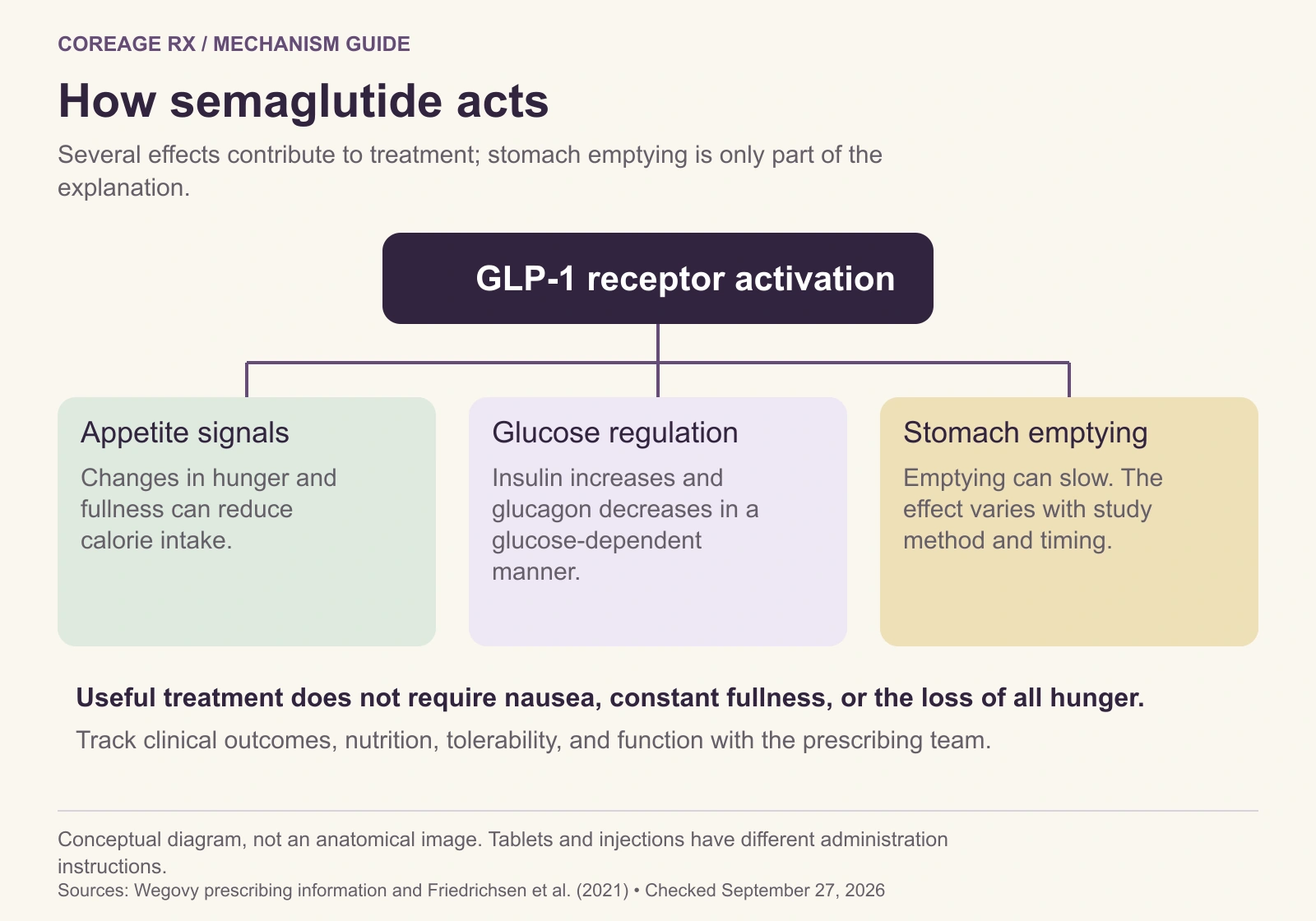
Wegovy contains semaglutide, a medicine that activates GLP-1 receptors involved in appetite, food intake, and glucose regulation. It can make it easier to eat less by changing hunger and fullness signals. It also delays stomach emptying, although the size and timing of that effect are more complicated than the shorthand “food stays in your stomach longer.” Wegovy prescribing information
Understanding these effects helps set realistic expectations. Treatment does not need to eliminate all hunger or cause nausea to be useful. It also does not remove the need for adequate nutrition, follow-up, and a plan that fits your health history.
What is GLP-1, and what does semaglutide do?
GLP-1 is a hormone involved in regulating appetite and blood glucose. Semaglutide is a GLP-1 receptor agonist: it binds to and activates the receptor used by GLP-1. The Wegovy label describes GLP-1 receptors in several brain regions involved in appetite regulation. Wegovy prescribing information
A helpful way to understand the treatment is as a change in several signals that influence eating and glucose control. It is not simply a stimulant or a substance that flushes fat out through urine.
The label describes three effects that patients often ask about:
| Effect | Plain-language explanation | What it does not establish |
|---|---|---|
| Appetite and calorie intake | Hunger, fullness, and eating-related signals can change | Everyone will lose interest in food or eat the same amount |
| Glucose-dependent insulin and glucagon effects | The pancreas responds differently when glucose is elevated | Hypoglycemia is impossible, particularly with other diabetes medicines |
| Delayed gastric emptying | Movement of food out of the stomach can slow | Every digestive symptom is normal or the stomach stops working |
These mechanisms overlap, but none should be used as a do-it-yourself dosing test. Your appetite on one afternoon cannot tell you whether a higher dose is appropriate.
How does Wegovy affect hunger and fullness?
The prescribing information states that semaglutide decreases calorie intake and that this is likely mediated through appetite effects. Human research also supports changes in hunger, fullness, and eating control. Wegovy prescribing information
In a randomized trial involving 72 adults with obesity, participants received weekly injected semaglutide, escalated to 2.4 mg, or placebo for 20 weeks. The semaglutide group reported less hunger, greater fullness and satiety, and better control of eating. At a test lunch where participants could eat freely, energy intake was 35% lower than in the placebo group. Semaglutide appetite trial
That 35% result applies to a measured lunch under the trial conditions. It is not a recommendation to cut your daily food intake by 35%, and it does not predict the exact change any person will experience.
Some people describe reduced “food noise,” meaning fewer intrusive thoughts about food or less pressure to keep eating. That phrase can be useful for describing an experience, but it is not a standardized home test of treatment success. Our first-month semaglutide guide explains how to record changes without expecting a single universal timeline.
Our guide to Wegovy gastric emptying and digestion separates stomach emptying from whole-gut transit and medicine half-life, with persistent-symptom and procedure-planning questions.
Does Wegovy work mainly by slowing the stomach?
Slower gastric emptying is part of the pharmacology, but it should not be treated as the complete explanation for weight loss. The current label states that semaglutide delays gastric emptying. Its appetite effects are also central to the explanation of reduced calorie intake. Wegovy prescribing information
The 20-week appetite study adds nuance. Using an indirect test based on paracetamol absorption after a standardized breakfast, the investigators found no evidence of delayed gastric emptying at week 20. They still observed appetite and food-intake effects. This finding reflects one method and study time point; it does not erase the label’s gastric-emptying warning or establish that the effect never occurs. Semaglutide appetite trial
The practical lesson is that a person does not need to feel food “sitting” in the stomach for treatment to have an effect. Persistent vomiting, severe pain, or inability to eat and drink normally deserves assessment, rather than being celebrated as a sign that the medicine is working.
What happens to insulin and glucagon?
Semaglutide stimulates insulin secretion and reduces glucagon secretion in a glucose-dependent manner. Insulin helps regulate how the body handles glucose; glucagon is another pancreatic hormone involved in maintaining blood glucose. These effects can lower blood glucose. Wegovy prescribing information
“Glucose-dependent” is useful context, but it does not eliminate every low-glucose risk. The Wegovy label warns about hypoglycemia, particularly when used with insulin or an insulin secretagogue such as a sulfonylurea. A clinician may need to adjust other medicines and specify monitoring.
Tell the prescriber about all diabetes medicines, including medicines prescribed by another practice. If food intake changes substantially or you become ill, ask how your monitoring and sick-day plan should work. Do not make independent insulin or Wegovy adjustments based on a general mechanism explanation.

Does Wegovy burn fat directly?
The label describes weight reduction with greater fat-mass loss than lean-mass loss and a reduction in calorie intake, likely mediated by appetite. “Burns fat directly” can obscure that explanation and imply that food intake, nutrition, and physical function no longer matter. Wegovy prescribing information
Weight loss can include lean tissue as well as fat. A useful care plan considers strength, function, protein intake, and tolerable activity alongside the scale. The exact plan depends on age, medical conditions, dietary needs, and how much food you can comfortably eat.
Our semaglutide, protein, and muscle guide explains why preserving function deserves attention. Severe food restriction or deliberately tolerating vomiting is not a sound way to intensify the medicine’s effects.
How quickly should you notice it working?
People notice changes at different times. The starting phase includes gradual dose escalation to improve tolerability. Appetite, weight, glucose, and side effects are different outcomes and may change on different schedules. Wegovy prescribing information
A helpful record includes the exact product and prescribed dose, whether doses were taken as directed, appetite between meals, ability to meet nutritional needs, side effects, and longer-term weight or health trends. If you have diabetes, include the measurements your clinician requested.
The absence of dramatic appetite suppression after an early dose does not prove failure. Conversely, feeling unable to eat is not automatically the desired response. Discuss both inadequate response and excessive effects at follow-up.
Our guide to semaglutide plateaus and treatment review can help structure that conversation. It does not replace checking whether you are using the right formulation and following its instructions.
Do Wegovy tablets and injections work the same way?
Both contain semaglutide and activate GLP-1 receptors. They differ in how the medicine enters the body, their administration schedule, dose strengths, and some approved uses. Current U.S. labeling includes both Wegovy injection and Wegovy tablets. Wegovy prescribing information
The tablets use a specific formulation to support absorption through the stomach. Their instructions concerning an empty stomach, water, and waiting before food or other oral medicines matter. Injection instructions depend on the supplied device. Neither route should be improvised from directions for a different semaglutide product.
The current label provides specific guidance for switching between Wegovy formulations. Do not assume that an oral milligram equals an injected milligram. Our oral semaglutide versus injections article and Wegovy cost guide cover routine and access questions.
Compounded semaglutide is a separate category. It is not FDA approved and does not inherit the approval, evidence, or instructions of a Wegovy product. FDA compounding information
Our guide to Wegovy and inflammation research reviews primary CRP analyses and distinguishes biomarker changes, cardiovascular context and the injection’s defined MASH indication.
Why is Wegovy prescribed for more than weight alone?
The approved uses depend on the formulation and patient population. The current label includes weight reduction and maintenance for specified patients, and reduction of major cardiovascular events in adults with established cardiovascular disease and overweight or obesity. The injection also has specified pediatric and noncirrhotic MASH uses that should not automatically be applied to the tablets. Wegovy prescribing information
The mechanism behind each clinical benefit is not fully settled. The label states that the exact cardiovascular risk-reduction mechanism has not been established. It also describes the mechanism in human MASH as incompletely understood and potentially involving multiple pathways.
That distinction matters: a medicine can have evidence supporting a defined clinical use without a simple explanation that it “cleans arteries” or “heals the liver.” Eligibility and expected benefit should be discussed for the condition actually being treated.

What safety questions belong in the discussion?
Wegovy has a boxed warning concerning thyroid C-cell tumors observed in rodents. It is contraindicated for people with a personal or family history of medullary thyroid carcinoma or MEN 2, and for people with a prior serious hypersensitivity reaction to semaglutide or its ingredients. The human relevance of the rodent tumor findings is uncertain. Wegovy prescribing information
The label also covers pancreatitis, gallbladder disease, kidney injury related to volume depletion, severe gastrointestinal reactions, diabetic retinopathy concerns, and other precautions. Tell the team about pregnancy plans, significant digestive problems, diabetes eye disease, and all other medicines.
Because delayed gastric emptying can matter during general anesthesia or deep sedation, tell the procedural team you use Wegovy. Follow an individualized plan rather than a universal internet instruction to stop for a fixed interval. See our semaglutide and anesthesia guide for the questions to ask.
Turning the mechanism into a useful treatment plan
Ask what outcome you are treating, how response will be assessed, what nutrition and activity support fits your circumstances, and when tolerability should prompt contact. Our Wegovy side-effects guide provides a symptom-focused companion.
If reviewing CoreAge Rx’s semaglutide service, confirm the exact product and its regulatory status during evaluation. Understanding how semaglutide acts is a starting point. Choosing an appropriate formulation and maintaining follow-up are what make that knowledge useful in day-to-day care.
Interpret long-term results with the study scope
- Wegovy before-and-after evidence and expectations — Review defined trial populations, timelines, maintenance, nutrition and tolerability rather than selected transformation photos.
Educational information for adults; individual treatment decisions require a qualified clinician. Sources checked September 27, 2026. Original AI-generated article illustrations depict fictional people and objects, not patient outcomes. Other editorial images are illustrative. Graphics summarize the cited sources.