
A “peptide stack” is a marketing or community term for combining two or more products, often for goals such as recovery, body composition, sleep, or healthy aging. The phrase does not identify a standardized treatment, an approved combination, or an evidence-based dosing protocol.
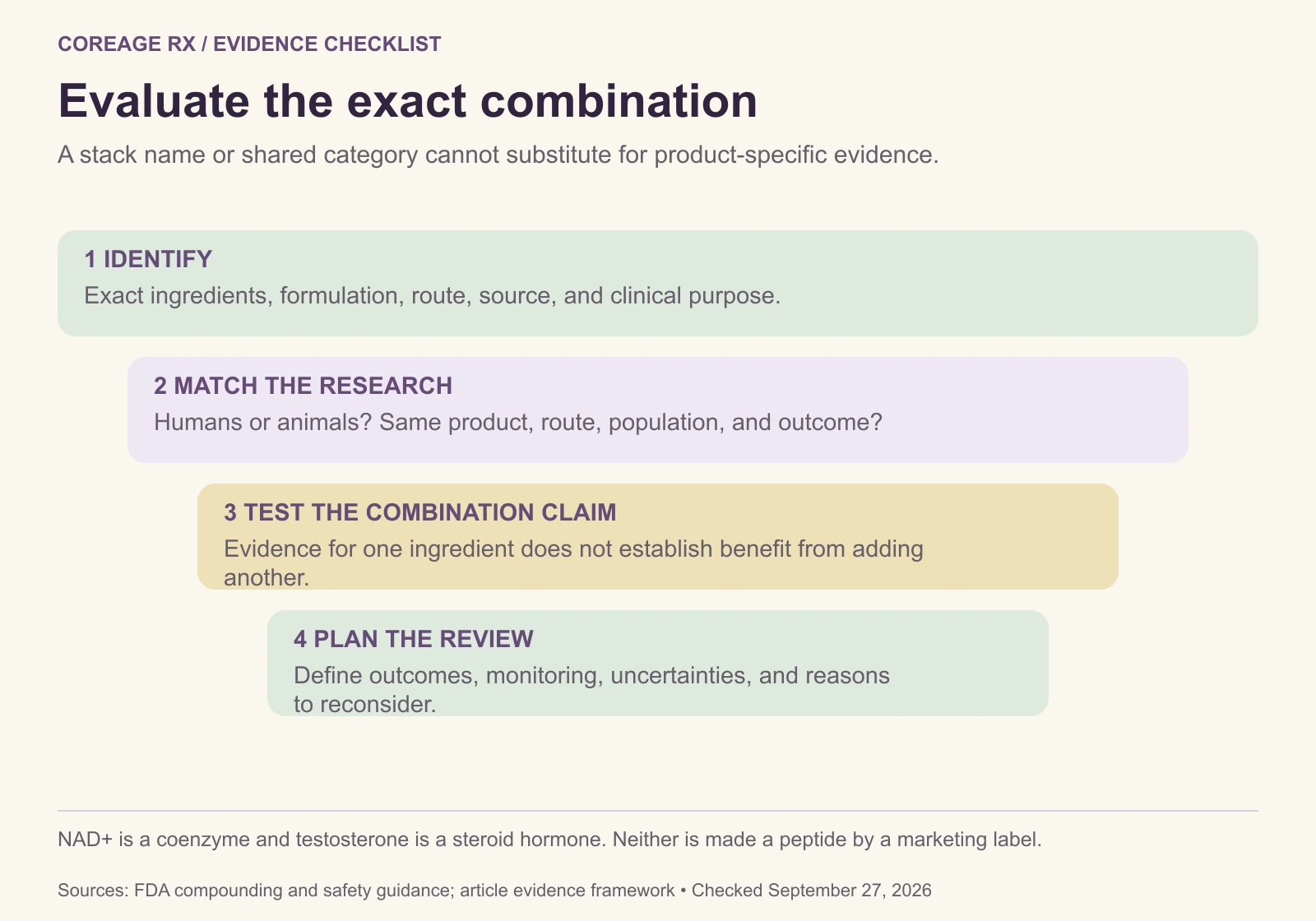
Before considering a combination, establish exactly what each product contains, how it is administered, what condition is being treated, and what human evidence supports using those products together. Evidence about a single ingredient cannot automatically establish the safety or benefit of a stack.
For a formulation example, our guide to PDA and BPC-157 evidence questions separates seller identity claims from FDA free-base and acetate review and limited human ulcerative-colitis evidence.
Why the word peptide tells you very little about a treatment
Peptides are chains of amino acids, but the category includes substances with very different actions and evidence. Some peptide medicines have FDA-approved uses. Other compounds sold online have limited human data or significant unresolved safety questions.
The relevant unit of evaluation is the exact medicine, formulation, route, dose, and indication. “Peptide therapy” is too broad to establish whether a particular treatment works or whether two treatments are compatible.
For example, approved GLP-1 medicines have product-specific prescribing information and trial evidence. A research compound promoted for tendon recovery does not inherit that evidence merely because it is also called a peptide. Our Sermorelin versus other peptides guide explains why names and mechanisms need to be kept distinct.
What counts as evidence for a combination?
Start by separating four different claims:
| Evidence available | What it may help establish | What it cannot establish by itself |
|---|---|---|
| Laboratory or animal findings | A biological effect worth investigating | A safe and effective human regimen |
| A human study of one ingredient | Outcomes for that ingredient under the studied conditions | The benefit of adding a second compound |
| Human research on the exact combination | Information about the studied population, route, and schedule | Suitability for every patient or a different preparation |
| Personal testimonials | What one person reports experiencing | Causation, comparative effectiveness, or reliable risk estimates |
A rationale such as “these affect different pathways” is a hypothesis about a combination. It is not equivalent to a trial showing that the combination improves a meaningful outcome without unacceptable harms.
Ask for the actual study. Check whether it involved people, whether the ingredients match, and whether the outcome was a symptom, physical function, laboratory marker, or another measure. A change in a biomarker does not necessarily mean a person feels or functions better.
FDA has identified concerns with several promoted compounds
FDA maintains information about certain substances used in compounding that may present significant safety risks. The concerns vary by compound and route. They should be described accurately rather than converted into the claim that every peptide has the same risk. FDA compounding-substance safety information
| Substance discussed by FDA | Examples of the stated concerns |
|---|---|
| BPC-157 | Limited safety information for proposed routes, immune-response concerns, and peptide-related impurities |
| CJC-1295 | Limited clinical data and reports including increased heart rate and systemic vasodilatory reactions |
| Injectable GHK-Cu | Limited human safety data and concerns involving aggregation and impurities |
| Ipamorelin acetate | Serious adverse events reported in an intravenous gastric-motility study; insufficient information for certain other injectable routes |
| Thymosin beta-4 fragment LKKTETQ, also called TB-500 on FDA’s page | Lack of identified human exposure data for the specified fragment and unresolved safety concerns |
These summaries do not establish a safe stack or an appropriate dose. They identify reasons that confident sales claims require scrutiny. FDA compounding-substance safety information
Route and identity matter here. An adverse-event report from intravenous ipamorelin research does not prove the same event rate with a different route, but missing route-specific data also does not prove safety. Likewise, a study of full-length thymosin beta-4 cannot automatically validate the different fragment identified as TB-500.
Does combining products increase benefit?
It might seem intuitive that several products addressing different goals should produce a larger overall benefit. That needs testing. A combination can also make the treatment harder to interpret: if sleep improves, swelling appears, or glucose changes, which product contributed?
Introducing several products around the same time creates practical uncertainty. The clinician needs a complete list, start dates, formulation details, and meaningful outcomes to assess. Without those, a positive or negative change can be incorrectly attributed to the most recently discussed ingredient.
Ask what additional benefit the second product is expected to provide beyond the first and what evidence supports that expectation. Also ask what would count as lack of benefit and when the plan would be reassessed. “Synergy” without a measurable outcome is not enough to evaluate a treatment decision.

Sermorelin combinations need their own review
Sermorelin affects growth hormone signaling. That does not make it interchangeable with recombinant growth hormone or with every compound promoted as a growth hormone secretagogue. Historical Geref products and present-day compounded preparations also need to be distinguished. FDA Geref determination
Combining agents that influence a related pathway requires more than assuming their effects will add neatly. Discuss the clinical purpose, symptom history, relevant testing, and how adverse effects will be monitored. The Sermorelin guide and IGF-1 testing article provide background for that conversation.
If you are reviewing CoreAge Rx’s Sermorelin offering, ask about the evidence and instructions for the exact preparation being proposed. Product availability is not evidence supporting an additional combination.
NAD+ and TRT are different categories
NAD+ is a coenzyme involved in cellular reactions, not a peptide. NIH’s niacin fact sheet explains its role in metabolism and other cellular processes. Those biological roles do not establish that adding an NAD+ injection to another treatment improves a specific clinical outcome. NIH niacin and NAD information
Our NAD+ injection evidence guide and NAD+ nasal versus injection comparison address the importance of route-specific evidence. A result involving an oral precursor, an infusion, or a laboratory experiment should not be assumed to apply to every marketed NAD+ product.
TRT uses testosterone, a steroid hormone. It has its own diagnostic and monitoring questions, including fertility, blood count, and other treatment considerations. See questions before starting TRT and TRT monitoring.
Grouping NAD+, testosterone, and peptides under a “longevity stack” does not remove those differences. Each proposed treatment needs a clinical reason, evidence appropriate to the route, and a plan for assessing benefit and harm.
Compounding and registration do not establish approval
Compounded drugs are not FDA approved. FDA does not evaluate their safety, effectiveness, and quality before marketing, and they are not FDA-approved generics. Compounding may serve specific medical needs that an approved medicine cannot meet; that role should not be represented as blanket approval for a multi-ingredient package. FDA compounding questions and answers
A pharmacy license, a facility registration, or a certificate for a raw ingredient answers a different question from whether the final combination has been clinically studied. Ask which pharmacy prepares the product, what is actually in it, and which documentation applies to the finished preparation.
Our compounding-pharmacy checklist uses tirzepatide as its example, but the distinction between pharmacy identity and product approval is useful when evaluating other compounded offerings too.
Can you mix peptides in one syringe or vial?
Do not create a combination by mixing separately supplied products based on an online stack recipe. Compatibility, concentration, stability, and sterility need professional evaluation. A solution that looks normal does not prove that a mixture is suitable for injection.
CDC identifies combining medicines and preparing batches of syringes as manipulations that may constitute pharmaceutical compounding. Its injection-safety guidance also emphasizes clean technique and one-time use of sterile needles and syringes. CDC injection safety
If a clinician prescribes a professionally prepared combination, the dispensing pharmacist should explain the exact ingredients, concentration, route, handling, and usable limits. A pre-mixed vial still needs clinical justification and clear instructions; convenience does not resolve uncertainty about benefit.

What should you disclose during a medication review?
Include prescriptions from every clinic, over-the-counter medicines, supplements, injections, nasal products, and items purchased as “research” products. If the identity is uncertain, bring the container or a photo of the label through a private clinical channel rather than guessing.
List when each product was started, what you hoped it would do, any observed changes, and whether a prescriber is monitoring it. This is especially useful when fatigue, sleep problems, swelling, appetite changes, or other symptoms overlap with the advertised benefits.
Do not omit a product because it was described as natural or sold without a prescription. The clinician needs to know what was actually taken to assess symptoms and plan care.
Questions that make a proposed stack easier to evaluate
Ask the prescribing clinician:
- What diagnosis or specific problem is each ingredient intended to address?
- What human evidence supports the exact combination and route?
- Which benefits are measured clinical outcomes, and which remain theoretical?
- What risks or interactions are uncertain?
- What monitoring is appropriate, and who coordinates it?
- What would make us stop, change, or reconsider the plan?
- Is a simpler, better-studied approach available for the same goal?
Those questions can turn a broad recovery or anti-aging claim into a reviewable clinical decision. If the evidence is limited, the uncertainty should remain visible rather than being replaced with a confident cycle or dosing chart.
If you are already using several products and develop severe symptoms, seek medical care and provide the complete list. For routine decisions, begin with a qualified clinician, a clearly defined problem, and evidence that matches the proposed treatment.
Educational information for adults; individual treatment decisions require a qualified clinician. Sources checked September 27, 2026. Original AI-generated article illustrations depict fictional people and objects, not patient outcomes. Other editorial images are illustrative. Graphics summarize the cited sources.