
Sulfur burps on Zepbound are burps with an odor people often describe as rotten eggs. Zepbound can cause belching and other digestive symptoms, but the smell does not establish the cause, prove that treatment is working, or identify a remedy that will stop it immediately.
Start with the symptoms around the burping. Occasional odor after a meal is different from burping with repeated vomiting, severe abdominal pain, substantial diarrhea, or difficulty drinking. This guide explains what Zepbound’s trials measured, what you can reasonably observe at home, and when to contact the prescribing team.
Did Zepbound trials measure sulfur burps?
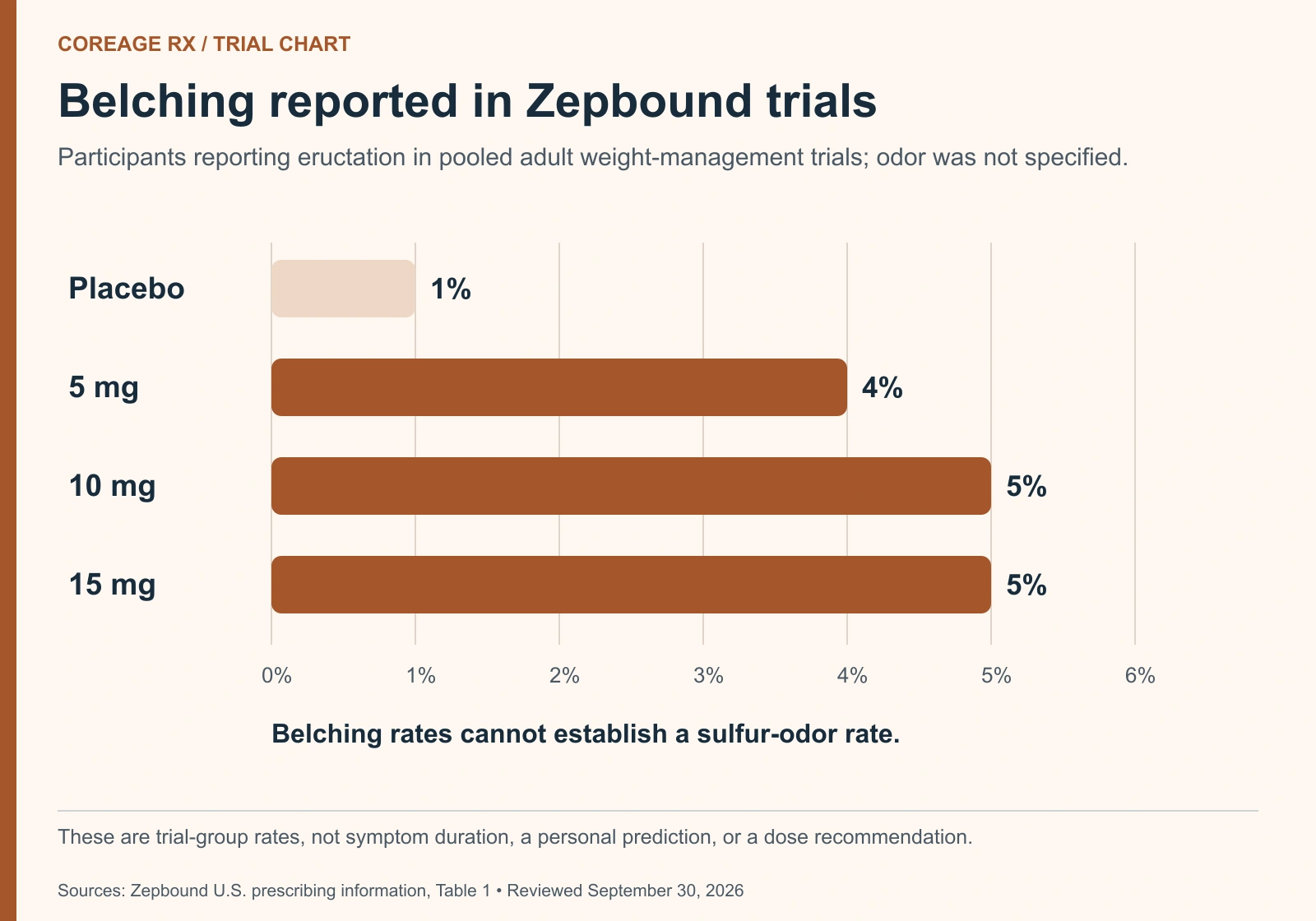
The current prescribing information reports eructation, the medical term for belching. In the pooled adult weight-management trials, it occurred in 1% of participants receiving placebo, 4% receiving Zepbound 5 mg, and 5% receiving either 10 mg or 15 mg. The table does not identify which burps had a sulfur odor. Zepbound prescribing information
| Trial group | Participants reporting belching |
|---|---|
| Placebo | 1% |
| Zepbound 5 mg | 4% |
| Zepbound 10 mg | 5% |
| Zepbound 15 mg | 5% |
These are study-group percentages, not the percentage of days someone will burp. They cannot predict an individual’s symptoms or establish a sulfur-burp rate. The groups also followed planned treatment schedules; the table is not a guide for choosing your dose.
Zepbound contains tirzepatide, as does Mounjaro, but the brands’ trial populations and reported rates differ. Our Mounjaro sulfur-burp article discusses that product’s evidence separately. Use the information for the medicine you actually receive.
Why might burping change after starting treatment?
Tirzepatide delays gastric emptying, meaning food leaves the stomach more slowly. The label describes the largest effect after the first dose, with the effect diminishing over time. That provides useful background, but it does not demonstrate why a particular person’s burps smell different. Zepbound prescribing information
Burping can also reflect swallowed air. Eating quickly, chewing gum, and drinking carbonated beverages can increase swallowed air and gas symptoms. Other digestive conditions may contribute, especially when burping is accompanied by pain, bowel changes, or reflux. NIDDK gas symptoms and causes
Avoid treating the phrase “food rotting in your stomach” as a diagnosis. An odor cannot establish gastroparesis, a bacterial infection, or an intestinal overgrowth condition. Those diagnoses require a clinical assessment. Similarly, one episode after a meal does not prove that every ingredient in that meal needs to be removed from your diet.
What should you notice first?
Instead of tracking smell alone, describe a few concrete details:
- When the symptoms began relative to starting Zepbound, a dose change, or a restart.
- Whether the burps occur occasionally, after meals, or throughout the day.
- Whether there is heartburn, nausea, vomiting, abdominal swelling, diarrhea, or constipation.
- Whether you can eat, drink, and urinate normally.
- Any recent illness, travel, new supplement, or change in another medicine.
A short note is enough to begin the conversation. For example, “Burping started after this week’s increase, especially after dinner; I also feel nauseated but can drink normally” gives the clinician more useful information than a smell rating alone.
Our tirzepatide nausea and reflux guide helps separate related complaints. Heartburn, vomiting, and belching can occur together, but they are not interchangeable symptoms.
What can you try for mild symptoms?
When symptoms are mild and you are otherwise well, slow down at meals, take manageable portions, and stop eating when comfortably full. Notice whether a large or rich meal repeatedly makes fullness or nausea worse. Smaller meals may be easier to tolerate, but they still need to provide adequate nourishment.
Reducing carbonated drinks or gum is a reasonable experiment when swallowed air seems to be part of the problem. Change one or two habits at a time so you can tell what helps. NIDDK discusses these common contributors to belching. NIDDK gas guidance
Do not turn a list of supposedly “sulfur-producing foods” into a broad ban on eggs, vegetables, protein foods, or other nutritious choices. An individual food pattern is worth discussing; a restrictive diet based only on an odor can create a different problem. A dietitian can help when several foods seem difficult to tolerate.
The Zepbound meal-planning guide and tirzepatide protein guide offer wider context. During troublesome digestive symptoms, the immediate aim is a tolerable eating and drinking routine, not forcing faster weight loss.

What if you also have diarrhea or constipation?
Tell the clinician about bowel symptoms rather than treating the burps as an isolated issue. Zepbound trials reported both diarrhea and constipation. A medicine’s effect on stomach emptying does not mean every person will experience the same bowel change. Zepbound prescribing information
With diarrhea, the important questions include frequency, duration, blood or fever, and whether fluid losses can be replaced. Our Zepbound diarrhea guide explains these concerns. Diarrhea with significant weakness, reduced urination, or inability to drink needs prompt assessment.
With constipation, report hard stools, straining, incomplete emptying, and any abdominal pain or vomiting. Do not automatically add large amounts of fiber when the abdomen is severely swollen or you cannot pass gas. The GLP-1 constipation guide explains when ordinary self-care is no longer the appropriate next step.
Could the cause be an infection?
Sometimes. For example, the NHS lists egg-smelling burps among possible symptoms of giardiasis, an intestinal infection. Diarrhea, cramps, bloating, and exposure to contaminated water may be relevant to that assessment. NHS giardiasis information
This does not mean sulfur burps diagnose Giardia or that everyone with the symptom needs an infection test. Tell the clinician about untreated water, recent travel, sick contacts, and persistent diarrhea when applicable. The full history determines what to investigate.
Do not start antibiotics, antiparasitic medicines, or a “gut cleanse” based on smell. A newly appearing symptom after months on a stable dose also deserves a fresh look rather than an automatic assumption that Zepbound is responsible.
Is there an instant remedy or an over-the-counter treatment?
There is no universal instant treatment established for sulfur burps on Zepbound. A product that helps acid reflux may not address another source of burping. A gas product may not change the odor, and combining several products makes it harder to identify what is helping or causing new symptoms.
Ask a pharmacist or the prescribing team about the actual symptom you want to treat. Bring the names of antacids, acid-reducing medicines, antidiarrheals, supplements, and other medicines you are already using. Your medical history and accompanying symptoms can change which options are suitable.
Do not use a supplement claim such as “GLP-1 detox” as evidence that a product can correct medication intolerance. Persistent symptoms warrant a treatment review even if an over-the-counter product temporarily makes them less noticeable.
Should the next dose change?
Contact the prescriber before a planned increase when burping is part of a persistent or disruptive digestive pattern. Zepbound’s dose selection considers both response and tolerability. The label does not give one dose adjustment for every patient with belching. Zepbound prescribing information
Avoid taking extra injections, shortening the interval, splitting doses, or independently switching between a pen and a compounded vial. Describe any recent treatment interruption accurately; restarting after a gap may require a different conversation from continuing a stable routine.
Our tirzepatide missed-dose and restart guide explains the scheduling questions. It does not replace an individualized plan when you are unwell or unable to maintain food and fluid intake.

Which symptoms need urgent attention?
Seek prompt medical attention for severe or persistent abdominal pain, repeated vomiting, inability to keep fluids down, marked weakness, fainting, or substantially reduced urination. Abdominal pain with fever or jaundice also needs assessment.
Zepbound’s medication guide directs patients to stop the medicine and contact a healthcare provider right away for severe abdominal pain that will not go away, with or without vomiting, because this can be a symptom of pancreatitis. The pain may extend to the back. Breathing difficulty, facial or throat swelling, or collapse is an emergency. Zepbound safety information
Do not wait for a fixed sulfur-burp timeline when these symptoms are present. The associated pain, vomiting, hydration problem, or allergic reaction matters more than the odor.
Common questions
Do sulfur burps mean Zepbound is working?
No. The odor is not a validated measure of treatment benefit. Review agreed outcomes, nutrition, function, and tolerability with the clinician. Stronger digestive symptoms are not a reason to assume you are receiving a better result.
Will they disappear after a specific number of injections?
The label does not establish a universal sulfur-burp schedule. It describes patterns for some broader gastrointestinal adverse effects, but those patterns cannot predict when one person’s odor will resolve. Persistent or worsening symptoms should be reported.
Can a different injection site prevent them?
The label does not establish a site that reliably prevents sulfur burps. Use approved sites and the correct instructions for your device. Our Zepbound injection-site guide covers technique questions without promising a symptom-free location.
What should I ask a treatment service?
Ask who handles adverse effects, how quickly you can obtain advice, and how the prescribed product and follow-up plan are identified. If reviewing CoreAge Rx tirzepatide care, confirm the exact preparation and pharmacy. A compounded preparation is not Zepbound, and branded trial findings do not prove that every compounded product has the same safety or performance.
Educational information for adults; individual treatment decisions require a qualified clinician. Sources reviewed September 30, 2026. Original AI-generated article images depict fictional people and objects, not patient outcomes. Other editorial images are illustrative. Graphics summarize the cited sources.