Creatine is often discussed after menopause as if muscle strength, bone density, and fracture prevention were one benefit. They are separate outcomes, and randomized trials give a more nuanced picture than that broad promise suggests.
A small trial in older women found benefits for selected muscle measures when creatine was combined with resistance training. A larger two-year trial in postmenopausal women did not improve its primary bone-density endpoint, although some secondary measures favored creatine. Reading both helps identify what the supplement may contribute and what it has not established.
What is creatine expected to do?
Creatine participates in the body’s system for rapidly supplying energy during muscular work. That provides a rationale for studying it with resistance exercise, particularly for repeated high-intensity effort. It is not a hormone and does not replace estrogen after menopause. NIH supplement information.
A plausible mechanism still needs clinical testing. The meaningful question is not simply whether a supplement reaches muscle, but whether adding it improves a relevant outcome beyond the comparison treatment.
Our creatine monohydrate guide explains basic terminology. This article focuses on selected randomized studies in older or postmenopausal women, where the populations and endpoints need to remain visible.
How did the smaller trial separate training from supplementation?
Gualano and colleagues randomized 60 vulnerable older women for 24 weeks into four groups: placebo, creatine, placebo plus resistance training, or creatine plus resistance training. The primary outcome was muscle strength measured with one-repetition-maximum tests. Original 2014 trial.
The four-group design helps distinguish several comparisons. Creatine plus training versus placebo alone asks about the whole combined intervention. Creatine plus training versus training with placebo asks more directly what the supplement adds to the training program.
Those comparisons should not be blended. If both exercise groups improve more than a non-exercise group, that is not automatically evidence that creatine produced all the improvement.
What did the strength results show?
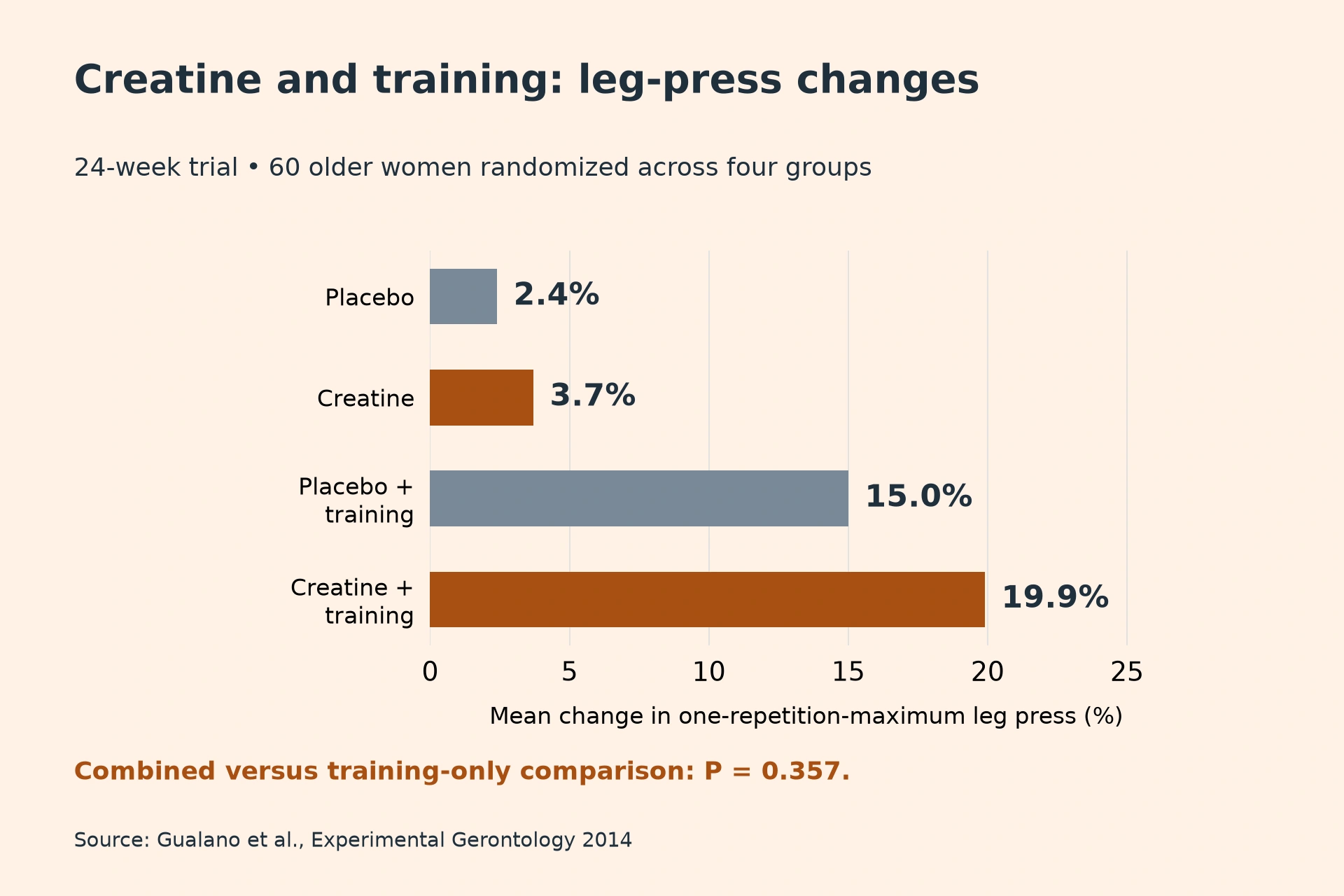
Leg-press strength increased by 19.9% with creatine plus training and 15.0% with placebo plus training. The combined intervention outperformed the non-training groups, but the difference versus training alone was not statistically significant: P = 0.357. Strength results.
Bench-press gains favored creatine plus training compared with the other groups. The report also found greater appendicular lean-mass improvement with the combined intervention. However, changes in bone mass and bone markers did not significantly differ between groups.
This is a useful example of mixed evidence within one trial. A supplement may show a signal for one test without demonstrating the same advantage for another. A headline saying “creatine improves strength by 20%” would wrongly assign the entire combined-group change to the supplement.
What does appendicular lean mass measure?
Appendicular lean mass refers to lean tissue in the arms and legs. It is often used in muscle research, but a body-composition measure is not a direct count of new muscle fibers or a measurement of everyday strength.
Lean tissue measurements include water, which is relevant when studying creatine. A change in lean mass therefore needs interpretation alongside strength and function. The small trial’s favorable lean-mass result should not be turned into an exact promise of muscle gain for every user.
Our creatine and water-weight guide and creatine versus protein guide explain related distinctions. Creatine and dietary protein serve different roles; one does not remove the need for adequate overall nutrition.
What did the larger two-year trial test?
Chilibeck and colleagues randomized 237 postmenopausal women, with a mean age of 59, to creatine monohydrate or placebo. Both groups participated in a resistance-training and walking program for two years. The research dose was 0.14 grams per kilogram of body weight per day. Original 2023 report.
The primary endpoint was femoral-neck bone mineral density. The study also assessed other bone sites, bone geometric properties, lean tissue, strength, walking, and adverse events. The dose and exercise schedule were research procedures, not an individualized recommendation for readers to copy.
This trial was larger and longer than many supplement experiments. Its negative primary result deserves at least as much attention as the favorable secondary findings.
Did creatine improve bone density?
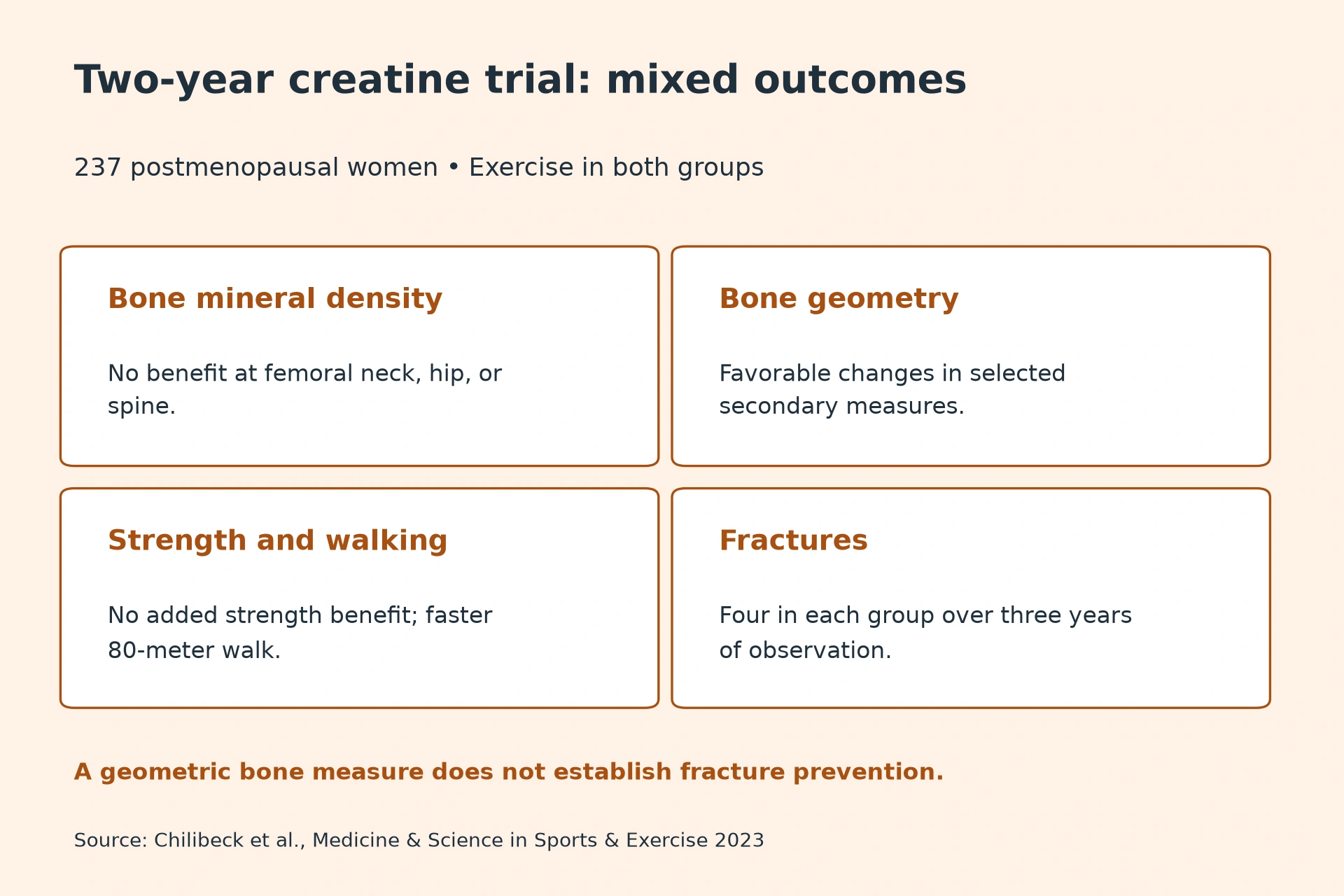
No significant benefit was found for bone mineral density at the femoral neck, total hip, or lumbar spine. In the main analysis, femoral-neck BMD moved from 0.725 to 0.712 g/cm² in the creatine group and from 0.721 to 0.706 g/cm² in the placebo group. Bone-density results.
Both groups’ averages decreased. The slightly different numerical changes do not establish a treatment benefit when the formal comparison did not show one. Presenting the smaller decrease as proof that creatine “stopped bone loss” would misstate the trial.
The investigators did report favorable changes in selected geometric properties at the proximal femur. Geometry describes aspects of bone structure that may relate to mechanical strength. It is not interchangeable with BMD or a demonstrated reduction in fractures.
| Outcome in the two-year trial | Interpretation |
|---|---|
| Femoral-neck BMD, the primary endpoint | No established benefit |
| Total-hip and lumbar-spine BMD | No established benefit |
| Selected proximal-femur geometry measures | Favorable differences on some secondary measures |
| Bench-press and hack-squat strength | Both groups improved; no added creatine advantage established |
| Timed 80-meter walk | Favorable change with creatine |
| Lean tissue | Favorable result in a valid-completer subanalysis |
| Fractures | Four reported in each group across three years of observation |
What happened to strength and walking?
Both groups improved their bench-press and hack-squat performance, without a significant additional strength advantage from creatine in the reported analyses. The exercise program itself was an important part of both arms. Performance results.
Time to walk 80 meters improved from 48.6 to 47.1 seconds with creatine, compared with 48.3 to 48.2 seconds with placebo. That favorable measured result does not automatically establish a large improvement in daily independence, endurance over longer distances, or fall prevention.
Across three years of observation, including an additional year after the intervention, four fractures were reported in each group. The study was not a large fracture-prevention trial, so those small counts cannot establish equivalence or a protective effect.
Why does the completer analysis matter?
The two-year paper reported greater lean-tissue gain with creatine in a subanalysis of valid completers. A completer analysis focuses on participants who finish the intervention and required assessments. It may be useful, but completion can be related to motivation, health, adherence, and other factors.
The primary intention-to-treat approach keeps participants in their assigned groups and handles missing information according to the study’s methods. A favorable completer result should not be relabeled as a positive primary finding in all randomized women.
Adherence was imperfect: supplement consumption averaged 56% in the creatine group and 60% with placebo, while resistance-training attendance was about 61% in both groups. Those figures make implementation part of the evidence. They do not justify assuming that perfect adherence would necessarily have produced a different primary result. Adherence and analyses.
Does this mean creatine is useless after menopause?
No. The trials suggest potential value for selected muscle or performance outcomes, while showing that the effect is not uniform and the bone-density claim is weak in the larger study. A balanced interpretation leaves room for a useful supplement without treating it as a universal prescription.
The most relevant question is what you want to improve. If the aim is a specific training outcome, creatine may be one option to discuss. If the aim is fracture prevention, a supplement claim should not delay an appropriate osteoporosis assessment and treatment plan.
Our creatine after 50 guide and creatine for women guide provide practical context. For hormone-related bone evidence, the WHI fracture review examines a different intervention and different outcomes.
How should safety and product quality be considered?
The NIH Office of Dietary Supplements describes creatine’s evidence, common dosing approaches, and reported adverse effects, including weight gain related to water retention. Individual health conditions, medicines, and product composition still matter. NIH guidance.
People with kidney disease or unexplained kidney-test abnormalities should discuss supplementation with a clinician. Creatine can complicate interpretation of creatinine-based testing, so the supplement history should be part of the medical record. Our creatine and kidney-health guide explains the questions to ask.
Avoid assuming that a blend with many ingredients has the same evidence as creatine monohydrate. Check the actual amount per serving and any additional ingredients. Independent quality testing can help assess manufacturing quality, but it does not prove the advertised clinical benefit.
Where does Strong Suit fit?
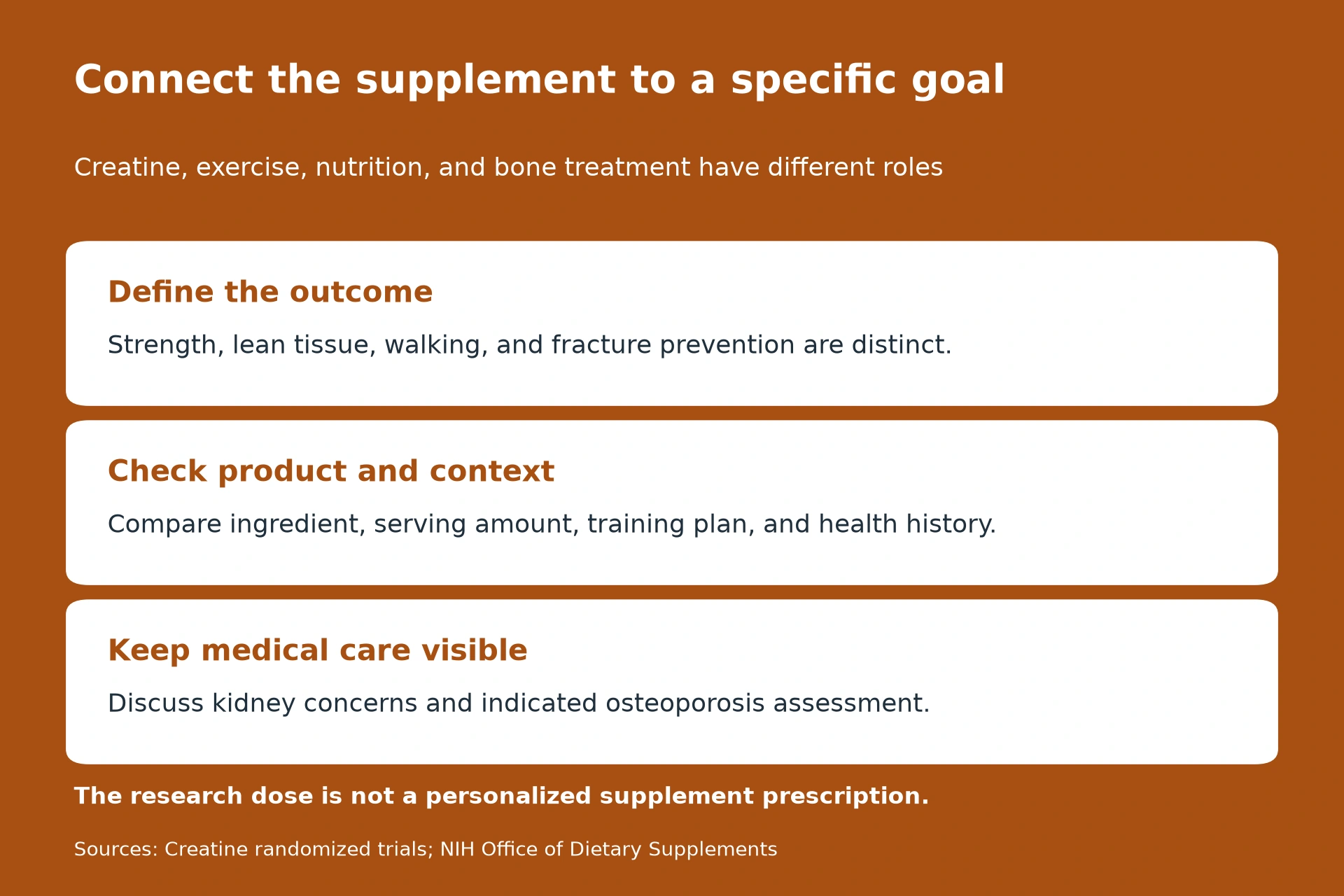
CoreAge Rx’s Strong Suit product page provides the product’s current ingredient and serving information. Compare that information with the form and amount used in research, and discuss whether it fits your medical history and goals.
The studies reviewed here are not trials of the CoreAge Rx product itself. They do not establish that every serving schedule, blend, or user will reproduce the published results. The supplement-label guide can help readers make that distinction.
A practical plan should also identify the activity being supported. Consistent, appropriately adapted training and adequate nutrition are part of the context in which many creatine findings arise. A supplement alone should not be described as equivalent to that whole program.
Video: why strength training matters for women
This Mayo Clinic Radio discussion explains the broader role of strength training. It provides useful exercise context, but it is not a trial of creatine or proof of a supplement’s effect on bone density.
Frequently asked questions
Does creatine replace HRT after menopause?
No. They are different interventions with different purposes, evidence, and risks. Creatine is not estrogen replacement.
Does the two-year trial show stronger bones?
It found favorable results for some geometric measures, but no BMD benefit and no established fracture prevention. “Stronger bones” without those details is too broad.
Why did one trial show a strength benefit and another not?
Population, training, duration, outcome, adherence, and sample size differed. A supplement’s effect may vary, and one positive test should not be generalized to every measure.
What should I track if I try creatine with professional guidance?
Agree on a specific training or functional goal, tolerance, body-weight changes, and any relevant medical monitoring. A scale increase alone cannot distinguish water, lean tissue, and fat, and it does not establish whether the supplement is worthwhile.
Original papers and supporting sources
The references distinguish full research papers, published abstracts, and official guidance. This educational narrative review is not a systematic review or an individual treatment recommendation. Sources were checked in October 2026.
- Gualano B et al. Creatine supplementation and resistance training in vulnerable older women: a randomized double-blind placebo-controlled clinical trial. (2014). Published abstract reviewed. DOI: 10.1016/j.exger.2014.02.003.
- Chilibeck PD et al. A 2-yr Randomized Controlled Trial on Creatine Supplementation during Exercise for Postmenopausal Bone Health. (2023). Full text reviewed. DOI: 10.1249/mss.0000000000003202. Open full text.
- NIH Office of Dietary Supplements: exercise and athletic performance. Official guidance.