Breast-cancer risk is one of the most important questions in a menopause-treatment conversation. It is also an area where the phrase “HRT increases risk” can obscure meaningful differences between regimens, populations, and outcomes.
The long-term Women’s Health Initiative report followed two separate randomized trials. One tested conjugated equine estrogen alone in women with prior hysterectomy. The other tested that estrogen plus medroxyprogesterone acetate in women with a uterus. Their breast-cancer results differed, and neither should be generalized to every hormone product or every patient.
What exactly did the two WHI trials compare?
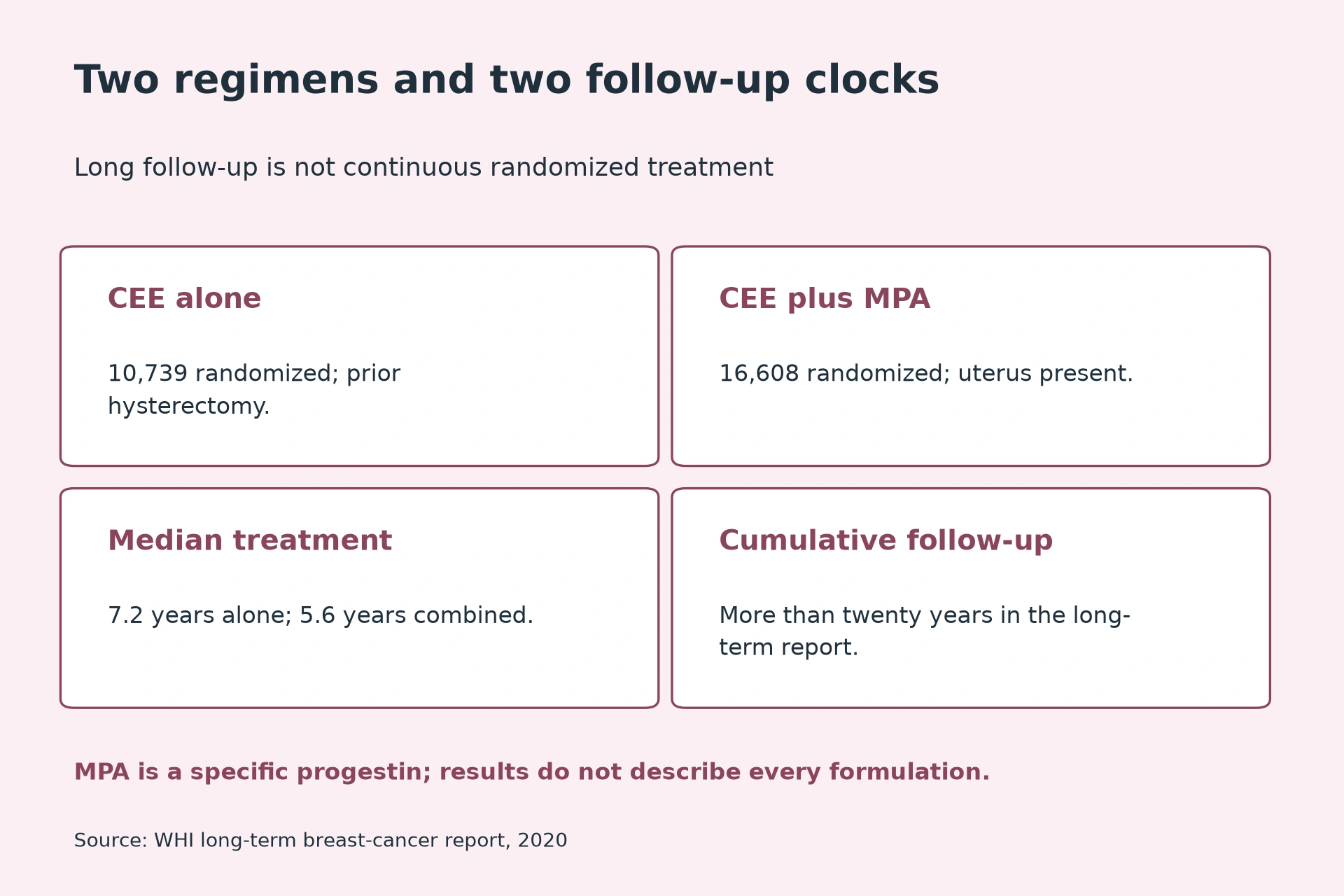
The estrogen-alone trial randomized 10,739 women with prior hysterectomy to oral conjugated equine estrogen, or CEE, at 0.625 mg daily versus placebo. The combined trial randomized 16,608 women with a uterus to the same CEE dose plus medroxyprogesterone acetate, or MPA, at 2.5 mg daily versus placebo. Original long-term report.
Participants were aged 50–79 at enrollment, had no prior breast cancer, and had a negative baseline screening mammogram. Average age across the trials was about 63.4. These eligibility details matter when applying the findings to younger symptomatic patients or people with a cancer history.
The trials did not randomly assign the same population to estrogen alone versus combined therapy. Uterus status determined which trial a woman could enter. Therefore, comparing the active groups directly would not preserve the original randomization.
How long did treatment and follow-up last?
The combined-regimen intervention stopped after a median 5.6 years, and the estrogen-alone intervention stopped after a median 7.2 years. The 2020 report examined outcomes over more than twenty years of median cumulative follow-up. Treatment and follow-up periods.
This is a study of the long-term association with prior randomized treatment, including years after the intervention ended. It is not evidence from twenty uninterrupted years of assigned hormone use.
That distinction matters for questions about duration. The report cannot simply tell a patient what will happen if they take a different formulation continuously for two decades. It also cannot be reduced to a short-term adverse-event count from the original intervention period alone.
What happened with estrogen alone?
In the hysterectomy trial, breast cancer occurred in 238 women assigned CEE and 296 assigned placebo. Annualized incidence was 0.30% versus 0.37%, with a hazard ratio of 0.78 and a 95% confidence interval of 0.65–0.93. Estrogen-alone results.
Breast-cancer deaths numbered 30 versus 46. The hazard ratio for breast-cancer mortality was 0.60, with a 95% confidence interval of 0.37–0.97. The report therefore found lower incidence and lower breast-cancer mortality associated with prior randomized CEE use in this population.
These results should not be converted into a recommendation to take estrogen to prevent breast cancer. The treatment has other effects and risks, and this trial did not establish a prevention indication or test every estrogen preparation.
What happened with estrogen plus MPA?
In the trial involving women with a uterus, breast cancer occurred in 584 women assigned CEE plus MPA and 447 assigned placebo. Annualized incidence was 0.45% versus 0.36%, with a hazard ratio of 1.28 and a 95% confidence interval of 1.13–1.45. Combined-regimen results.
Breast-cancer deaths numbered 71 versus 53. The mortality hazard ratio was 1.35, with a 95% confidence interval of 0.94–1.95 and P = 0.11. The mortality comparison did not meet statistical significance.
“No significant mortality difference” does not mean the study proved there was no possible mortality effect. The confidence interval includes uncertainty. Equally, it would be inaccurate to report the numerical difference as a demonstrated increase in breast-cancer deaths.
How can the absolute rates be understood?
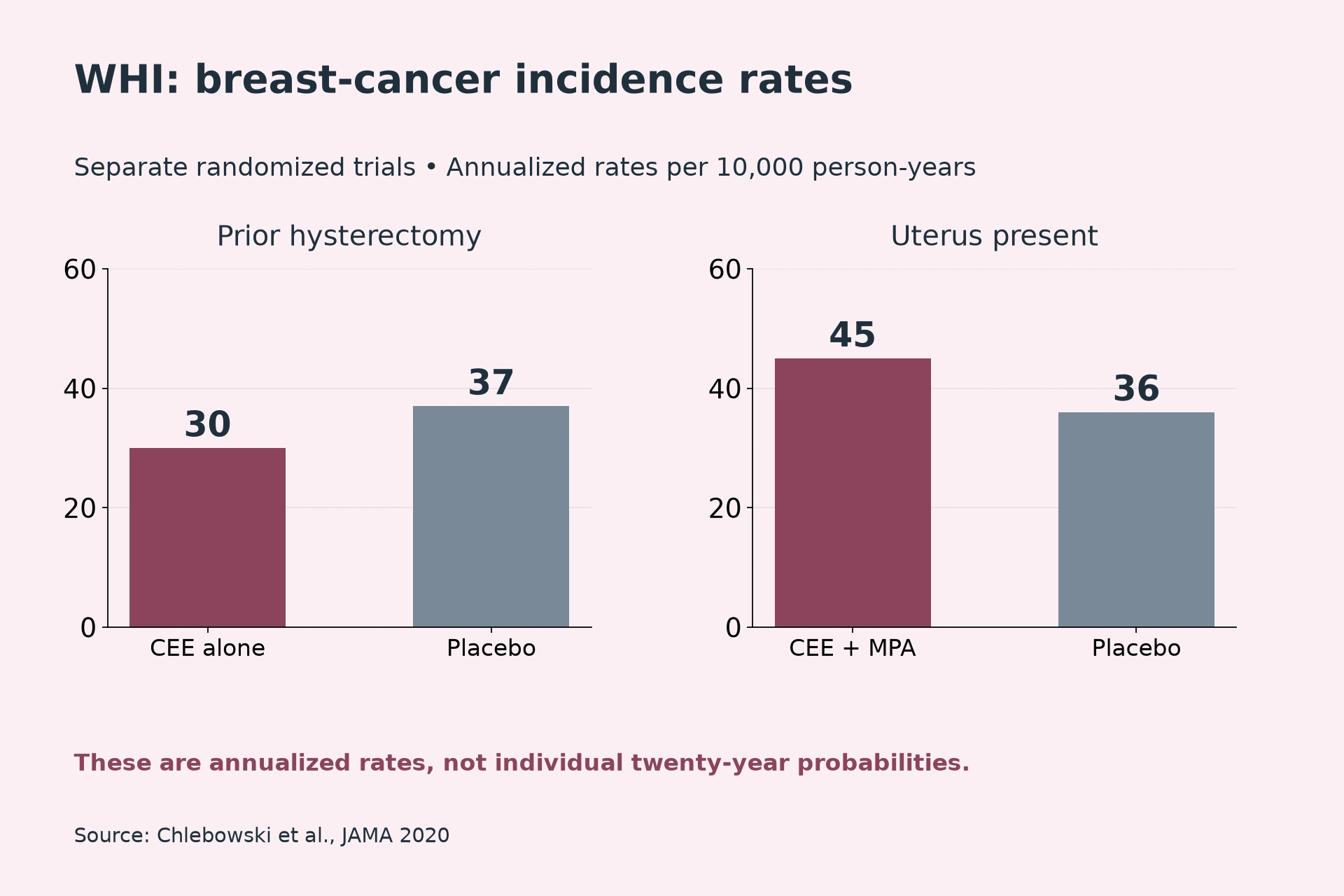
An annualized incidence of 0.45% corresponds to about 45 cases per 10,000 person-years; 0.36% corresponds to about 36. For the combined trial, the displayed difference is therefore approximately nine additional cases per 10,000 person-years. This is a conversion of the reported rounded rates, not a new individualized risk model.
In the estrogen-alone trial, 0.30% versus 0.37% corresponds to about 30 versus 37 cases per 10,000 person-years. Keeping absolute rates beside relative measures helps readers understand the scale of the observed differences.
A person-year is a unit of follow-up time. These annualized rates should not be multiplied mechanically by a fixed number of years to predict someone’s cumulative risk. Risk, follow-up, competing events, and treatment exposure change over time.
| Outcome | CEE alone versus placebo, prior hysterectomy | CEE plus MPA versus placebo, uterus present |
|---|---|---|
| Breast-cancer cases | 238 versus 296 | 584 versus 447 |
| Annualized incidence | 0.30% versus 0.37% | 0.45% versus 0.36% |
| Incidence hazard ratio | 0.78 (95% CI 0.65–0.93) | 1.28 (95% CI 1.13–1.45) |
| Breast-cancer deaths | 30 versus 46 | 71 versus 53 |
| Mortality conclusion | Significantly lower in this analysis | No statistically significant difference |
Does this show that progesterone is the problem?
The combined trial used medroxyprogesterone acetate, a particular progestin. It did not test every progestogen, and it did not compare MPA directly with oral micronized progesterone in the same randomized population.
It is therefore too broad to say that WHI proves all progesterone-containing regimens have the same breast-cancer effect. It is also too broad to claim that a different product is risk-free because it was not the one used in WHI. Evidence for an alternative should be evaluated on its own design and limitations.
Our estrogen and progesterone guide explains why the distinction matters. “Bioidentical” describes molecular identity, not a guarantee of safety, effectiveness, manufacturing quality, or a particular cancer outcome.
Why not omit progestogen if estrogen alone looked more favorable?
For people with a uterus, systemic estrogen generally requires appropriate endometrial protection because unopposed estrogen can increase endometrial-cancer risk. The breast-cancer comparison does not remove that need. Menopause Society guidance.
The estrogen-alone WHI trial involved women who had already had a hysterectomy. It cannot justify copying that regimen in someone with an intact uterus. Nor is it a reason to pursue hysterectomy merely to use a different hormone strategy.
The HRT after hysterectomy guide and starting-HRT questions help organize this discussion. The exact regimen should be chosen with a clinician who knows the person’s history.
What about patches, lower doses, and vaginal estrogen?
WHI’s studied regimens were oral systemic treatments. The results do not directly quantify the breast-cancer effect of every transdermal estradiol dose, every progestogen schedule, or low-dose local vaginal estrogen.
Our patch-versus-pill guide and vaginal versus systemic estrogen guide explain why route and treatment purpose matter. Local treatment for genitourinary symptoms is a different decision from systemic treatment for hot flashes.
Different evidence does not mean no evidence or no risk. For a person with previous breast cancer, decisions about menopausal symptoms require individualized discussion with the treating oncology and menopause teams. These WHI results came from women without prior breast cancer and do not settle that separate situation. American Cancer Society guidance.
What changed in FDA labeling in 2026?
In February 2026, the FDA announced approved labeling changes for six menopausal hormone products. Statements about cardiovascular disease, breast cancer, and probable dementia were removed from their boxed warning. FDA announcement.
The placement and wording of a warning can change as an agency reassesses evidence and risk communication. That action does not erase the WHI event counts or demonstrate identical outcomes for all regimens. It also does not mean a patient should ignore the current warnings and contraindications for the exact prescribed product.
For a useful conversation, keep three things separate: the original trial data, current product labeling, and the individual’s treatment decision. They inform one another but are not interchangeable.
How should personal risk enter the discussion?
Ask about personal and family cancer history, previous breast findings, current screening, uterus status, symptoms, and treatment preferences. A clinician may recommend a formal risk assessment or specialist input depending on the history. A family-history detail cannot be translated into a precise personal risk by applying a trial hazard ratio alone.
Also identify the expected benefit. If hot flashes are disrupting sleep and daily life, that burden matters. If symptoms are limited to vaginal dryness or urinary concerns, a different approach may fit. Our hot-flash trial review and vaginal estrogen UTI review examine specific treatment questions.
Screening remains important, but a normal mammogram is not a guarantee that hormone therapy carries no future risk. New breast changes should be evaluated regardless of whether a person uses HRT.
What should be clarified about an offered product?
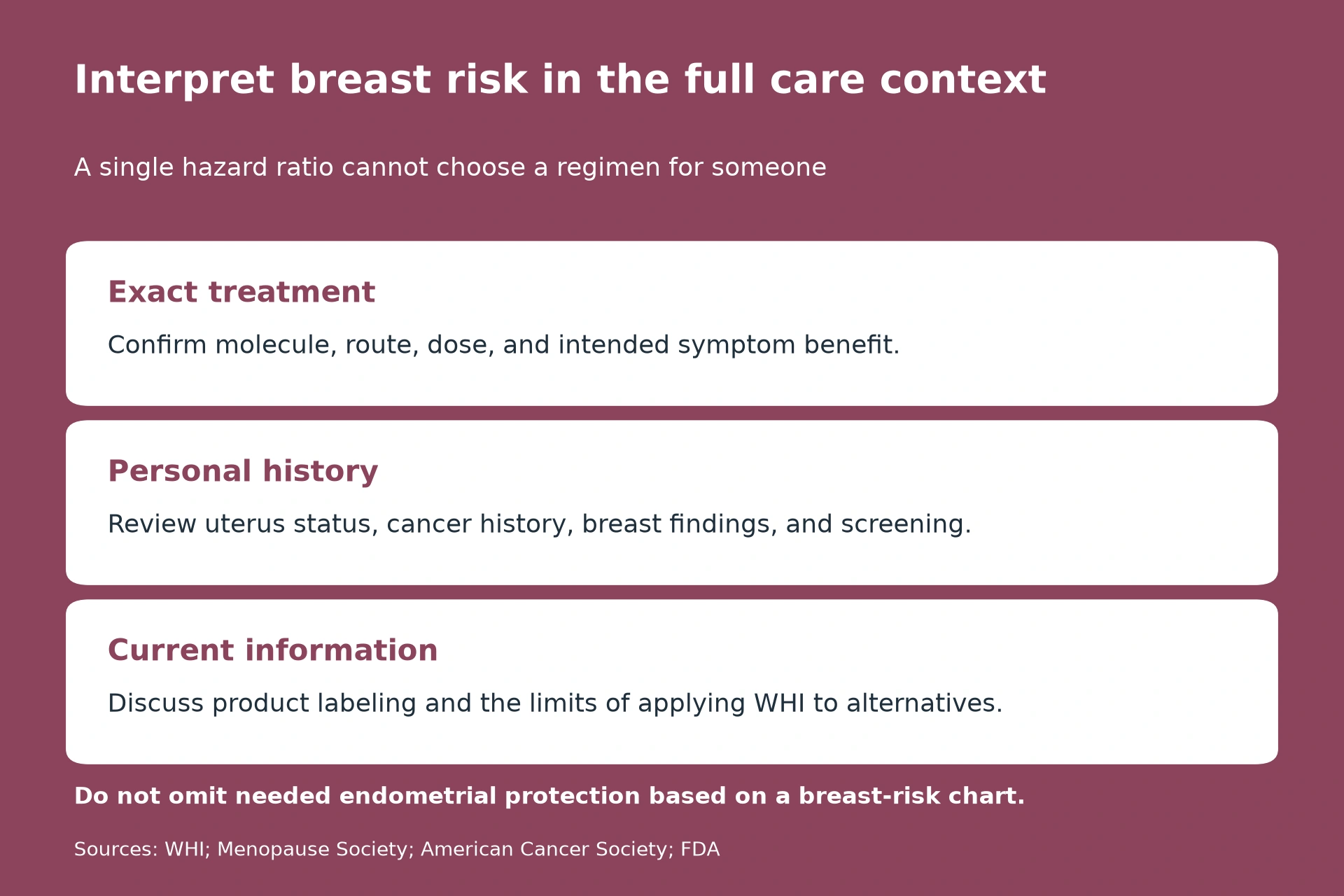
CoreAge Rx’s estrogen page and oral progesterone page provide service information. Ask for the exact ingredient, dose, route, intended indication, regulatory status, and monitoring plan. Do not assume a product has the WHI evidence simply because it is described as hormone therapy.
The same principle applies to claims of superior safety. A different molecule or delivery route may be clinically relevant, but the strength and type of supporting evidence should be stated. An observational association, short symptom trial, and long randomized cancer follow-up answer different questions.
A treatment decision can be revisited as symptoms and health change. Our HRT duration guide discusses that ongoing review without turning an age or anniversary into a universal stopping rule.
Video: framing the treatment conversation
This Mayo Clinic overview discusses considerations when choosing menopausal hormone therapy. It is an older educational video and predates the 2020 follow-up and 2026 labeling update; use the written evidence above for those developments.
Frequently asked questions
Does all HRT cause breast cancer?
The WHI results differed between two specific regimens in different eligible populations. A universal statement loses those distinctions and cannot describe every product or person accurately.
Is estrogen alone a breast-cancer prevention medicine?
This report does not establish that use. Lower breast-cancer outcomes in one trial population must be considered alongside other effects and the actual indication for treatment.
Does no significant mortality difference mean no risk?
No. A nonsignificant comparison contains uncertainty. It should not be presented as proof of equivalence or proof of harm.
What is the most useful number to ask about?
Ask for both absolute and relative risk, the population and time period behind them, and whether the evidence applies to the exact regimen under discussion. Those details make a number interpretable.
Original papers and supporting sources
The references distinguish full research papers, published abstracts, and official guidance. This educational narrative review is not a systematic review or an individual treatment recommendation. Sources were checked in October 2026.
- Chlebowski RT et al. Association of Menopausal Hormone Therapy With Breast Cancer Incidence and Mortality During Long-term Follow-up of the Women’s Health Initiative Randomized Clinical Trials. (2020). Published abstract reviewed. DOI: 10.1001/jama.2020.9482.
- The Menopause Society: hormone therapy. Official guidance.
- American Cancer Society: menopausal hormone therapy and cancer risk. Official guidance.
- FDA: 2026 labeling changes for menopausal hormone therapy. Official guidance.